TL;DR
Livingetc reports that interior designers are using split artworks to cover wall-mounted TVs, with panels that separate when the screen is needed. Designers cited in the article describe the approach as a decorative alternative to visible screens and a way to reduce visual distraction; the report does not establish how widespread the trend is.
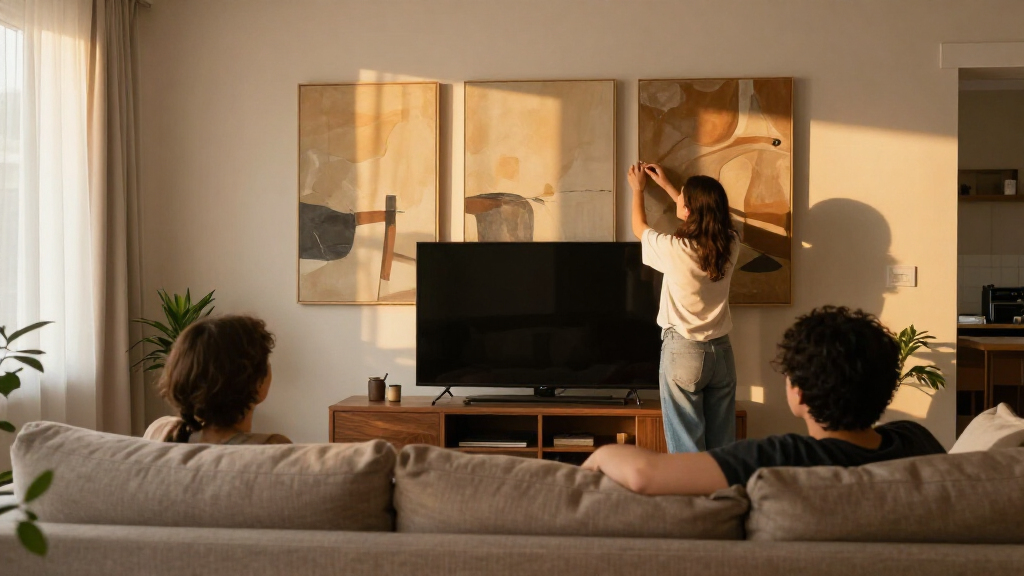
Interior designers are using paired artwork panels to cover wall-mounted televisions when they are not in use, according to a Livingetc report on the design approach. The panels meet to display an image and pull apart to reveal the screen, offering homeowners a way to keep a TV available while making it less prominent in a living room.

Get furniture and decor delivered free with Prime
- Fast, free delivery on millions of items
- Prime Video, Amazon Music and more included
- Member-only deals all year
The installations are designed as functional wall art: a print or bespoke artwork is divided between two panels that slide or pull away from the center. With the panels closed, the television is concealed; when viewing is wanted, the artwork separates. Livingetc describes designs ranging from a celestial map to a set of commissioned, colorful works.
Designer Phoebe Hollond of Studio Hollond told Livingetc that she used a split design based on her interest in astronomy. The print depicts the positions of fixed stars relative to the ecliptic in 1730, according to the report. Hollond’s project places the panels above a fireplace, where the closed artwork can read as a decorative feature rather than a screen.
Designer Natasha Lyon took a collaborative approach, working with Paris-based artist Andrea Mongenie on eight bespoke artworks for a TV-cover project. Livingetc also describes other concealment methods the designers have used, including bi-fold cabinets, sliding artwork, media units and tapestry wall hangings. The article presents split panels as one option among several, not a replacement for every TV-hiding solution.
A Screen That Can Disappear
The approach addresses a common design tension: televisions are useful, but their dark screens can dominate a wall when switched off. A split artwork gives homeowners a way to retain the television while changing what is visible in the room when it is not being watched. Unlike a permanent cabinet, the panels leave the screen accessible without requiring it to be stored elsewhere.
The design also makes the cover itself part of the room’s decor. A print can be chosen to reflect the homeowner’s interests or suit the space, and the panels can act as a focal point while closed. That means the solution is not only about concealing technology; it is also a bespoke design feature whose appearance depends on the artwork, materials and installation.
Lyon told Livingetc that she considers mental health alongside practical needs in her design work, and described the ability to shut out visual and audio distractions as a motivation. That is her stated design rationale, rather than evidence that the installations improve health. The report offers designers’ views and examples, but no research comparing wellbeing or screen use in homes with and without TV covers.
Products Worth Considering

Dyson Airwrap Co-anda2x Multi-Styler and Dryer for Curly and Coily Hair, Ceramic Pink/Rose Gold (2025)

Dyson V8 Cordless Vacuum

Philips Hue Play Gradient Light Tube, Large, Black
As an affiliate, we earn on qualifying purchases.
Other Ways to Conceal a TV
Designers have long used cabinetry and furniture to make televisions less visible. The Livingetc report says Hollond previously designed furniture with an automated lift that raised a TV for use and lowered it out of sight afterward. Lyon has also designed a bi-fold cabinet and a media unit with large sliding artwork, as well as using tapestry wall hangings.
Split artwork differs in that the cover is made from multiple panels that move apart, rather than a single image or a screen hidden inside furniture. The source describes examples made for particular projects, including a celestial print and custom art developed with an artist. It does not provide prices, dimensions, installation specifications or evidence of how commonly these systems are being commissioned.
“TVs on the whole are ugly; they are not something you should have on your walls, so why not put them in a TV box and hide them with a piece of art.”
— Phoebe Hollond of Studio Hollond, speaking to Livingetc
How Widely the Designs Are Used
The Livingetc article presents designer projects and professional opinions, but does not establish that split artworks are being adopted widely across households. Its headline describes broad interest, yet the material provided includes no market figures, survey results, sales data or comparison with other TV-concealment methods.
Practical details are also absent. The report does not state whether the panels are manually operated or use a mechanism, what they cost, how they are mounted, or whether they can be fitted around televisions of different sizes. It also does not assess maintenance, installation constraints or how well a cover works in rooms where the TV is not wall-mounted.
The stated wellbeing benefits remain a designer’s perspective. The article does not cite clinical research showing that covering a television reduces stress or screen time. The confirmed point is narrower: designers have made these installations for specific projects, and the panels are intended to conceal the screen when closed.
More Project Details Needed
The report identifies completed design examples but gives no future launch dates, product releases or announced expansion plans. Readers considering the idea would need to ask a designer or supplier about panel movement, mounting, measurements and cost for a particular room; those details are not supplied in the article.
Further reporting or project information could clarify whether the designs are custom commissions or available as repeatable products, and how their pricing compares with cabinets, lift systems and other art-based covers. Until such information is available, the development is best understood as a design approach shown in individual projects, rather than a quantified change in the wider interiors market.
Key Questions
What is a split-artwork TV cover?
It is a set of artwork panels that meet to cover a television and separate to reveal the screen. The Livingetc report describes designs made for individual interior projects.
Who are the designers featured in the report?
Livingetc features Phoebe Hollond of Studio Hollond and designer Natasha Lyon. Lyon’s project involved artist Andrea Mongenie.
Does the report show that split artwork is a widespread trend?
No. It describes examples and designers’ views, but provides no market data or survey showing how widely the approach is being used.
Can covering a TV improve wellbeing?
Lyon told Livingetc that reducing visual and audio distraction informed her design choices. The article does not provide research showing that these covers improve mental health or reduce screen use.
How much do split-artwork covers cost?
The source does not give prices, installation costs or product specifications. Costs would depend on the design and project, but the report does not quantify them.
Source: livingetc.com