TL;DR

Get furniture and decor delivered free with Prime
- Fast, free delivery on millions of items
- Prime Video, Amazon Music and more included
- Member-only deals all year
A hole near the end of many rulers is mainly a storage feature: it lets the ruler hang on a hook or peg. Family Handyman also reports a historical classroom use involving slate boards and cleaning cloths, while holes on specialty rulers can help with binder storage, circle drawing or craft tasks.
Most holes near the end of a ruler are for hanging it up, according to a Family Handyman report, rather than for measuring or improving accuracy. The feature is especially practical for longer rulers that are awkward to store in a drawer or toolbox, though holes on some school and craft rulers have other uses.
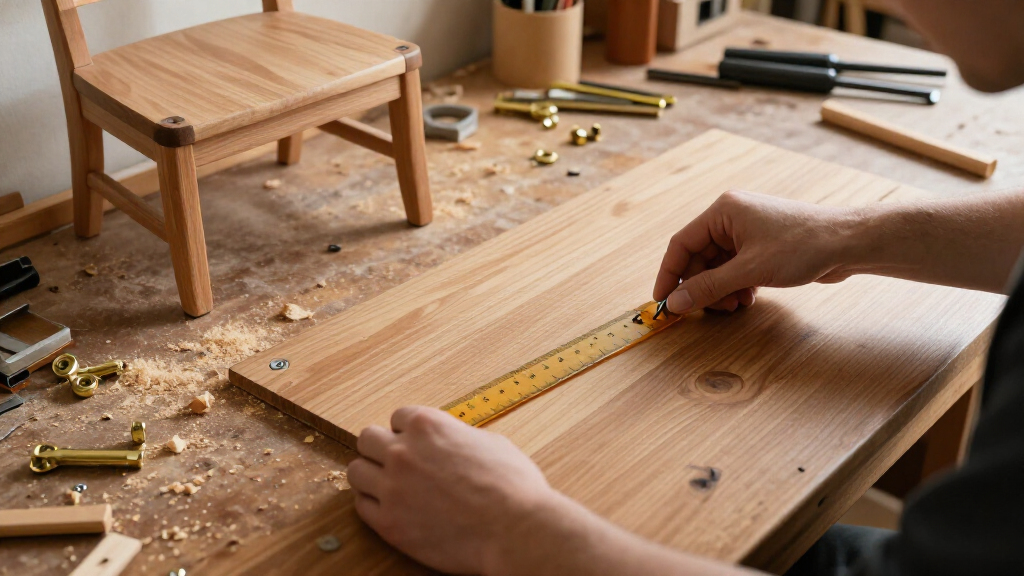
The report says the end hole allows a ruler to be hung from a hook, nail or pegboard. That keeps it accessible and can save space, particularly for longer metal rulers. The hole’s purpose depends on the ruler: a basic model may have a single hanging hole, while specialized designs can use openings as part of a task.
Family Handyman describes a historical classroom use connected to slate boards. Before paper notebooks became common in schools, students wrote on reusable slates, which could be wiped clean with a damp cloth. According to the report, some students attached a cleaning cloth to their ruler with string threaded through its hole. The report says this practice ended as schools moved away from slate boards, but the hole remained on many rulers.
Other holes may be positioned to fit the rings of a three-ring binder, or arranged to help draw circles by holding a pin in place while a pencil traces around it. Craft and quilting rulers can include openings or slots for marking fabric, aligning cuts or guiding a rotary cutter. These functions are design-specific; the article cautions that a compass is a better tool when circle measurements need to be exact.
A Small Feature With Practical Uses
For most people, the hole is a storage convenience, not a feature that changes how a ruler measures. A ruler with no hole can measure just as accurately as one with a hole, according to the report. Knowing that distinction can help readers avoid treating a common design detail as a measuring aid or assuming every opening has the same function.
The feature also reflects how everyday tools can retain design elements after their original uses fade. The reported slate-and-cloth practice offers a possible explanation for why holes appeared in some older classroom rulers, while hanging remains a straightforward use today. On specialty rulers, the openings may be functional parts of a particular craft or storage system rather than decoration.
Products Worth Considering

Philips Hue White and Color Ambiance Smart Light Starter Kit, 2 A19 Bulbs with Hub

TCL 65 Inch QM8L Series SQD-Mini LED QLED 4K Smart Google TV

TCL 65-Inch QM6K QLED Mini-LED 4K HDR Smart Google TV, 144Hz
As an affiliate, we earn on qualifying purchases.
From Slate Classrooms to Storage Hooks
The Family Handyman report describes two different periods in the hole’s use. In the historical account, reusable slate boards served as writing surfaces before paper notebooks became common in schools. A cloth attached to a ruler could be used to wipe a slate clean. The report cites the University of Wisconsin–Madison’s object history of slate among its sources, but it does not give a date for when the cloth practice began or how widespread it was.
Modern ruler designs vary by intended use and manufacturer. The article cites product information from STAEDTLER, Kapro and Westcott, alongside the university’s slate material. It notes that some longer metal rulers have holes at one or both ends, while many smaller plastic rulers do not. Specialty rulers may add openings or slots for particular drawing, binding, sewing or cutting tasks.
“The hole at the end of a ruler is mainly there for storage.”
— Family Handyman report
How Widespread Was the Slate Use?
The report presents the slate-cleaning cloth as a historical use, but does not establish when or how widely students used rulers this way. It also does not trace a precise timeline showing how the hole’s design changed as schools adopted paper notebooks. The purpose of any particular ruler’s openings cannot be determined from appearance alone; it depends on that model’s design and intended use.
The report does not claim that every ruler hole began as a slate-related feature. Some openings are clearly described as binder holes or as parts of specialized drawing and craft tools. For an unfamiliar ruler, product instructions or the manufacturer’s description would be needed to confirm its intended function.
Check the Ruler’s Intended Use
No new product announcement or policy change is reported. The practical next step is to check the ruler’s shape, hole placement and manufacturer information: a single end hole commonly supports hanging, evenly spaced holes may fit a binder, and openings on specialty rulers may guide a particular task. For precise circle drawing, the report recommends using a compass rather than relying on a ruler hole.
Key Questions
What is the hole at the end of a ruler for?
It is mainly for hanging and storage, letting the ruler sit on a hook, nail or pegboard instead of taking up space in a drawer.
Were ruler holes used with slate boards?
Family Handyman reports that some students used string through the hole to attach a damp cloth for wiping reusable slate boards. The report does not state how common or widespread the practice was.
Why do some rulers have several holes?
Multiple holes can serve different purposes. Some school rulers fit into three-ring binders, while openings on specialty models may help with circle drawing, fabric marking or cutting.
Does a hole make a ruler more accurate?
No. The report says a ruler without holes can measure just as accurately as one with them.
Can I use a ruler hole to draw an exact circle?
Some specialty rulers are designed to help draw circles, but the report says a compass is a better choice when exact measurements matter.
Source: familyhandyman.com