TL;DR

Get furniture and decor delivered free with Prime
- Fast, free delivery on millions of items
- Prime Video, Amazon Music and more included
- Member-only deals all year
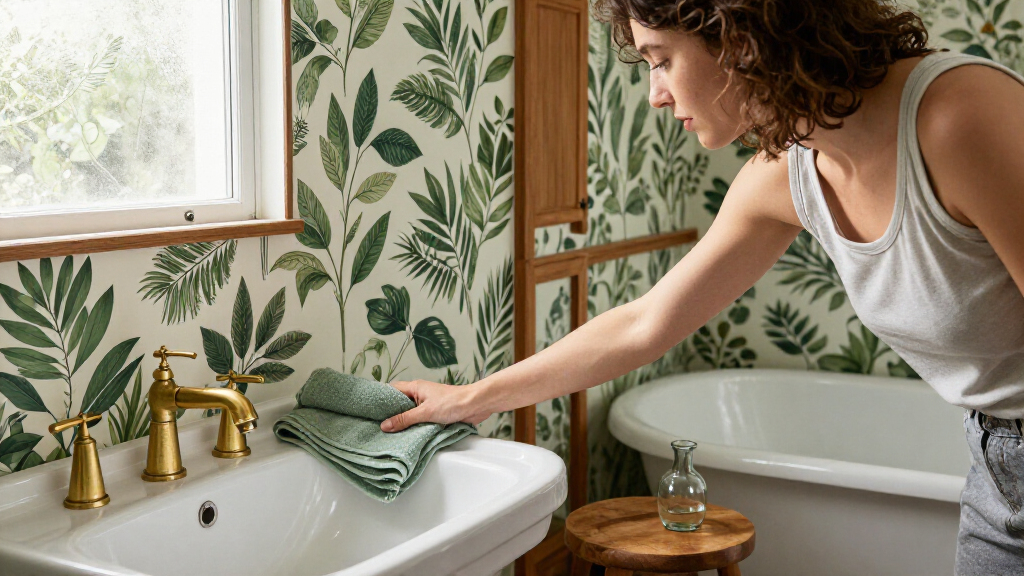
Livingetc’s bathroom design report presents bathroom wallpaper as a way to give bathrooms more personality, especially in small powder rooms and spaces with limited natural light. Its examples show designers pairing patterns with tile, marble and brass, or limiting wallpaper to one wall; the report does not establish how different papers perform in humid conditions.
Livingetc has published a collection of bathroom designs arguing that wallpaper can make a bathroom a more expressive part of a home, with examples ranging from leafy prints in a small powder room to fine-line illustrations in a dim bathroom. The report documents designers’ choices rather than testing wallpaper products, and presents pattern as one way to add character where changes to the room itself may be limited.
The examples show several different approaches rather than one prescribed look. In a Philadelphia home, designer Brittany Hakimfar used foliage-and-tree wallpaper in a petite powder room to add warmth and visual drama to a large, bright house. In an Art Deco apartment, designer Sheena Holton used fine-line drawings to make a small bathroom feel more playful despite its lack of natural light and the inability to alter its original layout.
Other projects use wallpaper selectively or as part of a wider mix of finishes. C&M Interiors used a nude-figure print sparingly, while designers from The 1818 Collective describe stripes as a way to bring rhythm and continuity to a bathroom with a sloping ceiling. In another home, wallpaper on a wardrobe door marks the entrance to an ensuite, extending the pattern into the adjoining bedroom rather than covering the bathroom walls.
The report also features more layered schemes: floral paper alongside patterned floor tile and a patterned shower, a bamboo design with a silk-moiré effect beside a marble sink, and crocodile-effect green walls paired with brass hardware. A small ensuite combines palm-patterned paper with red zellige tiles. Across the examples, the designers use contrast, color and texture to connect wallpaper with the room’s existing materials.
How Pattern Changes a Bathroom
Bathrooms are often treated as primarily functional rooms, but the featured projects show how wallpaper can give a small or constrained space a distinct visual identity. A powder room, which is used differently from a main living area, can accommodate a more concentrated pattern; a single wallpapered wall can add interest without making every surface compete for attention.
The examples also make a practical design point: wallpaper does not have to stand alone. Pairing it with tile, marble, painted trim or metal hardware can help a pattern feel connected to the rest of the room. That matters to readers weighing a decorative change against larger renovations, though the report offers design inspiration, not evidence that wallpaper suits every bathroom or every moisture condition.
Products Worth Considering

Levoit Core 400S-P Smart Air Purifier for Large Rooms

LG C2 Series 65-Inch OLED evo 4K Smart TV (OLED65C2PUA, 2022)

Bose Lifestyle Ultra Wireless Home Speaker
As an affiliate, we earn on qualifying purchases.
From Utility Room to Design Feature
The report’s premise is that bathrooms are no longer necessarily kept visually separate from the rest of a home’s design. It describes a shift away from treating the room as purely functional and toward using it as a place for more deliberate color and decoration. Its projects illustrate that approach through different home styles, from an Art Deco apartment to a loft bathroom and a home with a hidden ensuite entrance.
Rather than relying on one trend, the collection presents varied patterns and applications: botanical scenes, delicate line drawings, stripes, figures, textured effects and animal-inspired finishes. Some examples use wallpaper as the main visual feature; others coordinate it with tile or use it on a door. The source does not provide product testing, installation guidance or a comparison of wallpaper materials.
““The wallpaper was used sparingly, but it truly ties everything together with historic-style nude muses with an antiqued backdrop.””
— Maria Hogrefe, C&M Interiors
Moisture Suitability Is Not Addressed
The source is a design report, not a technical guide. It does not specify the wallpaper materials, adhesives, ventilation conditions or installation methods used in each project, and it does not compare how the examples hold up to humidity, splashes or frequent cleaning. It also provides no costs, maintenance data or information about how difficult the designs are to remove.
Readers therefore cannot use the examples alone to determine whether a particular paper is suitable for a bathroom, especially in areas exposed to direct water. The report’s visual suggestions should be distinguished from advice on product ratings or installation requirements, which are not supplied in the source.
Check Products Before Installation
Livingetc’s collection offers examples readers can use to compare patterns and placements, but the source does not announce a product test, new wallpaper range or follow-up study. Anyone considering a similar scheme would need to check the manufacturer’s guidance for the chosen paper and adhesive, and consider the room’s ventilation and exposure to water before installation.
The next practical step is to decide whether wallpaper will cover a full room, one wall or a feature such as a door, then coordinate it with tile, trim and fixtures. The report leaves durability, maintenance and project costs unresolved, so those details will depend on the materials selected and the conditions in the individual bathroom.
Key Questions
What is Livingetc’s main point about bathroom wallpaper?
The report presents wallpaper as a way to add pattern, color and character to bathrooms, with examples in both compact powder rooms and larger design schemes.
Does wallpaper need to cover every bathroom wall?
No. The examples include wallpaper used sparingly on a wall, as well as broader applications. The report shows selective use as one option, but does not prescribe a particular coverage.
What patterns appear in the featured bathrooms?
The projects include botanical prints, fine-line drawings, stripes, figures, bamboo motifs and crocodile-effect finishes, among other designs.
Is the report a guide to choosing bathroom-safe wallpaper?
No. It is a collection of design examples and does not assess moisture resistance, adhesives, ventilation, installation or long-term performance. Check product guidance for the specific bathroom and wallpaper.
Source: livingetc.com