
In adulthood, your taste preferences can shift due to a blend of genetics and environmental influences. The brain processes signals from your taste buds and surrounding aromas, allowing you to develop new likes over time. Genetics may contribute greatly, as variations in taste receptor genes impact what flavors you enjoy. Social contexts also play a key role; positive shared meals and repeated exposures can enhance your willingness to try unfamiliar foods. If you've ever found yourself liking something you once disliked, there's a science behind it. There's much more to discover about how these factors intertwine.
Key Takeaways
- Taste preferences in adulthood are influenced by genetic factors, accounting for 32% to 54% of variance in individual choices.
- Environmental and social contexts play a crucial role in shaping taste preferences through exposure, shared meals, and positive experiences.
- The exposure effect suggests that repeated encounters with foods can shift aversion to acceptance after approximately 10-15 experiences.
- Neuroplasticity allows taste preferences to adapt over time, integrating emotions and experiences with flavor perception.
- Early exposure to diverse flavors fosters adaptability and encourages lifelong healthy eating habits and a preference for complex tastes.

EISCO Super Taster Test Kit – PTC Paper Strips with Biodegradable Box & Instructions – Lab Quality – Classroom Pack – PTC Paper, Sodium Benzoate, Thiourea, and Control (No Chemical), 100 Strips Each
ARE YOU A SUPERTASTER? || “Supertasters” are people who have the ability to taste the substance Phenylthiourea (PTC)….
As an affiliate, we earn on qualifying purchases.
As an affiliate, we earn on qualifying purchases.
Understanding Taste Perception
Understanding taste perception involves recognizing how your brain interprets sensations from both taste buds and olfactory receptors. Your taste buds detect five primary tastes: sweet, salty, sour, bitter, and umami. Together, these tastes contribute to your overall flavor experiences.
This gustatory system also serves as a defense mechanism, helping you identify potentially harmful substances. For instance, an aversion to bitter flavors often signals toxicity.
As you grow, your taste perception changes. Your heightened sensitivity to sweetness as a child evolves into a preference for more complex flavors during adolescence and adulthood.
Environmental factors play a significant role in shaping your food preferences. Cultural exposure, such as the popularity of dishes like Mushroom Masala, and social contexts influence what you find appealing, highlighting the importance of learning through experience and interaction.
Moreover, research shows that repeated exposure to specific foods, especially when paired with positive experiences, can help you accept flavors you once disliked.
Hunger states can also enhance your taste perception, making you more open to trying new foods. By understanding how these elements interact, you can better appreciate your evolving taste preferences throughout life.
flavor exposure food sampler
As an affiliate, we earn on qualifying purchases.
As an affiliate, we earn on qualifying purchases.
Genetic Influences on Taste

Genetic influences play a crucial role in shaping your taste preferences, affecting how you perceive and accept different flavors. Research shows that genetic factors can account for 32% to 54% of the variance in taste preferences across various age groups.
For instance, if you're classified as a "super taster," you might've between 15,000 to 20,000 taste buds, making you more sensitive to certain flavors, especially bitter ones. This heightened sensitivity can greatly impact your food choices, influencing whether you enjoy or avoid complex tastes like those in broccoli or Brussels sprouts.
Notably, cultural factors and exposure to different cuisines, such as Chinese cuisine, can also shape your preferences over time, introducing you to diverse flavors and textures that might become acquired tastes.
Variations in taste receptor genes, such as TAS2R38, further explain why some people develop acquired likes more easily than others. If your genetic makeup predisposes you to accept certain flavors, you may find it simpler to adapt to new foods.
Twin studies reveal that identical twins share more similar food preferences than fraternal twins, underscoring the considerable impact of genetics on your taste. Ultimately, your unique genetic profile not only shapes your current preferences but also lays the foundation for the acquired likes you may develop throughout your life.
![Classroom Genetic Taste Testing Experiment Kit, N-Propylthiouracil (N-Prop) and Control Paper [Each Vial Contains 100 Strips]](https://m.media-amazon.com/images/I/413knmfBIOL._SL500_.jpg)
Classroom Genetic Taste Testing Experiment Kit, N-Propylthiouracil (N-Prop) and Control Paper [Each Vial Contains 100 Strips]
As an affiliate, we earn on qualifying purchases.
As an affiliate, we earn on qualifying purchases.
Environmental Impact on Preferences
Throughout life, your taste preferences are heavily influenced by the environment around you. Environmental factors like cultural exposure and social interactions shape what you enjoy eating. For instance, studies show that preferences can differ greatly across cultures, revealing how your surroundings play a vital role.
When you're repeatedly exposed to diverse foods, such as Farm-to-Table Cooking, you're likely to develop a greater acceptance and enjoyment of those foods. This concept, known as mere exposure theory, suggests that familiarity enhances your liking.
The impact of social context can't be overstated. Influential figures such as peers and family members can sway your initial acceptance of certain foods, leading to acquired tastes over time. Your home environment, especially during childhood, is particularly essential. Early and varied experiences with food can promote open-mindedness and adaptability to new flavors as you grow older.
Moreover, positive experiences tied to communal meals can transform your perception of previously disliked foods. Enjoyable social settings create positive associations that enhance your acceptance of these foods, showing just how significant context is in shaping your taste preferences.

Acquired Taste
As an affiliate, we earn on qualifying purchases.
As an affiliate, we earn on qualifying purchases.
Social Context and Acquired Taste

When you're sharing meals with friends or family, your taste preferences can shift in surprising ways.
If everyone's enjoying spicy or bitter dishes, you might find yourself more willing to try them out.
These social experiences create positive associations that can reshape your palate over time.
Social Influence on Taste
Shaped by the social environments we engage in, our taste preferences often reflect the influence of those around us. Consider how social contexts can impact your food choices:
- Peer Pressure: Especially during adolescence, you might find yourself adopting the food preferences of your friends to fit in.
- Shared Experiences: Enjoying a meal with family or friends can create positive associations with certain foods, making you more likely to enjoy them in the future.
- Observational Learning: When you see others, especially respected individuals, enjoying specific dishes, you're more inclined to try them yourself.
The mere exposure effect shows that repeated experiences with foods in social settings can enhance your liking, even for items you once disliked.
Observational learning plays an important role in this process, as you mimic the choices of those around you. Flavor-flavor associations developed during shared meals can transform your perception of new or challenging foods, making them seem more appealing.
Consequently, the social influence on your taste preferences is profound, highlighting how intertwined our culinary experiences are with social interactions. Embracing these influences can lead you to discover a wider array of flavors you may come to love.
Contextual Flavor Associations
Your social experiences not only influence your food choices but also create contextual flavor associations that shape your acquired taste preferences. When you share meals with others, especially food enthusiasts, the social context plays an essential role in enhancing your willingness to try new flavors.
Engaging in communal dining experiences fosters a sense of adventure, encouraging you to explore tastes you might've initially dismissed. Research shows that flavor-flavor associations can help condition positive feelings toward challenging tastes. When you pair a familiar, liked flavor with something you don't enjoy, it can gradually shift your perception.
In addition, the mere exposure effect suggests that repeated interactions with specific foods in social settings can increase your liking for those items simply due to familiarity. Cultural influences and shared meals create an environment ripe for trying diverse flavors.
As you bond with others over food, you may find yourself more open to experimenting with flavors that once seemed unpalatable. Over time, these contextual flavor associations deepen your appreciation for a broader range of tastes, enriching your culinary experiences and reshaping your palate.
Mechanisms of Taste Learning

When you encounter a food you dislike, repeated exposure can surprisingly shift your taste preference over time.
Social settings play a vital role, as sharing these experiences with others can enhance your willingness to try new flavors.
Repeated Exposure Effects
Taste preferences can greatly shift through repeated exposure, leading you to appreciate foods you once disliked. It's fascinating how your taste buds can evolve with just a bit of persistence.
Here are three key points to reflect upon:
- Familiarity Breeds Preference: The mere exposure effect suggests that the more you encounter a food, the more likely you're to enjoy it, even if you initially found it unpleasant.
- The Power of Pairing: Combining disliked foods with flavors you enjoy, like sweet or salty elements, can mask unpleasant tastes and help ease you into acceptance.
- Motivation Matters: If you have health goals or dietary changes in mind, you might be more willing to try foods you previously avoided, amplifying the effects of repeated exposure.
Typically, it takes about 10-15 exposures to shift your perception from aversion to acceptance. Each bite can trigger a subtle change in how you perceive those flavors, proving that food changes aren't just about the ingredients but also about how often you give them a chance.
Social Context Influence
Social interactions play a significant role in shaping your taste preferences, often enhancing your willingness to try foods you might've previously avoided. In social environments, shared meals with family or friends create a positive atmosphere that encourages you to explore new flavors. This experience allows you to experience positive reinforcement, making you more open to foods you once disliked.
Observational learning is another key mechanism at play. You tend to mimic the food preferences of those you respect, especially during adolescence when peer influence is particularly strong. If your friends enjoy a specific dish, you're more likely to give it a try.
Additionally, cultural contexts affect food availability and exposure, leading you to develop tastes that align with socially accepted norms. The mere exposure effect also contributes to your evolving preferences. Repeated social encounters with certain foods foster familiarity, increasing your likelihood of developing a positive attitude towards them.
Engaging in social eating experiences with food enthusiasts creates a supportive environment that encourages you to experiment with diverse flavors, ultimately facilitating the acquisition of new tastes throughout your adulthood.
Neurobiology of Taste Preferences
At the heart of our experience with flavors lies the neurobiology of taste preferences, where specialized chemoreceptors play an essential role in detecting taste stimuli. These taste receptors send signals to your brain, providing crucial information for evaluating flavors.
Here are three key aspects to reflect on:
- Taste Reactivity: Your brain evaluates flavors through oromotor and somatic reflexes, showing how chemical properties and past experiences influence your responses.
- Conditioned Taste Aversion (CTA): If you've ever avoided a food after a bad experience, you've experienced CTA. Your brain forms negative associations with certain tastes, greatly impacting your preferences.
- Neuroplasticity: Over time, your taste preferences can adapt. Repeated exposure to specific flavors can reshape the neural pathways involved in taste perception.
The gustatory system interacts with various brain regions like the insula and orbitofrontal cortex, integrating taste with emotional and sensory experiences.
This complex interplay highlights the dynamic nature of your taste preferences, showing that they're not fixed but can evolve as your experiences and exposures change.
Strategies for Developing New Tastes
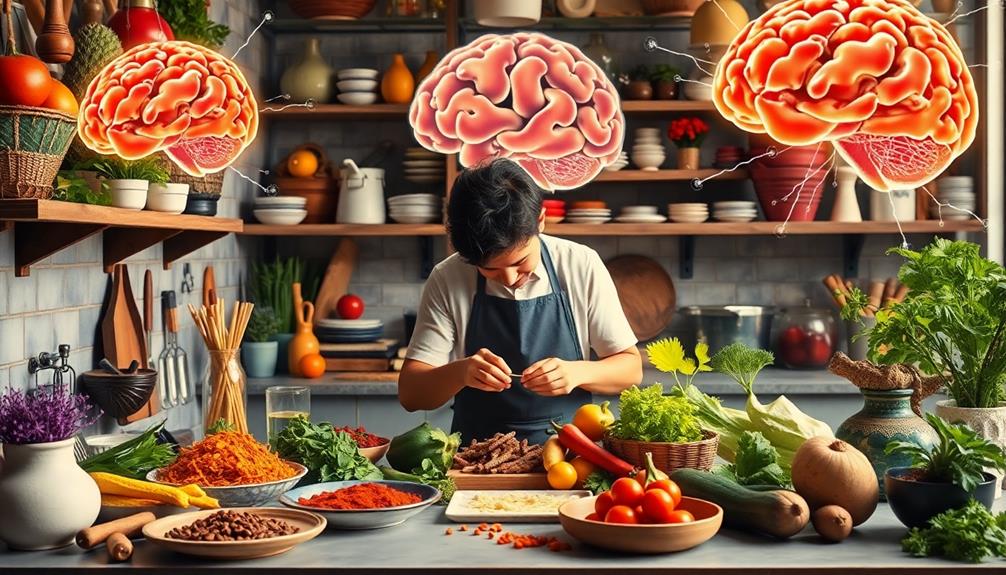
Developing new taste preferences can be an exciting journey, and employing specific strategies can make the process smoother.
Start by gradually exposing yourself to new foods. Research suggests that it may take 10-15 tries before you truly accept and enjoy a previously disliked taste. Pair challenging flavors, like bitter or sour, with sweeter or saltier ingredients to mask negative tastes, turning them into a more positive experience.
Eating in supportive social settings can also help. When you share new foods with friends or family, you create better associations that make you more willing to explore unfamiliar flavors.
Additionally, try to eat when you're hungry; this state can enhance your openness to trying foods you might usually avoid.
Role of Early Exposure

Early exposure to a variety of flavors can greatly shape your taste preferences, making it easier for you to embrace new foods later in life. Here's why early food experiences matter:
- Adaptability: Children with diverse flavor experiences can quickly adapt to new tastes, thanks to their less established preferences.
- Healthy habits: Positive early food experiences can promote lifelong healthy eating habits, encouraging openness to a wider variety of foods.
- Social interactions: Sharing meals with family enhances willingness to try new foods, reinforcing positive associations with different flavors.
When you expose children to a range of flavors and textures, they're more likely to develop a preference for complex tastes as they grow older.
This early exposure not only builds a foundation for adventurous eating but also fosters an appreciation for culinary diversity.
By introducing various foods during formative years, you pave the way for easier acceptance of new flavors in adulthood.
Ultimately, the richness of your early food experiences can considerably influence your willingness to explore and enjoy new tastes throughout your life.
Embrace those early moments—they're key to shaping your palate!
Importance of Taste Diversity

Taste diversity plays an essential role in maintaining a balanced diet and overall health. By incorporating a variety of flavors—sweet, salty, sour, bitter, and umami—you encourage your body to consume a broader range of nutrients. This approach helps reduce the risk of deficiencies often associated with picky eating habits.
When you embrace diverse tastes, you not only enhance your meals but also improve your food enjoyment and satisfaction. Your early exposure to different flavors can foster open-mindedness towards new foods, which often leads to healthier eating patterns in adulthood.
Culturally rich culinary traditions introduce you to various flavors and textures, promoting greater taste acceptance. The physiological effects of a varied diet extend beyond nutritional benefits; they also support your psychological well-being. Positive food experiences are linked to improved mood and emotional health, making it essential to explore diverse tastes.
Ultimately, taste diversity is vital for creating enjoyable eating experiences while ensuring your body receives the necessary nutrients for peak functioning. By prioritizing a varied diet, you can cultivate healthier habits that benefit both your physical and mental health.
Frequently Asked Questions
Do Your Taste Preferences Change as We Get Older?
Yes, your taste preferences do change as you age. You might find yourself enjoying more complex flavors while sweet tastes become less appealing. Social interactions and new experiences can also shape your evolving palate over time.
What Is the Psychology Behind Taste Preferences?
Imagine a child's first bite of broccoli, cringing at the taste. As you grow, your experiences shape preferences; cultural influences, repeated exposure, and negative associations all play vital roles in what you love or avoid.
What Is the Neuroscience of Taste Perception?
Taste perception relies on your taste buds and olfactory receptors, processing flavors through neural pathways. Your brain links tastes to emotions, influencing what you enjoy or dislike based on past experiences and associations.
How Taste Preferences in Infancy Differ From Taste Preferences in Adulthood?
Taste preferences in infancy lean towards sweetness, driven by energy needs, while in adulthood, you often develop a taste for complex flavors. Your palate evolves, embracing bitterness and sourness that once seemed unappealing.
Conclusion
As you savor the rich tapestry of flavors life offers, remember that your taste buds are as adaptable as your mind. Each new dish is a chance to dance with unfamiliar ingredients, painting your palate with vibrant experiences. Embrace the symphony of tastes, letting the sweet, savory, and bitter notes intertwine in delicious harmony. By welcoming diversity on your plate, you'll not only expand your culinary horizons but also enrich your life's journey, one delightful bite at a time.