An alarm clock for teens should be easy to set, readable at night, and suited to how deeply its owner sleeps. I’d choose the Netzu Digital Alarm Clock as the best overall for its dual alarms, adjustable display, and straightforward controls. The Sunrise Alarm Clock stands out for teens who prefer a gradual wake-up and sleep sounds, while the Amazon Basics Small Digital Oval Alarm Clock is a simple choice for a tight bedside space. The main tradeoffs are simplicity versus extra features, a gentle wake-up versus a louder alarm, and a bright display versus a dark bedroom. Read on for how all 12 options compare and which one fits different routines.

Get furniture and decor delivered free with Prime
- Fast, free delivery on millions of items
- Prime Video, Amazon Music and more included
- Member-only deals all year
Complete the kit


Key Takeaways
- Netzu is the most balanced pick: dual alarms and a dimmer offer useful flexibility without making the clock’s core job complicated.
- The Sunrise Alarm Clock and ANJANK serve different sleep routines: both add sound and speaker functions, but a gradual light wake-up is distinct from a clock centered on white noise and Bluetooth.
- Heavy sleepers have a specialized option: Cadmos advertises a 110dB alarm, a more direct fit for teens who sleep through gentler wake-up cues than the compact or kid-oriented picks.
- Small, simple clocks still have a place: Amazon Basics prioritizes an uncomplicated display and nightlight, while DreamSky’s small RGB model adds color for teens who want a more expressive bedside look.
- Projection, mirror finishes, and extra lighting are preference-led features: Mesqool, Peakeep, Topski, and Odokee suit different bedroom setups, but each adds a feature that matters only if the teen will use it.
| Topski Digital Alarm Clock with RGB Display and Night Light | 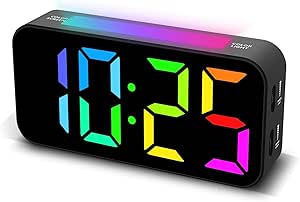 | Best Overall for a Colorful Teen Bedroom | Display: 7-inch LED display | Digit height: 2.36 inches | Alarms: Two | VIEW ON AMAZON | See Our Full Breakdown |
| Amazon Basics Small Digital Oval Alarm Clock with Nightlight and Battery Backup |  | Best Compact, No-Frills Pick | Display: 0.7-inch green LED | Shape and color: Oval; black | Power: AC corded electric | VIEW ON AMAZON | See Our Full Breakdown |
| Netzu Digital Alarm Clock for Bedrooms, Loud with Dual Alarms, Dimmer, Snooze, Easy to Set |  | Best for Shared Rooms and Different Schedules | Display: 48 mm blue bold font | Power: USB with AAA battery backup | Brightness: Five levels | VIEW ON AMAZON | See Our Full Breakdown |
| Alarm Clock for Kids with White Noise Sleep Aid, OK to Wake, Snooze |  | Best for Sleep Routines | Display: Digital | Ambient light: 11 colors; three brightness levels | White noise: Built-in music player with sleep timer | VIEW ON AMAZON | See Our Full Breakdown |
| Sunrise Alarm Clock White Noise Machine with Bluetooth Speaker, Dimmable Sunrise Light, 25 Sleep Sounds for Bedroom |  | Best Premium Wake-Up and Sleep Aid | Sunrise simulation: Yes | Sleep sounds: 25 | Bluetooth: Yes | VIEW ON AMAZON | See Our Full Breakdown |
| DreamSky Small Digital Alarm Clock for Bedroom, RGB Kids Alarm Clock Boys |  | Best Simple Pick | Display: 2-inch LED | Brightness: Adjustable dimmer | Alarm volume: 30–90 dB | VIEW ON AMAZON | See Our Full Breakdown |
| Odokee Digital Alarm Clock with Large Display and Night Light |  | Best for Customizable Wake-Ups | Display: 2-inch digital LED | Brightness: 5 levels | Alarm: Adjustable volume; 5 wake-up sounds | VIEW ON AMAZON | See Our Full Breakdown |
| Cadmos 110dB Extra Loud Alarm Clock for Heavy Sleepers Adults with RGB Display and Night Light |  | Best for Heavy Sleepers | Display: 6.3 inches; 2.17-inch numerals | Maximum alarm volume: 110 dB | Display colors: 15 RGB options | VIEW ON AMAZON | See Our Full Breakdown |
| DreamSky Wooden Digital Alarm Clock for Bedroom with Large Numbers |  | Best Decor-Friendly Pick | Display: 1.8-inch numbers | Material: Wood | Dimensions: 6.1 W × 2.8 H inches | VIEW ON AMAZON | See Our Full Breakdown |
| ANJANK White Noise Sound Machine Alarm Clock with Bluetooth Speaker |  | Best for Sleep Sounds and Music | Model: AC209 | Sound options: 21 | Alarm sounds: 8 | VIEW ON AMAZON | See Our Full Breakdown |
| Mesqool Digital Projection Alarm Clock with Dual Alarms and 5-Level Dimmer |  | Best for Ceiling-Time Viewing | Display: 7-inch digital display | Projection: 180° rotatable with adjustable focus and 5 brightness levels | Projection distance: 1.6–9.8 ft | VIEW ON AMAZON | See Our Full Breakdown |
| Peakeep Slim Digital Mirror Alarm Clock, Gold |  | Best for a Slim, Style-Conscious Nightstand | Display: 6-inch digital LED screen with mirror-style face | Dimensions and weight: 6 in W × 3.5 in H; 6.4 oz | Color and material: Gold plastic | VIEW ON AMAZON | See Our Full Breakdown |
| alarm clock for teen | Display | Power | Snooze |
|---|---|---|---|
| Topski Digital Alarm Clock wit | 7-inch LED display | — | 9 minutes |
| Amazon Basics Small Digital Ov | 0.7-inch green LED | AC corded electric | — |
| Netzu Digital Alarm Clock for | 48 mm blue bold font | USB with AAA battery backup | — |
| Alarm Clock for Kids with Whit | Digital | Corded electric | Yes |
| Sunrise Alarm Clock White Nois | Dimmable | — | — |
| DreamSky Small Digital Alarm C | 2-inch LED | AC adapter included | 9 minutes |
| Odokee Digital Alarm Clock wit | 2-inch digital LED | AC adapter included | 9 minutes |
| Cadmos 110dB Extra Loud Alarm | 6.3 inches; 2.17-inch numerals | AC adapter with Type-C cable | 9 minutes |
| DreamSky Wooden Digital Alarm | 1.8-inch numbers | Corded electric | — |
| ANJANK White Noise Sound Machi | — | — | — |
| Mesqool Digital Projection Ala | 7-inch digital display | 110 V AC; 2 AAA backup batteries required, not included | — |
| Peakeep Slim Digital Mirror Al | 6-inch digital LED screen with mirror-style face | Corded electric; 60-inch adapter included | 9 minutes |
More Details on Our Top Picks
Topski Digital Alarm Clock with RGB Display and Night Light
The Topski is a strong all-around pick for teens who want a clock that is easy to read and adds color to a bedside setup. Its 2.36-inch digits are more visible across a room than the Amazon Basics clock’s compact 0.7-inch display, while adjustable brightness lets a teen tone down the glow at bedtime. The nine RGB light effects, two alarms, and three volume levels add flexibility without the larger sleep-aid feature set of the sunrise model. The tradeoff is its dependence on an outlet: its optional AAA backup preserves time, but does not run the clock or alarm through an outage. Choose it over the Netzu if colorful ambient lighting matters more than having four alarm-volume levels; skip it if battery-powered operation is a priority.
Pros:- Large digits are easy to see from across a bedroom
- Nine RGB light effects add customizable bedside color
- Two alarms and three volume levels support different wake-up needs
- Display and night-light brightness can be adjusted or turned off
Cons:- Requires an outlet for normal operation
- AAA backup batteries are not included and do not operate the clock during an outage
Best for: Teens who want a large, easy-to-read bedside display, adjustable colorful lighting, and separate alarm settings for different schedules
Not ideal for: Teens who need the alarm to operate during a power outage or want a battery-powered clock
- Display:7-inch LED display
- Digit height:2.36 inches
- Alarms:Two
- Alarm volume:Three levels
- Snooze:9 minutes
- Night light:Nine RGB color effects
- Time format:12-hour or 24-hour
- Power and backup:Corded electric; two AAA batteries preserve time during outages but do not operate the clock
Our verdict“Choose the Topski for a readable, colorful clock with flexible alarms, but not for outage-proof operation.”
Amazon Basics Small Digital Oval Alarm Clock with Nightlight and Battery Backup
For a teen who wants a basic clock without a prominent glowing display, the Amazon Basics oval keeps the footprint small and the feature set simple. Its green LED display, nightlight, and repeating snooze cover everyday bedside needs, while the 9V backup retains the time and alarms in memory for up to eight hours during a power interruption. That makes it a more useful backup choice than the Topski, whose batteries do not keep the clock operating, though neither option is a substitute for a battery-powered alarm. The main compromise is visibility: its 0.7-inch display is much smaller than the Topski’s large digits or Netzu’s bold display. Teens who want colorful lighting, dual alarms, or multiple brightness controls should look elsewhere.
Pros:- Compact oval shape fits easily on a crowded bedside table
- Built-in nightlight provides a simple way to check the room at night
- 9V backup retains time and alarm settings for up to eight hours
- Repeating snooze allows extra time before getting up
Cons:- Small 0.7-inch display is less visible from across a bedroom than the Topski or Netzu
- Backup battery is not included and only retains settings for up to eight hours
Best for: Teens who prefer a compact, straightforward clock with a modest display and settings preserved through brief power interruptions
Not ideal for: Teens who need large digits visible across the room, multiple alarms, or colorful adjustable lighting
- Display:0.7-inch green LED
- Shape and color:Oval; black
- Power:AC corded electric
- Backup battery:One 9V battery, not included
- Backup duration:Up to 8 hours
- Features:Nightlight and repeating snooze
- Dimensions:4.5 × 3.5 × 2.4 inches
- Weight:0.4 pounds (91 g)
Our verdict“Pick this compact model for basic bedside timekeeping and short-term setting retention, not for a large or feature-rich display.”
Netzu Digital Alarm Clock for Bedrooms, Loud with Dual Alarms, Dimmer, Snooze, Easy to Set
The Netzu is the best fit here when two people—or one teen with weekday and weekend routines—need separate wake-up times. Its dual alarms and four volume levels give it more scheduling and sound flexibility than the Amazon Basics clock, while five brightness levels help tune the blue display to a bedroom’s nighttime conditions. The 48mm bold font is designed to be easy to read, though the product data does not give a digit height for a direct size comparison with the Topski’s 2.36-inch numbers. It is a practical, less decorative choice than the Topski’s RGB night light or the sunrise clock’s sleep sounds. One drawback is the setup guidance, which some users may find unclear; it also needs USB power for regular operation, and battery backup preserves settings rather than running the display.
Pros:- Two alarms support separate wake-up schedules
- Four volume levels offer more sound adjustment than the Topski
- Five brightness levels help adapt the display for nighttime
- Battery backup preserves settings during power outages
Cons:- Requires USB power for regular operation, and backup batteries cannot run the clock display
- Some users may find the setup instructions unclear
Best for: Teens sharing a room or managing separate school-day and weekend wake-up times who want adjustable volume and display brightness
Not ideal for: Teens who want plug-and-play setup, decorative ambient lighting, or a clock that keeps displaying time during an outage
- Display:48 mm blue bold font
- Power:USB with AAA battery backup
- Brightness:Five levels
- Alarm count:Two
- Volume:Four levels
- Time format:12-hour or 24-hour
- Dimensions:6.2 × 3 × 2.8 inches
- Features:Snooze; battery backup preserves settings
Our verdict“Choose the Netzu for flexible dual alarms and volume control, provided USB power and a potentially less intuitive setup work for you.”
Alarm Clock for Kids with White Noise Sleep Aid, OK to Wake, Snooze
This model is aimed at younger teens or light sleepers who want help winding down as well as a wake-up alarm. Its built-in white noise player, sleep timer, and 11-color ambient light give it a bedtime role the Topski does not offer, while weekday, weekend, daily, and single alarm modes make scheduling more adaptable than the Amazon Basics clock. A child lock may also appeal to families who want fewer accidental setting changes. The tradeoff is a more involved control set and a distinctly child-oriented feature mix; teens who only need a clear clock and a reliable wake-up sound may find it more than they need. It is corded with no battery backup, so unlike the Amazon Basics model, it does not retain settings through a power interruption.
Pros:- Built-in white noise player with sleep timer supports a bedtime routine
- Eleven ambient light colors and three brightness levels allow lighting adjustment
- Single, weekday, daily, and weekend alarm modes suit varied schedules
- Child lock can help prevent accidental setting changes
Cons:- Corded power with no battery backup means settings may not be retained through an outage
- Multiple controls and features may take time to learn
Best for: Families with younger teens or light sleepers who want white noise, a sleep timer, and flexible alarm schedules in one bedside device
Not ideal for: Teens seeking a simple clock, or households that need battery backup to preserve settings during power interruptions
- Display:Digital
- Ambient light:11 colors; three brightness levels
- White noise:Built-in music player with sleep timer
- Alarm modes:Single, weekday, daily, and weekend
- Snooze:Yes
- Child lock:Yes
- Power:Corded electric
- Dimensions and weight:5.2 inches wide × 4.2 inches high; 200 g
Our verdict“Choose this sleep-routine model for white noise and schedule options, but pick a simpler clock if waking up is the only goal.”
Sunrise Alarm Clock White Noise Machine with Bluetooth Speaker, Dimmable Sunrise Light, 25 Sleep Sounds for Bedroom
For teens who dislike an abrupt alarm, this sunrise model offers the most layered wake-up routine in the group: gradual sunrise simulation, three alarm modes, and 25 sleep sounds. Its Bluetooth speaker also lets a teen stream music or podcasts, giving it broader bedside use than the white-noise-focused kids’ clock. That extra range comes with a different priority: the product data does not list dual alarms or dedicated alarm-volume levels, so it is less clearly suited to two schedules or teens who need a louder, more adjustable wake-up. Compared with the simpler Topski, this is a better match for sleep and wake-up ambience than glanceable timekeeping. It has physical controls only, with no app or smart-home integration, which keeps operation self-contained but limits remote customization.
Pros:- Sunrise simulation offers a gradual alternative to an abrupt alarm
- Twenty-five sleep sounds support a customizable bedtime routine
- Bluetooth speaker can play streamed music and podcasts
- Dimmable display and 12 night-light colors allow bedside adjustments
Cons:- Physical-button controls only, with no app or smart-home integration
- Product data does not specify dual alarms or adjustable alarm-volume levels
Best for: Teens who prefer a gradual light-based wake-up and want sleep sounds and Bluetooth audio in the same bedside device
Not ideal for: Teens who need dual alarms, app or smart-home control, or clearly specified adjustable alarm volume
- Sunrise simulation:Yes
- Sleep sounds:25
- Bluetooth:Yes
- Speaker power:5 W
- Display:Dimmable
- Night light:12 colors
- Alarm modes:Three
- Sleep timer:Yes
Our verdict“Pick this model for sunrise lighting, sleep sounds, and Bluetooth audio, but not if multiple alarms or connected controls are priorities.”
DreamSky Small Digital Alarm Clock for Bedroom, RGB Kids Alarm Clock Boys
This is the straightforward choice for a teen who wants a readable bedside clock without extra sound modes or lighting effects. Its 2-inch LED display has an adjustable dimmer, and the alarm volume can be set from 30–90 dB, giving families room to tune the wake-up without jumping straight to the much louder Cadmos clock. The USB charging port also keeps a phone nearby overnight without adding a separate charger to the bedside setup.
Compared with the Odokee, this DreamSky keeps the feature set simpler, but gives up Odokee’s multiple wake-up sounds and colorful night light. It needs the included adapter for normal operation; two AAA batteries only preserve settings during an outage, not run the display. I’d pick it for a teen who values easy controls over extra bedside features.
Pros:- Large LED numerals with adjustable brightness
- Alarm volume adjusts from 30–90 dB
- USB port can charge a device at the bedside
- Simple controls and a 9-minute snooze
Cons:- Requires the AC adapter for normal operation
- Two AAA backup batteries are not included
- Backup batteries retain settings but do not power the display
Best for: Teens who want large, dimmable time numbers, a configurable alarm, and a USB charging port without extra sound or light modes.
Not ideal for: Teens who need a battery-powered clock during outages or want multiple alarm sounds and a built-in night light.
- Display:2-inch LED
- Brightness:Adjustable dimmer
- Alarm volume:30–90 dB
- Snooze:9 minutes
- Power:AC adapter included
- Backup:2 AAA batteries, not included; retains settings
- Charging:USB charging port
Our verdict“Choose this DreamSky for a teen who wants a readable, uncomplicated alarm with USB charging, rather than the extra sound and light options of the Odokee.”
Odokee Digital Alarm Clock with Large Display and Night Light
The Odokee suits teens who want more control over how the bedroom looks and sounds at bedtime. Its five brightness settings, adjustable alarm volume, and five wake-up sounds let them tune the clock to personal preferences, while the eight-color night light adds a gentle bedside glow. The 2-inch display is easy to read, and front-facing controls make adjustments more accessible than setups with less direct controls.
Compared with the simpler DreamSky Small Digital Alarm Clock, the Odokee offers more sound and light choices, but has more settings to manage. It also needs a wall outlet for the illuminated display; its two AAA batteries provide alarm backup only and are not included. I’d choose it for a teen who wants a more customizable bedside setup, not for someone seeking a battery-operated clock.
Pros:- Five wake-up sounds and adjustable alarm volume
- Five display brightness levels
- Eight night light colors
- USB charging port and front-facing controls
Cons:- Display lights only while connected to AC power
- Two AAA backup batteries are not included
- More sound and lighting settings than a teen wanting a basic clock may need
Best for: Teens who want several alarm sounds, adjustable volume, and a color night light alongside a large digital display.
Not ideal for: Teens who need the clock display to work away from an outlet or prefer the simplest possible controls.
- Display:2-inch digital LED
- Brightness:5 levels
- Alarm:Adjustable volume; 5 wake-up sounds
- Snooze:9 minutes
- Night light:8 colors
- Power:AC adapter included
- Backup:2 AAA alkaline batteries, not included; alarm backup only
- Dimensions:5.5 × 4 inches
Our verdict“Pick the Odokee over the DreamSky Small Digital Alarm Clock when a teen will make use of its extra wake-up sounds and night light.”
Cadmos 110dB Extra Loud Alarm Clock for Heavy Sleepers Adults with RGB Display and Night Light
For a teen who sleeps through ordinary alarms, the Cadmos puts wake-up volume ahead of subtlety. Its alarm reaches 110 dB, with adjustable levels, while the large 6.3-inch display and 2.17-inch numerals are easy to read from farther across a room. That makes it a more forceful wake-up option than the DreamSky Small Digital Alarm Clock, whose alarm tops out at 90 dB.
The tradeoff is a busier bedside experience: the Cadmos combines 15 display color options, a seven-color night light, and two USB ports, so setup may take more attention than a basic clock. Its three AAA backup batteries are not included, and the supplied information describes them as backup rather than a way to run the clock day to day. I’d reserve this one for teens who genuinely need a loud alarm and want a large, colorful display.
Pros:- Alarm volume reaches 110 dB with adjustable levels
- Large 6.3-inch display with 2.17-inch numerals
- 15 RGB display options and a seven-color night light
- Two USB charging ports
Cons:- A very loud alarm may disturb siblings or roommates
- Three AAA backup batteries are not included
- Multiple color and alarm settings may take longer to configure
Best for: Heavy-sleeping teens who need a high-volume alarm, large visible numbers, and convenient charging for two bedside devices.
Not ideal for: Teens who share a room, need a quiet wake-up, or prefer an uncomplicated clock with fewer display settings.
- Display:6.3 inches; 2.17-inch numerals
- Maximum alarm volume:110 dB
- Display colors:15 RGB options
- Brightness:4 levels
- Night light:7 colors
- Snooze:9 minutes
- Power:AC adapter with Type-C cable
- Charging:2 USB ports, DC 5V/1A
- Backup:3 AAA batteries, not included
Our verdict“Choose the Cadmos over the DreamSky Small Digital Alarm Clock when a teen needs a substantially louder wake-up and can tolerate a more feature-heavy clock.”
DreamSky Wooden Digital Alarm Clock for Bedroom with Large Numbers
This DreamSky is for a teen who wants an alarm clock that looks less like a gadget on a nightstand. Its wooden exterior and slim, 6.1-inch-wide shape give it a more furniture-friendly feel than the colorful Cadmos, while the 1.8-inch numbers remain easy to read. Adjustable brightness helps prevent the display from becoming a distraction in a dark bedroom, and the adjustable alarm volume lets the teen choose a gentler or more assertive wake-up.
Compared with the DreamSky Small Digital Alarm Clock, this model places more emphasis on appearance and includes daylight-saving-time adjustment, but its listed features omit a USB charging port. It must stay plugged in to illuminate the display; battery backup is for power interruptions, not portable use. I’d choose it for a teen who cares about bedroom decor as much as a clear clock face.
Pros:- Wooden design blends more easily with bedroom decor
- 1.8-inch numbers are easy to read
- Adjustable display brightness and alarm volume
- Includes snooze, DST, and battery backup
Cons:- Display lights only while plugged into power
- No USB charging port is listed
- Backup battery operation does not make it a portable clock
Best for: Teens who prefer understated wooden-look decor, readable numbers, and adjustable alarm and display settings.
Not ideal for: Teens who want a USB charging port, a battery-powered display, or a colorful, more playful clock design.
- Display:1.8-inch numbers
- Material:Wood
- Dimensions:6.1 W × 2.8 H inches
- Weight:0.28 kg
- Power:Corded electric
- Display brightness:Dimmable
- Alarm:Adjustable volume
- Additional features:DST, snooze, and battery backup
Our verdict“Choose this DreamSky over the colorful Cadmos if a teen values a quieter-looking wooden design more than RGB effects and dual USB charging.”
ANJANK White Noise Sound Machine Alarm Clock with Bluetooth Speaker
The ANJANK is the most sleep-focused choice here: it pairs an alarm clock with 21 relaxing sounds, a Bluetooth speaker, and a seven-color night light. For a teen who wants to wind down with sound or play music from a phone, those extras offer more bedside use than the straightforward DreamSky Small Digital Alarm Clock. Its 0–100% dimming for the display and light also gives the teen fine control over how much glow remains at night.
That versatility brings a tradeoff: the available product details do not specify a power source, so buyers should confirm the power arrangement before choosing it. The compact body may also limit speaker size compared with a dedicated speaker, and the listed 21 sounds are separate from its eight alarm sounds. I’d pick it for a teen who will use its sound and Bluetooth features, rather than someone who just needs a reliable wake-up display.
Pros:- Combines alarm clock, sound machine, Bluetooth speaker, and night light
- 21 sound options and 8 alarm sounds
- Seven light colors with display and light dimming from 0–100%
- Bluetooth 5.0 and dual 10 W speakers
Cons:- Power source is not specified in the provided product details
- Compact dimensions may limit speaker size
- More features to manage than a teen who only needs an alarm clock may want
Best for: Teens who want a bedside alarm combined with sleep sounds, a Bluetooth speaker, and a dimmable colored light.
Not ideal for: Teens who only need a simple alarm, want a clearly specified power arrangement, or expect large-speaker sound from a compact device.
- Model:AC209
- Sound options:21
- Alarm sounds:8
- Volume levels:30
- Night light:7 colors
- Dimming:Display and light adjustable from 0–100%
- Bluetooth:Version 5.0
- Speakers:Dual 10 W
- Dimensions:4.72 × 2.95 × 2.76 inches
Our verdict“Choose the ANJANK over the DreamSky Small Digital Alarm Clock if a teen will use sleep sounds and Bluetooth playback, and verify its power requirements before buying.”
Mesqool Digital Projection Alarm Clock with Dual Alarms and 5-Level Dimmer
The rotatable ceiling projection makes this a strong fit for teens who want to check the time without reaching for a phone or turning toward the bedside display. Its 180° projector has adjustable focus and five brightness levels, so the projected digits can be aimed and tuned to suit the room. Compared with the Peakeep Slim Digital Mirror Alarm Clock, Mesqool adds projection and a second alarm, while Peakeep offers a slimmer, mirror-style face and one less alarm-setting burden.
Dual alarms can help accommodate different wake times, and the beeps rise gradually across five volume settings. The tradeoff is dependence on an outlet for normal use; backup AAA batteries preserve clock settings rather than replacing corded operation. Its USB port is handy for a phone, but its 1 A output is not meant for higher-power devices.
Pros:- Rotatable, focus-adjustable projection can be aimed at a wall or ceiling
- Five brightness levels let teens tune both the projection and display
- Two alarms support different wake times
- Gradually increasing beep volume and a 9-minute snooze offer flexible waking
Cons:- Requires AC power for normal operation
- Two AAA backup batteries are not included and do not replace corded power
- The 5 V/1 A USB output is limited for charging larger devices
Best for: Teens who want the time projected onto a bedroom wall or ceiling and need separate alarm settings for different schedules
Not ideal for: Teens who need a battery-powered clock for a room without a convenient outlet or want a USB port suited to charging a tablet
- Display:7-inch digital display
- Projection:180° rotatable with adjustable focus and 5 brightness levels
- Projection distance:1.6–9.8 ft
- Alarms:2
- Alarm and snooze:Beep with 5 volume levels and gradually increasing volume; 9-minute snooze
- Power:110 V AC; 2 AAA backup batteries required, not included
- USB output:5 V/1 A
- Dimensions and weight:7.99 in W × 3.58 in H; 8.48 oz
- Time format:12/24-hour; daylight saving time function
Our verdict“Choose Mesqool if ceiling projection and two alarm settings matter more than cordless use or higher-output USB charging.”
Peakeep Slim Digital Mirror Alarm Clock, Gold
The 6-inch mirror-style LED face gives this Peakeep a cleaner, more decorative look than the projection-focused Mesqool, while its six brightness levels help teens adjust the display for a dark bedroom. Its gold plastic frame also brings a more distinct style than a plain digital clock. Five alarm volume settings, spanning 55–100 dB, let the wake-up sound be set to suit a lighter or heavier sleeper, and the 9-minute snooze keeps the controls familiar.
This is the simpler choice for teens who want a readable bedside display without projected digits or dual alarms. That simplicity means less schedule flexibility than the Mesqool, which has two alarms. Peakeep still needs its included adapter for regular use, and its four AAA backup batteries are not included, so factor in the extra battery requirement.
Pros:- Large 6-inch LED display is easy to read from across a bedroom
- Six brightness levels allow more display adjustment than Mesqool’s five
- Five alarm volume settings cover a broad range from 55 to 100 dB
- Included 60-inch adapter and battery backup support bedside use through power interruptions
Cons:- Requires an outlet for normal operation
- Four AAA backup batteries are required and not included
- Unlike Mesqool, it has no projection and no second alarm
Best for: Teens who want a large, dimmable digital display in a slim gold design and need adjustable alarm volume
Not ideal for: Teens who want ceiling projection, multiple independent alarms, or a clock that can run normally without an outlet
- Display:6-inch digital LED screen with mirror-style face
- Dimensions and weight:6 in W × 3.5 in H; 6.4 oz
- Color and material:Gold plastic
- Brightness:6 levels
- Alarm volume:5 settings, 55–100 dB
- Snooze:9 minutes
- Power:Corded electric; 60-inch adapter included
- Backup batteries:4 AAA batteries required, not included
- Usage:Indoor, tabletop
Our verdict“Pick Peakeep for a slim, adjustable bedside display and flexible alarm volume, but choose Mesqool if projection or dual alarms matter more.”
How We Picked
I ranked these clocks around the needs that tend to matter most in a teen’s bedroom: reliable wake-up options, easy controls, readable displays, and manageable nighttime brightness. I also looked at whether a feature solves a real routine problem—for example, dual alarms for changing schedules, battery backup for power interruptions, or sound options for a teen who prefers background audio. A clock with more features did not automatically rank higher; extra functions can mean more setup, more bedside clutter, or features a teen may never use.
Netzu earns the top spot for its practical mix of dual alarms, dimming, and accessible controls. The sunrise and sound-machine models rank well for teens who will use their added wake-up or sleep functions, while Amazon Basics is a stronger fit for shoppers who want a simpler clock. Specialized picks such as Cadmos for loud alarms and Mesqool for projection rank according to their narrower use cases. Product titles describe advertised features; buyers should check the specific listing for details such as power requirements and backup behavior.
Factors to Consider When Choosing Alarm Clock For Teens
The right clock depends less on a teen’s age than on their wake-up habits, bedroom setup, and willingness to manage extra features. Before choosing, match the alarm style and controls to the routine; then decide whether light, sound, projection, or a compact design earns space on the nightstand.
Match the alarm to how deeply they sleep
A teen who wakes to a standard alarm may not need an extra-loud model, while someone who regularly sleeps through alarms could benefit from a more forceful sound. The Cadmos advertises a 110dB alarm, but a very loud alert may disturb siblings or anyone sharing a room. A sunrise clock offers a gentler approach, though light may not be enough for a heavy sleeper or a room with blackout curtains. Think about whether the teen responds better to sound, light, or both before choosing. Avoid treating maximum volume as a substitute for a consistent sleep schedule.
Choose controls they can operate half-asleep
Complicated settings can turn a useful clock into a source of missed alarms, especially when a teen needs different wake times on school days and weekends. Dual alarms help with separate schedules, but only if the controls make it clear which alarm is active. Look for buttons and labels that are easy to distinguish in low light, and consider whether the teen will need to change settings often. A simpler model can be the better choice for someone who only needs one daily alarm. Before buying a feature-rich clock, ask whether its extra controls will actually fit the household routine.
Set display brightness for the bedroom, not the product photo
A large, bright display is convenient from across a room, but it can be distracting in a dark bedroom. A dimmer gives a teen more control than a fixed-brightness screen, particularly if the clock sits close to the bed. If the bedroom is shared, a bright nightlight or colorful display may bother someone else even when the teen likes the look. Check what kind of brightness adjustment is offered and whether the clock has a separate nightlight. Do not assume that a feature described as dimmable can be turned fully off; verify the controls in the product details.
Treat sleep sounds and Bluetooth as optional extras
White noise and built-in sounds may help a teen settle, but they can also add another device function to set up and maintain. A clock with Bluetooth can play personal audio, though it may encourage more phone use at bedtime if the phone stays within reach. Decide whether the teen needs a dedicated sound machine or simply a dependable alarm. If sleep audio matters, check how playback is controlled and whether the clock’s alarm can be set independently. Paying for extra sound features makes more sense when they replace a separate bedside device.
Check power and backup needs before relying on an alarm
Digital clocks may depend on an outlet, batteries, or a combination, and those arrangements affect where they can sit and what happens during a power cut. Battery backup can preserve alarm settings or clock time on some models, but its exact role varies, so check the product details rather than assuming it keeps the display running. A teen who charges devices elsewhere may prefer a clock with a clear, stable bedside setup. For school mornings, it can be sensible to use a second alarm source until the new clock’s power behavior is understood. This is especially useful when a model’s functions depend on continuous power.
Measure the bedside space and account for shared rooms
A compact clock can leave room for books, glasses, or a phone, while a projection or sound-machine model may take up more space. Projection is useful only if the bedroom wall or ceiling is positioned to show the time clearly; room layout can limit the benefit. In a shared room, consider whether light, alarm volume, and sound playback will affect another sleeper. Mirror-style and RGB designs may suit a teen who cares about bedroom appearance, but style should not outweigh legibility and dependable controls. Measure the intended spot and check the clock’s dimensions before choosing.
Frequently Asked Questions
Is a sunrise alarm better than a loud alarm for a teen?
It depends on how the teen wakes and how much control they have over the bedroom lighting. A sunrise clock can provide a gradual visual cue, which may suit someone who dislikes abrupt alarms. A louder alarm is a more direct option for a heavy sleeper, but it may disturb other people nearby. Teens who sleep through light or keep blackout curtains closed may need sound as the main wake-up cue. If you are unsure, prioritize a reliable audible alarm over light alone.
Do teens need dual alarms?
Dual alarms are useful when a teen’s schedule changes, such as different wake times on school days and weekends, or when two people share a clock. They are less helpful if the teen has one steady schedule and may accidentally leave the wrong alarm active. Clear controls matter as much as the number of alarms. Before choosing a dual-alarm model, check whether each alarm can be set and switched independently. For a simple routine, one easy-to-manage alarm may be the safer fit.
Should I choose a clock with white noise or Bluetooth?
Choose white noise if the teen wants a dedicated source of sleep sounds and will use it regularly. Bluetooth is more flexible for playing personal audio, but it adds setup and can keep a phone involved in the bedtime routine. Neither feature is necessary for a clock’s alarm function, so avoid paying for both unless the teen has a clear use for them. Check how sound playback interacts with the alarm and whether controls are easy to manage. A plain alarm clock may be a better match for someone who already uses another device for audio.
Is an extra-loud alarm a good idea for a shared bedroom?
It can help a teen who consistently sleeps through ordinary alarms, but a very loud alarm may wake everyone in the room. Think about where the clock will sit and whether the teen can use a more moderate setting if one is available. A sunrise cue or a second alarm source may be less disruptive, though light and sound affect sleepers differently. If the room is shared, discuss the alarm choice with the other person before buying. The loudest option is not automatically the most practical one.
What features should I prioritize for a first alarm clock?
For a first clock, prioritize readable numbers, simple alarm controls, and a display that can be adjusted for nighttime use. Extra features such as projection, Bluetooth, and multiple sound modes can be appealing but may add setup without improving the basic wake-up routine. A straightforward model gives a teen room to learn how to set and manage an alarm independently. If the teen has a known need—such as sleeping through alarms or wanting a sunrise cue—choose a specialized feature to address it. Confirm the power arrangement and backup behavior before relying on the clock for school mornings.
Conclusion
For the best overall balance, I recommend the Netzu: its dual alarms and dimmer suit changing teen schedules without centering the choice on extras. For best value and a simple start, the Amazon Basics clock is the straightforward pick; for best for beginners, it also makes sense for teens who want a basic display and nightlight rather than a sound system. The Sunrise Alarm Clock is my premium-style pick for teens who will use both gradual light and sleep sounds. Choose Cadmos for a specific need—waking a heavy sleeper—and consider Mesqool if ceiling or wall projection fits the room. If none of those needs apply, a compact DreamSky or a simple digital model may be a better bedside fit than a clock with features the teen will not use.