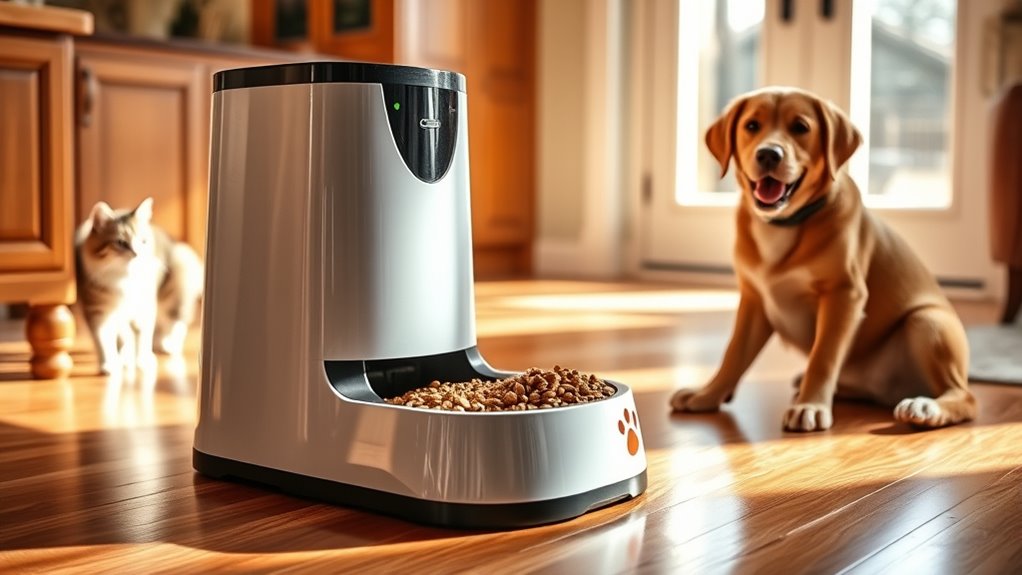

For busy owners, the PETLIBRO 5L Wi-Fi Automatic Pet Feeder is my best overall pick because app scheduling offers a practical balance of convenience and everyday feeding control. The PETLIBRO RFID Feeder stands out for households that need diet tracking, while the Frienhund 7L feeder with a 2K camera adds remote visual check-ins. The main tradeoffs are straightforward: connected features add flexibility but depend on a reliable setup, while simpler timed feeders can be easier to manage but offer less remote oversight. Capacity, meal scheduling, and whether food must be portioned for one pet or two also shape the right choice. Read on for the full breakdown and recommendations by household.

Get furniture and decor delivered free with Prime
- Fast, free delivery on millions of items
- Prime Video, Amazon Music and more included
- Member-only deals all year
Complete the kit


Key Takeaways
- PETLIBRO 5L Wi-Fi is my best overall fit for busy owners who want app-based scheduling without choosing a feeder built around a more specialized need.
- PETLIBRO RFID differentiates itself with diet tracking, making it a stronger match for households where monitoring an individual pet’s meals matters more than basic timed dispensing.
- Frienhund’s 7L capacity and 2K camera combine longer storage between refills with visual check-ins, but buyers should weigh those extras against the simpler setup of non-camera feeders.
- For two-cat households, the oneisall and HoneyGuaridan Wi-Fi models are more relevant starting points than single-bowl designs; shared feeding still may not suit pets that need separate portions.
- The lineup ranges from compact 3L and 4L feeders to larger 7L and 8L options, so busy owners should match capacity to the pet’s daily intake and refill routine rather than choosing by storage size alone.
| Heartgon Automatic Cat Feeder with Stainless Steel Bowl |  | Best for Frequent Scheduled Meals | Brand: Heartgon | Model: APF02 | Capacity: 5 liters | VIEW ON AMAZON | See Our Full Breakdown |
| oneisall Automatic Cat Feeder for Two Cats |  | Best for Two Cats on a Set Routine | Brand: oneisall | Model: PFD-002 | Capacity: 5 L (20 cups); listed capacity 11 lb | VIEW ON AMAZON | See Our Full Breakdown |
| Yuposl Automatic Cat Feeder, 3L |  | Best Compact Feeder with Flexible Power | Brand: Yuposl | Model: YPF03-PW00 | Capacity: 3 L (12 cups) | VIEW ON AMAZON | See Our Full Breakdown |
| Voluas Automatic Cat Feeder, 4L Timed Dry Food Dispenser |  | Best for Simple, Easy-to-Read Scheduling | Capacity: 4 L (16.9 cups) | Meals per day: 1–4 | Portion size: Approximately 6–7 g per portion | VIEW ON AMAZON | See Our Full Breakdown |
| HoneyGuaridan Automatic Cat Feeder for Two Cats with Wi-Fi App Control |  | Best App-Controlled Feeder for Two Cats | Model: S25D | Capacity: 3.5 L | Pet type: Cats | VIEW ON AMAZON | See Our Full Breakdown |
| ANDOLL HOME Automatic Cat Feeder, 4L |  | Best for Simple Scheduled Feeding | Capacity: 4 liters | Meals per day: Up to 8 | Voice recording: 10 seconds | VIEW ON AMAZON | See Our Full Breakdown |
| PETLIBRO RFID Automatic Cat Feeder with Wi-Fi and Diet Tracking |  | Best for Multi-Cat Food Control | Capacity: 3 liters | Connectivity: Bluetooth and dual-band Wi-Fi (2.4GHz and 5GHz) | Power: Corded electric with battery backup | VIEW ON AMAZON | See Our Full Breakdown |
| Nityers 8L Automatic Pet Feeder with LCD Screen |  | Best for Fewer Refills | Capacity: 8L (34 cups) | Scheduled meals: Up to 6 per day | Portions: 1–50 per meal, approximately 1/16 cup each | VIEW ON AMAZON | See Our Full Breakdown |
| PETLIBRO 5L Wi-Fi Automatic Pet Feeder |  | Best for Remote Scheduling | Capacity: 5 liters | Wi-Fi: 2.4 GHz and 5 GHz | Meals per day: Up to 10 | VIEW ON AMAZON | See Our Full Breakdown |
| Frienhund Automatic Pet Feeder with 2K Camera, 7L Storage, and Dual-Band Wi-Fi |  | Best for Camera Monitoring | Capacity: 7 L (29 cups) | Meals per day: Up to 15 | Portions per meal: Up to 20 | VIEW ON AMAZON | See Our Full Breakdown |
| TYM Automatic Cat Feeder, 7L, Programmable for 9 Meals a Day |  | Best for App-Free Scheduling | Capacity: 7L / 29 cups | Meals per day: Up to 9 | Portions per meal: 1–15 portions | VIEW ON AMAZON | See Our Full Breakdown |
| automatic pet feeders for busy owner | Capacity | Power | Dimensions |
|---|---|---|---|
| Heartgon Automatic Cat Feeder | 5 liters | Dual power supply | 7 × 7 × 10 inches |
| oneisall Automatic Cat Feeder | 5 L (20 cups); listed capacity 11 lb | DC power; backup with 4 AA batteries (not included) | 16.73 × 7.09 × 13.4 in |
| Yuposl Automatic Cat Feeder | 3 L (12 cups) | 3 D-size alkaline batteries (not included) or wall power | — |
| Voluas Automatic Cat Feeder | 4 L (16.9 cups) | 5V USB adapter or 3 D-cell batteries (not included) | 7.4 × 7.4 × 11.25 in |
| HoneyGuaridan Automatic Cat Fe | 3.5 L | AC adapter or 4 AA batteries (not included) | — |
| ANDOLL HOME Automatic Cat Feed | 4 liters | 5V DC adapter or 3 AA batteries (not included) | 12 × 7 × 13 inches |
| PETLIBRO RFID Automatic Cat Fe | 3 liters | Corded electric with battery backup | 10.43 × 9.45 × 17.13 inches |
| Nityers 8L Automatic Pet Feede | 8L (34 cups) | Type-C adapter or 4 AA batteries (not included) | — |
| PETLIBRO 5L Wi-Fi Automatic Pe | 5 liters | — | 7.95 × 7.72 × 11.54 inches |
| Frienhund Automatic Pet Feeder | 7 L (29 cups) | 5 V DC adapter or 3 D-cell batteries | — |
| TYM Automatic Cat Feeder | 7L / 29 cups | Included adapter or 3 C-size batteries (not included) | — |
More Details on Our Top Picks
Heartgon Automatic Cat Feeder with Stainless Steel Bowl
For owners whose day is divided by work, errands, or school runs, the Heartgon APF02 can schedule up to six meals daily and offers 20 portion settings. That makes it a better fit for frequent, smaller feedings than the Voluas 4L, which allows up to four meals a day. The 5-liter hopper also means fewer refills than the smaller Yuposl 3L, while the stainless steel bowl gives the feeding area a practical, easy-clean surface. A voice recording can add a familiar cue at mealtime, and dual power supplies add flexibility if one source is interrupted. The tradeoff is that the listing does not define portion size, so owners who need precise measured servings should check whether its controls suit their feeding plan. Its stated 7-by-7-inch footprint is compact, but height and counter placement still matter.
Pros:- Schedules up to six meals per day for owners away during normal feeding times.
- Twenty portion settings allow feeding amounts to be adjusted.
- Five-liter capacity reduces how often the hopper needs refilling compared with the Yuposl 3L.
- Stainless steel bowl, voice recorder, and dual power supply add useful everyday flexibility.
Cons:- Portion sizes are not specified, making it harder to match servings to a precise feeding plan.
- The listing gives dimensions but little detail about setup or cleaning beyond the bowl material.
- It lacks the remote scheduling and feeding records offered by the HoneyGuaridan app-controlled model.
Best for: Cat owners who want up to six scheduled daily feedings, a stainless steel bowl, and a larger hopper without app-based controls.
Not ideal for: Owners who need documented portion weights or app monitoring, or who have very limited space for a 10-inch-tall feeder.
- Brand:Heartgon
- Model:APF02
- Capacity:5 liters
- Daily meal schedule:Up to 6 meals
- Portion settings:20 portions
- Bowl material:Stainless steel
- Power:Dual power supply
- Dimensions:7 × 7 × 10 inches
Our verdict“Choose the Heartgon if you want frequent scheduled meals and a 5-liter hopper, but skip it if verified portion weights or remote app control are priorities.”
oneisall Automatic Cat Feeder for Two Cats
The oneisall PFD-002 is built around a specific household problem: feeding two cats without making them share one bowl. Its bowls sit 16 inches apart, and each receives adjustable portions at up to six scheduled meals per day. That physical separation is a clear advantage over the Heartgon, which has one listed stainless steel bowl, while the HoneyGuaridan adds app control and slow-feeder inserts but holds less food at 3.5 liters. The oneisall’s 5 L hopper and sealed lid with desiccant support a less hands-on routine; the product description estimates food for about 10 days for two adult cats, though actual use depends on intake. A 10-second voice recording can cue meals. The compromises are a dry-kibble-only design, a main unit that cannot be washed with water, and a 0.5-inch kibble-size limit.
Pros:- Two stainless steel bowls spaced 16 inches apart give cats separate eating areas.
- Schedules up to six meals daily with portions of approximately 10 g per bowl.
- Five-liter capacity and sealed, desiccant-equipped hopper reduce refill and freshness concerns.
- Dishwasher-safe bowls, a 10-second voice message, and a two-year warranty are included.
Cons:- Works with dry kibble smaller than 0.5 inch only.
- The main feeder unit cannot be washed with water.
- Backup four-AA batteries are not included, and the feeder is larger than single-bowl options.
Best for: Households with two cats that eat dry kibble and need separate bowls plus scheduled meals during workdays or short trips.
Not ideal for: Owners using large or non-dry food, households that need a water-washable feeder body, or people who want app-based feeding records.
- Brand:oneisall
- Model:PFD-002
- Capacity:5 L (20 cups); listed capacity 11 lb
- Feeding schedule:Up to 6 meals per day
- Portion size:Approximately 10 g (1/12 cup) per portion per bowl
- Kibble size:Less than 0.5 in
- Bowl spacing:16 in
- Power:DC power; backup with 4 AA batteries (not included)
- Dimensions:16.73 × 7.09 × 13.4 in
Our verdict“Pick the oneisall for two cats that need separate scheduled dry-food servings; choose the HoneyGuaridan instead if app monitoring and slow-feeder bowls matter more.”
Yuposl Automatic Cat Feeder, 3L
With a 3 L capacity and a choice of wall power or three D-size batteries, the Yuposl YPF03-PW00 suits owners who need a straightforward feeder that can sit away from an outlet. It schedules one to six meals daily and accepts dry food sized 2–15 mm, giving it a broader stated kibble range than the oneisall, which limits kibble to under 0.5 inch. Most parts are removable and washable, and the dishwasher-safe stainless steel bowl makes routine cleanup easier than with the oneisall’s non-washable main unit. In exchange, its hopper is smaller than the Heartgon’s 5 liters and the two-cat oneisall’s 5 L, so households with larger appetites may refill it more often. Battery life is listed as over 180 days, but actual duration depends on use; batteries are not included, and this is a dry-food feeder.
Pros:- Supports one to six scheduled meals daily with adjustable portions.
- Wall power or three D-size batteries allow placement where an outlet is inconvenient.
- Accepts dry food sized 2–15 mm, with an anti-jam design described for that range.
- Removable washable parts and a dishwasher-safe stainless steel bowl simplify cleanup.
Cons:- The 3 L hopper holds less than the 5-liter Heartgon and oneisall feeders.
- Designed for dry food only.
- Three D-size alkaline batteries are not included, and food duration varies with pet intake.
Best for: Owners of cats, small dogs, or small animals who need flexible placement, washable parts, and scheduled dry-food meals.
Not ideal for: Multi-pet households with high food consumption or owners who need wet-food dispensing or included backup batteries.
- Brand:Yuposl
- Model:YPF03-PW00
- Capacity:3 L (12 cups)
- Meal schedule:1–6 meals per day
- Food type:Dry food
- Compatible food size:2–15 mm
- Power:3 D-size alkaline batteries (not included) or wall power
- Battery life:Over 180 days
- Bowl:Dishwasher-safe stainless steel
Our verdict“Choose the Yuposl for a flexible, easy-to-clean setup in a smaller household, but look to a larger-capacity feeder if refills are your main concern.”
Voluas Automatic Cat Feeder, 4L Timed Dry Food Dispenser
The Voluas 4L favors a simple routine over a packed feature set: owners can program one to four meals per day using its LCD screen, with portions of about 6–7 g each. That lower meal limit makes it less flexible than the Heartgon, Yuposl, or oneisall, all of which schedule up to six meals. For owners whose cats eat a few predictable meals, though, the display and straightforward controls may be easier to manage than the HoneyGuaridan’s app-based setup. The 4 L hopper sits between the Yuposl’s smaller 3 L and the 5-liter Heartgon and oneisall, and the feeder can run from USB power or three D-cell batteries. A voice recording can call a pet to its bowl. It remains limited to dry food, batteries are not included, and the listing does not specify a backup duration or battery life.
Pros:- LCD screen provides a direct way to program scheduled meals.
- Adjustable portions of approximately 6–7 g allow feeding amounts to be tailored.
- USB power or three D-cell batteries provide two power options.
- Four-liter capacity and a 10-second voice recorder support a predictable daily routine.
Cons:- Schedules up to four meals per day, fewer than the six-meal Heartgon, Yuposl, and oneisall.
- Designed for dry food only.
- Three D-cell batteries are not included, and battery-life details are not provided.
Best for: Cat owners who want a display-based feeder for up to four daily dry-food meals and prefer local controls over app features.
Not ideal for: Owners who need more than four meals per day, a two-cat split-bowl setup, or clear battery-life information.
- Capacity:4 L (16.9 cups)
- Meals per day:1–4
- Portion size:Approximately 6–7 g per portion
- Power:5V USB adapter or 3 D-cell batteries (not included)
- Voice recorder:Up to 10 seconds
- Dimensions:7.4 × 7.4 × 11.25 in
- Weight:3.7 lbs
- Food type:Dry food
- Warranty:1 year
Our verdict“Choose the Voluas for a basic, screen-led schedule of up to four dry-food meals, but skip it if your pet needs more frequent feedings.”
HoneyGuaridan Automatic Cat Feeder for Two Cats with Wi-Fi App Control
The HoneyGuaridan S25D is the most connected pick in this group: its app supports meal scheduling, feeding records, remaining-food checks, and remote extra portions. For owners who may need to adjust a meal while away, that remote access offers more flexibility than the oneisall, which relies on its programmed routine and voice recording. The HoneyGuaridan also feeds two cats with separate stainless steel bowls and slow-feeder inserts, a useful combination when cats eat quickly or need distinct stations. Its sealed, desiccant-equipped hopper and anti-jam operation support day-to-day feeding, while battery backup adds another layer of continuity. The tradeoff is capacity: at 3.5 L, it holds less than the oneisall’s 5 L, so two cats may require more frequent refills. App control also depends on Wi-Fi, and AA backup batteries are not included.
Pros:- App supports meal scheduling, feeding records, remaining-food checks, and remote extra portions.
- Includes two stainless steel bowls and two slow-feeder bowls for separate feeding stations.
- Sealed hopper with desiccant helps keep kibble fresh, while anti-jam operation supports regular dispensing.
- AC power with four-AA battery backup provides an alternative power source.
Cons:- The 3.5 L capacity is smaller than the oneisall’s 5 L hopper for two-cat feeding.
- App control requires Wi-Fi, so remote features depend on a working network.
- Four AA backup batteries are not included.
Best for: Two-cat households where an owner wants to adjust feedings remotely, check feeding records, and offer slow-feeder inserts.
Not ideal for: Owners who prefer a fully offline feeder, have unreliable Wi-Fi, or prioritize maximum hopper capacity over app control.
- Model:S25D
- Capacity:3.5 L
- Pet type:Cats
- Connectivity:2.4 GHz and 5 GHz Wi-Fi
- App:HGsmart for iOS and Android
- Bowls:Two stainless steel bowls and two slow-feeder bowls
- Power:AC adapter or 4 AA batteries (not included)
Our verdict“Pick the HoneyGuaridan if remote control and slow-feeder options matter more than hopper size; choose the oneisall for a larger, less connected two-cat setup.”
ANDOLL HOME Automatic Cat Feeder, 4L
The ANDOLL HOME suits busy owners who want routine meals without adding an app to the setup. Its schedule can dispense up to eight meals a day, while a short voice recording can call a cat to the bowl. The sealed lid and desiccant compartment are useful when food sits in the hopper for several days, and battery backup can keep scheduled feeding going through a power outage—provided you supply the batteries.
Compared with the PETLIBRO 5L Wi-Fi Feeder, this model gives up remote scheduling and alerts in favor of a more straightforward routine. Its 4-liter capacity is also smaller than the Nityers 8L, so it suits owners who refill regularly rather than those seeking maximum capacity. It handles dry food only, and the three AA backup batteries are not included.
Pros:- Schedules up to eight meals daily
- Ten-second voice recording can cue pets at feeding time
- Sealed lid and desiccant compartment help protect dry food
- Battery backup supports feeding during power outages
Cons:- Three AA backup batteries are not included
- Dry food only
- No app connectivity for remote schedule changes or alerts
Best for: Owners who want a straightforward, locally programmed dry-food schedule and a voice cue without relying on Wi-Fi.
Not ideal for: People who need app-based remote changes, wet-food dispensing, or a large hopper for long stretches between refills.
- Capacity:4 liters
- Meals per day:Up to 8
- Voice recording:10 seconds
- Power:5V DC adapter or 3 AA batteries (not included)
- Dimensions:12 × 7 × 13 inches
- Material:Stainless steel
- Bowl tilt:8 degrees
- Warranty:1 year
Our verdict“Choose the ANDOLL HOME for dependable scheduled dry-food meals without app controls, but pick the PETLIBRO 5L if remote management matters more.”
PETLIBRO RFID Automatic Cat Feeder with Wi-Fi and Diet Tracking
For a busy household where one cat keeps raiding another’s meal, this feeder’s defining advantage is RFID-controlled access: the included collar tag lets it open for a designated cat. App scheduling, portion control, and eating-habit tracking add a useful record for owners managing separate diets, while dual-band Wi-Fi supports remote access and alerts. Battery backup can help preserve the feeding routine during an outage.
This is a more targeted choice than the PETLIBRO 5L Wi-Fi Feeder, which offers app scheduling and alerts but not the same cat-specific access control. The tradeoff is that the RFID reader depends on the provided collar tag; it is not microchip activated, and the tag may not suit every cat. At 3 liters, its hopper is smaller than the Frienhund 7L, and the base and reader should not be washed with water.
Pros:- RFID access helps keep other pets from taking the designated cat’s food
- App supports meal schedules, portion control, and diet tracking
- Dual-band Wi-Fi supports remote access and alerts
- Battery backup helps maintain feeding during power outages
Cons:- Requires the included RFID collar tag and is not microchip activated
- The 3-liter hopper holds less than the Frienhund 7L
- Feeder base and RFID reader should not be washed with water
Best for: Owners of cats on separate diets who need app scheduling and a way to limit access to one tagged cat.
Not ideal for: Homes where pets will not wear the included collar tag, or owners seeking a microchip-activated feeder or a high-capacity hopper.
- Capacity:3 liters
- Connectivity:Bluetooth and dual-band Wi-Fi (2.4GHz and 5GHz)
- Power:Corded electric with battery backup
- Dimensions:10.43 × 9.45 × 17.13 inches
- Weight:7.7 pounds
- Materials:ABS, PC, silica gel, stainless steel, and TPE
- Tag compatibility:Included RFID collar tag only; not microchip activated
- Model:PLAF301
Our verdict“Pick this PETLIBRO when controlling which cat eats each portion matters more than maximizing hopper capacity or avoiding a collar tag.”
Nityers 8L Automatic Pet Feeder with LCD Screen
The Nityers makes sense for owners whose main time-saver is going longer between hopper refills. Its 8-liter capacity is substantially larger than the ANDOLL HOME’s 4 liters and the PETLIBRO 5L’s 5 liters, while its LCD controls schedule up to six meals a day. Portions can be adjusted in increments of about 1/16 cup, giving owners a way to tailor dispensing rather than relying on a single preset amount.
A locking lid, desiccant bag, and anti-jamming mechanism address common dry-food concerns, and removable parts plus a stainless steel bowl make cleaning more manageable. The tradeoff is less scheduling frequency than the ANDOLL HOME or PETLIBRO 5L, which each support more daily meals. It has no listed app control, runs dry food only, and cannot handle kibble larger than 18 mm. Backup requires four AA batteries, sold separately.
Pros:- 8-liter hopper reduces how often owners need to refill
- Schedules up to six meals with adjustable portions
- Removable parts and stainless steel bowl aid cleaning
- Locking lid and anti-jamming features support reliable dry-food dispensing
Cons:- Four AA backup batteries are not included
- Dry food only, with kibble limited to 18 mm
- Supports fewer scheduled meals per day than the ANDOLL HOME and PETLIBRO 5L
Best for: Busy owners who want a large dry-food reserve, on-device scheduling, and removable parts for routine cleaning.
Not ideal for: Owners who need app-based remote control, more than six meals daily, wet-food dispensing, or use kibble larger than 18 mm.
- Capacity:8L (34 cups)
- Scheduled meals:Up to 6 per day
- Portions:1–50 per meal, approximately 1/16 cup each
- Power:Type-C adapter or 4 AA batteries (not included)
- Bowl diameter:6.7 inches
- Bowl material:Stainless steel
- Food compatibility:Dry food only; kibble up to 18 mm
- Features:LCD screen, voice recording and playback, manual feeding, desiccant bag, and anti-jamming mechanism
Our verdict“Choose the Nityers if reducing refills matters more than app control or frequent daily meal scheduling.”
PETLIBRO 5L Wi-Fi Automatic Pet Feeder
The PETLIBRO 5L is a strong fit for owners whose schedules change and who want to manage meals away from home. Its app supports up to 10 meals a day, feeding records, and portion settings, while notifications can flag low food, jams, and other issues. A customizable voice call can play at mealtimes, and the twist-lock lid, sealing strip, and desiccant bag help protect the dry kibble sitting in the hopper.
Compared with the ANDOLL HOME 4L, this model adds Wi-Fi scheduling and alerts; unlike the PETLIBRO RFID feeder, it does not restrict access to one tagged cat. Its 5-liter capacity is more modest than the Nityers 8L, and the feeder is limited to dry kibble between 2 and 15 mm. It uses corded power, and the base should not be washed, so setup and cleaning need some care.
Pros:- App supports remote scheduling and feeding records
- Schedules up to 10 meals per day with adjustable portions
- Alerts can flag low food, jams, and other issues
- Twist-lock lid, sealing strip, and desiccant bag help protect kibble
Cons:- Limited to dry kibble 2–15 mm in diameter
- Corded power is listed without battery backup
- Feeder base should not be washed
Best for: Owners who want to adjust a cat’s meal schedule remotely and receive alerts about low food or dispensing problems.
Not ideal for: Households needing RFID-based food access, battery backup, wet-food dispensing, or compatibility with kibble outside the 2–15 mm range.
- Capacity:5 liters
- Wi-Fi:2.4 GHz and 5 GHz
- Meals per day:Up to 10
- Portions per meal:1–48; 1/12 cup per portion
- Food compatibility:Dry kibble, 2–15 mm diameter
- Dimensions:7.95 × 7.72 × 11.54 inches
- Power source:Corded electric
- Voice recording:Up to 10 seconds; up to 10 meal calls
- Warranty:24 months
Our verdict“Choose the PETLIBRO 5L if remote schedule changes and alerts are more useful to you than the Nityers 8L’s larger capacity.”
Frienhund Automatic Pet Feeder with 2K Camera, 7L Storage, and Dual-Band Wi-Fi
The Frienhund is for owners who want more than a schedule: its camera and two-way audio let them check the feeding area and interact with a cat through the app. Night vision and motion alerts add visibility after dark, while the feeder handles up to 15 meals daily and stores 7 liters of food. A removable tank and stainless steel bowl support cleaning, and battery backup can help maintain feeding when power fails.
Compared with the PETLIBRO 5L Wi-Fi Feeder, Frienhund brings camera monitoring and greater capacity, but its extra features mean more setup and storage decisions. It also exceeds the Nityers 8L in meal frequency, though the Nityers holds more food. Backup needs three D-cell batteries, which are not specified as included. Cloud storage terms are also unclear, so owners wanting recorded footage should check that before relying on it.
Pros:- Camera with night vision and motion alerts supports remote monitoring
- Two-way audio allows interaction through the app
- 7-liter storage and up to 15 meals daily suit frequent scheduling
- Removable food tank and stainless steel bowl aid cleaning
Cons:- Battery backup requires three D-cell batteries, with inclusion not specified
- Cloud storage availability and terms are not described
- Camera and app features add complexity compared with the PETLIBRO 5L
Best for: Owners who travel or work away from home and want camera monitoring, two-way audio, and a high-capacity scheduled feeder.
Not ideal for: Buyers who want a simple feeder without camera setup, depend on clearly defined cloud storage, or do not want to source three D-cell batteries for backup.
- Capacity:7 L (29 cups)
- Meals per day:Up to 15
- Portions per meal:Up to 20
- Camera:3 MP with night vision
- Wi-Fi:Dual-band 2.4 GHz and 5 GHz
- Audio:Two-way audio
- Storage:TF card up to 128 GB and cloud storage
- Power:5 V DC adapter or 3 D-cell batteries
- Warranty:One year
Our verdict“Pick the Frienhund if seeing and speaking to your pet matters alongside scheduled feeding, but choose a simpler Wi-Fi feeder if you only need remote meal control.”
TYM Automatic Cat Feeder, 7L, Programmable for 9 Meals a Day
For busy owners who want a large dry-food supply without adding an app to the daily routine, the TYM 7L feeder offers a practical middle ground. Its capacity of up to 29 cups and schedule of up to nine meals a day can reduce frequent refills while splitting food into smaller feedings. Compared with the PETLIBRO 5L Wi-Fi Automatic Pet Feeder, TYM gives up remote app control but offers more stated capacity and straightforward LCD-and-button operation. A battery backup can keep feeding during a power outage, though the three C-size batteries are not included. The moisture-sealing lid, desiccant compartment, and dishwasher-safe stainless steel bowl support everyday food storage and cleanup. The tradeoff is that the clock needs resetting after a power outage and reconnection, making this less hands-off after an interruption than an app-connected option.
Pros:- 7L capacity helps reduce how often owners need to refill the hopper.
- Schedules up to nine meals daily, with adjustable portions for more frequent feeding.
- Battery backup can keep scheduled dispensing going during a power interruption.
- Dishwasher-safe stainless steel bowl and app-free LCD controls simplify routine use.
Cons:- Three C-size backup batteries are not included.
- The clock must be reset after a power outage and reconnection.
- Designed for dry food, so it cannot serve owners who need wet-food dispensing.
Best for: Owners of one or more dry-food-fed cats who want a high-capacity schedule with physical controls and no Wi-Fi setup.
Not ideal for: Owners who need app-based remote scheduling, wet-food dispensing, or a feeder that retains its clock without resetting after a power outage.
- Capacity:7L / 29 cups
- Meals per day:Up to 9
- Portions per meal:1–15 portions
- Approximate portion size:10g
- Power:Included adapter or 3 C-size batteries (not included)
- Food type:Dry food
- Bowl:Dishwasher-safe stainless steel
- Controls:Buttons and LCD display; no app or Wi-Fi
- Warranty:1 year
Our verdict“Choose the TYM if you want a large, app-free dry-food feeder with frequent meal scheduling and can accept resetting its clock after an outage.”

How We Picked
I compared these feeders around the problems busy owners are trying to solve: keeping meals on schedule, reducing routine refill work, and checking or controlling feeding when away from home. I weighed stated capacity, meal-programming features, app or camera functions, multi-pet suitability, and practical details such as bowl material and display controls. A feature mattered most when it addressed a real feeding need, not simply because it added complexity.
The ranking favors balanced day-to-day usefulness first, then gives higher placement to products with a clear advantage for a defined household need. That puts the PETLIBRO 5L Wi-Fi in the overall spot, while the RFID and camera models rank as more specialized choices. Simpler and smaller-capacity feeders remain viable picks for owners who value straightforward scheduling or fewer connected features, but they rank lower for buyers seeking remote flexibility or less frequent refills. Since the listed features do not establish every detail of reliability, portion accuracy, or app performance, I avoid treating any model as a substitute for checking fit with a pet’s diet and routine.
Factors to Consider When Choosing Automatic Pet Feeders For Busy Owners
Choosing a feeder is less about collecting features and more about deciding which part of your routine needs help. I’d start with the feeding plan, then check capacity, household setup, and how much remote access you will actually use.
Match Capacity to Your Refill Routine
A larger hopper can mean fewer refill chores, but capacity only helps when it suits your pet’s food and daily intake. Compare the feeder’s stated volume with how much dry food your pet eats, rather than assuming a bigger number automatically means a set number of days. Kibble size and shape can affect how comfortably food moves through a dispenser, so check compatibility before relying on scheduled portions. A small household or a single cat may find a 3L or 4L model easier to fit into a limited space. Larger households or owners away for longer stretches may value 7L or 8L storage, while still keeping a regular check on food levels. Avoid filling a large hopper and treating it as a reason to leave food unattended for extended periods.
Choose Scheduling Around the Pet’s Routine
List the meals your pet needs across a typical day before deciding how many programmable meals matter. More schedule slots are useful for pets who benefit from frequent small meals, but they add little for an animal with a simple morning-and-evening routine. Check whether the feeder supports the portion pattern your veterinarian or feeding plan calls for; a meal count alone does not tell you how precise each serving will be. Owners with changing work hours may value app scheduling, while a consistent schedule can be handled by a basic timed dispenser. A common mistake is buying the most programmable option without checking that its controls are easy to adjust. Pick the simplest interface that can keep up with real changes to your week.
Decide Whether Remote Access Is Worth the Setup
Wi-Fi control is most useful when you want to adjust a meal or check feeding while away, rather than just set a repeating schedule once. A camera goes further by letting you see the feeding area, but it does not by itself confirm exactly how much food a pet ate. Connected features depend on a suitable home network and an app workflow you are comfortable maintaining. If you rarely change schedules remotely, a feeder with local controls may be easier to live with. Before choosing a connected model, check the setup requirements and what functions remain available if the network or app is unavailable. Pay for remote features when they solve a recurring problem, not simply because they appear more advanced.
Plan for Separate Feeding in Multi-Pet Homes
A feeder described for two cats may help serve a shared feeding area, but that does not automatically give each pet an individually controlled portion. If one animal eats faster, needs a different diet, or must avoid another pet’s food, a shared outlet can create a new management problem. RFID-based access and diet tracking are more relevant when identifying an individual pet is part of the feeding plan. Measure the available feeding space and consider whether both pets can eat comfortably at the same time. Do not assume a dual-bowl design prevents food stealing without checking how portions are distributed. For pets with medical or weight-management needs, ask your veterinarian whether a shared feeder setup is appropriate.
Treat Portion Control as a Feeding-Plan Question
Scheduled portions can help keep a routine consistent, but the programmed setting still needs to match the food and the pet’s needs. Serving size descriptions are not interchangeable with a measured amount by weight, especially when kibble shapes vary. If your pet follows a calorie-controlled diet, confirm the amount dispensed with a kitchen scale during setup and revisit it if the food changes. Avoid relying on a feeder to correct overfeeding if treats, shared bowls, or other food sources remain part of the day. A busy schedule makes consistency helpful, but it does not remove the need to monitor appetite and body condition. Seek veterinary guidance for a pet whose feeding plan has specific medical requirements.
Account for Cleaning and Food Storage
Daily convenience can disappear if the hopper, chute, or bowl is difficult to clean. Look for removable parts and clear care instructions, then consider how often the feeding area will need washing in your home. Stainless steel bowls, such as the one on the Heartgon, may appeal to owners who prefer that bowl material, but bowl choice is only one part of maintenance. Keep dry food sealed and follow the feeder’s guidance for loading and cleaning instead of leaving old kibble in place indefinitely. A large capacity can reduce refill frequency while making a full cleaning session more involved. Choose a setup that fits the amount of upkeep you can realistically maintain.
Frequently Asked Questions
Should I choose a Wi-Fi feeder or a basic timed feeder if my work hours change?
If your schedule changes often and you may need to adjust meals while away, a Wi-Fi feeder offers more flexibility than a timer set in advance. For a stable routine, a simpler timed model can handle recurring meals without relying on app access. Think about how often you would truly change a schedule remotely, not just whether the feature is available. Also check what controls still work if your home network is down. In this lineup, the PETLIBRO 5L Wi-Fi and HoneyGuaridan Wi-Fi models suit buyers prioritizing connected control, while the Voluas and other timed options are worth comparing for a more direct setup.
Is a two-cat feeder enough if my pets eat different foods?
Not necessarily. A dual-feeding design can serve two pets, but it may not separate diets or stop one cat from eating the other’s portion. If the food types or allowed amounts differ, look for a way to control access by pet and verify how portions are assigned. The PETLIBRO RFID model is the lineup’s more relevant choice when individual identification and diet tracking matter. Even then, consider your pets’ behavior and ask a veterinarian about any medically restricted feeding arrangement. A shared feeder is a poor fit when one pet needs reliable protection from the other’s food.
How much feeder capacity do I need for a busy week?
Work backward from your pet’s daily food amount and the number of days between refills, then leave room for routine checks. Capacity labels describe volume, not a guaranteed number of feeding days, and different kibble can occupy space differently. The 3L and 4L models may suit owners who refill often or have limited counter space, while 7L and 8L options can reduce refill frequency. Larger storage does not remove the need to keep food fresh or inspect the feeder. If you will be away for an extended period, arrange a person to check on the pet and equipment rather than relying on capacity alone.
Can I rely on an automatic feeder to manage my pet’s weight?
A feeder can make meal timing more consistent, but it cannot decide the right daily calorie target or account for food given elsewhere. Portion settings also need checking against the actual kibble and your pet’s feeding plan. Weigh a test serving rather than assuming a programmed portion matches a particular amount by weight. Keep track of treats, shared food, and changes in appetite, which a standard feeder may not capture. For weight concerns or a prescribed diet, set the plan with your veterinarian and use the feeder as one part of that routine.
Does a camera-equipped feeder replace having someone check on my pet?
No. A camera can provide a visual check-in, but it does not replace a person who can respond if a pet is unwell, the feeder jams, or the food runs out. Video also may show a pet near the bowl without confirming how much it ate. The Frienhund combines a 2K camera with 7L storage, which makes it a distinctive remote-monitoring option in this lineup. Consider whether you need visual access often enough to justify camera setup and upkeep. For trips or long absences, arrange a human check-in as well.
Conclusion
For most busy owners, I’d start with the PETLIBRO 5L Wi-Fi as the best overall choice: it pairs app-based scheduling with a practical capacity without centering the decision on a niche feature. The Yuposl 3L is my best value-style pick for buyers who want a smaller, straightforward timed feeder, while the Frienhund 7L camera model is the premium-style choice for owners who want both larger storage and visual check-ins. Beginners who prefer fewer connected controls should compare the Voluas 4L and ANDOLL HOME 4L options before choosing a more feature-heavy model. For specific needs, choose PETLIBRO RFID for pet identification and diet tracking, or consider oneisall and HoneyGuaridan for a two-cat setup. Match the feeder to your household’s portion rules and refill habits; the most useful model is the one that supports a routine you can still monitor.