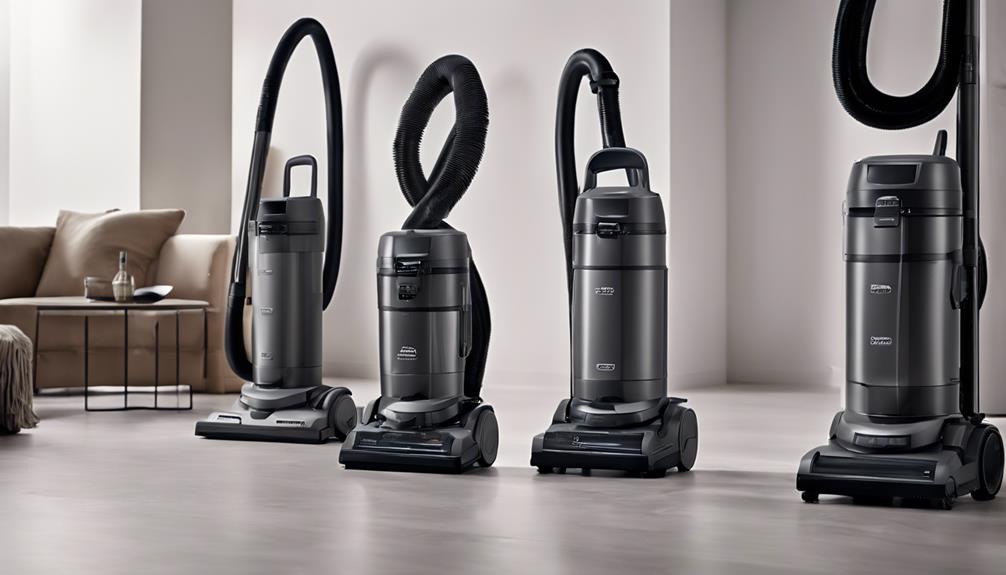

For a bagless commercial vacuum cleaner that balances everyday usability with a commercial upright design, I’d start with the Sanitaire Response SC5900A. The Hoover Commercial TaskVac is a straightforward alternative for buyers who want a familiar upright format, while the ProTeam ProVac FS 6 offers a backpack setup for cleaning routes where maneuverability matters more than an upright’s push-and-pull routine. The main tradeoffs are cleaning format, how often you’ll empty and maintain the dust cup, and whether onboard tools suit your spaces. Bagless models avoid replacement bags, but dust disposal and filter care become part of regular upkeep. Read on for how each option fits different commercial cleaning needs.

Get furniture and decor delivered free — and shop member deals
- Fast, free delivery on millions of items
- Access to Prime Big Deal Days deals on October 6–7
- Prime Video, Amazon Music and more included
Complete the kit


Key Takeaways
The Sanitaire Response SC5900A earns the overall lead because it offers a commercial upright format suited to routine floor cleaning without requiring buyers to move to a specialized setup.
The Hoover TaskVac is the more approachable upright alternative; buyers should compare its tool access and maintenance routine with the Sanitaire models before choosing on familiarity alone.
The ProTeam ProVac FS 6 stands apart as the backpack pick, trading upright simplicity for a format that can make cleaning around furniture and through occupied spaces easier.
The Sanitaire SC5845D and SL4410A give buyers two additional Sanitaire upright options, so the choice should turn on their specific tool and handling needs rather than brand name alone.
The Bissell Commercial Pro Cup adds onboard tools to a bagless upright design, a practical distinction for jobs that alternate between open floors and edges or above-floor surfaces.
| Sanitaire Response Commercial Upright Vacuum (SC5900A) |  | Best Overall for Mixed Floors | Model: SC5900A | Type: Commercial upright vacuum | Design: Bagless | VIEW ON AMAZON | See Our Full Breakdown |
| Hoover Commercial TaskVac Bagless Upright Vacuum Cleaner |  | Best for Easy Room-to-Room Carrying | Type: Bagless upright vacuum | Weight: 15 pounds | Power cord length: 35 feet | VIEW ON AMAZON | See Our Full Breakdown |
| Sanitaire Force Commercial Upright Vacuum, SC5845D, Black |  | Best for Carpet Coverage and Filtration | Model: SC5845D | Type: Commercial upright vacuum | Cleaning path: 15 inches | VIEW ON AMAZON | See Our Full Breakdown |
| ProTeam ProVac FS 6 Commercial Backpack Vacuum with Power Nozzle Tool Kit |  | Best for Stairs and Obstructed Areas | Type: Commercial backpack vacuum | Capacity: 6 quarts | Filtration: Four-level filtration with HEPA media filter | VIEW ON AMAZON | See Our Full Breakdown |
| Sanitaire Professional Bagless Upright Commercial Vacuum with Tools, SL4410A |  | Best for Light-Duty Carpet Maintenance | Model: SL4410A | Vacuum type: Bagless upright | Dirt cup capacity: 1 quart | VIEW ON AMAZON | See Our Full Breakdown |
| Bissell Commercial Pro Cup Bagless Upright Vacuum with On-Board Tools |  | Best for Flexible Floor Care | Type: Bagless upright vacuum | Cleaning path: 13.5 inches | Power cord: 30 feet, replaceable | VIEW ON AMAZON | See Our Full Breakdown |
| bagless commercial vacuum cleaner | Type | Model | Cleaning path |
|---|---|---|---|
| Sanitaire Response Commercial | Commercial upright vacuum | SC5900A | — |
| Hoover Commercial TaskVac Bagl | Bagless upright vacuum | — | — |
| Sanitaire Force Commercial Upr | Commercial upright vacuum | SC5845D | 15 inches |
| ProTeam ProVac FS 6 Commercial | Commercial backpack vacuum | — | — |
| Sanitaire Professional Bagless | — | SL4410A | 13 inches |
| Bissell Commercial Pro Cup Bag | Bagless upright vacuum | — | 13.5 inches |
More Details on Our Top Picks
Sanitaire Response Commercial Upright Vacuum (SC5900A)
The Sanitaire Response is the most adaptable upright here for facilities that move between carpet and hard flooring. Its Surface Sense Technology detects floor types and adjusts brush roll speed, reducing the need to stop and change settings between rooms. Soft and stiff bristles support that mixed-surface approach, while the detachable handheld wand, onboard tools, and built-in lights extend its use to dim corners and above-floor areas. Compared with the carpet-focused Sanitaire Force SC5845D, the Response is a better fit for varied floors; the Force offers a wider 15-inch path and a stated 3.5-quart cup. The Response’s tradeoff is that the supplied details do not give its weight, capacity, or cord length, making it harder to judge for long shifts or large areas.
Pros:- Detects floor types and adjusts brush roll speed automatically
- Soft and stiff bristles support both hard floors and carpet
- Detachable handheld wand and onboard tools handle above-floor cleaning
- Built-in lights help reveal debris in dim areas
Cons:- Weight, dirt-cup capacity, and cord length are not specified in the supplied product data
- The available details do not establish its suitability for extended commercial shifts
Best for: Commercial cleaners responsible for buildings with both carpet and hard floors who want automatic surface adjustment and onboard above-floor tools
Not ideal for: Buyers who need verified dirt-cup capacity, weight, or cord reach before choosing equipment for large facilities
- Model:SC5900A
- Type:Commercial upright vacuum
- Design:Bagless
- Floor detection:Surface Sense Technology with sonar
- Brush roll:Soft bristles for hard floors and stiff bristles for carpet
- Lighting:Built-in lights
- Attachments:Detachable handheld wand and onboard tools
Our verdict“Choose the Response for mixed-floor cleaning with automatic brush adjustment, provided the unspecified capacity and reach fit your needs.”
Hoover Commercial TaskVac Bagless Upright Vacuum Cleaner
At 15 pounds, the Hoover TaskVac is the clearest choice here for crews who regularly carry a vacuum between floors or rooms. Its 35-foot cord can reduce outlet changes across a work area, and the included wand, crevice tool, and upholstery/dusting brush cover detail work beyond the main floor. Compared with the heavier-duty feature set described for the Sanitaire Force SC5845D, the TaskVac emphasizes portability and straightforward upkeep: its dirt cup is easy to empty, and the brush roll and belt are designed for easy replacement. That serviceability can help simplify routine maintenance, though the supplied details do not state cup capacity, filtration, or a cleaning-path width. Buyers prioritizing those measurable specifications may find the Force easier to assess; TaskVac’s case rests on carrying ease and practical reach.
Pros:- 15-pound weight makes it easier to carry between rooms and up stairs
- 35-foot power cord offers extended reach between outlets
- Wand, crevice tool, and upholstery/dusting brush support detail cleaning
- Easy-change brush roll and belt simplify routine maintenance
Cons:- Dirt-cup capacity is not specified in the supplied product data
- Filtration level and cleaning-path width are not provided
Best for: Janitorial staff moving between rooms or floors who want a relatively light upright with a long cord and above-floor accessories
Not ideal for: Facility managers who need a documented dirt-cup capacity, filtration level, or cleaning-path width to compare equipment
- Type:Bagless upright vacuum
- Weight:15 pounds
- Power cord length:35 feet
- Wand:12 inches
- Crevice tool:11 inches
- Other accessory:Upholstery/dusting brush
- Maintenance features:Easy-change brush roll and belt; clean drop dirt cup
Our verdict“Pick the TaskVac for portable, routine carpet cleaning across rooms when carrying weight and cord reach matter most.”
Sanitaire Force Commercial Upright Vacuum, SC5845D, Black
The Sanitaire Force SC5845D is the strongest match in this group for carpeted areas where coverage per pass and stated filtration details matter. Its 15-inch cleaning path can cover more carpet with each pass than the 13-inch path listed for the Sanitaire Professional SL4410A. A washable HEPA exhaust filter and 3.5-quart dirt cup also give buyers concrete capacity and filtration details that several other picks lack. The tradeoff is a narrower use case: the supplied data recommends it for carpet, while the Sanitaire Response is described as suitable for both carpet and hard floors with automatic surface detection. The Force is corded and its tools support above-floor work, but buyers cleaning mostly hard floors or needing cordless movement should look elsewhere.
Pros:- 15-inch cleaning path covers more area per pass than the SL4410A’s stated 13 inches
- 3.5-quart dirt cup provides stated capacity for routine cleaning
- Washable HEPA exhaust filter supports cleaner exhaust without disposable filter replacement
- Stretch hose and onboard tools support above-floor cleaning
Cons:- Product data recommends it for carpet, limiting its appeal for mostly hard-floor facilities
- Corded power restricts movement to the available outlets
Best for: Commercial cleaning teams covering broad carpeted areas that want a wide cleaning path, a larger stated dirt cup, and washable HEPA exhaust filtration
Not ideal for: Teams whose routes are mostly hard flooring or who need freedom from outlet-to-outlet cord limits
- Model:SC5845D
- Type:Commercial upright vacuum
- Cleaning path:15 inches
- Filter:Washable HEPA exhaust filter
- Dirt cup capacity:3.5 quarts
- Noise level:70.6 dB
- Power:Corded electric; 120 volts; 2200 watts; 10 A
- Included tools:Stretch hose, two-piece wand, crevice tool, and dusting brush
Our verdict“Choose the Force for carpet-heavy sites that value its wide path, 3.5-quart cup, and washable HEPA exhaust filter.”
ProTeam ProVac FS 6 Commercial Backpack Vacuum with Power Nozzle Tool Kit
The ProTeam ProVac FS 6 takes a different approach from the upright models: its backpack format can help cleaners move around furniture, stairs, and other obstacles without pushing a floor head ahead of them. The padded, breathable harness is intended to support longer cleaning sessions, while the power nozzle tool kit addresses carpet cleaning across different pile heights. Its four-level filtration includes a HEPA media filter, a feature that may suit sites focused on dust control. Compared with the upright Hoover TaskVac, this pick trades a familiar push-and-steer format for hands-free movement and a stated six-quart capacity. The product description frames it for residential cleaning, however, so commercial buyers should check that its intended workload matches their site; backpack wear also will not suit every cleaner.
Pros:- Backpack format supports movement around furniture and on stairs
- Padded, breathable harness is designed for extended wear
- Four-level filtration includes a HEPA media filter
- Power nozzle kit supports carpet cleaning across different pile heights
Cons:- Description positions it for residential cleaning, which may not suit every commercial workload
- Backpack format may be uncomfortable or unsuitable for some operators
Best for: Cleaning teams handling stairs, furnished rooms, and above-floor surfaces who are comfortable wearing a backpack vacuum
Not ideal for: Facilities needing a product explicitly positioned for heavy commercial workloads or crews who prefer upright operation
- Type:Commercial backpack vacuum
- Capacity:6 quarts
- Filtration:Four-level filtration with HEPA media filter
- Included accessories:Power nozzle tool kit
- Harness:Padded, breathable harness
- Color:Gray
Our verdict“Select the ProVac FS 6 when maneuverability on stairs and around furniture matters more than an upright format.”
Sanitaire Professional Bagless Upright Commercial Vacuum with Tools, SL4410A
The Sanitaire Professional SL4410A suits smaller commercial routes that need basic carpet-height flexibility and a predictable cord reach. Its five height settings let an operator adjust for different carpet types, while the 13-inch cleaning path is narrower than the Sanitaire Force SC5845D’s 15-inch path. A removable one-quart dirt cup avoids bags, but its smaller stated capacity may mean more frequent emptying than the Force’s 3.5-quart cup. The 30-foot cord and onboard crevice, dusting/upholstery, and extension tools add practical range for routine cleaning. This is explicitly a light-duty commercial model, so it makes more sense for modest workloads than for crews covering extensive floor areas or seeking larger capacity.
Pros:- Five height settings accommodate different carpet types
- Removable dirt cup avoids disposable vacuum bags
- 30-foot cord reduces the need to change outlets
- Onboard crevice, combination dusting/upholstery, and extension tools support detail work
Cons:- One-quart dirt cup is smaller than the Force SC5845D’s stated 3.5-quart capacity
- Product is described as light-duty commercial, limiting its fit for heavier workloads
- 13-inch cleaning path covers less width per pass than the Force’s 15-inch path
Best for: Small offices or light-duty cleaning crews that need adjustable carpet height and a bagless upright with onboard tools
Not ideal for: Large facilities or high-volume crews likely to be slowed by a one-quart cup and a 13-inch cleaning path
- Model:SL4410A
- Vacuum type:Bagless upright
- Dirt cup capacity:1 quart
- Cleaning path:13 inches
- Height adjustment:5 settings
- Power cord length:30 feet
- Power source:Corded electric
- Included tools:Crevice tool, combination dusting brush/upholstery tool, and extension wand
- Potential cleaning area:4,680 sq. ft.
Our verdict“Choose the SL4410A for modest commercial carpet routes where height adjustment and onboard tools matter more than capacity or speed.”
Bissell Commercial Pro Cup Bagless Upright Vacuum with On-Board Tools
The Bissell Commercial Pro Cup suits facilities that need one bagless upright for both carpet and hard floors. Its 13.5-inch cleaning path and five height settings let buyers adjust the cleaner to different carpet pile and floor surfaces, while the washable filters and dirt container avoid routine bag replacement. Compared with the Hoover Commercial TaskVac Bagless Upright, this Bissell’s listing emphasizes a replaceable 30-foot cord and includes an extension wand alongside crevice, dusting, and upholstery tools, giving staff options for above-floor touch-ups. The tradeoff is that the product data gives no weight, capacity, or motor-performance figures, so buyers cannot judge how it will handle long shifts or large debris loads. Its polypropylene construction and corded design also favor practical utility over portability.
Pros:- Works on carpets and hard floors, with five height positions for adjustment
- Bagless dirt container and washable filters reduce recurring replacement needs
- Includes crevice, dusting, upholstery, and extension-wand tools for detail cleaning
- 30-foot power cord is designed for easy replacement
Cons:- No dirt-container capacity or vacuum weight is provided in the supplied product data
- A corded upright offers less mobility than the ProTeam ProVac FS 6 backpack design
- Polypropylene construction prioritizes utility, with no supplied durability details for heavy commercial use
Best for: Small offices, shops, and cleaning teams that need adjustable carpet and hard-floor coverage plus onboard tools for routine detail work
Not ideal for: Large facilities that need documented dust capacity, weight, or performance details to plan extended cleaning shifts
- Type:Bagless upright vacuum
- Cleaning path:13.5 inches
- Power cord:30 feet, replaceable
- Height adjustment:5 positions
- Filtration:Washable filters
- Tools:Crevice tool, combination dusting brush, upholstery tool, extension wand
- Construction:Polypropylene
Our verdict“Choose the Bissell for mixed-floor cleaning and onboard detail tools, provided you do not need published capacity or weight figures for planning.”

How We Picked
I compared these six machines on the factors that change day-to-day commercial use: floor-cleaning format, access to tools, ease of moving through a work area, and the maintenance involved in emptying a dust cup and caring for filters. A bagless design can reduce reliance on disposable bags, but it does not remove upkeep; dust handling and filter cleaning still affect workflow. I also considered whether a product’s format appears suited to open floor runs, furnished rooms, or mixed cleaning routes.
The Sanitaire Response SC5900A ranks first as the most balanced starting point among the upright options. The Hoover TaskVac follows as a familiar, accessible upright choice, while the Sanitaire SC5845D and SL4410A serve buyers comparing alternative Sanitaire configurations. The Bissell Pro Cup earns a distinct place for its onboard tools, and the ProTeam ProVac FS 6 ranks as a specialized backpack option: valuable for the right route, but a less direct match for buyers who want a conventional upright.
| bagless commercial vacuum cleaner | Model | Type |
|---|---|---|
| Sanitaire Response Commercial | SC5900A | Commercial upright vacuum |
| Hoover Commercial TaskVac Bagl | — | Bagless upright vacuum |
| Sanitaire Force Commercial Upr | SC5845D | Commercial upright vacuum |
| ProTeam ProVac FS 6 Commercial | — | Commercial backpack vacuum |
| Sanitaire Professional Bagless | SL4410A | — |
| Bissell Commercial Pro Cup Bag | — | Bagless upright vacuum |
Factors to Consider When Choosing Bagless Commercial Vacuum Cleaner
Before choosing a model, match the vacuum to the work pattern and the people who will maintain it. A machine that suits open hallways may slow a crew in crowded rooms, and bagless convenience depends on having a sensible dust disposal routine.
Match the format to the cleaning route
Start by mapping the route rather than focusing on the machine’s headline features. Long, open floor runs often suit an upright because the operator can keep a steady forward path. Rooms with tight furniture layouts, stairs, or frequent above-floor tasks may call for a more maneuverable setup or readily accessible tools. A backpack design changes the physical demands of the job, so consider operator comfort and training before selecting one for a whole crew. If staff switch between building types, walk through the most awkward spaces with them before deciding. Buying for the largest room alone can leave the vacuum cumbersome everywhere else.
Plan for dust cup and filter upkeep
Bagless means the dirt goes into a reusable container, not that disposal disappears. Frequent emptying can interrupt work on large or dusty sites, while an overfilled cup can undermine cleaning performance. Check how the cup is removed and emptied, and whether filters need routine washing or replacement. If staff empty dust indoors, fine debris can return to the air or settle nearby, so identify a suitable disposal point and process. A common mistake is comparing only the cost of bags while overlooking labor for emptying and filter care. Choose the system your team can maintain consistently.
Think about dust exposure during disposal
Emptying a dust cup can release dust, which may matter in healthcare, hospitality, or other settings with sensitive occupants. Consider who empties the vacuum, where the task happens, and what protective practices your workplace requires. Ask whether the cup and filters are easy to handle without shaking debris loose. A bagged machine may be a better operational fit for some facilities even when a bagless model is the target category. If you must stay bagless, build the disposal step into the cleaning procedure rather than leaving it to individual judgment. Convenience is only useful when the disposal routine fits the site.
Check tool access against your task mix
Onboard tools are useful when a crew regularly cleans edges, upholstery, vents, or other above-floor surfaces during the same pass. They are less valuable if those tasks are handled with separate equipment or rarely appear on the schedule. Look at where tools attach, whether the hose reaches the intended areas, and how quickly staff can switch between floor and detail work. Also consider whether tool storage adds bulk or creates parts that can be misplaced. Buyers sometimes pay attention to the number of included tools instead of whether those tools match actual jobs. A smaller, relevant tool set can be more productive than extras that stay unused.
Account for operator changes and training
Commercial equipment often moves between shifts and users, so controls and maintenance steps need to be easy to hand over. A simple upright may be faster to teach for routine floors, while a backpack vacuum requires proper adjustment and technique. Ask who will set up the machine, empty it, clear blockages, and check filters. If operators vary in height or experience, have several people handle the format before standardizing on it. Poor fit can lead to fatigue or inconsistent cleaning even when the vacuum suits the building on paper. Training time belongs in the ownership decision alongside the machine’s features.
Choose for the surface mix and service routine
Commercial spaces can combine carpet, rugs, and hard flooring, and the right setup depends on which surfaces dominate the route. Confirm that the vacuum is intended for the surfaces your crew will clean and check how brush or floor settings are managed. Think about the maintenance tools and replacement filters or parts your facility can obtain when needed. A machine that fits the floor mix but is difficult to service can create avoidable downtime. Before purchase, assign responsibility for routine checks and record the upkeep schedule. This makes comparisons more realistic than treating all bagless uprights as interchangeable.
Frequently Asked Questions
Is a bagless commercial vacuum a good fit for a facility with heavy daily use?
It can be, if the dust cup capacity and emptying routine match the cleaning volume. Heavy use can mean frequent stops to empty the container, so estimate how much debris the crew collects per route rather than assuming any commercial label guarantees long intervals. Filter care also needs an assigned schedule. Consider where staff can empty the cup without spreading dust into occupied areas. If the worksite cannot support that routine, a bagged model may better match operations.
Should I choose the ProTeam backpack model over an upright?
Choose the backpack format when maneuvering through furnished spaces, stairs, or crowded routes is central to the job and operators are comfortable wearing the equipment. An upright is usually the more direct fit for crews focused on open floor cleaning and familiar push-and-pull operation. The backpack format calls for attention to fit, adjustment, and training across users. Compare a typical route, not just one difficult room. If most work is open carpet, the specialized format may not repay its learning curve.
How should I compare bagless models when dust cup capacity is not clear?
Ask the manufacturer or seller for capacity and emptying guidance, then relate those details to your actual cleaning schedule. You can also estimate from the area and soil level your crew handles, while allowing for especially dusty periods. Cup shape and ease of removal matter because a nominally large bin can still be awkward to empty. Review filter cleaning steps at the same time, since they affect the maintenance burden. Avoid choosing by capacity alone without considering disposal time and access.
Are onboard tools worth prioritizing for commercial cleaning?
They are worthwhile when the same staff regularly move between floor cleaning and edges, stairs, or upholstery. Keeping tools on the machine can reduce trips to a supply closet and make quick detail work more practical. For routes handled entirely by dedicated floor equipment, onboard tools may add little value. Check that the hose and attachments reach the places you need and can be returned to storage quickly. The Bissell Pro Cup’s tool setup is a distinct reason to compare it, but the right choice depends on task frequency.
When should a facility pay more for a specialized vacuum format?
Pay more for specialization when it solves a repeated bottleneck across the workweek, such as difficult movement through furnished areas or frequent above-floor cleaning. First identify how often that bottleneck occurs and how much staff time it consumes. A specialized format can add training and fit requirements, so account for those alongside the benefit. If the problem is occasional, a conventional upright with suitable tools may be enough. Match the purchase to the dominant route rather than an unusual one-off task.
Conclusion
For most buyers seeking a bagless commercial upright, I’d begin with the Sanitaire Response SC5900A as the best overall fit in this group. The Hoover Commercial TaskVac is my best value-style pick for buyers who want a familiar upright, while the ProTeam ProVac FS 6 is the premium-style choice for crews whose routes benefit from a backpack format. Beginners should compare the Response and TaskVac first, focusing on which maintenance routine their team can follow easily. For mixed floor and detail work, look closely at the Bissell Pro Cup and its onboard tools; choose between the Sanitaire SC5845D and SL4410A by matching their configurations to your actual tasks. The right choice is the format your crew can operate and maintain across its full route.
Halloween Picks
halloween
As an affiliate, we earn on qualifying purchases.