For a family night with a mix of ages and attention spans, UNO is my best overall pick: its simple turns and broad player range make it easy to bring everyone in. Pictionary stands out for lively team play, while Sequence offers a calmer mix of cards and planning. The main tradeoff is choosing between quick, easy-to-learn rounds and longer games with more strategy or surprises. Some picks depend on reading, drawing, or patience, so the right fit depends on who is playing. Read on for the full breakdown and help matching a game to your family.

Get furniture and decor delivered free with Prime
- Fast, free delivery on millions of items
- Prime Video, Amazon Music and more included
- Member-only deals all year
Complete the kit


Key Takeaways
- UNO is the most flexible crowd pick in this lineup, with support for up to 10 players and rules that are quick to teach.
- Pictionary favors expressive, team-based groups; families who prefer quiet turns or dislike drawing may get more from Sequence or Yahtzee.
- Sequence blends accessible rules with planning, making it a stronger choice for families who want more decisions than a simple luck-based game.
- Scrabble and Tapple reward word skills under different conditions: Scrabble gives players time to build words, while Tapple adds a fast-paced timer.
- Monopoly and The Game of Life suit families with time to spare, while Trouble, Sorry!, and UNO are easier to fit into shorter sessions.
| Hasbro Gaming Yahtzee Dice Game |  | Best for Quick, Repeatable Rounds | Players: 2 or more | Recommended age: 8 years and up | Game type: Dice and strategy game | VIEW ON AMAZON | See Our Full Breakdown |
| Hasbro Gaming Trouble Board Game for Ages 5 and Up, 2–4 Players |  | Best for Younger Players | Brand: Hasbro | Age range: 5 years and up | Players: 2–4 | VIEW ON AMAZON | See Our Full Breakdown |
| Hasbro Gaming Scrabble Classic Crossword Board Game |  | Best for Word-Loving Families | Players: 2–4 | Recommended age: 8 years and up | Playing time: Approximately 40 minutes | VIEW ON AMAZON | See Our Full Breakdown |
| Tapple Family Word Game |  | Best for Larger Groups | Brand: USAOPOLY | Players: 2–8 | Recommended age: 8 years and up | VIEW ON AMAZON | See Our Full Breakdown |
| Sequence – Original Game with Folding Board, Cards, and Chips by Jax |  | Best for Team Strategy | Players: 2–12 | Ages: 7 and up | Board size: 19.75 × 15.25 inches | VIEW ON AMAZON | See Our Full Breakdown |
| The Game of Life Board Game for Ages 8+ |  | Best for Big Life Choices | Players: 2–4 | Recommended age: 8 years and up | Language: English | VIEW ON AMAZON | See Our Full Breakdown |
| Pictionary Board Game for Ages 8+ |  | Best for Creative Teams | Age range: 8+ | Clue cards: 222 | Included components: 222 clue cards, 2 category cards, 2 card boxes, 2 erasable markers, 2 erasable boards, 1 gameboard, 2 movers, 1 sand timer, 1 die, and rules | VIEW ON AMAZON | See Our Full Breakdown |
| Monopoly Game, Family Board Game for 2-6 Players and Kids Ages 8+ |  | Best for Property Traders | Players: 2–6 | Recommended age: 8 years and up | Tokens included: 8: Top Hat, Rubber Ducky, Scotty, Hazel, Race Car, Penguin, Battleship, and Thimble | VIEW ON AMAZON | See Our Full Breakdown |
| Sorry! Classic Family Board Game |  | Best for Friendly Rivalry | Players: 2–4 | Recommended age: 6 years and up | Playing time: 120 minutes | VIEW ON AMAZON | See Our Full Breakdown |
| Mattel Games UNO Card Game, Ages 7+, 2–10 Players |  | Best for Large Groups | Players: 2–10 | Age range: 7 years and up | Included components: 112 cards and instructions | VIEW ON AMAZON | See Our Full Breakdown |
| board games for family night | Players | Included components | Recommended age | Edition |
|---|---|---|---|---|
| Hasbro Gaming Yahtzee Dice Gam | 2 or more | — | 8 years and up | — |
| Hasbro Gaming Trouble Board Ga | 2–4 | Gameboard, plastic game unit with Pop-O-Matic die roller, 16 pegs, and instructions | — | Classic Edition |
| Hasbro Gaming Scrabble Classic | 2–4 | Gameboard, 100 wooden letter tiles, 4 wooden tile racks, drawstring letter bag, and game rules | 8 years and up | Standard Edition |
| Tapple Family Word Game | 2–8 | — | 8 years and up | — |
| Sequence | 2–12 | Folding game board, playing cards, chips, and instructions | — | — |
| The Game of Life Board Game fo | 2–4 | Gameboard with spinner, 90 cards, 4 cars, 36 pegs, money pack, and game guide | 8 years and up | Standard Edition |
| Pictionary Board Game for Ages | — | 222 clue cards, 2 category cards, 2 card boxes, 2 erasable markers, 2 erasable boards, 1 gameboard, 2 movers, 1 sand timer, 1 die, and rules | — | Special Edition |
| Monopoly Game | 2–6 | — | 8 years and up | — |
| Sorry! Classic Family Board Ga | 2–4 | Gameboard, 12 pawns, 45 cards, and instructions | 6 years and up | Standard |
| Mattel Games UNO Card Game | 2–10 | 112 cards and instructions | — | — |
More Details on Our Top Picks
Hasbro Gaming Yahtzee Dice Game
Yahtzee suits family nights when everyone wants to join in quickly and take turns without learning a large set of rules. Players roll for combinations and decide which results to keep, so there is a small strategic choice behind the luck. Compared with Trouble, it gives players more say over how to pursue a score; Trouble is simpler for younger children to follow. Yahtzee also works well across ages, but its luck factor means thoughtful choices will not always beat a lucky roll. It requires at least two players, and families looking for team play or a shared board challenge may prefer Sequence. I’d choose it for a familiar, easy-to-repeat game that can fit between longer family activities.
Pros:- Easy-to-understand combinations make it accessible across generations
- Players make choices about which dice results to keep
- Fast turns make it easy to fit into a casual family night
Cons:- Requires at least two players
- Luck plays a substantial part in the final score
Best for: Families with children ages 8 and up who want a familiar game with quick turns and simple strategic choices.
Not ideal for: Households with one player or families who want a board-based team game with less dependence on luck.
- Players:2 or more
- Recommended age:8 years and up
- Game type:Dice and strategy game
- Objective:Roll combinations to earn the highest score
- Featured combinations:Straights, full houses, and five of a kind
- Play style:Luck and strategic choices
Our verdict“Choose Yahtzee for an easy-to-start dice game that mixes luck with small tactical decisions.”
Hasbro Gaming Trouble Board Game for Ages 5 and Up, 2–4 Players
Trouble is the clearest fit here for families introducing younger children to a board game: press the Pop-O-Matic, move a peg, and race to the finish. The contained die roller keeps the roll simple and reduces loose pieces, while optional Power Up spaces can add a twist after players know the classic rules. Compared with Yahtzee, Trouble has a more visible race and less choice about what to do with a roll; that makes it easier for many five-year-olds, though less strategic for older players. Landing on another player’s space can send a peg back to the start, which adds tension but may frustrate children who dislike setbacks. With a two-to-four-player limit, it is also less suited to larger gatherings than Tapple.
Pros:- Simple race-to-the-finish objective is easy for young children to follow
- Pop-O-Matic keeps the die contained during rolls
- Classic rules and optional Power Up spaces offer two ways to play
- Gameboard, pegs, roller, and instructions are included
Cons:- A landed-on peg can be sent back to the beginning
- Limited to two to four players
- Movement depends heavily on the die roll
Best for: Families with children ages 5 and up who want a straightforward first board game for two to four players.
Not ideal for: Larger families or players who prefer word challenges and meaningful control over each turn.
- Brand:Hasbro
- Age range:5 years and up
- Players:2–4
- Included components:Gameboard, plastic game unit with Pop-O-Matic die roller, 16 pegs, and instructions
- Edition:Classic Edition
- Model number:A5064
- Gameplay options:Classic gameplay or Power Up spaces
Our verdict“Pick Trouble as a simple, hands-on introduction to family board games for younger children.”
Hasbro Gaming Scrabble Classic Crossword Board Game
Scrabble Classic rewards families who enjoy building words and weighing a move against the board’s premium squares. Its wooden letter tiles and racks give each player a clear workspace, while team play offers a way for mixed-age families to discuss words together. Compared with the faster Tapple, Scrabble gives players more time to plan and score, but it asks more of their vocabulary and patience. The roughly 40-minute playing time makes it a more deliberate choice for the evening, and the two-to-four-player limit rules out larger groups unless players share teams. I’d put it ahead of Yahtzee for families who want language to drive the game, but skip it if uneven spelling skills could make the table feel lopsided.
Pros:- Wooden tiles and four racks give players a defined place to build words
- Premium board squares add tactical choices to word placement
- Supports both head-to-head and team play
- Included guide offers strategies and alternate ways to play
Cons:- Limited to two to four players
- Word-building and vocabulary skill can create an uneven match
- Approximately 40 minutes calls for more time than a quick party game
Best for: Families with children ages 8 and up who enjoy spelling, word puzzles, and either head-to-head or team play.
Not ideal for: Families seeking a fast, low-pressure game for a larger group or players with very different comfort levels with English vocabulary.
- Players:2–4
- Recommended age:8 years and up
- Playing time:Approximately 40 minutes
- Language:English
- Edition:Standard Edition
- Included components:Gameboard, 100 wooden letter tiles, 4 wooden tile racks, drawstring letter bag, and game rules
- Model number:F4204
Our verdict“Choose Scrabble for a more thoughtful family night centered on words, planning, and team discussion.”
Tapple Family Word Game
Tapple turns word recall into a quick group challenge: name something that fits the category and starts with an available letter before the built-in ten-second timer runs out. Its two-to-eight-player range makes it a better fit for a crowded family night than Scrabble, which is limited to four players and takes longer to play. The wheel stores 36 cards with 144 categories, so families can carry the game without managing a separate box of prompts. That speed is also the main tradeoff: the timer can reward quick recall over careful thinking, and some players may find the pressure uncomfortable. Since play depends on English vocabulary and word association, it is less flexible for mixed-language groups than Sequence.
Pros:- Accommodates up to eight players, more than Scrabble or Trouble
- Built-in ten-second timer keeps turns moving
- Wheel stores the 36 category cards for easier transport
- 144 categories provide variety across repeated sessions
Cons:- The ten-second limit can pressure players who need more thinking time
- Depends on English vocabulary and word association
- Fast recall may matter more than careful strategy
Best for: Families and mixed-age groups of two to eight who want a portable, energetic word game with short rounds.
Not ideal for: Players who dislike timed pressure or households where English vocabulary varies widely.
- Brand:USAOPOLY
- Players:2–8
- Recommended age:8 years and up
- Playing time:15 minutes
- Contents:Portable Tapple wheel with built-in timer, 36 cards (144 categories), and instructions
- Material:Paper and plastic
- Language:English
- Educational objective:Vocabulary and word association
Our verdict“Pick Tapple for a portable, fast-moving word challenge that can include a larger family group.”
Sequence – Original Game with Folding Board, Cards, and Chips by Jax
Sequence gives a family night a shared objective: use cards to place chips and make five in a row. It supports two to twelve players, so it can bring a larger group to one board where players still make strategic choices. Compared with Trouble, which centers on moving pegs around a race, Sequence asks players to plan placements and watch how the board changes. That broader player range comes with a practical tradeoff: the included chips are small, and the game may challenge children who have not yet developed much planning skill. The folding board makes storage easier, though its stated size is substantial when open. I’d choose it over Yahtzee when a family wants a visual board challenge that can accommodate a crowd.
Pros:- Supports two to twelve players, making it suitable for larger family groups
- Five-in-a-row objective gives players a clear shared board to track
- Folding board helps with storage and portability
- Cards and chip placements create opportunities for planning
Cons:- Planning can be challenging for very young children
- Small game pieces may be difficult for some players to handle
- Open board measures 19.75 by 15.25 inches
Best for: Families with children ages 7 and up who want a shared strategy game that can include a large group.
Not ideal for: Households with very young children, players who find small chips difficult to handle, or families short on space for an open board.
- Players:2–12
- Ages:7 and up
- Board size:19.75 × 15.25 inches
- Card size:2.25 × 3.5 inches
- Chips:135 total: 50 green, 50 blue, and 35 red
- Included components:Folding game board, playing cards, chips, and instructions
- Objective:Create five-in-a-row sequences on the board
Our verdict“Choose Sequence for a larger family group that wants more board strategy than a simple dice race.”
The Game of Life Board Game for Ages 8+
Career, family, and retirement choices give this game a story arc that feels different from the quick turns in UNO. Players spin to move, make decisions along the way, and can invest in numbers for a chance to earn money when those numbers come up. That mix gives family members more to talk about than a simple race, though the spinner still leaves much of the movement to chance. The included cars, pegs, cards, and play money help make milestones visible for younger players. With room for only 2–4 players, it fits a smaller household better than Pictionary or Monopoly. Choose it when your family likes a longer, unfolding game; skip it if you want a large-group option or a session built around quick rounds.
Pros:- Career, family, and retirement decisions give the game a clear narrative
- Investment tracker adds a choice with a chance to earn money
- Cars, pegs, cards, and play money make progress tangible
Cons:- The 2–4 player limit excludes larger family groups
- Spinner-driven movement adds luck that can outweigh players’ choices
Best for: Families of two to four with children aged eight and up who enjoy story-like choices and a longer game
Not ideal for: Larger families or groups who need space for more than four players
- Players:2–4
- Recommended age:8 years and up
- Language:English
- Edition:Standard Edition
- Included components:Gameboard with spinner, 90 cards, 4 cars, 36 pegs, money pack, and game guide
- Card breakdown:55 Action cards, 20 Career cards, 11 House cards, and 4 Invest cards
- Model number:F0800
Our verdict“Pick The Game of Life for a small family that wants an unfolding journey with decisions, and choose UNO when flexible group size and quicker rounds matter more.”
Pictionary Board Game for Ages 8+
Fast sketches and shouted guesses make Pictionary the liveliest team choice in this set, especially for families who enjoy performing for one another. Its 222 clue cards, category cards, erasable boards, markers, and sand timer set up a brisk round where drawing is a way to communicate, not a test of artistic skill. Compared with Scrabble Classic, it favors visual clues and group energy over spelling and word knowledge. That makes it easier to mix different strengths, though players who dislike drawing or guessing under time pressure may feel put on the spot. The age guidance starts at eight, so it may not suit a family with younger children. Choose it for animated team play; choose The Game of Life for a quieter game centered on individual choices.
Pros:- Team sketches and guesses invite everyone to participate
- 222 clue cards and varied categories provide a broad range of prompts
- Erasable boards and markers support repeated rounds
Cons:- Drawing against a timer can put shy players on the spot
- The age guidance excludes families with younger children
Best for: Families with children aged eight and up who like team play, quick guessing, and drawing silly clues
Not ideal for: Players who dislike drawing in front of others or families looking for a calm, strategy-focused game
- Age range:8+
- Clue cards:222
- Included components:222 clue cards, 2 category cards, 2 card boxes, 2 erasable markers, 2 erasable boards, 1 gameboard, 2 movers, 1 sand timer, 1 die, and rules
- Edition:Special Edition
- Model year:2019
- Manufacturer:Mattel
- Model number:GMT97
Our verdict“Choose Pictionary for an expressive family that enjoys team guessing, while Scrabble is a better fit for groups who prefer wordplay over drawing.”
Monopoly Game, Family Board Game for 2-6 Players and Kids Ages 8+
Buying, trading, and collecting rent make this Monopoly the pick for families who want negotiation and longer-term decisions to shape the evening. Its support for 2–6 players gives it room for more people than The Game of Life or Sorry!, and eight tokens let players choose a marker that suits them. The same property-building loop asks the group to manage cash and deal with setbacks over many turns, so family night can run long. That length suits players who enjoy watching fortunes shift, but it can test the patience of younger children or anyone hoping to finish in a short session. Compared with the rapid card turns of UNO, Monopoly offers more negotiation and a slower build. Pick it for a group ready to settle in and trade; skip it when time is limited.
Pros:- Supports up to six players, more than The Game of Life or Sorry!
- Property purchases and trades create negotiation between family members
- Eight tokens offer a choice of player markers
Cons:- A game can take a long time to complete
- The slower property-building pace may be hard for younger children to follow
Best for: Families of two to six with children aged eight and up who enjoy negotiation, property strategy, and extended play
Not ideal for: Families with limited evening time or younger children who lose interest during long turns
- Players:2–6
- Recommended age:8 years and up
- Tokens included:8: Top Hat, Rubber Ducky, Scotty, Hazel, Race Car, Penguin, Battleship, and Thimble
- Gameplay:Buy, sell, and trade properties; collect rent
Our verdict“Choose Monopoly when your family wants a long trading session with room for six, and choose UNO for faster play that accommodates more players.”
Sorry! Classic Family Board Game
Card-driven moves and pawn-sending surprises give Sorry! a more direct kind of family rivalry than the career choices in The Game of Life. Players race pawns from start to home, while drawing cards to decide their moves and sometimes sending an opponent back to start. That creates sudden reversals that can make the table lively, though a bad draw may frustrate players who prefer steady control. The recommended age of six and up makes it accessible to younger families than Pictionary or Monopoly. Its listed playing time is 120 minutes, a long session for a game built around a simple race, so families should be ready to pause or make space for a drawn-out match. Choose it for playful competition; choose UNO for broader group capacity and card play without a board.
Pros:- Recommended for ages six and up, younger than several other picks here
- Card draws create varied movement choices
- Sending opponents back adds a lively competitive twist
Cons:- The listed playing time of 120 minutes may be too long for a family evening
- Supports only two to four players
Best for: Families with children aged six and up who enjoy direct, unpredictable competition around a board
Not ideal for: Families seeking a reliably short game or a player count above four
- Players:2–4
- Recommended age:6 years and up
- Playing time:120 minutes
- Included components:Gameboard, 12 pawns, 45 cards, and instructions
- Brand:Hasbro Gaming
- Genre:Family
- Language:English
- Edition:Standard
Our verdict“Pick Sorry! for a younger family that enjoys playful setbacks, and choose UNO if you need a larger group to join or want card play.”
Mattel Games UNO Card Game, Ages 7+, 2–10 Players
Room for 2–10 players makes UNO the easiest fit here when family night includes several generations or a few extra guests. Matching by color or number keeps the basic turn simple, while action and wild cards can change who plays next and keep a round moving. Color-identifying symbols give players another way to tell cards apart, and three blank wild cards let families create house rules. Compared with Monopoly, UNO takes up less table space and avoids a long property-building session, though it offers less room for negotiation or sustained planning. Players still need to track which colors and numbers match, and the custom cards work best when the group agrees on rules before play. Choose UNO for flexible, accessible group rounds; choose Pictionary if your family wants a louder team activity.
Pros:- Supports up to ten players, the largest group in this selection
- Color-identifying symbols offer another way to distinguish card colors
- Three blank wild cards allow families to make custom rules
- Action and wild cards add changes to the basic matching turns
Cons:- Players need to keep track of matching colors or numbers
- House rules for the blank wild cards require group agreement
Best for: Families and mixed-age gatherings of two to ten players who want simple, portable rounds and custom house rules
Not ideal for: Players seeking a board-centered strategy game or families who prefer gameplay without tracking color and number matches
- Players:2–10
- Age range:7 years and up
- Included components:112 cards and instructions
- Special cards:Action cards, wild cards, and 3 blank wild cards
- Accessibility:Color-identifying symbols on cards
- Language:English
- Container type:Box
- Model number:GDJ85
Our verdict“Choose UNO for flexible rounds with a large group, and choose Monopoly when your family would rather spend the evening trading and building a property strategy.”
How We Picked
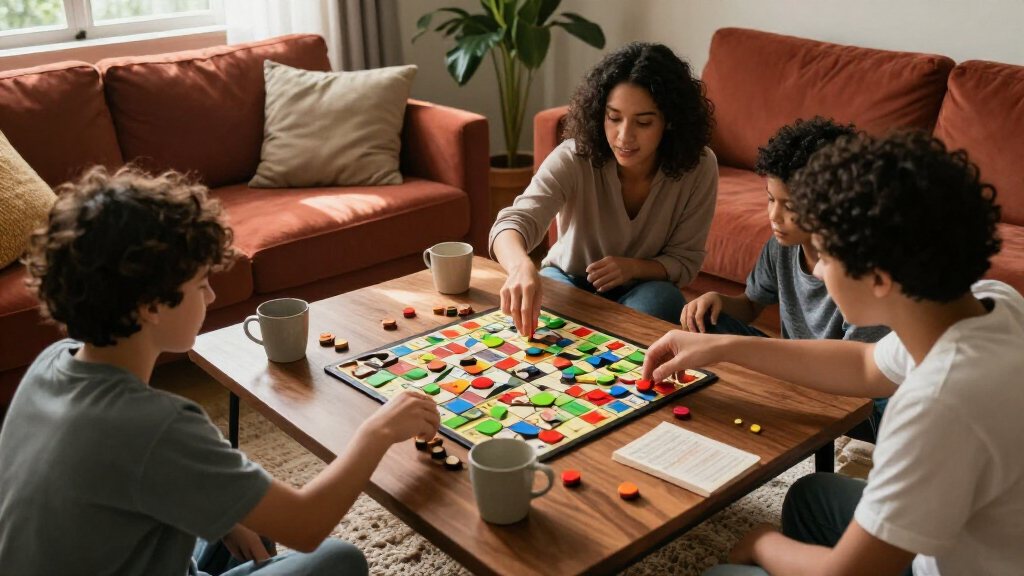
I ranked these games for how well they can bring a family group together: ease of learning, age and player flexibility, pace, interaction, and the kinds of skills or patience each game asks from players. I also weighed how much the game’s format can accommodate different comfort levels, such as word play, drawing, planning, or luck. A wide player range helps, but it does not automatically make a game a good fit if turns run long or the central activity excludes some family members.
UNO ranks first because its broad player count and quick rules make it adaptable to more family nights. Pictionary and Sequence follow for their distinct group and strategy experiences. Yahtzee, Trouble, and Sorry! lean on simple, luck-forward play; Scrabble and Tapple are more rewarding for word-focused groups. The Game of Life and Monopoly offer a more involved session, which gives them a narrower fit for families with limited time or younger players. These rankings reflect family-night usefulness, not a claim that one style suits every household.
| board games for family night | Edition | Model number |
|---|---|---|
| Hasbro Gaming Yahtzee Dice Gam | — | — |
| Hasbro Gaming Trouble Board Ga | Classic Edition | A5064 |
| Hasbro Gaming Scrabble Classic | Standard Edition | F4204 |
| Tapple Family Word Game | — | — |
| Sequence | — | — |
| The Game of Life Board Game fo | Standard Edition | F0800 |
| Pictionary Board Game for Ages | Special Edition | GMT97 |
| Monopoly Game | — | — |
| Sorry! Classic Family Board Ga | Standard | — |
| Mattel Games UNO Card Game | — | GDJ85 |
Factors to Consider When Choosing Board Games For Family Night
Choosing a family game is less about finding one that everyone likes equally and more about avoiding a mismatch between the group and the game’s demands. These factors can help you pick a format your family will actually want to bring out again.
Match the Game to Your Group’s Ages
Age labels are a starting point, but reading ability, turn-taking, and comfort with competition matter just as much. A younger player may follow simple luck-based moves before they can enjoy spelling or strategic choices. Mixed-age groups can also create a large skill gap, especially when the game rewards vocabulary or planning. Before choosing, ask whether adults can help without playing the younger person’s turn for them. A game with short turns may make that support feel natural. Avoid picking only by the youngest player’s age if the rest of the group will lose interest.
Decide How Much Time You Have
Family night can mean a quick activity after dinner or a long session with room for a slow build. The mistake is assuming a game’s listed age or player count tells you how long it will hold attention. Long games can be satisfying when everyone wants an ongoing contest, but they are harder to pause if someone needs to leave. Short rounds make it easier to rotate players or stop on a natural break. If your schedule varies, choose a game that still feels complete after one round. Save longer formats for evenings when the group has agreed to stay with the game.
Choose the Right Kind of Interaction
Some families enjoy teams, shared guesses, and noisy moments; others prefer everyone to focus on their own turn. These styles can change the feel of the whole evening, even when the rules are simple. Team games may help less confident players contribute alongside an adult, while direct competition can make small wins and setbacks more visible. Think about whether your group likes performing, bluffing, word challenges, or quiet planning. A mismatch can make a game feel stressful instead of social. Ask what kind of interaction people are in the mood for before setting up.
Account for Reading, Drawing, and Speed
Many family games ask for a particular skill beyond understanding the rules. Reading-heavy play can leave younger children dependent on help, while timed word games may favor quick recall. Drawing challenges can be funny for some players and uncomfortable for others. A family can soften these gaps with teams or house rules, but those changes work best when everyone agrees before play begins. Consider whether the core challenge is something each person can enjoy, even if they are not the strongest at it. The best fit gives every player a way to participate without needing to excel.
Balance Luck Against Strategy
Luck can keep a game accessible because new players may stay competitive without mastering a complex system. The tradeoff is that careful choices may not always lead to a win, which can frustrate players who want control. Strategy-focused play gives decisions more weight but may reward experienced players more than newcomers. For a mixed group, a modest amount of planning alongside unpredictable outcomes can keep play engaging across skill levels. Think about whether your family values a fair contest or a surprising shared experience more. That preference matters more than choosing the game with the most rules.
Check Player Count and Setup Friction
A game that works beautifully with four may feel different with two or six, so check the intended group size before buying. Larger groups can mean more conversation, but also longer waits between turns. Setup, sorting pieces, and putting the game away affect whether it gets used on an ordinary weeknight. Small components can be harder to manage around young children or crowded tables. Consider where you will play and who will handle the pieces afterward. A game that is easy to start and store may earn more repeat nights than a more elaborate one.
Frequently Asked Questions
Which game in this roundup works for the widest range of family sizes?
UNO accommodates the largest stated group in this selection, with play for 2–10 people. That makes it a flexible option when relatives or friends join unexpectedly. A high player count can still mean a longer wait between turns, so it may feel less brisk with a full group. For a smaller gathering that wants shared team activity, Pictionary may be a better fit. Choose based on how many people will play regularly, not just the biggest possible gathering.
What should I choose if younger children are playing with adults?
Look for rules that are easy to follow and turns that do not require advanced reading or word knowledge. Trouble and Sorry! lean on straightforward movement and luck, which can help reduce skill gaps. UNO also has simple core play, though younger players may need help with card effects at first. Scrabble and Tapple ask for word skills, so they can be harder to balance across ages. Teams or a relaxed house rule can help, but check that older players still find the game engaging.
Which options are better when our family has limited time?
UNO, Yahtzee, Trouble, and Sorry! are easier to approach as shorter, repeatable sessions than Monopoly or The Game of Life. Actual play time depends on the group, so agree on a stopping point before starting if your evening has a firm end. Quick rounds also make it simpler to let someone join or leave between games. If your family likes deeper play, save a longer game for a night with fewer schedule constraints. The right choice is the one that fits the time you have without making the ending feel rushed.
Is a word game a good choice for a family with mixed reading levels?
It can be, if the group enjoys language challenges and is comfortable adjusting teams or offering help. Scrabble gives players time to consider their moves, while Tapple adds pressure to answer quickly, which can magnify differences in speed and vocabulary. Neither format is automatically fair across ages. Pairing younger players with adults can make participation more balanced, but avoid turning help into taking over. If reading confidence varies widely, a drawing, card, or luck-based game may be a smoother choice for that evening.
Should I choose a longer game for a more memorable family night?
Longer games can create a sustained shared contest, but extra time alone does not make a night more enjoyable. Monopoly and The Game of Life are better suited to groups that want a larger commitment and can stay engaged through extended turns. A quick game can be more memorable if everyone gets to participate and the pace suits the group. Consider attention spans, bedtime, and whether players like ongoing strategic decisions. If you are unsure, start with a shorter format and choose a longer game for a night when everyone asks for one.
Conclusion
UNO is my best overall pick for families that need flexible group size and an easy entry point. For value in repeatable, low-fuss play, I’d look first at Yahtzee; its dice format makes it simple to start a fresh round. Pictionary is my premium-style pick for families who want a more expressive, team-centered event, while Trouble is my beginner pick for players who benefit from simple turns and luck-driven movement. Choose Sequence if your group wants more planning, Scrabble or Tapple for word play, and Monopoly or The Game of Life when everyone is ready to commit more time. Match the game to the people and evening you have, and the choice becomes much clearer.
Evergreen bestsellers Picks

Dyson V15 Detect Cordless Vacuum

Ninja CREAMi Scoop & Swirl 13-in-1 Ice Cream and Soft Serve Maker (NC701)

Vitamix 5200 Blender with 64 oz Container, Black
As an affiliate, we earn on qualifying purchases.