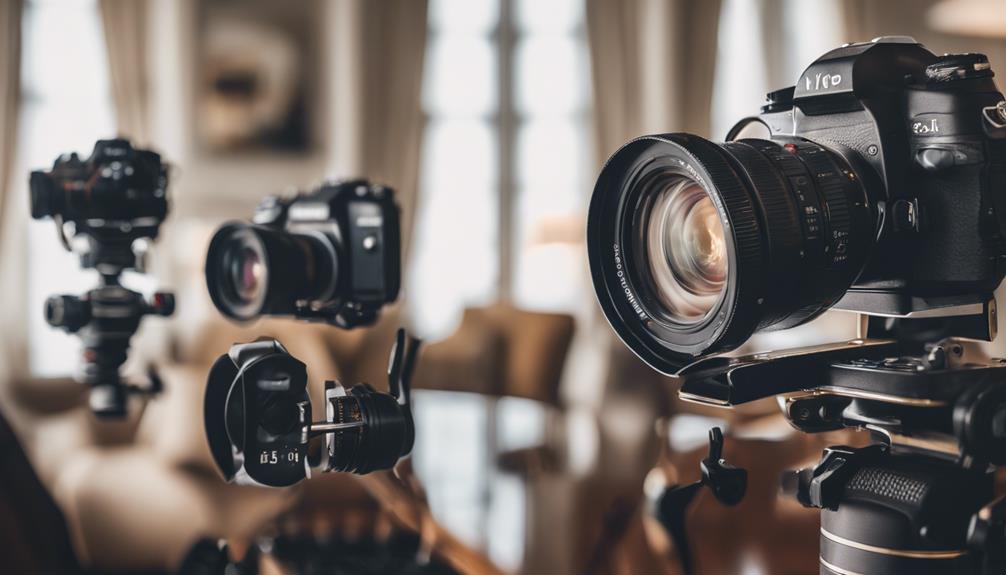

For interior real estate photos that let viewers look around a room, I’d start with two 360-degree cameras: the Ricoh Theta Z1 for detailed stills and the Theta SC2 for Business for dedicated room-capture features. The Z1 pairs 23MP images with two large 1-inch sensors and HDR modes, while the SC2 offers 5.2K 360° stills, Room Mode, and Time Shift Shooting. The choice is less about a conventional wide-angle photograph and more about the kind of tour you plan to publish: higher image detail and internal storage on the Z1, or real-estate-oriented capture tools on the SC2. Both use fixed-focus 360° optics, so neither replaces a standard interchangeable-lens camera for carefully composed, straight-line property photography.

Get furniture and decor delivered free with Prime
- Fast, free delivery on millions of items
- Prime Video, Amazon Music and more included
- Member-only deals all year
Complete the kit


Key Takeaways
- The Ricoh Theta Z1 is my pick for more detailed 360° stills, thanks to its 23MP output and two 1-inch back-illuminated sensors.
- The Theta SC2 for Business has specific room-capture tools, including Room Mode for interiors with varying brightness.
- Choose the Z1 when you want 51GB of built-in storage; choose the SC2 if its OLED status display and Time Shift Shooting better match your workflow.
- Both cameras capture the entire room in 360°, but their fixed-focus lenses make them different tools from a conventional real-estate camera and wide-angle lens.
- The Z1 leads on sensor size and still-image resolution, while the SC2’s case rests on purpose-built interior features rather than larger sensors.
| Ricoh Theta Z1 51GB 360° Camera |  | Best Overall for Detailed 360° Interior Stills | Still image resolution: 23MP, approximately 6720 × 3360 | Image sensors: Two 1-inch back-illuminated CMOS sensors | Video: 3840 × 1920 at 30 fps | VIEW ON AMAZON | See Our Full Breakdown |
| Ricoh Theta SC2 for Business 360° Camera |  | Best for Purpose-Built Interior Capture | Still image resolution: 5.2K 360° | Video resolution: 4K 360° | Sensor type: CMOS | VIEW ON AMAZON | See Our Full Breakdown |
| camera for interior real estate photo | Still image resolution | Image stabilization | Connectivity | Image sensors |
|---|---|---|---|---|
| Ricoh Theta Z1 51GB 360° Camer | 23MP, approximately 6720 × 3360 | 3-axis rotation correction | USB 3.0 Type-C and high-speed wireless transfer | Two 1-inch back-illuminated CMOS sensors |
| Ricoh Theta SC2 for Business 3 | 5.2K 360° | Hybrid | USB and 802.11ac | — |
More Details on Our Top Picks
Ricoh Theta Z1 51GB 360° Camera
The Ricoh Theta Z1 takes the lead for buyers whose priority is image detail in a 360° property tour. Its two 1-inch back-illuminated CMOS sensors and 23MP still output give it the strongest still-image specification in this lineup. That advantage matters when a viewer zooms into a virtual tour to inspect room features, rather than simply glancing around the space. HDR shooting also gives property photographers an exposure option for interiors where bright windows sit alongside darker areas.
Compared with the SC2 for Business, the Z1 is the more imaging-led choice: it offers a higher stated still resolution and larger sensors, while the SC2 brings dedicated Room Mode and Time Shift Shooting. The Z1 does not list an equivalent room mode, so a buyer who values a purpose-built interior workflow may prefer the SC2’s targeted controls. For a shoot where detail and HDR options carry greater weight, I’d favor the Z1.
The practical package is strong for moving between rooms. 51GB of internal storage means the supplied specification identifies substantial built-in capacity, avoiding dependence on a compatible memory card for recording. The magnesium alloy body and 3-axis rotation correction add to its appeal for a camera that may be repositioned across a property. Its 4K-equivalent video is suitable for 360° clips, though the stated 3840 × 1920 resolution at 30 fps is not a reason to choose it over the SC2, which also records 4K 360° video.
There are limits. The listing does not specify battery life or whether removable storage is supported, so I would check those details against the intended shoot length and backup routine before buying. And the Z1 remains a fixed-focus 360° camera, not a flexible system for conventional wide-angle listing images. Choose it for detailed immersive stills; skip it if your main need is a standard camera with lens choice, or if SC2-specific room controls matter more than sensor and resolution advantages.
Pros:- 23MP 360° still images from two 1-inch back-illuminated sensors
- HDR imaging gives another option for rooms with bright windows and darker areas
- 51GB of built-in storage is specified
- 3-axis stabilization supports smoother 360° video capture
Cons:- The supplied product details do not specify battery life
- Removable storage support is not specified
- Its fixed-focus 360° format does not replace a conventional wide-angle camera
Best for: Real estate photographers who prioritize detailed 360° still images, want HDR shooting options, and value 51GB of internal storage for property tours.
Not ideal for: Photographers who need interchangeable lenses, a conventional wide-angle workflow, or clearly specified battery and removable-storage details before planning long shoots.
- Still image resolution:23MP, approximately 6720 × 3360
- Image sensors:Two 1-inch back-illuminated CMOS sensors
- Video:3840 × 1920 at 30 fps
- Internal storage:51GB
- Image stabilization:3-axis rotation correction
- Shooting features:HDR and interval shooting
- Aperture settings:F2.1, F3.5, or F5.6
- Connectivity:USB 3.0 Type-C and high-speed wireless transfer
Our verdict“I’d choose the Theta Z1 for the strongest listed combination of 360° still detail, larger sensors, HDR options, and built-in storage.”
Ricoh Theta SC2 for Business 360° Camera
The Theta SC2 for Business earns its place by focusing on the practical demands of interiors. Its Room Mode is designed for spaces with varying brightness, a useful match for rooms that combine window light with shadowed corners. The camera records 5.2K 360° still images and 4K 360° video, and its OLED display shows settings, connection status, and battery life at a glance. For a property photographer moving quickly between rooms, those job-specific touches may be more useful than a headline sensor advantage.
Against the Z1, the SC2 is the more specialized pick, not the higher-spec still camera. The Z1 lists 23MP resolution and two 1-inch sensors, plus HDR shooting and 51GB of built-in storage. The SC2 instead brings the real-estate-oriented Room Mode and Time Shift Shooting, which can keep the photographer from appearing in the finished 360° image. That can make the SC2 appealing for clean virtual tours, though the provided specifications do not give an equivalent megapixel figure for its 5.2K stills, making direct still-detail comparison less clear.
Time Shift Shooting addresses a visible annoyance of spherical photography: the camera can capture at different times to reduce the photographer’s presence in the image. Hybrid stabilization also supports smoother footage, while USB and 802.11ac connectivity give options for transfer and connection. The 0.5-inch OLED is a small but practical difference from the Z1’s listed feature set because it provides on-camera feedback rather than leaving every status check to a connected device.
The tradeoffs are worth weighing. The SC2 is not water resistant, and the supplied details say a compatible memory card is required for recording, so storage planning is part of the setup. Its fixed-focus lens also limits it to the intended 360° approach; it is not a substitute for a lens-based camera when you need conventional architectural compositions. I’d choose it over the Z1 when Room Mode, photographer removal, and visible status information take priority. If maximum stated still resolution and known internal capacity matter more, the Z1 is the stronger match.
Pros:- Room Mode is designed for real estate and interiors with varying brightness
- 5.2K 360° stills and 4K 360° video are specified
- Time Shift Shooting can keep the photographer out of the frame
- OLED display shows settings, connection status, and battery life
Cons:- Not water resistant
- Requires a compatible memory card for recording
- The supplied specifications do not state a megapixel figure for still images
Best for: Agents and property photographers who want a 360° camera with a room-oriented exposure mode, photographer-removal capture, and an OLED status display.
Not ideal for: Buyers who prioritize the highest stated still-image resolution, want documented built-in storage, or need a water-resistant camera.
- Still image resolution:5.2K 360°
- Video resolution:4K 360°
- Sensor type:CMOS
- Interior feature:Room Mode
- Photographer-removal feature:Time Shift Shooting
- Image stabilization:Hybrid
- Display:0.5-inch OLED
- Connectivity:USB and 802.11ac
- Focus and storage:Fixed focus; compatible memory card required for recording
Our verdict“I’d pick the SC2 for its real-estate-specific room controls and Time Shift Shooting, not as the lineup leader for documented sensor and still-resolution specifications.”

How We Picked
I ranked these cameras for a specific job: creating 360° interior images and walkthrough material for real estate listings. For that use, I weighed still-image detail, how each model handles rooms with mixed brightness, and the practical steps involved in a shoot. Storage, status feedback, stabilization, and features that can keep the photographer out of a spherical image also matter when a camera has to move efficiently from room to room.
The Z1 ranks first because its two 1-inch back-illuminated sensors, 23MP still output, HDR modes, and 51GB of internal storage give it the stronger overall imaging and workflow case on the supplied specifications. The SC2 for Business ranks second, but its Room Mode and Time Shift Shooting make it a more targeted option for property interiors. I have not treated video or audio features as substitutes for still-photo quality: they matter most to agents who also publish virtual tours. Neither pick is a conventional camera-and-wide-angle-lens kit, and that limitation is part of the comparison.
| camera for interior real estate photo | Connectivity |
|---|---|
| Ricoh Theta Z1 51GB 360° Camer | USB 3.0 Type-C and high-speed wireless transfer |
| Ricoh Theta SC2 for Business 3 | USB and 802.11ac |
Factors to Consider When Choosing Camera For Interior Real Estate Photos
For interior real estate, the first decision is whether you need a 360° virtual-tour camera or a conventional camera for composed listing photos. Both Ricoh options here capture a full spherical view, making them useful for immersive room tours. They are not interchangeable-lens systems, so the best choice depends on how you want viewers to experience the property.
360° tours versus conventional listing photos
A 360° camera records the space around its position, so viewers can explore a room by panning through a tour. That makes it useful for conveying layout and continuity between rooms. A conventional camera with an appropriate wide-angle lens instead gives the photographer more control over framing, perspective, and individual still compositions. I’d use these Ricoh cameras when immersive navigation through a property is the goal, not as the only camera for every listing deliverable.
Choose image detail or room-specific controls
The Z1’s stated strengths are its 23MP still images, dual 1-inch sensors, and HDR mode. Those specifications give it the clearer case when still-image detail is the main selection factor. The SC2’s Room Mode is built around interior capture with varying brightness, and Time Shift Shooting can reduce the photographer’s appearance in a tour. Decide which problem you most want the camera to solve: the Z1 favors imaging specifications, while the SC2 emphasizes job-specific features.
Plan for storage and shoot duration
The Z1 lists 51GB of internal storage, an explicit capacity that can simplify planning across multiple rooms. The SC2 listing specifies a compatible memory card is required for recording, so buyers should account for card choice and available capacity. The supplied Z1 information does not state battery life, and the SC2 lists battery status on its OLED display without giving a runtime figure. For either model, match your accessories and charging plan to the number of properties and rooms you expect to capture.
Treat video and stabilization as supporting features
Both cameras offer 360° video: the Z1 records at 3840 × 1920 and 30 fps, while the SC2 is described as recording 4K 360° video. The Z1 lists 3-axis rotation correction; the SC2 lists hybrid stabilization. These capabilities can support walkthrough clips, but buyers focused on still photos should put image detail and room exposure ahead of video labels. The Z1 also lists four-channel spatial audio, which may matter when a tour includes sound, but it is not a deciding factor for silent property stills.
Check the practical limitations before buying
Neither listing describes interchangeable lenses, so don’t expect either camera to cover conventional architectural photography by itself. The SC2 is explicitly not water resistant, which calls for care during transport and outdoor transitions. For the Z1, battery life and removable-storage support are not specified in the supplied details. I’d verify any missing operational information that affects a planned shoot, especially when the camera will be used across several properties in one session.
Frequently Asked Questions
Which Ricoh Theta is better for interior real estate photos?
I’d choose the Theta Z1 when detailed 360° stills are the priority, since it lists 23MP images and two 1-inch sensors. I’d choose the SC2 for Business when Room Mode and Time Shift Shooting are more useful to the workflow. Neither is a conventional wide-angle camera, so the right pick depends on whether the listing needs immersive spherical tours or standard composed photographs.
Is a 360° camera enough for a property listing?
A 360° camera can provide an immersive view of each room and help viewers understand how spaces connect. It does not offer the same framing choices as a conventional camera with a wide-angle lens, so I would treat it as a tool for virtual tours rather than a complete replacement for all listing photography. A combined workflow may suit agents who need both room exploration and carefully composed stills.
What is the main difference between the Z1 and the SC2 for Business?
The Z1’s listed advantages center on image hardware and capacity: two 1-inch back-illuminated sensors, 23MP stills, HDR, and 51GB of internal storage. The SC2 stands out for room-oriented features, including Room Mode, Time Shift Shooting, and an OLED status display. In short, the Z1 has the stronger documented still-image specification, while the SC2 offers more explicitly property-focused capture tools.
Do these cameras handle rooms with bright windows and darker corners?
The SC2’s Room Mode is described as helping capture real estate interiors across varying brightness levels. The Z1 lists HDR imaging, which gives another option for scenes with a wide range of light. Those features can support challenging interiors, but the supplied information does not establish identical results across both cameras, so I would select based on the mode that fits your workflow and review sample images for the type of property you photograph.
Which camera is easier to plan storage for?
The Z1 is simpler to plan around on the supplied specifications because it lists 51GB of internal storage. The SC2 requires a compatible memory card for recording, so you need to select and carry appropriate media. If you prefer built-in capacity, the Z1 has the clearer advantage; if you already manage memory cards as part of each shoot, the SC2’s requirement may fit your routine.
Conclusion
For photographers who want the most detailed documented 360° stills and built-in storage, I recommend the Ricoh Theta Z1. For agents who value Room Mode, Time Shift Shooting, and an OLED status display, the Theta SC2 for Business is the more targeted interior tool. If your deliverables rely mainly on conventional, composed property photographs rather than virtual tours, I would choose a standard camera and suitable wide-angle lens instead of treating either 360° model as a full replacement.
Halloween Picks

Govee Outdoor Halloween Projector Light, 3D Dynamic Visual Holiday Decor

12.2 ft Halloween Inflatable Outdoor Decoration – Giant Pumpkin

Kalolary 11 ft Halloween Inflatable Archway Ghost House Tunnel
As an affiliate, we earn on qualifying purchases.