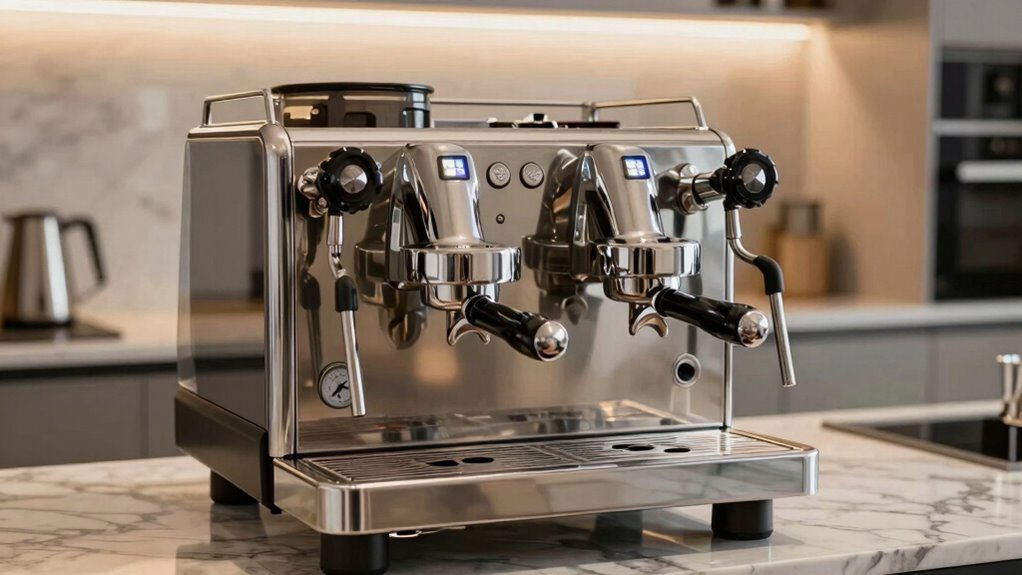
The Breville Oracle Dual Boiler is my best overall pick for a prosumer dual boiler espresso machine because its more assisted workflow suits buyers who want espresso and milk drinks without managing every step manually. For hands-on control, I’d also look at the Rancilio Silvia Pro X; the Rocket Espresso R58 Tune is a premium option for buyers drawn to a separate control interface and traditional setup. Across this lineup, the main tradeoff is between automation and hands-on control, with grinder integration, footprint, and maintenance adding further differences. A dual boiler can brew and steam at once, but it does not by itself guarantee easier dialing-in or better coffee. Read on for the full comparison and guidance on which setup matches your routine.

Get furniture and decor delivered free with Prime
- Fast, free delivery on millions of items
- Prime Video, Amazon Music and more included
- Member-only deals all year
Complete the kit


Key Takeaways
- The Breville Oracle is my best overall pick for buyers who want an assisted espresso workflow, while the Silvia Pro X better suits people who want more direct control.
- Grinder integration is a convenience tradeoff, not an automatic upgrade. The Chefman, Gevi, and Meraki combine functions, but buyers who already own a capable grinder may prefer a standalone machine.
- The two Diletta Alto listings target distinct needs. The black version specifies an adjustable OPV in addition to PID and a shot timer, a useful distinction for buyers focused on pressure setup.
- Premium pricing should buy a workflow or build advantage that matters to you. The Rocket R58 Tune is a premium-oriented choice, but its appeal depends on whether its control approach suits your routine.
- Several listings are closely related rather than clearly separate concepts. The two Gevi built-in-grinder entries and the two Diletta Alto versions call for checking exact specifications before choosing.
| Tuni E2 Gen3 Dual Boiler Espresso Machine with Super+ Steam Power, Ivory |  | Best for Steam Control | Operation: Semi-automatic | Boiler system: Dual boiler | Brew head: 58 mm | VIEW ON AMAZON | See Our Full Breakdown |
| AMZCHEF Dual-Boiler Espresso Machine with Automatic Milk Frother |  | Best for Assisted Milk Drinks | Operation: Semi-automatic | Heating system: Dual boiler | Portafilter: 58 mm | VIEW ON AMAZON | See Our Full Breakdown |
| Chefman Crema Deluxe Espresso Machine with Double Boiler and 30-Setting Grinder |  | Best All-in-One Grinder Setup | Operation: Semi-automatic | Boiler: Double boiler | Grinder: Conical burr, 30 settings | VIEW ON AMAZON | See Our Full Breakdown |
| Diletta Alto Dual Boiler Espresso Machine with PID and Shot Timer |  | Best for Manual Barista Control | Boiler system: Dual boiler | Temperature control: PID for brew and steam | Portafilter: 58 mm | VIEW ON AMAZON | See Our Full Breakdown |
| Gevi Dual Boiler Espresso Machine with Built-In Grinder |  | Best Compact Built-In Grinder Pick | Operation: Semi-automatic | Boiler system: Independent dual boilers | Grinder: Built-in, 31 grind levels | VIEW ON AMAZON | See Our Full Breakdown |
| Rocket Espresso R58 Tune Dual Boiler Espresso Machine, Stainless Steel |  | Best for Plumb-In Prosumer Setups | Brew boiler capacity: 0.58 L | Steam boiler capacity: 1.8 L | Pump: Rotary | VIEW ON AMAZON | See Our Full Breakdown |
| Breville Oracle Dual Boiler Espresso Machine, Stainless Steel |  | Best for Guided, Grinder-Included Convenience | Operation mode: Semi-automatic | Boilers: Dual stainless-steel boilers | Temperature control: PID with triple-heating system | VIEW ON AMAZON | See Our Full Breakdown |
| Meraki Dual Boiler Espresso Machine with Grinder and Built-In Scales |  | Best for Integrated Dose-and-Yield Tracking | Brew boiler capacity: 350 ml | Steam boiler capacity: 550 ml | Grinder: 45 settings with micro-adjustment | VIEW ON AMAZON | See Our Full Breakdown |
| Breville Dynamic Duo Espresso Machine Bundle with Dual Boiler and Smart Grinder Pro |  | Best Grinder-and-Machine Bundle | Model: BEP920BSS | Boiler system: Dual boiler | Grinder: Precision conical burr grinder with automatic grind-and-dose | VIEW ON AMAZON | See Our Full Breakdown |
| Rancilio Silvia Pro X Espresso Machine, Black |  | Best Compact Manual-Control Pick | Brew boiler capacity: 300 ml | Steam boiler capacity: 1 L | Water tank capacity: 2 L | VIEW ON AMAZON | See Our Full Breakdown |
| Diletta Alto Dual Boiler Espresso Machine with PID, Shot Timer, and Adjustable OPV (Black) |  | Best for Hands-On Control | Boiler type: Dual boiler | Portafilter size: 58 mm | Capacity: 3 liters | VIEW ON AMAZON | See Our Full Breakdown |
| Breville BES920XL Dual Boiler Espresso Machine, Brushed Stainless Steel |  | Best for Programmable Convenience | Boiler configuration: Dual stainless steel boilers | Temperature control: PID, ±2°F | Portafilter size: 58 mm | VIEW ON AMAZON | See Our Full Breakdown |
| Gevi Dual Boiler Espresso Machine with Built-In Burr Grinder |  | Best for an All-in-One Setup | Operation mode: Semi-automatic | Coffee input: Ground coffee and whole beans | Grind settings: 31 levels | VIEW ON AMAZON | See Our Full Breakdown |
| dual boiler espresso machine prosumer | Power | Dimensions | Temperature control | Portafilter |
|---|---|---|---|---|
| Tuni E2 Gen3 Dual Boiler Espre | 1500 watts | — | PID + NTC | — |
| AMZCHEF Dual-Boiler Espresso M | — | 16.4 × 10 × 14.4 inches (D × W × H) | — | 58 mm |
| Chefman Crema Deluxe Espresso | 1500 watts | — | — | 58 mm |
| Diletta Alto Dual Boiler Espre | 1400 watts | 19.75 × 12 × 14.5 inches (D × W × H) | PID for brew and steam | 58 mm |
| Gevi Dual Boiler Espresso Mach | 1500 watts | 13.8 × 12.6 × 16.5 inches | NTC and PID | 58 mm stainless steel |
| Rocket Espresso R58 Tune Dual | 1600 W, 120 V | 19 × 16 × 16.8 in (D × W × H) | — | — |
| Breville Oracle Dual Boiler Es | — | — | PID with triple-heating system | — |
| Meraki Dual Boiler Espresso Ma | 1600 W, 120 V | 14.57 × 14.57 × 16.33 in (D × W × H) | — | 58 mm, E61-compatible |
| Breville Dynamic Duo Espresso | — | — | PID | 58 mm; 22 g dose |
| Rancilio Silvia Pro X Espresso | 1000 W, 120 V | 16.5 × 10 × 15.2 in (D × W × H) | Dual PID | — |
| Diletta Alto Dual Boiler Espre | 1400 watts | 19.75 × 12 × 14.5 inches | — | — |
| Breville BES920XL Dual Boiler | 1700 W | 14.7 × 14.8 × 14.7 inches | PID, ±2°F | — |
| Gevi Dual Boiler Espresso Mach | — | 18.85 × 15.66 × 18.85 inches | — | 58 mm |
More Details on Our Top Picks
Tuni E2 Gen3 Dual Boiler Espresso Machine with Super+ Steam Power, Ivory
The Tuni E2 Gen3 is a flexible pick for home baristas who want to brew and steam at once but also adjust steam power to suit different milk drinks. Its dual boilers reduce the wait between pulling espresso and frothing, while PID and NTC temperature controls support more consistent brewing. Compared with the AMZCHEF, which adds a hands-free frothing station, the Tuni keeps milk preparation manual, giving the user more direct control but requiring more technique. Hot and cold brewing add range beyond a conventional espresso setup. The included baskets, pitcher, and dosing accessories make it ready for varied recipes, though the machine still relies on pre-ground coffee. Choose it for hands-on drink making, not for an all-in-one grinder or automated workflow.
Pros:- Dual boilers let brewing and steaming happen at the same time.
- PID and NTC controls support precise temperature management.
- Adjustable steam power gives users control over milk texture.
- Includes multiple baskets, a pitcher, a tamper, and cleaning accessories.
Cons:- Requires a separate grinder or pre-ground coffee.
- Manual preparation and steaming take practice and attention.
Best for: Home baristas who want adjustable steam power, simultaneous brewing and steaming, and accessories for experimenting with espresso and milk drinks.
Not ideal for: Buyers who want a built-in grinder or automated milk preparation, since it requires ground coffee and manual operation.
- Operation:Semi-automatic
- Boiler system:Dual boiler
- Brew head:58 mm
- Temperature control:PID + NTC
- Brewing functions:Hot and cold
- Power:1500 watts
- Pressure:20 bar
- Included pitcher:400 ml
- Color:Ivory
Our verdict“Choose the Tuni E2 Gen3 if hands-on milk control and hot-or-cold brewing matter more than built-in grinding or automated frothing.”
AMZCHEF Dual-Boiler Espresso Machine with Automatic Milk Frother
The AMZCHEF pairs a prosumer-style 58 mm portafilter and dual heating with a hands-free frothing station, making it the most assisted milk-drink option in this group. Separate brew and milk temperature settings, along with adjustable pre-infusion and extraction times, give users meaningful control over recipes without requiring them to steam every pitcher by hand. That makes it a different proposition from the Tuni E2 Gen3, whose adjustable steam power favors manual technique. The tradeoff is countertop space: at 16.4 inches deep, it needs more room than buyers may expect from a home machine. Its semi-automatic brewing still asks the user to handle the espresso workflow, so the automatic milk system does not make it a one-touch coffee maker.
Pros:- Dual heating supports brewing and milk preparation at the same time.
- Hands-free frothing station reduces the manual work of steaming.
- Adjustable brew temperature, milk temperature, pre-infusion, and extraction time.
- 58 mm portafilter supports a familiar prosumer-style workflow.
Cons:- The 16.4-inch depth takes considerable countertop space.
- Semi-automatic espresso preparation still requires user involvement.
Best for: Home users who make milk-based drinks often and want guided, hands-free frothing alongside adjustable brew and milk temperatures.
Not ideal for: Small-kitchen owners or buyers seeking a fully automatic espresso workflow; its footprint is substantial and espresso preparation remains hands-on.
- Operation:Semi-automatic
- Heating system:Dual boiler
- Portafilter:58 mm
- Regulated extraction pressure:9–12 bar
- Brew temperature range:190–205°F
- Milk temperature range:113–194°F
- Pre-infusion setting:0–30 seconds
- Dimensions:16.4 × 10 × 14.4 inches (D × W × H)
- Weight:24.4 pounds
Our verdict“Pick the AMZCHEF if assisted milk frothing is a priority and you have room for a relatively deep machine.”
Chefman Crema Deluxe Espresso Machine with Double Boiler and 30-Setting Grinder
The Chefman Crema Deluxe makes a strong case for buyers who want a grinder and dual-boiler workflow in one appliance. Its 30-setting conical burr grinder avoids the need to pair a separate grinder with the machine, while the double boiler allows espresso extraction and milk frothing at the same time. Compared with the Gevi, which offers 31 grind levels and a built-in grinder, the Chefman is distinguished by its 3-liter removable reservoir; that capacity can mean fewer refills during regular use. The tradeoff is less freedom to upgrade the grinder separately, and the provided information does not specify temperature-control features. Its 58 mm portafilter and included baskets suit a hands-on routine, but semi-automatic operation still requires dialing in and preparing each shot.
Pros:- Built-in conical burr grinder offers 30 grind settings.
- Double boiler supports brewing and frothing at the same time.
- Removable 3-liter reservoir reduces refill interruptions.
- Includes a 58 mm portafilter and single- and double-shot baskets.
Cons:- The integrated grinder cannot be upgraded independently of the machine.
- Temperature-control details are not specified in the provided product data.
- Semi-automatic preparation requires the user to manage each shot.
Best for: Home espresso drinkers who want a built-in grinder, a large removable water reservoir, and simultaneous espresso and milk preparation in one machine.
Not ideal for: Buyers who already own a preferred grinder or want to upgrade grinder and machine independently; its integrated setup limits that flexibility.
- Operation:Semi-automatic
- Boiler:Double boiler
- Grinder:Conical burr, 30 settings
- Portafilter:58 mm
- Water reservoir:3 liters, removable
- Pump pressure:15 bar
- Power:1500 watts
- Voltage:120 volts
- Warranty:1 year
Our verdict“Choose the Chefman if you want a single appliance with a built-in grinder and a roomy reservoir, rather than a modular espresso setup.”
Diletta Alto Dual Boiler Espresso Machine with PID and Shot Timer
The Diletta Alto is the most hands-on, traditional choice in this batch: it pairs dedicated brew and steam boilers with PID control, a shot timer, and an adjustable OPV. Those tools suit experienced users who want to tune pressure and track extraction, rather than rely on an integrated grinder or guided milk system. Compared with the AMZCHEF, the Alto offers more direct manual control but lacks hands-free frothing and adjustable brew-time settings. Its 22-minute brew warm-up also calls for planning, while its 40-pound weight and nearly 20-inch depth make it a poor fit for frequently rearranged or tight counters. The included bottomless portafilter and multiple baskets support a more involved workflow, but this machine rewards patience rather than convenience.
Pros:- Dedicated brew and steam boilers support simultaneous operation.
- PID controls and a shot timer aid repeatable manual brewing.
- Adjustable OPV allows brew-pressure customization.
- Includes a bottomless portafilter, multiple baskets, and a tamper.
Cons:- Brew warm-up takes 22 minutes.
- At 40 pounds and 19.75 inches deep, it is difficult to move and needs substantial counter space.
Best for: Experienced home baristas who value adjustable brew pressure, a shot timer, and a traditional manual workflow over automated features.
Not ideal for: Buyers who want quick startup, a compact machine, or built-in grinding; the Alto has a long warm-up and weighs 40 pounds.
- Boiler system:Dual boiler
- Temperature control:PID for brew and steam
- Portafilter:58 mm
- Capacity:3 liters
- Power:1400 watts
- Dimensions:19.75 × 12 × 14.5 inches (D × W × H)
- Weight:40 pounds
- Included portafilters:Double and bottomless
- Origin:Made in Milan, Italy
Our verdict“Choose the Diletta Alto if you want manual pressure and extraction control and can accommodate its slow warm-up and heavy build.”
Gevi Dual Boiler Espresso Machine with Built-In Grinder
The Gevi combines independent dual boilers with a built-in grinder offering 31 grind levels, putting it among the more space-conscious all-in-one choices in this selection. Its 13.8-inch width is narrower than the AMZCHEF’s 16.4-inch depth, although the Gevi still needs room for its grinder and is not a tiny appliance. Temperature control uses both NTC and PID, and the removable 2.8-liter tank and drip tray make routine cleaning easier. Compared with the Chefman Crema Deluxe, the Gevi offers one additional stated grind setting but a smaller reservoir. It keeps the process semi-automatic, so users still need to dose, prepare the portafilter, and manage milk steaming themselves.
Pros:- Independent boilers allow brewing and milk steaming at the same time.
- Built-in grinder provides 31 grind levels.
- NTC and PID temperature controls support brew consistency.
- Removable 2.8-liter tank and drip tray simplify cleaning.
Cons:- The built-in grinder makes the setup less modular than a separate grinder and machine.
- It still occupies countertop space despite its relatively narrow layout.
- Semi-automatic operation requires hands-on preparation.
Best for: Home users who want an integrated grinder and dual-boiler workflow in a relatively narrow machine, with adjustable grinding and removable cleaning parts.
Not ideal for: Buyers who want automated milk drinks, a fully automatic routine, or a machine that needs very little counter space.
- Operation:Semi-automatic
- Boiler system:Independent dual boilers
- Grinder:Built-in, 31 grind levels
- Portafilter:58 mm stainless steel
- Temperature control:NTC and PID
- Water tank:2.8 liters, removable
- Dimensions:13.8 × 12.6 × 16.5 inches
- Weight:15 pounds
- Power:1500 watts
Our verdict“Choose the Gevi if you want a relatively narrow dual-boiler machine with an integrated grinder and can accept a hands-on workflow.”
Rocket Espresso R58 Tune Dual Boiler Espresso Machine, Stainless Steel
The R58 Tune is the most plumbing-ready choice in this group: its rotary pump supports a direct water-line connection, while the separate 0.58 L brew and 1.8 L steam boilers let you pull shots and steam milk at once. Programmable 3-bar pre- and post-infusion gives experienced home baristas more control over how a puck is wetted and how extraction ends. Compared with the Rancilio Silvia Pro X, the Rocket offers a larger steam boiler and plumb-in capability, but it takes up more counter space and weighs 80 lb. The detachable PID touchscreen and scheduled auto-on add convenience, though this remains a substantial, hands-on machine rather than a compact, forgiving starter. Its 1600 W draw on 120 V power is another practical limit to check against your kitchen setup.
Pros:- Separate boilers support brewing and steaming at the same time.
- Rotary pump supports water-line plumbing and pressure ramps.
- Programmable 3-bar pre- and post-infusion enables more control over extraction.
- Detachable PID touchscreen and scheduled auto-on add setup flexibility.
Cons:- At 80 lb, it is difficult to move and needs a sturdy, planned location.
- Its 19-inch depth and 16-inch width demand substantial counter space.
- The 1600 W draw may be a constraint on a shared 120 V circuit.
Best for: Experienced home baristas planning a water-line-connected setup who want programmable infusion and strong simultaneous steaming.
Not ideal for: Buyers with a small counter, limited lifting help, or no suitable 120 V circuit; the 80 lb chassis and 1600 W draw call for planning.
- Brew boiler capacity:0.58 L
- Steam boiler capacity:1.8 L
- Pump:Rotary
- Infusion programming:3-bar pre- and post-infusion
- Power:1600 W, 120 V
- Dimensions:19 × 16 × 16.8 in (D × W × H)
- Weight:80 lb
- Material:Stainless steel
Our verdict“Choose the R58 Tune if plumbing flexibility and programmable infusion matter more to you than compact size and easy relocation.”
Breville Oracle Dual Boiler Espresso Machine, Stainless Steel
The Oracle suits buyers who want prosumer-style dual boilers without building a separate grinder-and-machine workflow. Its integrated Baratza grinder, auto dial-in adjustment, and hands-free MilQ microfoam reduce the number of steps between beans and milk drinks; the 5.7-inch touchscreen and Wi-Fi add guided operation. That convenience sets it apart from the Rancilio Silvia Pro X, which offers adjustable preinfusion and dual PID control but leaves grinding and milk technique more manual. The tradeoff is a larger, more feature-dependent machine: at 18 × 18 × 22.5 inches and 17.24 kg, it needs generous counter space, and its automation may feel limiting to buyers who want to manage every variable themselves. The smart features also create more controls to learn than a straightforward semi-automatic setup.
Pros:- Dual stainless-steel boilers support simultaneous extraction and steaming.
- Integrated Baratza grinder has 45 adjustable settings.
- Auto dial-in and PID temperature control support repeatable shots.
- Hands-free MilQ system and touchscreen simplify milk-drink preparation.
Cons:- Its 18 × 18 × 22.5-inch footprint is demanding for a small kitchen.
- The integrated grinder and automation offer less modularity than separate equipment.
- The many guided and connected features add a learning curve.
Best for: Busy home users who want dual-boiler drinks, integrated grinding, and automated milk texturing in one guided system.
Not ideal for: Manual-focused baristas who want separate equipment and direct control over grinding and milk preparation, or anyone short on counter space.
- Operation mode:Semi-automatic
- Boilers:Dual stainless-steel boilers
- Temperature control:PID with triple-heating system
- Grinder:Integrated Baratza precision burr grinder, 45 settings
- Interface:5.7-inch color touchscreen
- Connectivity:Wi-Fi
- Capacity:77 fl oz
- Dimensions and weight:18 × 18 × 22.5 in; 17.24 kg
Our verdict“Pick the Oracle if you want a highly assisted all-in-one dual-boiler workflow and have room for its large footprint.”
Meraki Dual Boiler Espresso Machine with Grinder and Built-In Scales
Meraki’s defining advantage is its combination of a built-in grinder and scales accurate to 0.2 g, which can help a methodical user track both dose and espresso yield without adding separate measuring gear. Independent boilers, PID control, preinfusion, and a heated grouphead aim to keep brewing steady while milk is prepared. Compared with the Breville Oracle, Meraki gives more emphasis to measured inputs and outputs than to automatic milk texturing and connected guidance. Its 45 grind settings with micro-adjustment also invite hands-on dialing in. The compromise is a comparatively compact boiler set—350 ml for brewing and 550 ml for steam—and the supplied information lists a one-cup capacity. Buyers who regularly make several milk drinks in succession may prefer a machine with more stated capacity; those who enjoy adjusting and recording recipes are a better match.
Pros:- Built-in scales measure dose and yield to within 0.2 g.
- Integrated grinder offers 45 marked settings with micro-adjustment.
- Independent boilers and PID control support simultaneous brewing and steaming.
- Heated grouphead, preinfusion, and 58 mm portafilter support controlled extraction.
Cons:- The listed boiler capacities are modest for frequent back-to-back milk drinks.
- Product information lists a one-cup capacity, which may not suit shared use.
- Numerous grinder and measurement adjustments take time to learn.
Best for: Recipe-focused home baristas who want an integrated grinder and precise dose-and-yield measurement in a semi-automatic dual-boiler machine.
Not ideal for: Households that routinely make multiple drinks back-to-back or buyers seeking a simple, minimally adjustable workflow.
- Brew boiler capacity:350 ml
- Steam boiler capacity:550 ml
- Grinder:45 settings with micro-adjustment
- Scale accuracy:Within 0.2 g
- Temperature and extraction features:PID control and preinfusion
- Portafilter:58 mm, E61-compatible
- Power:1600 W, 120 V
- Dimensions:14.57 × 14.57 × 16.33 in (D × W × H)
Our verdict“Choose Meraki if weighing dose and yield within an integrated dual-boiler setup matters more than high-volume drink making.”
Breville Dynamic Duo Espresso Machine Bundle with Dual Boiler and Smart Grinder Pro
The Dynamic Duo is a practical route into prosumer preparation for buyers who want a separate grinder and machine in one coordinated bundle. Its Smart Grinder Pro offers 60 settings, while the dual-boiler machine adds PID temperature control, low-pressure preinfusion, and 9-bar extraction. Volumetric or timed shot controls let you choose between repeatable programmed doses and a more hands-on approach. Compared with the Breville Oracle, this bundle keeps grinding separate and skips the Oracle’s automated milk texturing and touchscreen guidance, giving owners more independent control but more steps to manage. The tradeoff is a learning curve across the grinder and machine, and the supplied product data does not give dimensions or weight, making counter planning harder. It makes the most sense for buyers ready to dial in both components rather than seeking a highly automated routine.
Pros:- Dual boilers allow simultaneous espresso preparation and milk steaming.
- Included conical burr grinder has 60 settings and automatic grind-and-dose.
- PID temperature control and low-pressure preinfusion support controlled extraction.
- Volumetric, timed, and manual shot options accommodate different workflows.
Cons:- Managing grinder settings and machine controls can take practice.
- Unlike the Oracle, it does not include hands-free milk texturing or an integrated grinder.
- Product data does not specify dimensions or weight for counter planning.
Best for: Newer prosumer buyers who want a dual-boiler machine and capable separate grinder together, with room to learn manual dialing-in.
Not ideal for: Buyers who want automatic milk texturing, a guided touchscreen workflow, or clear size information before planning counter space.
- Model:BEP920BSS
- Boiler system:Dual boiler
- Grinder:Precision conical burr grinder with automatic grind-and-dose
- Grind settings:60
- Portafilter:58 mm; 22 g dose
- Extraction pressure:9 bar
- Temperature control:PID
- Shot controls:Volumetric, timed, or manual
Our verdict“Choose the Dynamic Duo if you want a separate grinder and dual-boiler machine as a coordinated starting setup and are willing to learn both.”
Rancilio Silvia Pro X Espresso Machine, Black
The Silvia Pro X is the most space-conscious machine here for buyers who want real dual-boiler capability without an integrated grinder or automated milk system. At 10 inches wide, it is much narrower than the Rocket Espresso R58 Tune, while retaining separate brew and steam boilers, dual PID controls, and adjustable low-pressure preinfusion. A built-in shot timer and programmable wake-up mode add practical help without replacing the barista’s control over preparation. Its 1-liter steam boiler is smaller than the Rocket’s 1.8-liter unit, so buyers making a run of milk drinks may favor the Rocket’s greater stated steam capacity and plumb-in option. The Silvia also needs more depth than its narrow width suggests: the listed specification is 16.5 inches, while the product description reportedly gives a different depth. Check the available space before choosing it.
Pros:- Separate brew and steam boilers support simultaneous drink preparation.
- Dual PID controls allow independent temperature management.
- Adjustable low-pressure preinfusion and shot timer aid manual shot control.
- Ten-inch width is notably narrower than the Rocket R58 Tune.
Cons:- The 1-liter steam boiler is smaller than the Rocket R58 Tune’s 1.8-liter boiler.
- Listed depth varies between product information, so counter fit needs checking.
- No grinder is included, unlike the Oracle and Dynamic Duo bundle.
Best for: Hands-on home baristas who need a narrow dual-boiler machine with dual PID control and adjustable preinfusion.
Not ideal for: Buyers who want an included grinder, automatic milk preparation, water-line plumbing, or a shallow machine for a tight counter.
- Brew boiler capacity:300 ml
- Steam boiler capacity:1 L
- Water tank capacity:2 L
- Temperature control:Dual PID
- Preinfusion:Adjustable low-pressure
- Power:1000 W, 120 V
- Dimensions:16.5 × 10 × 15.2 in (D × W × H)
- Operation mode and material:Semi-automatic; stainless steel
Our verdict“Pick the Silvia Pro X if you want narrow-width dual-boiler performance and manual control, and can accommodate its depth.”
Diletta Alto Dual Boiler Espresso Machine with PID, Shot Timer, and Adjustable OPV (Black)
The Alto suits prosumers who want separate brew and steam boilers without handing shot-making over to automation. Its PID controls and built-in shot timer put temperature and timing information in view, while the adjustable OPV gives experienced users another way to tune extraction. Compared with the Breville BES920XL, the Alto leans more toward manual operation and adjustment than programmable convenience. The included bottomless portafilter also makes it easier to observe puck preparation and diagnose channeling, though it asks for more skill than a standard spouted setup. That control comes with a 22-minute warm-up and a substantial 40-pound, 19.75-inch-long chassis. I’d choose it for deliberate, hands-on espresso routines, not for quick drinks with minimal setup.
Pros:- Dedicated brew and steam boilers support simultaneous extraction and milk steaming
- PID controls and a built-in shot timer aid repeatable, hands-on brewing
- Adjustable OPV and bottomless portafilter support pressure tuning and puck diagnosis
- Includes double and triple baskets plus backflushing accessories
Cons:- Listed brew warm-up time is 22 minutes
- Manual operation requires more attention and technique than the programmable Breville BES920XL
- Long, heavy chassis needs substantial counter space
Best for: Experienced home baristas who want separate boilers, manual control, and an adjustable OPV for dialing in espresso.
Not ideal for: Buyers who want fast startup, automated drink preparation, or a compact machine for a shallow counter.
- Boiler type:Dual boiler
- Portafilter size:58 mm
- Capacity:3 liters
- Power:1400 watts
- Voltage:120 volts
- Dimensions:19.75 × 12 × 14.5 inches
- Weight:40 pounds
- Warm-up time:22 minutes
- Operation:Manual
Our verdict“Choose the Alto if you value manual control and pressure adjustment more than quick warm-up or automated convenience.”
Breville BES920XL Dual Boiler Espresso Machine, Brushed Stainless Steel
The BES920XL is a strong fit for home baristas who want prosumer-style dual boilers with more guidance at the controls. Its programmable LCD and shot timer make routine shots easier to repeat, while PID regulation is specified to hold water temperature within ±2°F. Separate boilers let you brew and steam at once, so preparing milk drinks need not become a stop-and-wait process. Against the Diletta Alto, the Breville puts more emphasis on display-led settings and a larger water tank; the Alto offers an adjustable OPV and includes a bottomless portafilter, which may appeal more to tinkerers. The Breville still leaves grinding and milk texturing to you, and its manual steam wand takes practice. I’d pick it for accessible control, not for push-button drink making.
Pros:- Dual stainless steel boilers allow brewing and steaming at the same time
- PID temperature control is specified to regulate within ±2°F
- LCD, programmable settings, and shot timer support repeatable routines
- 84-ounce water tank reduces the need for frequent refills
Cons:- Requires ground coffee, so a separate grinder is needed
- Manual milk texturing takes practice
- Less suited to pressure-tuning enthusiasts than the Diletta Alto, which has an adjustable OPV
Best for: Home baristas who want programmable shot settings, a large water tank, and simultaneous brewing and steaming without moving to a fully manual prosumer setup.
Not ideal for: Buyers seeking a built-in grinder, automatic milk texturing, or the Alto’s adjustable OPV and bottomless portafilter in the box.
- Boiler configuration:Dual stainless steel boilers
- Temperature control:PID, ±2°F
- Portafilter size:58 mm
- Coffee dose:19–22 g
- Water tank capacity:84 oz
- Power:1700 W
- Dimensions:14.7 × 14.8 × 14.7 inches
- Weight:28.4 lb
- Warranty:2-year limited
Our verdict“Choose the BES920XL if programmable controls and a generous water tank matter more than built-in grinding or deeper manual pressure adjustment.”
Gevi Dual Boiler Espresso Machine with Built-In Burr Grinder
The Gevi takes a different route from the Diletta Alto and Breville BES920XL: it pairs espresso controls with a built-in burr grinder, so whole beans can go straight into the machine without a separate grinder taking up counter space. Its 31 grind settings, adjustable shot volume, and pre-infusion give beginners useful ways to shape a shot, while NTC and PID temperature control and a steam wand cover core espresso and milk-drink tasks. The tradeoff is that the supplied details do not specify the separate brew and steam boiler arrangement described for the Alto and Breville, so buyers focused on confirmed dual-boiler performance should compare carefully. At 18.85 inches in each listed dimension, it is not a small appliance, despite combining grinder and machine. I’d favor it for convenience, not for a proven compact footprint.
Pros:- Built-in grinder offers 31 grind settings for whole-bean use
- NTC and PID temperature control are included
- Pre-infusion and adjustable shot volume allow basic shot customization
- Includes a portafilter, filters, pitcher, tamper, and cleaning tool
Cons:- Provided product details do not specify separate brew and steam boiler configuration
- Listed dimensions of 18.85 × 15.66 × 18.85 inches call for considerable counter space
- A built-in grinder makes the machine less modular than pairing the Breville BES920XL with a separate grinder
Best for: Newer home espresso makers who want a grinder, adjustable grind settings, and basic shot customization in one appliance.
Not ideal for: Buyers who specifically require clearly documented separate brew and steam boilers, or who have limited counter depth and height.
- Operation mode:Semi-automatic
- Coffee input:Ground coffee and whole beans
- Grind settings:31 levels
- Portafilter:58 mm
- Special features:Adjustable shot volume, pre-infusion, auto shut-off, cup warmer
- Dimensions:18.85 × 15.66 × 18.85 inches
- Weight:15 lb
- Warranty:12 months with lifetime technical support
Our verdict“Choose the Gevi for an integrated grinder and approachable adjustments, but verify the boiler arrangement if dual-boiler performance is your priority.”

How We Picked
I ranked these machines around the needs of a prosumer home espresso workflow: stable brewing and steaming, meaningful control over extraction, practical usability, and a build that fits regular use. I also considered whether a machine integrates a grinder or other assistance, since convenience can save counter space while limiting upgrade flexibility. Maintenance demands, workflow complexity, and the role each machine fills matter alongside headline features.
The order favors machines that offer a clear fit for a broad range of home users, then distinguishes specialist choices by their strengths. Automation, control, and grinder integration do not suit every buyer, so no single feature automatically earns a higher rank. Where the supplied product names suggest overlapping versions, such as the Gevi and Diletta listings, I treat them as separate listings but advise checking exact configuration details rather than assuming they differ in unlisted ways. I do not infer performance claims from names alone.
Factors to Consider When Choosing Dual Boiler Espresso Machine Prosumer
Choosing a prosumer dual boiler involves more than deciding whether you want simultaneous brewing and steaming. I’d start with your everyday routine, then work through grinder plans, control preferences, space, and ownership demands. These choices can matter more than a long feature list.
Choose Your Level of Automation
Machines that automate or assist parts of preparation can shorten the learning curve and make repeated drinks less demanding. The tradeoff is that less manual involvement may also mean fewer opportunities to control each step yourself. Before paying for convenience, decide which tasks you genuinely want the machine to handle and which you enjoy doing. New espresso makers often mistake a dual boiler for a fully automatic workflow; it still takes good coffee, grinding, and adjustment to produce consistent shots. If you make milk drinks for several people, faster workflow may matter more than detailed manual control. If dialing in is part of the hobby, prioritize access to the controls you want.
Decide Whether to Buy a Machine With a Grinder
An integrated grinder can simplify a first setup and reduce the number of appliances on the counter. It also ties two important parts of the system together, so replacing or changing the grinder later may be less straightforward than upgrading a separate unit. Buyers who already own a grinder should avoid paying for duplicated equipment unless the integrated workflow offers a specific benefit. Check how the machine handles adjustment and cleaning, since grinder upkeep is part of regular ownership. A common mistake is to focus on the machine alone and leave too little of the budget or counter space for a suitable grinder. For a long-term setup, flexibility can be worth more than an all-in-one appearance.
Match Controls to Your Espresso Goals
Temperature control, shot timing, and pressure-related adjustment can help users repeat a recipe and diagnose changes in the cup. Those controls are useful only if you plan to learn what they do; extra settings can add complexity without improving your daily routine. Look for clear documentation and accessible controls, not just a long feature list. If you mainly want consistent milk drinks, a simpler interface may be easier to live with than a machine built around frequent experimentation. If you plan to refine recipes, prioritize control that supports repeatable adjustments. Avoid assuming that a named feature guarantees a particular result without checking the exact model specifications.
Plan for Counter Space and Daily Workflow
A dual boiler machine needs room not only for its body but also for cups, a grinder, milk, and the movements involved in making drinks. A compact footprint can be less useful if it leaves no convenient space for preparation or cleaning. Measure the counter, including clearance above the machine and access to the water reservoir or service points. Think about where you will place a knock box and whether the steam wand has room to move freely. Buyers sometimes compare machine dimensions but forget the accessories that make a prosumer setup workable. A tidy workflow can matter more than squeezing in the largest machine available.
Account for Cleaning and Long-Term Care
Regular backflushing, wiping the steam wand, and keeping the water system in good condition are part of owning a prosumer machine. An integrated grinder adds its own cleaning tasks, while more complex controls can make setup and troubleshooting less familiar. Check the manufacturer’s maintenance guidance and availability of routine service parts before buying. Water quality deserves attention because mineral buildup can affect operation and increase maintenance needs. Do not choose solely by how quickly a machine makes a drink; consider how much time you are willing to spend caring for it. A setup that fits your maintenance habits is more likely to stay enjoyable.
Spend More Only for a Specific Benefit
A premium machine makes sense when its build, workflow, or controls solve a need you can name. Paying more just because a model is positioned as prosumer may leave you with features you rarely use. Compare the complete setup, including grinder, water treatment, accessories, and available service, rather than judging the espresso machine in isolation. If you are still learning, a more assisted or straightforward machine may be a better match than an advanced model with many manual decisions. Experienced users may value fine control and serviceability more than convenience features. The best upgrade is the one that removes a real limitation in your current routine.
Frequently Asked Questions
Is a dual boiler machine worth choosing if I mostly drink straight espresso?
It can be, but the main advantage of two boilers is being able to brew and steam at the same time, which matters most when making milk drinks. For straight espresso, that simultaneous workflow may not justify the added size, complexity, or expense of a dual boiler. I’d give more weight to temperature control, grinder quality, and how easily you can repeat your preferred recipe. If you occasionally serve milk drinks, the flexibility may still be welcome. If milk is rarely part of your routine, compare simpler machines before committing.
Should I choose a built-in grinder or buy a separate grinder?
A built-in grinder can reduce counter clutter and make an initial setup easier, especially if you do not already own espresso equipment. A separate grinder is usually the more flexible route because you can change it without replacing the espresso machine. Consider how often you expect to adjust grind settings and whether grinder cleaning is easy on the model you are considering. If you already have a grinder you trust, an integrated option may duplicate equipment. Choose the all-in-one approach for convenience, not because integration alone promises better espresso.
Can a beginner handle a prosumer dual boiler machine?
Yes, but a dual boiler does not remove the need to learn dose, grind, and extraction. A machine with more assistance can make the routine less demanding, while a highly manual setup gives you more control but asks for more practice. Beginners should also budget time for learning and routine cleaning, not just the purchase itself. If you want to develop espresso skills, manual controls can be rewarding rather than a barrier. If you mainly want repeatable drinks with fewer decisions, favor a more guided workflow.
Do two listings of the same machine name mean the machines are identical?
Not always: a listing may identify a different finish, included feature, or configuration, and the product names alone do not settle the question. In this roundup, the two Diletta Alto listings differ by the black version’s stated adjustable OPV, while the Gevi names both describe a built-in grinder. Check the manufacturer’s exact model number, included accessories, and specification sheet before ordering. This is especially useful when listings use similar titles or omit details. Avoid assuming a feature is included unless the specific configuration states it.
What should I check before choosing a premium model like the Rocket R58 Tune?
Start by deciding whether its control approach, build, and workflow offer a real benefit over more assisted or straightforward options. Check the machine’s dimensions, power and water requirements, cleaning routine, and local service support before buying. Also compare the cost of a complete setup, including a grinder and any accessories you still need. A premium machine can suit an experienced enthusiast who values hands-on ownership, but it may be unnecessary for someone seeking a low-effort routine. Choose it for a specific fit, not for the premium label alone.
Conclusion
For most buyers, I’d choose the Breville Oracle as best overall when an assisted workflow matters, and the Breville Dynamic Duo as a value-minded bundle option for shoppers who want a machine and grinder in one package. The Rocket Espresso R58 Tune is my best premium pick for buyers who want a more enthusiast-oriented setup; the Oracle is also my best choice for beginners who prefer more workflow assistance. For hands-on control, compare the Rancilio Silvia Pro X with the Diletta Alto models, checking the exact OPV configuration. If saving counter space is the priority, consider an integrated-grinder option such as the Meraki, Gevi, or Chefman, but verify the specific model’s features and maintenance needs. Match the machine to your routine rather than buying the most feature-heavy option.