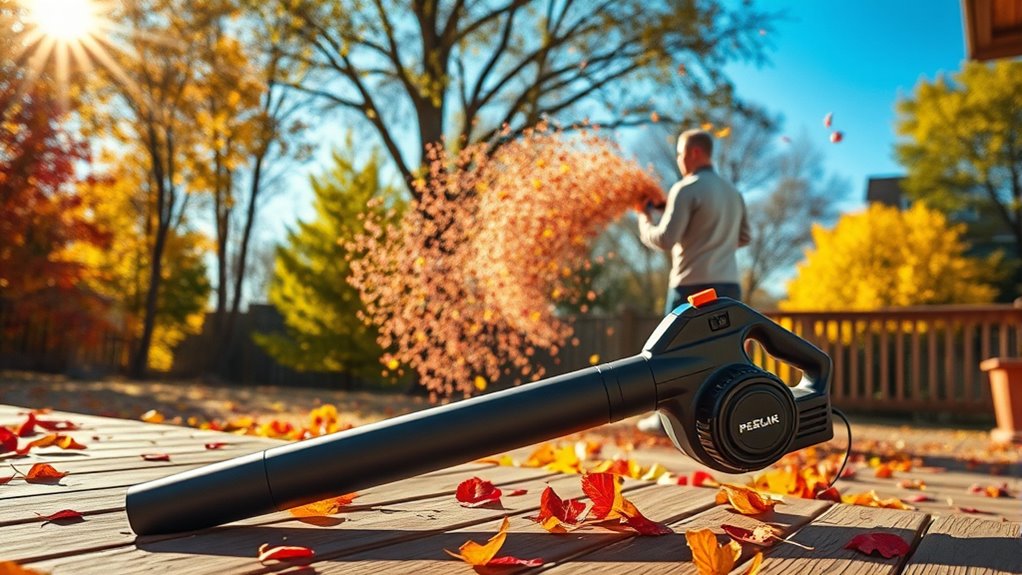

For quick cleanup of patios, driveways, and small yards, I’d choose the WORX 12 Amp Turbine WG520 as the best overall pick for its high-power corded design. The BLACK+DECKER LB700 is a simpler, lighter corded option, while the ZAGUOQI cordless blower stands out for battery-powered convenience. The main tradeoff is between uninterrupted corded power and cordless freedom with finite runtime; vacuum-mulcher models add leaf collection but take more setup. Read on for the full breakdown of all 13 options and how their designs fit different cleanup routines.

Get furniture and decor delivered free with Prime
- Fast, free delivery on millions of items
- Prime Video, Amazon Music and more included
- Member-only deals all year
Complete the kit

Key Takeaways
- The WORX WG520 is the best overall fit for fast, repeated cleanup when a cord is practical; its 12-amp turbine design gives it a more power-focused profile than the 7-amp handheld options.
- The BLACK+DECKER LB700 favors simplicity and light handling over the higher airflow claims of models such as the Grasstigon and WORX.
- Cordless convenience comes with a runtime question: several picks include two batteries, but buyers should still check charging time and whether the pack suits the size of their cleanup area.
- Vacuum-mulchers serve a different job from basic blowers: DUMOS and Heywork can collect and reduce leaves, but their extra modes and components add setup and storage needs.
- Specs need context. Airflow, air speed, motor power, and battery capacity describe different aspects of performance, so a single large number does not prove a model will be easiest for a particular yard.
| ZAGUOQI Cordless Handheld Leaf Blower with Two 4.0Ah Batteries |  | Best for Adjustable Cordless Cleanup | Power source: Battery powered | Voltage: 21 V | Motor: Brushless, up to 280,000 RPM | VIEW ON AMAZON | See Our Full Breakdown |
| Black+Decker LB700 Electric Leaf Blower – Corded Handheld, 7-Amp, 180 MPH, 180 CFM, Lightweight (4.4 lb) |  | Best for No-Battery Quick Jobs | Power source: Corded electric | Motor: 7 amp | Airflow: 180 CFM | VIEW ON AMAZON | See Our Full Breakdown |
| Cordless Leaf Blower, Handheld with 2 x 4.0 Ah Batteries – Orange |  | Best Lightweight Pick | Form factor: Handheld | Motor speed: 990,000 RPM | Air speed: 280 MPH | VIEW ON AMAZON | See Our Full Breakdown |
| Jenixy 7-Amp Corded Handheld Leaf Blower |  | Best for High Airflow Near an Outlet | Motor: 7 amp | Power source: AC corded, 120 V | Airflow: Up to 350 CFM | VIEW ON AMAZON | See Our Full Breakdown |
| Cordless Electric Leaf Blower with Two Batteries and Charger |  | Best for Nozzle Versatility | Power source: Battery powered | Voltage: 21 V | Airflow: Up to 420 CFM | VIEW ON AMAZON | See Our Full Breakdown |
| DUMOS Corded Electric Leaf Blower, Vacuum, and Mulcher |  | Best for Blow-and-Collect Cleanup | Power source: AC | Form factor: Handheld | Airflow capacity: 500 CFM | VIEW ON AMAZON | See Our Full Breakdown |
| Grasstigon Electric Leaf Blower Corded, 7-Amp, 390 CFM / 210 MPH |  | Best Lightweight Corded Pick | Power source: AC | Voltage: 120 volts | Airflow: 390 CFM | VIEW ON AMAZON | See Our Full Breakdown |
| Plymax Cordless Leaf Blower with Two 21V Batteries and Two Nozzles |  | Best for Cord-Free Spot Cleanup | Motor speed: 800,000 RPM | Batteries: 2 × 21V lithium batteries | Included accessories: Charger, wide nozzle, precision jet nozzle | VIEW ON AMAZON | See Our Full Breakdown |
| BLACK+DECKER BEBL750 Corded Handheld Leaf Blower |  | Best for Straightforward Leaf Blowing | Model: BEBL750 | Power source: Corded electric | Motor: 9 A | VIEW ON AMAZON | See Our Full Breakdown |
| Heywork 3-in-1 Leaf Vacuum Mulcher, 450 CFM Corded Blower |  | Best for Larger Collection Jobs | Power source: AC | Voltage: 120 V | Airflow capacity: 450 CFM | VIEW ON AMAZON | See Our Full Breakdown |
| RYAHT 20V Cordless Leaf Blower with Two Batteries and Charger |  | Best for Lightweight, Repeated Touch-Ups | Brand: RYAHT | Model: DD8179 | Power source: Rechargeable battery | VIEW ON AMAZON | See Our Full Breakdown |
| FAOGO 990,000 RPM Cordless Leaf Blower with 2 Batteries & Charger – Lightweight Handheld |  | Best for Short, High-Power Cordless Bursts | Brand: FAOGO | Model: RL-008 | Color: Green | VIEW ON AMAZON | See Our Full Breakdown |
| WORX 12 Amp Turbine Electric Leaf Blower (WG520) |  | Best for Fast Clearing Across Larger Areas | Power source: Corded electric | Voltage: 120V AC | Airflow capacity: Up to 600 CFM | VIEW ON AMAZON | See Our Full Breakdown |
| electric leaf blowers for quick cleanup | Power source | Weight |
|---|---|---|
| ZAGUOQI Cordless Handheld Leaf | Battery powered | 2.9 lb |
| Black+Decker LB700 Electric Le | Corded electric | 4.4 lb |
| Cordless Leaf Blower | — | Approximately 1 lb |
| Jenixy 7-Amp Corded Handheld L | AC corded, 120 V | 4.6 lb |
| Cordless Electric Leaf Blower | Battery powered | 2.74 lb without battery |
| DUMOS Corded Electric Leaf Blo | AC | 6.6 pounds |
| Grasstigon Electric Leaf Blowe | AC | 4 pounds |
| Plymax Cordless Leaf Blower wi | Battery | — |
| BLACK+DECKER BEBL750 Corded Ha | Corded electric | 7 pounds |
| Heywork 3-in-1 Leaf Vacuum Mul | AC | 5.5 pounds |
| RYAHT 20V Cordless Leaf Blower | Rechargeable battery | 3.4 lb |
| FAOGO 990,000 RPM Cordless Lea | — | — |
| WORX 12 Amp Turbine Electric L | Corded electric | 6.4 lb |
More Details on Our Top Picks
ZAGUOQI Cordless Handheld Leaf Blower with Two 4.0Ah Batteries
For quick cleanup across a patio, driveway, and garage, I’d favor the ZAGUOQI when having several power levels matters more than the simplest setup. Its six speed settings let you dial back for dust or use more force on scattered leaves, while the included two 4.0Ah batteries give you a spare to swap in. At 2.9 pounds, it is also lighter than the corded Black+Decker LB700, though that model avoids battery charging altogether. One specification needs caution: maximum air speed is listed as both 280 and 288 MPH, so I wouldn’t base a choice on the higher figure. It is a flexible residential tool, but its plastic construction and one-year warranty make it a less compelling fit for demanding, frequent yard work.
Pros:- Six speed settings suit different cleanup tasks.
- Includes two 4.0Ah batteries and a charger.
- 2.9-pound handheld design is easy to maneuver.
- Battery management protections cover overload, overheating, and over-discharge.
Cons:- Maximum air speed is inconsistent across the product information.
- Batteries need charging, unlike the corded Black+Decker LB700.
- Plastic construction and one-year warranty may be less suited to heavy, frequent use.
Best for: Homeowners who want a lightweight cordless blower with several speed levels and a spare battery for short, varied cleanup jobs.
Not ideal for: Buyers who need verified performance figures or want a corded tool that can run without battery charging.
- Power source:Battery powered
- Voltage:21 V
- Motor:Brushless, up to 280,000 RPM
- Airflow:650 CFM
- Maximum air speed:280 MPH in specifications; 288 MPH in title
- Speed settings:6
- Batteries:Two 4.0Ah lithium-ion batteries
- Weight:2.9 lb
- Warranty:One year
Our verdict“Choose the ZAGUOQI for flexible cordless cleanup with a spare battery, but skip it if you need dependable published air-speed figures.”
Black+Decker LB700 Electric Leaf Blower – Corded Handheld, 7-Amp, 180 MPH, 180 CFM, Lightweight (4.4 lb)
The LB700 makes the most sense when cleanup is close to an outlet and you’d rather avoid charging, swapping, or storing batteries. Its 7-amp corded motor supplies steady power for leaves and debris on lawns, sidewalks, and decks, while the 4.4-pound body is manageable for short sessions. Compared with the cordless ZAGUOQI, it gives up roaming freedom and weighs more, but its 180 CFM airflow figure is clearly stated and it can keep running while plugged in. The built-in cord retention helps reduce accidental unplugging, though it cannot remove the need to manage a cord around the work area. This is a straightforward choice for routine, outlet-adjacent cleanup rather than large properties or jobs spread across distant parts of a yard.
Pros:- Corded operation provides power without battery charging or runtime swaps.
- 7-amp motor delivers up to 180 CFM and 180 MPH.
- 4.4-pound weight is manageable for short cleanup sessions.
- Built-in cord retention helps prevent interruptions.
Cons:- Cord limits reach and movement compared with the cordless ZAGUOQI.
- An extension cord is needed when the outlet is not close to the work area.
- 180 CFM is less suited to moving bulky piles than higher-airflow options.
Best for: Homeowners with a nearby outdoor outlet who want a simple blower for quick sidewalk, deck, and driveway cleanup without battery upkeep.
Not ideal for: People who need to move freely around a large yard, work far from outlets, or avoid handling an extension cord.
- Power source:Corded electric
- Motor:7 amp
- Airflow:180 CFM
- Maximum air speed:180 MPH
- Form factor:Handheld
- Weight:4.4 lb
- Dimensions:16.5 × 7 × 11 in
- Warranty:2-year limited
Our verdict“Pick the LB700 for uncomplicated, outlet-close cleanup where continuous corded use matters more than freedom of movement.”
Cordless Leaf Blower, Handheld with 2 x 4.0 Ah Batteries – Orange
When hand fatigue is the main obstacle to finishing a quick cleanup, this orange cordless blower has a clear advantage: its listed weight is about 1 pound, far below the 2.9-pound ZAGUOQI. That makes one-handed passes around steps, garden beds, or a car easier, and its two swappable 4.0Ah batteries offer a backup for brief jobs. The fast charger and tool-free assembly also favor quick setup. Its stated 280 MPH air speed sounds strong on paper, but the description does not provide a CFM figure, so buyers have less information for judging how much debris it can move. Battery runtime may also limit longer sessions. I’d choose it for light, scattered cleanup and low-fatigue handling, not for sustained work on dense or heavy debris.
Pros:- Listed weight of about 1 lb supports one-handed use.
- Includes two 4.0Ah batteries and a fast charger.
- Tool-free assembly helps reduce setup time.
- Adjustable trigger speed control offers some control over the airflow.
Cons:- No CFM airflow figure is provided to help compare debris-moving capacity.
- Battery runtime may be limited for extended heavy-duty work.
- The listed motor speed and air speed do not establish performance on dense debris.
Best for: People who want a very light, one-handed cordless blower for scattered leaves and short cleanup tasks around a home.
Not ideal for: Buyers tackling long sessions or heavy debris who need clear airflow-volume data and sustained runtime.
- Form factor:Handheld
- Motor speed:990,000 RPM
- Air speed:280 MPH
- Batteries:Two 4.0Ah batteries
- Charging:Fast charger included
- Weight:Approximately 1 lb
- Dimensions:13.28 × 4.62 × 9.34 in
- Speed control:Adjustable trigger speed control
Our verdict“Choose this model for light cleanup where low weight is the priority, but look elsewhere for long runtimes or well-documented airflow volume.”
Jenixy 7-Amp Corded Handheld Leaf Blower
The Jenixy’s standout figure is up to 350 CFM, which gives it a different role from the Black+Decker LB700: it emphasizes moving a larger volume of air, rather than offering a stated higher wind speed. For quick clearing of loose leaves, dust, or debris near an outlet, that airflow and its 4.6-pound weight make it a practical corded option. An adjustable blowpipe can help tailor the reach, and the detachable design is easier to store than a fixed-length setup. The tradeoff is reach: it needs AC power, and an extension cord is not included. Its listed 155 MPH maximum is also lower than the LB700’s 180 MPH, so I’d favor the Jenixy for airflow volume and versatility around a home, not for a speed-first choice or cord-free mobility.
Pros:- Up to 350 CFM airflow is higher than the LB700’s stated 180 CFM.
- 4.6-pound handheld design supports manageable short sessions.
- Adjustable blowpipe and detachable design aid handling and storage.
- Suitable for indoor and outdoor cleanup.
Cons:- Corded power restricts range and requires access to an outlet.
- Extension cord is not included.
- 155 MPH maximum air speed is lower than the Black+Decker LB700’s stated 180 MPH.
Best for: Homeowners with outlet access who want high stated airflow for loose leaves, dust, and routine indoor or outdoor cleanup.
Not ideal for: Buyers who need cordless reach, a supplied extension cord, or a higher listed maximum air speed.
- Motor:7 amp
- Power source:AC corded, 120 V
- Airflow:Up to 350 CFM
- Maximum wind speed:155 MPH
- Weight:4.6 lb
- Dimensions:7.08 × 9.64 × 12.6 in
- Form factor:Handheld
- Extension cord:Not included
Our verdict“Choose the Jenixy for high stated airflow near an outlet, but pick a cordless model if your cleanup route spans the yard.”
Cordless Electric Leaf Blower with Two Batteries and Charger
This cordless blower is a useful fit for quick residential cleanup when the work shifts between open pavement and tighter spots. Its round and flat nozzles, plus an extension tube, offer more setup flexibility than the simpler handheld Black+Decker LB700, while two batteries let you keep a spare charged. At up to 420 CFM, it has a substantial stated airflow figure for light leaves and debris, but its maximum air speed is 150 MPH and it offers only two settings. That makes it less adjustable than the six-speed ZAGUOQI and a poor match for dense, wet piles. The 2.74-pound weight is listed without a battery, so the in-use weight will be higher. I’d see it as a practical light-duty kit, not a heavy-cleanup machine.
Pros:- Includes two 21V 4.0Ah batteries and a charger.
- Round and flat nozzles plus an extension tube add setup flexibility.
- Up to 420 CFM airflow is suited to routine light cleanup.
- Two speed settings allow a basic choice between lighter and routine tasks.
Cons:- 150 MPH maximum air speed and light-duty positioning limit suitability for heavy debris.
- Only two speed settings, fewer than the ZAGUOQI’s six.
- Listed 2.74-pound weight excludes the battery.
Best for: Homeowners who want a cordless kit with interchangeable nozzles for patios, garages, driveways, and other light-duty cleanup.
Not ideal for: Buyers who regularly move wet or heavy debris, need many speed options, or rely on a precise in-use weight.
- Power source:Battery powered
- Voltage:21 V
- Airflow:Up to 420 CFM
- Maximum air speed:150 MPH
- Speed settings:2
- Batteries:Two 21V 4.0Ah rechargeable lithium-ion batteries
- Weight:2.74 lb without battery
- Included accessories:Charger, extension tube, round nozzle, flat nozzle, user manual
Our verdict“Choose this kit for cordless light cleanup where nozzle options matter, but skip it for heavy debris or more precise speed control.”
DUMOS Corded Electric Leaf Blower, Vacuum, and Mulcher
The DUMOS suits quick cleanup when you want to gather leaves as well as move them. Its blower mode reaches 500 CFM, the highest stated airflow among these five options, and it can switch to vacuuming and mulching for debris that would otherwise need raking and bagging. The 15:1 mulch ratio and 1.2-bushel bag make it more of a collection tool than the simpler BLACK+DECKER BEBL750, which only blows. Variable speed gives you some control for lighter debris, but the cord ties your working area to an outlet, and the plastic body is a tradeoff against the Heywork’s stated aluminum components. At 6.6 pounds, it is also heavier than the 4-pound Grasstigon. I’d choose it for small-yard cleanup where vacuuming matters more than roaming freely.
Pros:- Blower, vacuum, and mulcher functions cover more cleanup steps than the BLACK+DECKER BEBL750
- 500 CFM is the highest stated airflow among these five products
- 15:1 mulch ratio reduces collected debris volume
- Variable speed and included 1.2-bushel bag support controlled collection
Cons:- Corded AC operation restricts reach and requires access to an outlet
- At 6.6 pounds, it weighs more than the 4-pound Grasstigon
- Plastic construction may feel less robust than the Heywork’s stated aluminum components
Best for: Homeowners with a nearby outdoor outlet who want to vacuum and mulch leaves instead of only blowing them into piles
Not ideal for: People clearing large or cord-distant areas, or anyone who wants the lightest blower for frequent handheld use
- Power source:AC
- Form factor:Handheld
- Airflow capacity:500 CFM
- Maximum air speed:167 MPH
- Mulch ratio:15:1
- Collection bag capacity:1.2 bushels
- Weight:6.6 pounds
- Material:Plastic
Our verdict“Choose the DUMOS if you want one corded tool to blow, vacuum, and mulch leaves in a compact yard.”
Grasstigon Electric Leaf Blower Corded, 7-Amp, 390 CFM / 210 MPH
At 4 pounds, the Grasstigon is the easiest of these corded choices to carry for quick sweeps around a patio, walkway, or small lawn. Its stated 210 MPH airspeed is higher than the BLACK+DECKER BEBL750’s 140 MPH, though the BLACK+DECKER moves more air by its listed CFM figures: 450 versus 390. That distinction makes the Grasstigon a plausible pick for directing stubborn, scattered debris, while the BEBL750 has the stronger stated airflow for moving broader piles. Two speed modes give you a lower setting for lighter jobs, and corded power avoids battery-runtime limits. The tradeoffs are the outlet tether and a plastic body; the nested tube assembly may also take extra attention before use. I’d favor it when low carry weight matters more than maximum airflow.
Pros:- Four-pound weight is lower than the other corded blowers listed here
- Stated 210 MPH airspeed exceeds the BLACK+DECKER BEBL750’s 140 MPH
- Two speed modes allow gentler sweeping or stronger blowing
- Corded AC power provides runtime without changing batteries
Cons:- Requires an outlet and extension cord, limiting mobility
- 390 CFM is below the stated airflow of the BLACK+DECKER BEBL750 and DUMOS
- Plastic construction and nested tube assembly may be less appealing to buyers seeking a simpler setup
Best for: People who want a light corded blower for short cleanup sessions on a small lawn, patio, or walkway
Not ideal for: Buyers needing cordless reach, higher stated airflow, or a blower with vacuum and mulching functions
- Power source:AC
- Voltage:120 volts
- Airflow:390 CFM
- Maximum airspeed:210 MPH
- Weight:4 pounds
- Speed modes:2
- Wattage:1800 watts
- Warranty:1 year
Our verdict“Pick the Grasstigon for lightweight, outlet-powered cleanup when easy carrying matters more than high airflow or cordless freedom.”
Plymax Cordless Leaf Blower with Two 21V Batteries and Two Nozzles
The Plymax is the cordless option here for small, scattered cleanup jobs where dragging a cord would be more trouble than the leaves themselves. Two included 21V batteries and a charger offer a ready-to-use setup, while the wide and precision nozzles let you switch between broader surfaces and tighter spots such as garage corners. That gives it a more flexible small-task role than the corded BLACK+DECKER BEBL750, but the comparison comes with an important information gap: Plymax lists an 800,000 RPM motor speed without a CFM or airspeed figure, so its leaf-moving strength is difficult to compare. Runtime is also unspecified, even with the second battery. I’d keep it in mind for patios, cars, and light debris, not as the clear choice for moving substantial leaf piles across a yard.
Pros:- Two 21V batteries and a charger are included
- Wide and precision nozzles suit different cleanup areas
- Cordless handheld design avoids the outlet tether of the BLACK+DECKER BEBL750
- Described as useful for yard, garage, patio, and car cleanup
Cons:- Battery runtime is not specified
- No CFM or airspeed rating is provided to compare leaf-moving performance
- The stated motor RPM does not establish how effectively it will clear larger piles
Best for: People who want a cordless blower for brief patio, garage, car, or light yard cleanup and value interchangeable nozzles
Not ideal for: Buyers clearing heavy or extensive leaf piles who need stated airflow and predictable runtime
- Motor speed:800,000 RPM
- Batteries:2 × 21V lithium batteries
- Included accessories:Charger, wide nozzle, precision jet nozzle
- Design:Lightweight, compact handheld
- Power source:Battery
- Stated uses:Leaves, dust, debris, patio and lawn cleaning, car drying
Our verdict“Choose the Plymax for portable, light-duty cleanup across several surfaces, but look elsewhere if you need measurable airflow for yard-wide leaf clearing.”
BLACK+DECKER BEBL750 Corded Handheld Leaf Blower
The BEBL750 is a straightforward choice for buyers who want strong stated airflow without a vacuum attachment or a collection bag to manage. Its 450 CFM exceeds the Grasstigon’s 390 CFM and is close to the DUMOS’s 500 CFM, making it better suited than the lighter Grasstigon to pushing loose leaves into piles. Two speed settings help adjust the blast for different cleanup tasks, while the built-in scraper can help loosen stuck debris before blowing. Its main limitation is scope: unlike the DUMOS and Heywork, it does not vacuum or mulch, so cleanup still means gathering and disposing of the leaves separately. The cord also restricts where you can work, and at 7 pounds it is heavier than the Grasstigon. I’d pick it for simple, outlet-powered blowing rather than all-in-one collection.
Pros:- 450 CFM offers more stated airflow than the Grasstigon
- Two speed settings suit different cleanup tasks
- Built-in scraper helps address stuck debris
- Cord retention helps manage the power connection during use
Cons:- Corded operation limits reach and requires access to an outlet
- At 7 pounds, it weighs more than the Grasstigon
- Blower-only design lacks the vacuum and mulching functions of the DUMOS and Heywork
Best for: Homeowners with a small or medium area near an outlet who want a dedicated blower with substantial stated airflow
Not ideal for: People who need cordless mobility, a very light handheld tool, or vacuuming and mulching in the same machine
- Model:BEBL750
- Power source:Corded electric
- Motor:9 A
- Airflow capacity:450 CFM
- Air speed:140 MPH
- Speed settings:2
- Weight:7 pounds
- Noise level:75 dB
Our verdict“Choose the BEBL750 if you want a dedicated corded blower with solid stated airflow and do not need debris collection features.”
Heywork 3-in-1 Leaf Vacuum Mulcher, 450 CFM Corded Blower
The Heywork gives leaf cleanup a blow, vacuum, and mulch workflow, with a 40 L collection bag that holds more than the DUMOS’s 1.2-bushel bag. Its 450 CFM is below the DUMOS’s 500 CFM, but still makes it a more collection-focused choice than the blower-only BLACK+DECKER BEBL750. The 15:1 mulch ratio reduces how quickly the bag fills, which can mean fewer interruptions while gathering foliage. Wheels and a shoulder strap are listed to help with handling, and the stated weight is 5.5 pounds. There are caveats: it still needs an outlet, its 158 MPH airspeed is lower than the Grasstigon’s stated 210 MPH, and the description mentions an aluminum body while the material spec says plastic. I’d choose it for bag capacity and versatility, not cordless convenience.
Pros:- Blower, vacuum, and mulcher functions handle more than the BLACK+DECKER BEBL750
- 40 L bag is larger by stated capacity than the DUMOS collection bag
- 15:1 mulching ratio helps reduce collected foliage volume
- Wheels and a shoulder strap are listed to assist handling
Cons:- Corded operation limits reach compared with the cordless Plymax
- 158 MPH stated airspeed is lower than the Grasstigon’s 210 MPH
- Product description and material spec conflict on whether the body is aluminum or plastic
Best for: Homeowners who want to vacuum and mulch a larger volume of leaves, with a nearby outlet and room to manage a collection bag
Not ideal for: People who need cordless mobility, the highest stated airspeed, or an unambiguous material specification
- Power source:AC
- Voltage:120 V
- Airflow capacity:450 CFM
- Maximum airspeed:158 MPH
- Bag capacity:40 L
- Mulching ratio:15:1
- Weight:5.5 pounds
- Noise level:65 dB
- Wattage:1800 W
Our verdict“Pick the Heywork when a large collection bag and three-in-one cleanup matter more than cordless reach or maximum airspeed.”
RYAHT 20V Cordless Leaf Blower with Two Batteries and Charger
The RYAHT is suited to quick jobs that happen in several spots: sweep a patio, clear dust from a walkway, then move to a tight corner without trailing a cord. Its 3.4-pound weight keeps it easier to handle than the 6.4-pound corded WORX WG520, while the two interchangeable batteries let you swap packs instead of waiting for a recharge. The stated runtime of up to 60 minutes applies at low speed and varies with conditions, so it is better read as a light-duty cleanup option than a promise for sustained heavy blowing. Two speed settings cover basic changes in task intensity, though they offer less fine control than a wider-range controller. I’d choose it for patios and small yard touch-ups, not large piles that call for the WORX’s higher airflow.
Pros:- Two interchangeable 20V batteries make it possible to keep a charged pack available.
- At 3.4 pounds, it is lighter than the corded WORX WG520.
- Two speeds let users choose a gentler setting for dust or a stronger one for debris.
- Includes a blower tube, extension nozzle, and fast charger.
Cons:- The up-to-60-minute runtime is specified for low speed and varies by conditions.
- Two speed settings provide limited control compared with more adjustable options.
- Its compact, lightweight design is less suited to clearing large piles quickly.
Best for: People who want a lightweight cordless blower for brief patio, walkway, and tight-space cleanups, with a spare battery ready to swap in.
Not ideal for: Buyers clearing large or wet leaf piles, or anyone who wants detailed speed adjustment beyond two settings.
- Brand:RYAHT
- Model:DD8179
- Power source:Rechargeable battery
- Voltage:20V
- Batteries:Two 2.0Ah batteries
- Speed settings:2
- Maximum runtime:Up to 60 minutes at low speed; varies by conditions
- Weight:3.4 lb
- Included components:Blower, blower tube, extension nozzle, two batteries, fast charger, and user manual
Our verdict“Choose the RYAHT for light, scattered cleanup where low weight and a spare battery matter more than high-volume clearing power.”
FAOGO 990,000 RPM Cordless Leaf Blower with 2 Batteries & Charger – Lightweight Handheld
The FAOGO stands apart from the RYAHT by emphasizing a 990,000 RPM turbo motor and claims of clearing wet leaves, dirt, and light snow, rather than a longer low-speed runtime. That makes it a more compelling fit for a short, demanding pass when outlet access is inconvenient. Its two-battery kit provides over 26 minutes of combined runtime, but that total still points to spot cleanup, not a long session across a large yard. The ergonomic, lightweight design and included storage bag make the kit easier to manage and put away, while the RYAHT’s stated low-speed runtime is better suited to slower, lighter tasks. The headline RPM alone does not establish airflow, so I’d focus on the stated use cases and limited runtime when deciding whether it suits your cleanup.
Pros:- Turbo motor is rated at 990,000 RPM and is described for wet leaves, dirt, and light snow.
- Two batteries provide over 26 minutes of combined runtime.
- Lightweight, ergonomic design is intended for one-handed use.
- Kit includes a charger, extended interface accessories, and a storage bag.
Cons:- Over 26 minutes of combined runtime may not cover larger cleanup jobs.
- The product data gives RPM but no CFM or MPH figure for comparing airflow.
- The high-power focus may be unnecessary for routine dust and light patio debris.
Best for: Cordless users who need brief, forceful cleanup of stubborn debris or light snow and value a lightweight kit with a storage bag.
Not ideal for: People who need extended runtime for a large yard or prefer airflow figures that make power easier to compare.
- Brand:FAOGO
- Model:RL-008
- Color:Green
- Motor speed:990,000 RPM
- Battery configuration:Two batteries and charger
- Total runtime:Over 26 minutes
- Included accessories:Extended interface accessories and storage bag
Our verdict“Pick the FAOGO for short cordless bursts on tougher debris, but choose a longer-runtime option for broader yard cleanup.”
WORX 12 Amp Turbine Electric Leaf Blower (WG520)
For quick cleanup over a driveway, lawn edge, or broad patio, the WORX WG520 leads this group with up to 600 CFM and a maximum air speed of 110 MPH. Its corded power avoids battery swaps and runtime limits, giving it an advantage over the cordless RYAHT and FAOGO when a job involves repeated passes or larger piles. That sustained output comes at the cost of reach: an outlet and extension cord constrain where you can work, unlike either battery-powered model. At 6.4 pounds, it is also heavier than the RYAHT, though its one-hand design and two-speed control help balance carrying comfort with a choice between lighter sweeping and stronger clearing. I’d rank it for speed across accessible areas, not for cordless convenience or detail work far from an outlet.
Pros:- Up to 600 CFM moves larger amounts of leaves and debris than the cordless models’ supplied data establishes.
- Corded electric operation provides continuous power without battery charging or gas fumes.
- Two-speed control suits both lighter sweeping and heavier clearing.
- One-hand design weighs 6.4 pounds.
Cons:- Requires access to an outlet, which limits mobility and working range.
- At 6.4 pounds, it is heavier than the 3.4-pound RYAHT.
- Its 40-inch length can be less convenient to store than a compact handheld cordless model.
Best for: Homeowners with accessible outdoor outlets who want to clear leaves and debris quickly from driveways, patios, sidewalks, and lawn areas.
Not ideal for: People who need to move freely around a large property without a cord, or who prioritize the lightest possible handheld blower.
- Power source:Corded electric
- Voltage:120V AC
- Airflow capacity:Up to 600 CFM
- Maximum air speed:110 MPH
- Speed control:2-speed
- Weight:6.4 lb
- Dimensions:40 × 9.5 × 10.9 in
- Material:Acrylonitrile Butadiene Styrene (ABS)
Our verdict“Choose the WORX WG520 when fast, sustained clearing matters more than freedom from a power cord.”

How We Picked
I ranked these options around the demands of quick, routine cleanup: moving dry leaves and light debris from hard surfaces without excessive setup, awkward handling, or unnecessary complexity. I considered power source, stated airflow and air speed where provided, motor rating, included batteries and accessories, weight information, speed settings, and whether a model also vacuums or mulches. Those details matter because a corded blower can keep running for a short chore, while cordless models trade that continuity for freedom of movement.
The order favors a clear fit for frequent cleanup, then separates lightweight simplicity, battery convenience, extra functions, and specialized power claims. Models with limited published specifications or unclear runtime details are harder to compare directly, so I avoid treating headline numbers as proof of superior real-world performance. A vacuum-mulcher ranks for collection needs rather than as a default upgrade, and cordless choices make most sense when their battery setup matches the job. The result is a guide to choosing by cleanup routine, not by one specification alone.
| electric leaf blowers for quick cleanup | Power source |
|---|---|
| ZAGUOQI Cordless Handheld Leaf | Battery powered |
| Black+Decker LB700 Electric Le | Corded electric |
| Cordless Leaf Blower | — |
| Jenixy 7-Amp Corded Handheld L | AC corded, 120 V |
| Cordless Electric Leaf Blower | Battery powered |
| DUMOS Corded Electric Leaf Blo | AC |
| Grasstigon Electric Leaf Blowe | AC |
| Plymax Cordless Leaf Blower wi | Battery |
| BLACK+DECKER BEBL750 Corded Ha | Corded electric |
| Heywork 3-in-1 Leaf Vacuum Mul | AC |
| RYAHT 20V Cordless Leaf Blower | Rechargeable battery |
| FAOGO 990,000 RPM Cordless Lea | — |
| WORX 12 Amp Turbine Electric L | Corded electric |
Factors to Consider When Choosing Electric Leaf Blowers For Quick Cleanup
For a quick chore, the best blower is often the one that is ready when you need it and easy to control around the surfaces you clean. I’d settle the practical questions first: where power comes from, what debris you need to move, and whether you want to blow leaves into a pile or collect them.
Match the power source to the cleanup route
A corded blower suits a short route near an outdoor outlet, such as a porch, driveway, or garage apron. It avoids battery runtime limits, but the cord can snag on furniture, steps, or landscaping and may slow movement around a larger property. A cordless model is easier to carry between scattered cleanup spots, though its usable time depends on battery capacity, workload, and charging readiness. Two included batteries can reduce interruptions, but they do not automatically mean continuous operation if one battery is charging or both run down. Before choosing cordless, think about the whole task rather than the advertised battery count: how many areas you’ll clear, how far apart they are, and whether you can recharge between sessions.
Choose airflow for the debris and surface
Air speed and airflow are related but different measures, and neither alone tells the whole story. Higher air speed can help shift stubborn debris in a focused stream, while airflow volume can matter when moving a broader sweep of loose leaves. Dry leaves on pavement are easier to clear than wet leaves lodged in grass, so a yard’s conditions can matter more than a headline spec. Narrow nozzles concentrate the stream; wider outlets can cover more ground but may give up some focus. For routine hard-surface cleanup, controllability can save time by keeping leaves out of garden beds and away from doorways. Avoid comparing numbers from different listings as if they were measured under identical conditions.
Treat weight and control as performance factors
A blower that feels tiring can turn a five-minute cleanup into a chore, especially when you need to hold it away from your body or work around steps. Published weight may exclude batteries, so cordless models can feel heavier once the battery is attached. A lower-powered unit may be sufficient for small patios if it is easy to aim and store, while a stronger blower can be less useful if it is uncomfortable to handle. Speed settings help match force to the task: lower output can keep light debris under control, and higher output can help move a heavier pile. If several people will use the tool, prioritize simple controls and manageable balance over maximum figures.
Decide whether vacuuming and mulching solve a real problem
A blower moves debris; a vacuum-mulcher can collect it and reduce its volume, which may help when you need to bag leaves rather than leave piles at the curb. That added function brings more parts to assemble, a collection bag to empty, and a different working rhythm from quick blowing. Vacuum modes can be less convenient for scattered debris across a wide area, where blowing everything into a pile is usually faster. Mulching also does not remove disposal work: the collected material still needs to go somewhere. Pick a combination model when collection is a regular part of your routine, not just because it offers more modes.
Check the full battery and accessory setup
For cordless models, confirm what the package includes and whether the batteries and charger are part of the listed configuration. Capacity labels such as amp-hours can help compare battery packs, but runtime varies with output setting, debris, and how continuously you operate the blower. Extra nozzles can improve access or concentrate airflow, yet they add value only if their shape suits your surfaces and cleanup habits. Check whether replacement batteries are available and compatible before committing to a battery platform. A supplied second battery is most useful when it meaningfully extends a session or can be swapped in promptly, not simply because the box contains two packs.
Plan around storage, noise, and maintenance
Quick cleanup tools are easiest to use when they can be reached without unpacking a complicated setup. Corded models need a safe place for the cord, while cordless units need dry battery storage and a charging spot. Vacuum-mulchers require room for the collection bag and may need more cleaning after use than a basic blower. Electric models avoid fuel mixing, but they still need clear air intakes, secure connections, and routine checks for wear or debris. Noise can also shape when you can use a blower in a close neighborhood, so check the manufacturer’s guidance and use hearing protection as appropriate. A tool that fits your storage and cleanup routine is more likely to be ready when leaves appear.
Frequently Asked Questions
Is a corded blower better than a cordless one for a five-minute cleanup?
It can be, if the cleanup is close to an outlet and the cord will not cross a walkway or snag on obstacles. A corded model is ready without checking battery charge and can keep running through repeated short tasks. Cordless is the better fit when leaves are spread across separate areas or you need to move around vehicles, stairs, or garden beds. For a small patio beside an outlet, cord management may matter more than runtime. Choose based on the route you clean, not just the length of the task.
Do I need two batteries for a small yard?
Not always. A second battery is useful if the first one cannot cover your usual cleanup or if you want a charged spare ready for an unexpected longer session. For a small paved area, one adequately charged pack may be enough, though the answer depends on the blower’s power setting and the debris. Battery capacity does not translate into a fixed runtime across models or conditions. Check whether replacement packs are readily available and whether the included charger can keep up with your routine.
Should I choose a model with the highest air-speed number?
No single air-speed figure should decide the purchase. Air speed describes how fast the air moves, while airflow volume describes how much air the tool moves; both can affect how leaves shift. The shape of the nozzle and your control over the stream also matter, especially near gravel, mulch, or delicate plants. For dry leaves on pavement, moderate power may be easier to direct than an unnecessarily forceful stream. Compare specifications alongside the surfaces and debris you actually clear.
When does a blower-vacuum-mulcher make sense?
It makes sense when you regularly need to collect leaves and reduce their volume, rather than simply move them into a pile. A combination tool can cut down on separate equipment, but switching modes and emptying the bag add steps. For quick clearing of a driveway or patio, a straightforward blower is often faster. A vacuum-mulcher is more appealing when leaf collection is part of a planned yard cleanup and you have a clear way to dispose of the material. Consider storage space and bag handling as well as the extra functions.
Can a lightweight 7-amp blower handle wet leaves?
It may move small amounts of damp debris, but wet leaves cling to pavement and are harder to shift than dry ones. A compact 7-amp model is better matched to routine dust, grass clippings, and dry leaves on nearby hard surfaces than to heavy, matted piles. For wet conditions, a more powerful blower or a rake may be more effective, depending on the surface. Avoid assuming that a high air-speed claim guarantees strong performance on wet leaves. If damp debris is common, choose for that workload rather than occasional dry cleanup.
Conclusion
For most buyers who want a dependable corded tool for quick cleanup, I’d start with the WORX 12 Amp Turbine WG520 as the best overall choice. The BLACK+DECKER LB700 is a sensible value-oriented pick for buyers who want a lighter, straightforward 7-amp blower for smaller jobs, while beginners may prefer its simple handheld format over a combination vacuum-mulcher. For cordless convenience, compare the ZAGUOQI and other two-battery options against the size of your cleanup route and your charging habits before choosing. If you need to collect and reduce leaves, the DUMOS or Heywork vacuum-mulcher is the more specific fit; for a power-focused corded alternative, consider the 12-amp WORX rather than choosing by a single airflow claim. I’d treat premium as a need-based choice here: spend the extra attention on stronger sustained corded power or added collection functions only when those features solve a regular problem.