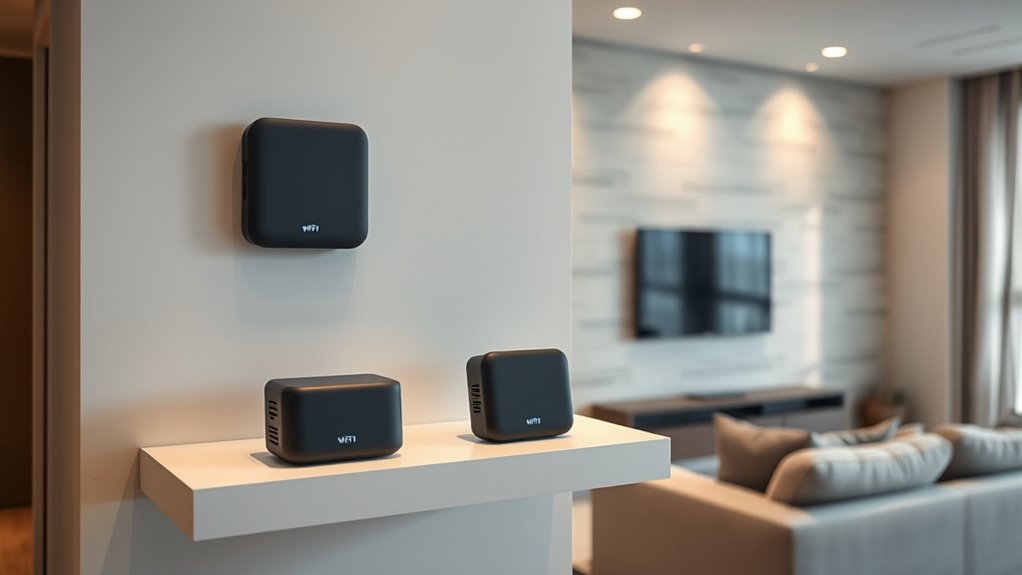
When choosing an ethernet backhaul mesh WiFi kit, the key factor is ensuring stable, high-speed connections across your entire home or office. The TP-Link Deco 7 BE23 stands out as the best overall choice, thanks to its WiFi 7 support and reliable performance. For those prioritizing speed, the Tenda BE5100 WiFi 7 Mesh System offers impressive multi-gigabit ports and MLO technology. However, tradeoffs exist: higher-end models tend to be more expensive, and some kits may require complex setup or compatibility considerations. Keep reading for a detailed breakdown of the best options and what to look for in your perfect mesh system.
Complete the kit


Key Takeaways
- Ethernet backhaul significantly improves stability and speed compared to wireless backhaul, especially in larger homes.
- WiFi 6 and WiFi 7 systems offer future-proofing but come at a higher cost; consider your current device compatibility.
- Ports matter: multi-gig ports (2.5G or 10G) on nodes can future-proof your setup and support faster wired connections.
- Coverage and node count should match your home’s size; more nodes don’t always mean better if they’re not properly placed.
- Setup complexity varies; some kits offer simple app-based installation, while others may require manual configuration.
| TP-Link Deco 7 BE23 Dual-Band WiFi 7 Mesh System (3-Pack) |  | Best Overall for Large Homes and Future-Proof Performance | Wi-Fi Technology: Wi-Fi 7 | Max Speed: 3.6 Gbps | Coverage: Up to 6,500 sq. ft | VIEW ON AMAZON | See Our Full Breakdown |
| Tenda BE5100 WiFi 7 Mesh WiFi System – 3-Pack, Dual-Band, Whole-Home Coverage (6,600 sq. ft.), 1×2.5G + 2×1G Ports, MLO, Ethernet Backhaul, VPN Ready |  | Best for Reliable Wired Backhaul and User-Friendly Management | WiFi Generation: Wi-Fi 7 | Coverage: 6600 sq.ft. | Number of Ports: 1×2.5G, 2×1G | VIEW ON AMAZON | See Our Full Breakdown |
| Tenda Nova Mesh WiFi System MW6 – 2-Pack, Covers up to 2400 sq.ft, AC1200 Dual-Band Whole Home WiFi Mesh Network for 90 Devices |  | Best Budget-Friendly Mesh with Easy Setup | Coverage: 2400 sq.ft | WiFi Standard: AC1200 | Number of Units: 2 | VIEW ON AMAZON | See Our Full Breakdown |
| Tenda AX3000 WiFi 6 Mesh System Nova MX12 (3-Pack) – Whole Home Coverage up to 7,000 sq. ft., Dual-Band WiFi Mesh Network for 160+ Devices |  | Best for High Device Capacity and Future-Ready Wi-Fi 6 | Coverage: up to 7,000 sq. ft. | WiFi Standard: Wi-Fi 6 (802.11ax) | Speed: 2976 Mbps | VIEW ON AMAZON | See Our Full Breakdown |
| WAVLINK AX3000 WiFi 6 Mesh System 2 Pack |  | Best for Large Spaces and High Device Support at a Budget | Speed: Up to 3.0 Gbps | Coverage: 5,000 sq. ft. | Supports Devices: 256+ | VIEW ON AMAZON | See Our Full Breakdown |
| TP-Link Deco X55 AX3000 WiFi 6 Mesh System (3-Pack) |  | Best Overall for Large Homes with High Device Density | Wi-Fi Standard: WiFi 6 (AX3000) | Coverage: 6500 sq ft | Number of Units: 3 | VIEW ON AMAZON | See Our Full Breakdown |
| WAVLINK AX3000 WiFi 6 Mesh System 3 Pack |  | Best for Large, High-Speed Coverage with Many Devices | WiFi Standard: WiFi 6 (AX3000) | Speed: Up to 3.0 Gbps | Coverage: 7300 sq ft | VIEW ON AMAZON | See Our Full Breakdown |
| Cudy AX1500 Gigabit Wi-Fi 6 Whole Home Mesh System, 860 sq.ft, M1500 1-Pack |  | Best for Small to Medium Homes with Secure Remote Access | Wi-Fi Speed: 1201 Mbps on 5 GHz, 300 Mbps on 2.4 GHz | Coverage: 860 sq ft per unit | Number of Ports: 3 (1 WAN + 2 LAN) | VIEW ON AMAZON | See Our Full Breakdown |
| TP-Link Deco X15 Dual-Band AX1500 WiFi 6 Mesh Wi-Fi System, 2-Pack |  | Best for Moderate-Sized Homes Seeking Wired Backhaul | Wi-Fi Standard: WiFi 6 (AX1500) | Coverage: up to 3,900 sq ft | Number of Units: 2 | VIEW ON AMAZON | See Our Full Breakdown |
| Cudy AC1200 Wi-Fi 5 Mesh System, 1700 sq.ft, 2-Pack |  | Best for Budget-Friendly Mesh with Wired Backhaul | Wi-Fi Standard: Wi-Fi 5 (802.11ac) | Speed: 867 Mbps on 5 GHz, 300 Mbps on 2.4 GHz | Coverage: 1700 sq.ft per unit | VIEW ON AMAZON | See Our Full Breakdown |
| TP-Link Deco X15 Dual-Band AX1500 WiFi 6 Mesh Wi-Fi System, 3-Pack |  | Best for Medium to Large Homes with WiFi 6 Efficiency | Wi-Fi Standard: WiFi 6 (AX1500) | Bands: Dual-band | Coverage Area: Up to 5,600 sq.ft. | VIEW ON AMAZON | See Our Full Breakdown |
| TP-Link Deco 7 BE23 Dual-Band WiFi 7 Mesh System (Pack of 12) |  | Best for Large-Scale, High-Speed, Future-Ready Networks | Wi-Fi Technology: Wi-Fi 7 | Speed: Up to 3.6 Gbps | Coverage: Up to 6,500 sq.ft. | VIEW ON AMAZON | See Our Full Breakdown |
| ethernet backhaul mesh wifi kit | Coverage | Number of Units |
|---|---|---|
| TP-Link Deco 7 BE23 Dual-Band | Up to 6,500 sq. ft | 3 |
| Tenda BE5100 WiFi 7 Mesh WiFi | 6600 sq.ft. | — |
| Tenda Nova Mesh WiFi System MW | 2400 sq.ft | 2 |
| Tenda AX3000 WiFi 6 Mesh Syste | up to 7,000 sq. ft. | — |
| WAVLINK AX3000 WiFi 6 Mesh Sys | 5,000 sq. ft. | — |
| TP-Link Deco X55 AX3000 WiFi 6 | 6500 sq ft | 3 |
| WAVLINK AX3000 WiFi 6 Mesh Sys | 7300 sq ft | 3 |
| Cudy AX1500 Gigabit Wi-Fi 6 Wh | 860 sq ft per unit | — |
| TP-Link Deco X15 Dual-Band AX1 | up to 3,900 sq ft | 2 |
| Cudy AC1200 Wi-Fi 5 Mesh Syste | 1700 sq.ft per unit | 2-Pack |
| TP-Link Deco X15 Dual-Band AX1 | — | 3 |
| TP-Link Deco 7 BE23 Dual-Band | Up to 6,500 sq.ft. | — |
More Details on Our Top Picks
TP-Link Deco 7 BE23 Dual-Band WiFi 7 Mesh System (3-Pack)
The TP-Link Deco 7 BE23 stands out for delivering next-generation Wi-Fi 7 speeds and robust coverage up to 6,500 sq. ft., making it ideal for large, tech-heavy households. Compared to the Tenda AX3000 MX12, it offers faster speeds and more advanced security features like WPA3 and HomeShield, along with multi-gigabit wired ports, enhancing both wired and wireless performance. The system’s AI-driven roaming ensures seamless device transitions, essential for busy smart homes. However, its reliance on Wi-Fi 7-compatible devices and higher cost mean it might be overkill for smaller homes or budget-conscious buyers. Setup can be complex for non-technical users, and full benefits depend on compatible hardware.
Pros:- Fast Wi-Fi 7 speeds up to 3.6 Gbps, ideal for demanding tasks
- Large coverage area with reliable coverage for big homes
- Supports multiple devices with stable, seamless connection
- Advanced security features including WPA3 and HomeShield
Cons:- Requires Wi-Fi 7 compatible devices to realize full speed benefits
- Higher price point compared to Wi-Fi 6 systems
- Setup complexity may challenge non-technical users
Best for: Homeowners with large properties wanting future-proof, high-speed Wi-Fi and extensive device support
Not ideal for: Small apartments or users with limited budgets who won’t benefit from Wi-Fi 7 speeds or need simple setups
- Wi-Fi Technology:Wi-Fi 7
- Max Speed:3.6 Gbps
- Coverage:Up to 6,500 sq. ft
- Number of Units:3
- Ports:2× 2.5G ports per unit
- Security:HomeShield, WPA3 encryption
Our verdict“This system is best suited for large homes seeking a cutting-edge, reliable mesh Wi-Fi network that prepares for future device standards.”
Tenda BE5100 WiFi 7 Mesh WiFi System – 3-Pack, Dual-Band, Whole-Home Coverage (6,600 sq. ft.), 1×2.5G + 2×1G Ports, MLO, Ethernet Backhaul, VPN Ready
Compared with the TP-Link Deco 7, the Tenda BE5100 emphasizes wired Ethernet backhaul support and ease of management through its app, making it ideal for users who prioritize connection stability over the highest possible speeds. The 6,600 sq. ft. coverage matches larger homes, and the multi-link operation (MLO) reduces latency, enhancing gaming and streaming experiences. Its dual-band speeds are slightly lower than Wi-Fi 7 max potentials, but the wired backhaul mitigates wireless interference. The system’s VPN support adds security, but the lack of a dedicated 6GHz band limits peak performance. Setup is straightforward via the app, offering a user-friendly experience.**
Pros:- Wired Ethernet backhaul for stable, interference-free performance
- Large coverage suitable for big homes
- Easy app-based setup and management
- Supports WPA3 and VPN for enhanced security
Cons:- Limited to dual-band speeds, missing 6GHz support
- Higher price for feature-rich system
- No mention of mesh compatibility with other brands
Best for: Tech-savvy homeowners who want reliable wired backhaul and simple management for large spaces
Not ideal for: Users seeking maximum Wi-Fi 7 speeds or a system that supports the latest 6GHz band, which this model lacks
- WiFi Generation:Wi-Fi 7
- Coverage:6600 sq.ft.
- Number of Ports:1×2.5G, 2×1G
- Supported Protocols:Wi-Fi 6, WPA3
- MLO:Yes
- Security Protocol:WPA3
Our verdict“This system makes sense for users who value wired backhaul stability and straightforward setup in large homes.”
Tenda Nova Mesh WiFi System MW6 – 2-Pack, Covers up to 2400 sq.ft, AC1200 Dual-Band Whole Home WiFi Mesh Network for 90 Devices
The Tenda Nova MW6 is an affordable choice for smaller homes or apartments, offering seamless coverage up to 2,400 sq. ft. and supporting up to 90 devices. While it doesn’t support Wi-Fi 6 or the newest Wi-Fi 7, its AC1200 dual-band speeds are sufficient for general streaming and browsing. Compared to the more advanced Tenda AX3000 MX12, it’s simpler and more cost-effective, but it also limits device support and bandwidth. The setup process is straightforward with the Tenda app, making it accessible for less tech-savvy users. However, the limited coverage area means additional units are often needed for larger spaces, and lack of wired backhaul support could impact stability in crowded environments.**
Pros:- Affordable price point for basic mesh coverage
- Easy app setup and management
- Supports multiple devices with stable Wi-Fi
Cons:- Limited to 2400 sq. ft. coverage, may need additional units
- Lacks Wi-Fi 6 and Wi-Fi 7 support for future-proofing
- No wired backhaul, potential for interference
Best for: Budget-conscious buyers seeking basic whole-home Wi-Fi in small to medium-sized apartments or homes
Not ideal for: Large homes or heavy users who need high speeds, extensive device support, or wired backhaul options
- Coverage:2400 sq.ft
- WiFi Standard:AC1200
- Number of Units:2
- Supports Devices:Up to 90
- Security:WPA2-PSK
- Setup:App-based
Our verdict“This mesh system suits buyers on a budget who need simple, reliable Wi-Fi coverage for smaller spaces.”
Tenda AX3000 WiFi 6 Mesh System Nova MX12 (3-Pack) – Whole Home Coverage up to 7,000 sq. ft., Dual-Band WiFi Mesh Network for 160+ Devices
The Tenda AX3000 MX12 offers significant coverage up to 7,000 sq. ft., making it a strong contender for large homes with many connected devices. Its Wi-Fi 6 support ensures higher speeds and better efficiency compared to Wi-Fi 5 systems like the Nova MW6, especially when managing over 160 devices simultaneously. Its MU-MIMO and OFDMA technologies optimize network performance, ideal for smart homes or offices. Unlike the TP-Link Deco X55, the MX12 supports wired backhaul options, providing more consistent mesh performance. However, firmware updates often require manual intervention, and it’s incompatible with MW series devices, limiting its interoperability. Setup via app is straightforward, but some users may encounter a learning curve.**
Pros:- Extensive coverage up to 7,000 sq. ft.
- Supports over 160 devices with Wi-Fi 6 efficiency
- Wired backhaul options for improved stability
- Easy app setup and management
Cons:- Firmware updates may require manual effort
- Incompatible with MW series devices for mesh compatibility
- No Wi-Fi 7 support or advanced security features
Best for: Large households or offices with many devices needing reliable Wi-Fi 6 coverage and expansive range
Not ideal for: Homes that prefer Wi-Fi 7 or require integrated security features like HomeShield, which this system lacks
- Coverage:up to 7,000 sq. ft.
- WiFi Standard:Wi-Fi 6 (802.11ax)
- Speed:2976 Mbps
- Number of Devices Support:Over 160
- Technology:MU-MIMO, OFDMA
- Backhaul:Wired or wireless
Our verdict“Ideal for large homes or offices that need high-capacity Wi-Fi 6 mesh coverage with wired backhaul flexibility.”
WAVLINK AX3000 WiFi 6 Mesh System 2 Pack
The WAVLINK AX3000 offers up to 3.0 Gbps speeds and coverage of 5,000 sq. ft., making it a solid option for large homes or offices with many devices. Its dual-band Wi-Fi 6 technology ensures efficient handling of high-bandwidth activities like streaming or gaming. Compared to the Tenda AX3000 MX12, WAVLINK emphasizes ease of setup via the app and large coverage, though it doesn’t support wired backhaul, which could impact stability in dense environments. Its support for over 256 devices and WPA3 encryption makes it a versatile, future-ready choice. However, some users may find the setup process slightly complex, and firmware updates are not as streamlined.
Pros:- Large coverage up to 5,000 sq. ft.
- Supports over 256 devices with Wi-Fi 6 efficiency
- Easy to set up via mobile app
- Supports WPA3 security for safer connections
Cons:- No wired backhaul support, potential interference in crowded environments
- Firmware updates can be less automatic
- Lacks Wi-Fi 7 support for future-proofing
Best for: Big households or small offices needing extensive coverage and support for many devices on a budget
Not ideal for: Users requiring wired backhaul or the latest Wi-Fi 7 features, which this system does not support
- Speed:Up to 3.0 Gbps
- Coverage:5,000 sq. ft.
- Supports Devices:256+
- WiFi Standard:Wi-Fi 6 (802.11ax)
- Encryption:WPA3
- Backhaul:Wireless
Our verdict“This mesh system offers a cost-effective, high-capacity Wi-Fi 6 solution for large spaces needing broad device support.”
TP-Link Deco X55 AX3000 WiFi 6 Mesh System (3-Pack)
The TP-Link Deco X55 excels in providing comprehensive coverage up to 6500 sq ft, making it ideal for large households or properties with multiple floors. Its support for up to 150 devices ensures reliable performance even in busy environments, surpassing the capacity of the TP-Link Deco X15, which supports fewer devices. The system’s WiFi 6 (AX3000) standard delivers fast speeds and future-proof connectivity, while the multiple Gigabit Ethernet ports enable wired backhaul options, crucial for maximizing network stability. Setup is streamlined via the Deco app, though some users might find the advanced features and security settings slightly complex. The need for a modem for most ISPs is a minor inconvenience, but not a dealbreaker given its performance. Overall, this system suits large homes needing robust, wired backhaul support and extensive device management.
Pros:- Extensive coverage up to 6500 sq ft
- Supports up to 150 devices simultaneously
- Includes multiple Gigabit Ethernet ports for wired backhaul
- Easy setup via the Deco app
Cons:- Requires a modem for most internet providers
- Advanced features may be complex for some users
Best for: Families with large homes and many smart devices seeking reliable, high-capacity Wi-Fi 6 coverage.
Not ideal for: Apartment dwellers or small offices with simple networking needs, as its extensive coverage and capacity may be unnecessary.
- Wi-Fi Standard:WiFi 6 (AX3000)
- Coverage:6500 sq ft
- Number of Units:3
- Maximum Devices:150
- Ethernet Ports per Unit:3
- Supports Ethernet Backhaul:Yes
Our verdict“This pick is perfect for large households or multi-story homes demanding high device capacity and wired backhaul options.”
WAVLINK AX3000 WiFi 6 Mesh System 3 Pack
The WAVLINK AX3000 offers impressive speeds up to 3.0 Gbps and covers up to 7,300 sq ft, making it well-suited for expansive homes or offices. Compared to the Cudy AX1500, which is more geared toward smaller spaces, WAVLINK’s higher throughput and larger coverage lend itself to demanding environments. Its support for over 256 devices and dual-band operation ensures robust, high-speed connectivity for multiple users streaming, gaming, or working remotely. The system supports both wireless and Ethernet backhaul, providing flexibility for wired setups, similar to the TP-Link Deco X55 but with a focus on speed and capacity. Setup is straightforward via app/web, but the higher price may be a consideration for budget-conscious buyers. Overall, WAVLINK is ideal for those needing enterprise-level performance in a home or small office setting.
Pros:- High-speed performance up to 3.0 Gbps
- Enormous coverage area of 7,300 sq ft
- Supports over 256 devices for busy households
- Flexible backhaul via wireless or Ethernet
Cons:- Higher cost compared to lower-speed systems
- Mesh setup may be complex for less technical users
Best for: Large households or small offices requiring high throughput and extensive coverage with flexible backhaul options.
Not ideal for: Users with modest internet needs or those on a tight budget, due to its higher price point and complex configuration.
- WiFi Standard:WiFi 6 (AX3000)
- Speed:Up to 3.0 Gbps
- Coverage:7300 sq ft
- Number of Units:3
- Supports Devices:256+
- Backhaul Options:Wireless or Ethernet
Our verdict“This system suits large spaces demanding top-tier speeds and high device support, especially where wired backhaul is preferred.”
Cudy AX1500 Gigabit Wi-Fi 6 Whole Home Mesh System, 860 sq.ft, M1500 1-Pack
The Cudy AX1500 is tailored for smaller spaces, offering speeds up to 1201 Mbps on 5 GHz and 300 Mbps on 2.4 GHz, with coverage around 860 sq ft per unit. Compared with larger systems like WAVLINK, it’s less suited for very big homes but excels in secure, fast Wi-Fi for typical residential use. Its built-in VPN feature provides added security for remote work, making it appealing to privacy-conscious users. The system supports up to 128 devices, adequate for most households, and supports wired Ethernet backhaul—a plus for stability. Setup is simple via app, but coverage per unit limits scalability for larger homes. It’s a strong choice for users who prioritize security and ease of use over extensive coverage.
Pros:- Fast Wi-Fi 6 speeds up to 1201 Mbps
- Supports up to 128 devices
- Includes built-in VPN for security
- Wired backhaul support for improved stability
Cons:- Limited coverage per unit at 860 sq ft
- Requires multiple units for larger areas
Best for: Small to medium-sized homes needing fast Wi-Fi with secure remote access and easy setup.
Not ideal for: Large homes or users requiring coverage beyond 860 sq ft per unit, as additional units will be needed.
- Wi-Fi Speed:1201 Mbps on 5 GHz, 300 Mbps on 2.4 GHz
- Coverage:860 sq ft per unit
- Number of Ports:3 (1 WAN + 2 LAN)
- Supports Devices:128
- Security Protocol:WPA3
- Backhaul:Ethernet or wireless
Our verdict“This system is a solid choice for small to medium homes seeking fast, secure Wi-Fi with straightforward setup.”
TP-Link Deco X15 Dual-Band AX1500 WiFi 6 Mesh Wi-Fi System, 2-Pack
The TP-Link Deco X15 offers a well-balanced setup with coverage up to 3,900 sq ft, supporting around 120 devices, making it suitable for medium-sized homes. Its dual-band WiFi 6 standard ensures faster speeds and better device support compared to WiFi 5 systems like the Tenda MW5G. The inclusion of wired backhaul ports greatly improves network stability, especially compared to the WAVLINK AX3000, which relies solely on wireless backhaul. The Deco X15’s setup via the Deco app is straightforward, and security features like TP-Link HomeShield add peace of mind. However, the 2-unit pack might require additional units for larger or multi-story homes, and some users may find the system less capable in very high-density environments. Overall, this system offers a reliable, balanced performance for homes needing wired backhaul support.
Pros:- Supports coverage up to 3,900 sq ft
- Includes wired backhaul ports
- Supports up to 120 devices
- Easy setup via Deco app
Cons:- Limited to 2 units, may need more for larger spaces
- Requires a modem for most ISPs
Best for: Homeowners with moderate space who want reliable Wi-Fi 6 coverage and wired backhaul for added stability.
Not ideal for: Very large homes or users with extensive device counts exceeding 120, who might need a system with higher capacity.
- Wi-Fi Standard:WiFi 6 (AX1500)
- Coverage:up to 3,900 sq ft
- Number of Units:2
- Ethernet Ports per Unit:2
- Supports Devices:120
- Security:TP-Link HomeShield
Our verdict“This system makes sense for moderate-sized homes that prioritize reliable Wi-Fi 6 with wired backhaul for improved stability.”
Cudy AC1200 Wi-Fi 5 Mesh System, 1700 sq.ft, 2-Pack
The Cudy AC1200 Mesh System offers reliable dual-band Wi-Fi 5 coverage suitable for smaller homes or apartments. Compared with Wi-Fi 6 options like the TP-Link Deco X15, it provides a more affordable solution, though it lacks the speed and future-proofing of Wi-Fi 6 and Wi-Fi 7. The wired backhaul capability enhances stability for streaming and gaming, making it a solid choice for users who prioritize connection reliability over raw speed. Setup is straightforward, especially with the app, and its support for multiple VPN protocols adds a layer of security for remote access. However, coverage per unit is limited to 1700 sq.ft., which may require additional nodes for larger spaces, and it doesn’t support Wi-Fi 6, potentially limiting performance as devices evolve.
Pros:- Quick and easy setup in under 3 minutes per node
- Supports multiple VPN protocols for secure remote access
- Seamless mesh coverage with smooth roaming
Cons:- Limited to 1700 sq.ft. per node, requiring multiple units for larger homes
- No Wi-Fi 6 support, limiting speed and device compatibility
Best for: Budget-conscious users with small to medium-sized homes seeking reliable wired backhaul and VPN support.
Not ideal for: Large households or those wanting Wi-Fi 6/7 compatibility for future-proofing, due to limited coverage and older Wi-Fi standard.
- Wi-Fi Standard:Wi-Fi 5 (802.11ac)
- Speed:867 Mbps on 5 GHz, 300 Mbps on 2.4 GHz
- Coverage:1700 sq.ft per unit
- Number of Units:2-Pack
- Ports:2x Gigabit RJ45 WAN/LAN
- Device Capacity:128 devices
- VPN Support:WireGuard, OpenVPN, IPsec, ZeroTier, PPTP, L2TP
Our verdict“This system makes sense for small homes or apartments needing a simple, affordable wired mesh solution with good security options.”
TP-Link Deco X15 Dual-Band AX1500 WiFi 6 Mesh Wi-Fi System, 3-Pack
The TP-Link Deco X15 excels at covering larger homes with up to 5,600 sq.ft. of seamless WiFi 6 mesh coverage. Compared with the Cudy AC1200, it offers faster speeds and better device management, especially as more WiFi 6 devices become common. Its dynamic backhaul intelligently manages traffic, ensuring stable performance even with many connected devices—up to 120. The setup via the Deco app is user-friendly, and built-in security features like TP-Link HomeShield add peace of mind. However, it requires a modem for internet access and may be more complex for users unfamiliar with WiFi 6, plus the price is higher for the 3-pack. It’s ideal for larger households or those investing in future-proof technology.
Pros:- Extensive coverage up to 5,600 sq.ft. with seamless mesh
- Supports up to 120 devices with dynamic backhaul
- Easy setup and management via Deco app
- Built-in security features for network protection
Cons:- Requires a separate modem, adding complexity
- Limited to WiFi 6 devices for full performance
Best for: Families or small businesses with large homes seeking extensive coverage and WiFi 6 efficiency.
Not ideal for: Users with small apartments or minimal device needs who don’t require WiFi 6’s advanced features, due to higher cost and complexity.
- Wi-Fi Standard:WiFi 6 (AX1500)
- Bands:Dual-band
- Coverage Area:Up to 5,600 sq.ft.
- Number of Units:3
- Ethernet Ports per Unit:2 Gigabit ports
- Device Support:Up to 120 devices
- Security:TP-Link HomeShield
Our verdict“This system is best suited for large homes needing robust WiFi 6 coverage and security, despite some initial setup complexity.”
TP-Link Deco 7 BE23 Dual-Band WiFi 7 Mesh System (Pack of 12)
The TP-Link Deco 7 BE23 pushes the boundary with Wi-Fi 7 technology, supporting speeds up to 3.6 Gbps and covering up to 6,500 sq.ft. with a 3-pack, making it ideal for very large homes or demanding setups. Its advanced features, including multiple high-gain antennas, wired backhaul options, and the latest security standards, provide a highly reliable and fast network. Compared to Wi-Fi 6 systems like the Deco X15, it offers significantly higher speeds and better handling of dense device environments, thanks to Multi-Link Operation (MLO). However, the higher cost and the need for a compatible modem mean it’s best suited for users with large spaces and a need for cutting-edge connectivity. The 12-pack might be overkill for most households but guarantees coverage for sprawling properties or multi-building setups.
Pros:- Supports Wi-Fi 7 for ultra-fast speeds
- Extensive coverage up to 6,500 sq.ft. with a 3-pack
- Multiple high-gain antennas and wired backhaul options
- Advanced security and VPN support
Cons:- Requires a compatible modem, adding setup complexity
- Higher cost due to advanced tech and pack size
- More units than necessary for small households
Best for: Large households, multi-story homes, or users needing the fastest, most future-proof Wi-Fi for many devices.
Not ideal for: Small homes or users with modest internet needs who want a simple, budget-friendly setup, as it’s expensive and overpowered for such use cases.
- Wi-Fi Technology:Wi-Fi 7
- Speed:Up to 3.6 Gbps
- Coverage:Up to 6,500 sq.ft.
- Number of Nodes:12
- Ethernet Ports:2× 2.5 Gbps WAN/LAN per unit
- Antenna Count:4 high-gain antennas per node
- Security Features:HomeShield, VPN support
Our verdict“This system is best for large, tech-savvy households or enterprises demanding the fastest speeds and maximum coverage with future-proof Wi-Fi.”

How We Picked
Our selection process focused on performance, ease of setup, build quality, and value. We prioritized mesh kits with reliable ethernet backhaul capabilities, ensuring consistent high speeds across the network. Compatibility with WiFi 6 and WiFi 7 standards was a key factor, as was the inclusion of multi-gig ports for future-proofing. We also considered coverage area and the number of nodes included, aiming to recommend options suitable for different home sizes and user needs. Products were ranked based on a balance of speed, stability, ease of use, and overall value, ensuring that both budget-conscious buyers and premium users find suitable options.
Factors to Consider When Choosing Ethernet Backhaul Mesh Wifi Kits
Choosing the right ethernet backhaul mesh WiFi kit involves evaluating several critical factors beyond just speed or price. Understanding these considerations helps avoid common pitfalls and ensures your network performs reliably over time. Here are the main factors to keep in mind when selecting a mesh system for wired backhaul.Coverage Area and Node Quantity
Matching the mesh system’s coverage to your home’s size is vital. Larger homes often require more nodes for seamless coverage, but simply adding more units doesn’t guarantee better performance if they’re not correctly placed. Consider the system’s advertised coverage and whether it supports multi-room or multi-story layouts. A well-designed system with fewer nodes can outperform a larger, poorly configured one.
Ethernet Backhaul Support and Ports
Ethernet backhaul provides a dedicated wired connection between nodes, reducing interference and increasing speed. Look for systems with multi-gig ports (2.5G or higher) to future-proof your setup. The presence of multiple Ethernet ports on nodes also allows for connecting wired devices directly, which can significantly enhance gaming, streaming, or work-from-home experiences.
WiFi Standard and Speed Capabilities
WiFi 6 and WiFi 7 standards offer faster speeds, better device handling, and improved efficiency. If your current devices support these standards, investing in a compatible mesh system makes sense. However, keep in mind that actual speeds depend on your internet plan and device compatibility. Higher-end standards tend to come with increased costs, so weigh the benefits against your specific needs.
Ease of Setup and Management
Some systems feature straightforward app-based setups, ideal for less tech-savvy users, while others might require manual configuration. Consider the level of control you want over your network and whether the system offers easy management features like guest networking, parental controls, or device prioritization. User-friendly interfaces can save time and frustration during installation and daily use.
Price and Long-term Value
While premium models offer advanced features and better hardware, they come at a higher price point. Conversely, budget options may lack multi-gig ports or WiFi 6/7 support, limiting future expansion. Balance your budget with your long-term needs—sometimes paying more upfront yields a more stable, scalable network that remains functional for years.
Frequently Asked Questions
Is ethernet backhaul necessary for a mesh WiFi system?
Ethernet backhaul is not strictly necessary but offers significant advantages in stability and speed, especially in larger or complex homes. Wireless backhaul can suffice in smaller spaces, but wired connections reduce interference and increase throughput. If you have the option to run Ethernet cables, systems with dedicated wired backhaul tend to deliver more consistent performance, particularly for high-bandwidth activities like gaming or 4K streaming.
Can I add more nodes later to my ethernet backhaul mesh system?
Most modern mesh systems support expanding with additional nodes, but compatibility varies. Check whether the system allows for easy expansion and if new nodes support wired backhaul to maintain performance. Some brands, like TP-Link and Tenda, make it straightforward to add compatible units, but always verify the specific model’s expansion options before purchasing.
How important are multi-gig Ethernet ports on mesh nodes?
Multi-gig ports (like 2.5G or 10G) are increasingly relevant as internet speeds improve and wired device connectivity becomes more critical. They enable faster wired connections for gaming PCs, NAS servers, and other demanding devices, future-proofing your network. If you plan to upgrade your internet service or have high-performance wired devices, prioritize systems with multi-gig ports.
Is WiFi 7 worth it for a home mesh system?
WiFi 7 offers potential for higher speeds, lower latency, and better handling of multiple devices. However, since most current devices support WiFi 6, the benefits of WiFi 7 might not be fully realized yet. Investing in WiFi 7 now can be a good move if you want a future-proof setup, but for most users, WiFi 6 systems provide excellent performance at a lower cost.
What’s the biggest mistake to avoid when choosing a mesh WiFi system?
The most common mistake is underestimating your coverage needs or overloading the system with too few nodes. Also, neglecting to check for wired backhaul support or compatibility with your existing devices can lead to disappointing performance. Carefully assess your home size, device density, and future expansion plans to choose a system that will meet your needs without requiring unnecessary upgrades later.
Conclusion
For most users seeking a reliable, high-performance home network, the TP-Link Deco 7 BE23 offers a strong balance of speed, coverage, and future-proof features, making it the best overall pick. Those on a budget or wanting straightforward setup might prefer the Tenda Nova MW6 for its affordability and simplicity. If you require premium features and maximum speed, the TP-Link Deco X55 or Deco X15 systems excel, especially for larger homes or demanding setups. Beginners and less tech-inclined users should look for systems with user-friendly apps, while power users should prioritize multi-gig ports and WiFi 6/7 support. Tailor your choice based on your current and future networking needs for the best long-term performance.