For summer cooling, my best overall pick is the DREO Fan for Bedroom, which pairs a tall adjustable design with quiet oscillation and a claimed 90-foot airflow reach. The Levoit Tower Fan is a good fit if you want auto mode and a remote, while the Honeywell TurboForce HT900 offers a compact way to move air across a desk or small room. The main tradeoffs are room coverage, noise, floor space, and how much control you need over airflow direction. A fan circulates air rather than lowering room temperature, so the right choice depends on where you sit or sleep and how air moves through your space. Read on for the full breakdown, buying advice, and picks for different needs.

Get furniture and decor delivered free with Prime
- Fast, free delivery on millions of items
- Prime Video, Amazon Music and more included
- Member-only deals all year
Complete the kit


Key Takeaways
- The amazon.com/dp/B07BNGPWT4?tag=perfectfitliving-20&ascsubtag=dc-340767″ target=”_blank” rel=”nofollow sponsored noopener”>amazon.com/dp/B0DQDQVTT3?tag=perfectfitliving-20&ascsubtag=dc-340767″ target=”_blank” rel=”nofollow sponsored noopener”>DREO bedroom pedestal fan leads this roundup for summer use because its adjustable height and oscillation can direct airflow across more of a room than a small tabletop model.
- Tower fans such as the Levoit and DREO models save floor space, while pedestal fans offer more height and a more direct path for airflow.
- The Honeywell HT900 and Amazon Basics desk circulator are better suited to nearby, focused cooling than to moving air across a large room.
- Several picks offer remotes, timers, or multiple speeds, but those controls matter most when they match your routine, such as adjusting a bedroom fan from bed.
- The FoldMag mini fan serves a different need from the room fans: personal airflow on the go, with less reach than a pedestal or tower fan.


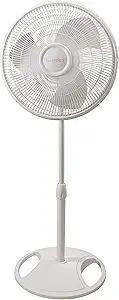


| fan | Speed settings | Noise level |
|---|---|---|
| DREO Fan for Bedroom | — | 20 dB |
| Honeywell TurboForce HT900 Tab | — | — |
| DREO 12-inch Whole Room Air Ci | 3 | 28 dB |
| Levoit Tower Fan with Oscillat | — | 28 dB listed |
| Lasko 2520 16-Inch Oscillating | — | — |
| Lasko Cyclone Oscillating Pede | 3 | — |
| Amazon Basics 16-Inch Pedestal | 3 | — |
| DREO Tower Fan for Bedroom | — | 25 dB in Sleep Mode |
| Amazon Basics 11-Inch Air Circ | 3 | 60 dB |
| Honeywell TurboForce Air Circu | 3 | — |
| Uthfy Adjustable Height Pedest | 16 | As low as 25 dB |
| FoldMag Portable Mini Fan | 5 | — |
More Details on Our Top Picks
DREO Fan for Bedroom, Upgraded 2026 Model, 90ft Airflow, Quiet Oscillating Standing Fan with Adjustable Height and Timer
The DREO standing fan makes the strongest case as a bedroom pick when summer heat calls for broad airflow without much motor noise. Its stated 90-foot reach and 1000 CFM output give it more room-moving ambition than the compact Honeywell TurboForce HT900, while its 20dB operation is suited to quieter spaces. Eight speeds, adjustable height, and horizontal oscillation let you tune where the air goes instead of settling for one fixed breeze. A remote and timer add convenience at bedtime. The tradeoff is its larger pedestal footprint and more involved setup; the HT900 is easier to place on a desk or mount on a wall. Choose this DREO for a bedroom or larger room where quiet, adjustable coverage matters more than compactness.
Pros:- Stated 90-foot airflow reach and 1000 CFM output suit larger rooms
- 20dB noise level is suited to quiet bedrooms
- Adjustable height and broad oscillation help direct airflow
- Remote, eight speeds, and timer give more control than basic tabletop models
Cons:- Pedestal design takes more floor space than the Honeywell TurboForce HT900
- Setup may take extra adjustment to get the desired performance
- Advanced feature set may be more than buyers need for a small room
Best for: Bedroom owners who want quiet, adjustable airflow across a larger room during summer
Not ideal for: Desk users or people with limited floor space who need a compact fan with simple setup
- Airflow distance:90 ft
- Airflow volume:1000 CFM
- Noise level:20 dB
- Height range:38–42 in
- Oscillation and pivot:90° horizontal oscillation; 105° pivot
- Speeds:8
- Timer:Up to 8 hours
- Motor and modes:DC motor; Auto and manual modes
Our verdict“Choose this DREO for quiet, wide-reaching summer airflow in a bedroom where a larger footprint is acceptable.”
Honeywell TurboForce HT900 Tabletop Air Circulator Fan, 3 Speeds, 90° Pivoting Head, Black
The Honeywell TurboForce HT900 is the straightforward choice when a summer breeze needs to fit on a desk, shelf, or wall. Its three speeds and 90° pivoting head make it easy to aim at a work area, and the stated airflow reach of up to 25 feet gives it more circulation range than its compact shape might suggest. Compared with the DREO 12-inch Whole Room Air Circulator Table Fan, it offers fewer listed controls and less reach, but its tabletop or wall mounting options suit tighter spaces. The main compromise is that the product data gives no oscillation feature, so it will not sweep air across a room on its own. It is best for focused airflow and simple placement, rather than hands-off coverage or a quiet bedroom specification.
Pros:- Compact format suits desks and tabletops
- Can be mounted on a wall to free up surface space
- Three speeds offer basic airflow adjustment
- 90° pivoting head helps aim airflow where it is needed
Cons:- No oscillation feature is listed for sweeping airflow around a room
- Up to 25-foot reach is shorter than the DREO 12-inch circulator’s stated 70 feet
- No noise level or timer is provided in the product data
Best for: People who need a compact desk, shelf, or wall-mounted fan for focused airflow in a small or medium room
Not ideal for: Buyers who want automatic room coverage, oscillation, or a stated low-noise level for sleep
- Model:HT900
- Fan type:Air circulator
- Speeds:3
- Head adjustment:90° pivoting
- Mounting options:Tabletop, desk, or wall-mounted
- Intended room size:Small to medium-sized rooms
- Airflow reach:Up to 25 ft
- Color:Black
Our verdict“Pick the HT900 for simple, directed airflow in a tight workspace where compact placement matters most.”
DREO 12-inch Whole Room Air Circulator Table Fan
For buyers who want a table fan to move summer air beyond the immediate desk area, the DREO 12-inch circulator stands out for its stated 70-foot reach and adjustable 120° tilt. That reach exceeds the Honeywell TurboForce HT900’s listed 25 feet, making the DREO a better fit for directing air through more of a room. Its 28dB noise level and detachable grille and blades also make it a practical bedroom option that can be cleaned more thoroughly than a basic enclosed design. The controls are deliberately simple: a knob selects among three speeds. That means less fine-tuning than the eight-speed DREO standing fan, and tilt must be adjusted by hand. Pick this model for broad circulation in a tabletop footprint, not remote operation or frequent automated repositioning.
Pros:- Stated airflow reach of up to 70 feet supports whole-room circulation
- 120° adjustable tilt offers flexible manual aiming
- Detachable grille and blades simplify cleaning
- 28dB noise level is suited to quieter rooms
Cons:- Three speeds provide less fine control than the eight-speed DREO standing fan
- Tilt adjustment is manual
- No remote control or oscillation is listed
Best for: People who want a cleanable tabletop circulator with broad reach for a bedroom or shared room
Not ideal for: Buyers who want remote controls, many speed choices, or automatic oscillation
- Fan size:12 in
- Airflow reach:Up to 70 ft
- Tilt range:120° adjustable
- Noise level:28 dB
- Speed settings:3
- Control type:Knob
- Cleaning:Detachable front grille and blades
- Brand:DREO
Our verdict“Choose this DREO table fan for broad, cleanable airflow when manual aiming and three speeds are enough.”
Levoit Tower Fan with Oscillation, Auto Mode, and Remote
The Levoit tower fan is the lineup’s most hands-off option for summer room cooling. Its temperature-sensing Auto mode adjusts airflow as room conditions change, while wide oscillation helps spread air beyond one seat. That gives it a more automatic approach than the Lasko 2520 pedestal fan, which relies on manual controls, and its remote and 12-hour timer suit evening use. Five speeds and four modes let you shift between Normal, Turbo, Sleep, and Auto. The stated 28 ft/s airflow describes velocity, rather than the reach figures supplied for the DREO circulators, so the products are not directly comparable on coverage distance. Noise is listed at 28 dB, though near-silent operation is specified only on low. Choose Levoit for convenience and mode variety; skip it if low noise at stronger airflow is your priority.
Pros:- Temperature sensor and Auto mode adjust airflow to room conditions
- Wide oscillation helps spread air across a room
- Remote and 12-hour timer add bedtime convenience
- Four modes and five speeds offer more choices than the Lasko 2520
Cons:- Near-silent operation is described only on low
- Airflow velocity is given, but no airflow distance is listed
- Tower format offers less height and tilt adjustment than a pedestal fan
Best for: People who want a tower fan that adjusts airflow automatically and can be controlled from across the room
Not ideal for: Light sleepers who need a stated quiet level at higher speeds or buyers comparing fans by airflow distance
- Airflow:Up to 28 ft/s
- Noise level:28 dB listed
- Fan speeds:5
- Fan modes:Normal, Turbo, Sleep, Auto
- Timer:12 hours
- Oscillation:Wide oscillation
- Controls:Remote control
- Cleaning:Removable rear grille
Our verdict“Pick the Levoit for summer convenience and automatic room adjustments if low-speed noise is acceptable.”
Lasko 2520 16-Inch Oscillating Pedestal Fan, White
The Lasko 2520 suits buyers who want a traditional pedestal fan with a broad sweep and few controls to learn. Its 16-inch head, three speeds, oscillation, and adjustable height up to 47 inches provide practical coverage for a room, while tool-free assembly keeps setup simpler than the DREO standing fan’s more involved setup. Manual pull-chain or push-button controls are the tradeoff: there is no listed remote, timer, or automatic temperature response like the Levoit tower fan offers. The plastic construction and indoor-only use also make this a more basic choice than feature-rich models. Still, its tilt-back head lets you aim airflow upward, and the fused safety plug is a useful built-in detail. Choose it for uncomplicated airflow and adjustable placement, not quiet operation or remote convenience.
Pros:- 16-inch head and wide oscillation provide broad airflow
- Adjustable height up to 47 inches and tilt-back head improve positioning
- Tool-free assembly simplifies setup
- Fused safety plug is included
Cons:- Manual controls lack the remote and timer offered by the Levoit tower fan
- Plastic construction and indoor-only use limit its versatility
- No noise level or airflow reach is specified
Best for: Buyers who want a straightforward, height-adjustable pedestal fan for indoor rooms and do not need remote controls
Not ideal for: People who want automated settings, a timer, remote operation, or a stated quiet noise level
- Fan size:16 in
- Mounting type:Pedestal
- Height:Adjustable up to 47 in
- Speeds:3
- Wattage:91 W
- Power:120 V corded electric
- Controls:Manual; pull chain or push button
- Assembly and use:Tool-free assembly; indoor use
Our verdict“Choose the Lasko 2520 for uncomplicated indoor pedestal airflow with adjustable height and easy assembly.”
Lasko Cyclone Oscillating Pedestal Fan, Adjustable to 54″, Model 1843, Black
For summer nights when I want air directed across a bed or seating area, the Lasko Cyclone offers a practical mix of height adjustment and remote control. Its stand reaches 54 inches, and the tilt-back head helps aim airflow where a tower fan may offer less control over direction. Compared with the Amazon Basics 16-Inch Pedestal Fan, the Cyclone has fewer documented breeze options, but its three speeds are described as quiet and its remote adds a straightforward four-hour shutoff timer. That limited timer is the main compromise for anyone who likes to run a fan through the night. The ETL listing and Blue Plug safety feature add reassurance, while the adjustable height suits rooms where furniture or bed height affects airflow.
Pros:- Adjustable stand reaches 54 inches
- Tilt-back head helps aim airflow
- Remote controls power, speed, and timer
- ETL listed with Blue Plug safety technology
Cons:- Timer shuts off after at most four hours
- Offers three speeds without the additional breeze modes listed for the Amazon Basics 16-Inch Pedestal Fan
Best for: Bedrooms where sleepers want adjustable airflow and remote operation for a few hours at a time
Not ideal for: People who want a timer longer than four hours or multiple breeze modes
- Model:1843
- Fan type:Oscillating pedestal fan
- Maximum height:54 inches
- Speed settings:3
- Oscillation:Yes
- Remote control:Yes
- Timer:4-hour auto shut-off
- Safety:ETL listed; Blue Plug safety technology
Our verdict“Choose the Lasko Cyclone for height-adjustable bedroom cooling with remote control, provided its four-hour timer suits your routine.”
Amazon Basics 16-Inch Pedestal Fan with Remote
The Amazon Basics pedestal fan gives me more ways to tailor airflow than the simpler Lasko Cyclone: three speeds are joined by nature, sleep, and normal modes. That combination can be useful in summer when a steady stream feels too direct, while the adjustable height and tilt help cover a medium or large room. Its 16-inch head and 60-watt AC motor make it a more room-oriented pick than the compact Amazon Basics 11-Inch Air Circulator Desk Fan, which is better suited to one person nearby. A remote and timer add convenience, though the supplied details do not specify a timer duration or a measured noise level. Choose it for settings flexibility and reach; skip it if quiet operation is your main deciding factor.
Pros:- Three speeds and three breeze modes
- Adjustable height and tilt help direct airflow
- Remote control is included
- Designed for medium to large rooms
Cons:- No measured noise level is provided
- Timer duration is unspecified
- Its pedestal format takes more floor space than a tabletop circulator
Best for: Households that want a remote-operated pedestal fan with several airflow modes for a medium or large room
Not ideal for: Light sleepers who need a verified low noise level or buyers seeking a compact desk fan
- Fan type:Pedestal
- Blade size:16 inches
- Power:60 W
- Speed settings:3
- Breeze modes:Nature, sleep, normal
- Adjustable height:Yes
- Tilt head:Yes
- Controls:Remote control; timer
Our verdict“Pick this Amazon Basics model for room coverage and mode variety if an unspecified noise level and timer duration are acceptable.”
DREO Tower Fan for Bedroom, 28ft/s Velocity, Ultra Quiet, 8 Speeds, 90° Oscillating, Remote Control, Black
For a bedroom where both quiet nighttime operation and broad airflow matter, the DREO tower fan is the most feature-rich choice in this group. Its dedicated sleep mode is specified at 25 dB, and eight speeds give me finer control than the three-speed Lasko Cyclone or the three-speed Amazon Basics pedestal fan. The stated airflow velocity of up to 28 ft/s and 90-degree oscillation are aimed at moving air across more of a room, while remote and touch controls offer two ways to adjust it. The tradeoff is a corded, indoor-only design, so it cannot follow outdoor summer gatherings or operate away from an outlet. A removable rear grille helps with cleaning, but buyers seeking a simple, adjustable-height pedestal fan may prefer the Lasko.
Pros:- Dedicated sleep mode specified at 25 dB
- Eight speeds and four operating modes
- 90-degree oscillation and stated airflow velocity up to 28 ft/s
- Remote and touch controls, plus a removable rear grille
Cons:- Corded electric operation requires an outlet
- Specified for indoor use only
- Does not offer the adjustable stand height of the Lasko Cyclone
Best for: Bedroom sleepers who want quiet operation, many speed choices, and oscillating airflow from a corded indoor fan
Not ideal for: People who need battery-powered or outdoor cooling, or prefer an adjustable-height pedestal design
- Motor:Brushless DC
- Speeds:8
- Modes:Normal, Natural, Sleep, Auto
- Noise level:25 dB in Sleep Mode
- Airflow velocity:Up to 28 ft/s
- Air flow capacity:1158 CFM
- Oscillation:90°
- Power:36 W
- Controls:Remote and touch
Our verdict“Choose the DREO for quiet, adjustable bedroom airflow through summer nights if you only need corded indoor use.”
Amazon Basics 11-Inch Air Circulator Desk Fan, 3 Speeds, Adjustable Tilt, Black
When summer cooling is needed at a desk or close to a chair, this compact circulator is easier to place and move than the full-height Lasko Cyclone. At three pounds, it can shift between rooms without the floor space or setup of a pedestal fan, and its 90-degree tilt helps direct airflow toward a seated person. The three speeds keep operation simple, but the listed 60 dB noise level makes it a less appealing bedside pick than the DREO Tower Fan, whose sleep mode is specified at 25 dB. Its seven-inch blade diameter and plastic construction also point to personal-range use rather than cooling a large room. I’d choose it for a small workspace, not as a substitute for broad room circulation.
Pros:- Three-pound weight makes it easy to move
- 90-degree tilt directs airflow
- Three speed settings
- Compact dimensions suit desks or floors
Cons:- Listed noise level is 60 dB
- Seven-inch blade diameter is better suited to nearby personal airflow than broad room coverage
- Plastic construction
Best for: Desk workers or students who want a lightweight fan they can aim at their immediate workspace
Not ideal for: Light sleepers or people expecting a compact fan to circulate air through a large room
- Dimensions:6.3 × 11.1 × 10.9 inches
- Blade diameter:7 inches
- Weight:3 pounds
- Speed settings:3
- Tilt:90 degrees
- Wattage:35 W
- Noise level:60 dB
- Power source:Corded electric
Our verdict“Choose this Amazon Basics circulator for portable desk cooling if its listed noise level is acceptable.”
Honeywell TurboForce Air Circulator Small Tabletop Fan, 3 Speeds, 90° Pivot, White
The Honeywell TurboForce suits buyers who want a compact fan to move air around a desk or small room without giving up a pivoting head. Its three speeds and 90-degree pivot make it more adjustable than a fixed-direction tabletop fan, and the listed noise comparison may appeal to people choosing a fan for a bedroom or office. The Amazon Basics 11-Inch Air Circulator gives a clearer portability case with its stated three-pound weight, while Honeywell’s description leans on an aerodynamic design for stronger airflow. Its reach is still limited to small and medium rooms, and the supplied specs do not give an absolute noise measurement or mention a remote. For summer use, it makes most sense near the person who needs cooling, rather than at the center of a large shared space.
Pros:- Three adjustable speeds
- 90-degree pivoting head
- Compact tabletop format
- Aerodynamic turbo design is intended to provide strong airflow
Cons:- Specified for small and medium rooms
- No remote or smart controls are listed
- Noise description gives no absolute decibel figure
Best for: People who want a compact, pivoting fan for a desk, bedroom, or small to medium room
Not ideal for: Buyers who need broad airflow for a large room, remote operation, or a specified noise measurement
- Type:Tabletop air circulator
- Size:Small
- Speed settings:3
- Head movement:90° pivot
- Color:White
- Noise description:25% quieter than comparable fans
- Mounting options:Desktop, tabletop, or wall-mounting
Our verdict“Pick the Honeywell TurboForce for adjustable, nearby airflow in a smaller space if you do not need remote controls.”
Uthfy Adjustable Height Pedestal Fan with 3D Oscillation
The Uthfy suits buyers who want adjustable airflow across a bedroom or living space through hot summer days and nights. Its 150° horizontal and 120° vertical oscillation can spread air across more of a room than the fixed-direction Honeywell TurboForce HT900, while the adjustable 38–46-inch height lets you aim airflow around beds, desks, or seating. Sixteen speeds and four modes give finer control than simpler pedestal options such as the Lasko 2520. The tradeoff is a more feature-heavy setup: its oscillation settings reset after shutdown, so preferred coverage may need to be selected again. The advertised 120-foot air-supply distance also does not establish how evenly it will cool a typical room. Quiet operation, a remote, and a night light add bedroom convenience, though this remains a full-size fan rather than a portable summer companion.
Pros:- Horizontal and vertical oscillation can distribute airflow across a wide area
- Sixteen speeds and four modes allow detailed airflow adjustment
- Adjustable height and remote make it easier to direct airflow from across the room
- Sleep mode, low stated noise level, and night light suit bedroom use
Cons:- Oscillation settings reset after shutdown
- The listed 120-foot air-supply distance may not reflect practical room coverage
- Its pedestal form is less convenient to move or pack than a personal fan
Best for: People who want broad, adjustable airflow for a bedroom or living room during summer, with quiet nighttime controls.
Not ideal for: Buyers who want a simple set-and-forget pedestal fan or a compact fan they can take outdoors.
- Fan type:Pedestal fan
- Adjustable height:38–46 inches
- Oscillation:150° horizontal and 120° vertical
- Speed settings:16
- Modes:Natural, Sleep, Turbo, Auto (Eco)
- Motor:24V brushless DC
- Noise level:As low as 25 dB
- Controls and features:Remote and touch controls, memory function, child lock, night light
- Timer:12 hours
Our verdict“Choose the Uthfy if you want quiet, widely adjustable airflow for summer comfort in a room; skip it if portability or simple controls matter more.”
FoldMag Portable Mini Fan, 5-Speed Magnetic Foldable Personal Neck Fan with Digital Display
The FoldMag is the lineup’s personal-use pick for travel, errands, and outdoor summer activities where a room fan like the Uthfy would be impractical. Its foldable pocket-sized design and magnetic attachment offer more ways to position it than a standard handheld fan, while five speeds and a digital display make adjustments easy to track. The main compromise is runtime: the stated battery life falls from up to six hours at low speed to three at maximum, so sustained high airflow may call for recharging. Magnetic mounting also depends on having a compatible surface, and the listing does not specify sound levels, which may matter when using higher speeds nearby. Compared with the Honeywell TurboForce HT900, FoldMag is easier to carry and use away from an outlet, but it is meant to cool one person rather than circulate air around a room.
Pros:- Compact, lightweight, foldable design is easy to pack
- Magnetic attachment supports flexible placement on compatible surfaces
- Five speeds and a digital display make settings easy to adjust and check
- USB-C charging and up to six hours of low-speed runtime support travel use
Cons:- Maximum-speed runtime is stated as only three hours
- Magnetic mounting may not work on every surface or setup
- Higher-speed sound may be noticeable, with no sound level specified
Best for: Commuters, travelers, and outdoor event-goers who want rechargeable personal airflow and flexible placement.
Not ideal for: People seeking room-wide summer cooling or those who need long runtime at the highest speed.
- Speed settings:5
- Battery life:Up to 6 hours at low speed; 3 hours at maximum speed
- Charging:USB-C fast charging
- Design:Foldable, pocket-sized
- Weight:Lightweight
- Display:Digital display
- Attachment:Magnetic adsorption
- Finish:Gunmetal PVD
Our verdict“Pick the FoldMag for portable, rechargeable summer airflow for one person, but choose a room fan if you need broader coverage.”
How We Picked
I ranked these fans by how well their listed features address everyday cooling needs: airflow reach, speed and direction control, oscillation, adjustability, noise claims, and useful controls such as timers or remotes. I also weighed where each design makes sense, since a small circulator for a desk should not be judged by the same room coverage expectations as a pedestal or tower fan. For summer use, the lead pick needed to combine room reach with flexible placement and features suited to bedrooms.
The DREO bedroom pedestal fan ranks first because its height adjustment, oscillation, and claimed 90-foot airflow reach make it the most versatile room option in this lineup. Tower models follow for people who value a slimmer footprint and added controls; simpler pedestal and tabletop fans rank well when their focused purpose suits the buyer. Compactness and portability help the smaller options, but their limited reach keeps them from competing as whole-room choices. Product descriptions do not provide directly comparable airflow or noise measurements, so I treat performance claims as manufacturer specifications rather than a controlled comparison.
Factors to Consider When Choosing Fans
Choose a fan around the space you want to cool and where you will feel its airflow. A larger feature list does not automatically mean better summer comfort; the important question is whether the fan can move air to your usual seat, desk, or bed without creating noise or clutter you dislike.
Match airflow to the room and your position
Think about the distance between the fan and the person who needs cooling before focusing on speed settings. A compact circulator can work well on a desk or bedside table when you sit nearby, but it may not spread airflow through a large room. Taller fans can direct air above furniture, while oscillation helps share it across more than one spot. Avoid assuming that a long manufacturer-stated reach means consistent cooling in every room; layout, open doorways, and obstacles affect how air travels. If you need air at a specific chair or bed, prioritize adjustable direction and placement. For several people in different parts of a room, wider oscillation may matter more than a narrow, forceful stream.
Pick a form that fits your floor plan
Pedestal, tower, tabletop, and personal fans solve different space problems. A pedestal fan can place airflow at a higher level and adjust to changing furniture arrangements, but its base and head take up visible floor space. Tower fans use a narrow footprint that can fit beside a dresser or sofa, though their airflow direction and height may be less adjustable. Table fans need a stable surface and an available outlet nearby, which can make cable placement part of the decision. Portable personal fans are useful when cooling needs to follow you, but they cannot replace a room fan. Measure the intended spot, including clearance for oscillation, before choosing a style.
Treat noise claims as one part of bedroom comfort
A fan described as quiet may still sound different at higher speeds, so consider how much airflow you need while sleeping. More speed can increase both airflow and audible motor or blade noise, making low-speed performance especially relevant for overnight use. A timer can help avoid running a fan longer than needed, while a remote lets you make adjustments without getting out of bed. Oscillation may distribute airflow more gently than aiming a strong stream at one spot, though personal comfort varies. Check whether the controls are easy to reach in the room where you plan to use the fan. When noise sensitivity is high, give less weight to a maximum-speed claim and more to quiet-use controls and placement options.
Pay for controls that fit your routine
Remotes, timers, auto modes, and many speed settings can make a fan easier to live with, but each has value only if you will use it. A remote is useful when the fan sits across the room or beside a bed; an auto mode can reduce the need for repeated manual adjustments. More settings give finer control, although they may add complexity for someone who just wants a simple switch and a few speeds. Check which controls are included rather than assuming every model has the same functions. If several people share the fan, straightforward buttons can be easier than a more elaborate feature set. Spend attention on the controls that remove a real inconvenience in your daily routine.
Consider airflow direction before relying on oscillation
Oscillation spreads airflow across a wider area, while a fixed or pivoting head can keep it pointed at one location. A common mistake is to choose broad oscillation when the fan needs to cool a single desk or bed; sweeping airflow may feel less consistent there. The reverse can happen in a shared space, where a fixed stream leaves other seats without much air movement. Tilt adjustment can help aim tabletop fans above or below the level of the fan itself. Some models list multi-directional movement, but buyers should confirm what axes or modes that description covers. Choose the motion pattern that matches the room’s layout and how stationary you are.
Separate room cooling from personal portability
A portable mini fan makes sense for commuting, travel, or brief personal cooling when a household fan is impractical. Its smaller size brings limited reach and airflow, so it is a poor substitute for cooling a bedroom or shared living space. For home use, a stable fan with a larger head or tower body can move air across a wider area without needing to be worn or held. If you move between rooms, consider whether carrying a fan is more convenient than placing a compact fan at each regular spot. Battery or charging details matter for portable use, but they do not tell you how effectively a fan will cool a room. Match portability to the actual setting instead of treating it as a universal advantage.
Frequently Asked Questions
Which fan style makes the most sense for cooling a bedroom in summer?
For a bedroom, start with placement: a pedestal fan can direct air from above furniture, while a tower fan takes up less floor space. If the fan will run while you sleep, check for quiet-operation claims, lower-speed options, a timer, and a remote you can reach from bed. Oscillation can spread airflow across the room, though some sleepers prefer a steady stream aimed away from their face. This roundup’s DREO bedroom pedestal model is the strongest match for adjustable room coverage, while Levoit’s tower adds auto mode and a remote in a slimmer shape. Neither style cools the air itself, so use the fan where moving air will reach you.
Can a tabletop air circulator cool a whole room?
A tabletop circulator can help move air around a room, but its size and placement shape how much of the space feels the airflow. It is most effective when set on a stable surface with a clear path toward the area you occupy. A single desk or bedside target is a better fit than expecting a compact fan to serve several distant seats. For broader coverage, consider a taller pedestal or tower model with oscillation. The Honeywell and Amazon Basics tabletop options in this roundup are best understood as nearby airflow choices, not direct substitutes for larger room fans.
Is a tower fan or pedestal fan better when floor space is limited?
A tower fan usually has a narrower footprint, which can make it easier to place beside furniture or along a wall. A pedestal fan needs more clearance around its base and head, but its adjustable height can help move air over furniture or toward a bed. Measure the available spot and account for the fan’s movement if it oscillates. Also check whether its controls and airflow direction suit the position you have available. In this lineup, the Levoit and DREO tower models favor a slimmer profile, while the Lasko and Amazon Basics pedestal models offer a more traditional raised fan design.
Do I need a remote or timer on a bedroom fan?
A remote is useful when the fan is across the room or you want to change settings from bed. A timer can be helpful if you prefer airflow while falling asleep but do not want the fan running all night. These features add convenience, but they do not improve airflow by themselves, so prioritize them after choosing a suitable size and placement. If you rarely adjust a fan once it is set, simple speed controls may be enough. Compare the listed controls carefully because features vary between models that look similar.
Should I buy a portable mini fan instead of a room fan?
Choose a mini fan when you need personal airflow while commuting, traveling, or moving around, and cannot keep a room fan nearby. Its compact form trades room coverage for portability, so it will not serve the same purpose as a pedestal, tower, or tabletop fan. For a fixed desk or bedside spot, a small tabletop model may provide more stable, hands-free airflow. If you need to cool a shared space, choose a room fan with reach and direction control. The FoldMag is the personal-use choice in this roundup; its role is distinct from the home cooling options.
Conclusion
For most buyers seeking a summer room fan, I recommend the DREO Fan for Bedroom as the best overall choice because its adjustable height, oscillation, and stated airflow reach combine flexibility with broad use. The Amazon Basics 11-Inch Air Circulator is my best value-style pick for a desk or nearby seat, while the Levoit Tower Fan is the premium-leaning option for buyers who want auto mode, oscillation, and a remote in a slim form. Beginners who want a straightforward tabletop fan can start with the Honeywell TurboForce HT900. For focused personal use away from home, choose the FoldMag mini fan; for a taller traditional room fan, compare the pedestal options. Pick by where you need airflow and how you want to control it.
Halloween Picks
halloween
As an affiliate, we earn on qualifying purchases.