
An outdoor smart plug lets you schedule or remotely control compatible patio and yard devices, but the right pick depends on how many outlets you need and which smart-home system you use. My best overall pick is the Kasa EP40, which pairs two independently controlled outlets with a straightforward feature set. The Tapo P400M stands out for Matter support, while the Wyze Outdoor Smart Plug adds energy monitoring for buyers who want more usage insight. Across this lineup, the main tradeoffs are outlet count, platform compatibility, monitoring features, and setup complexity. Read on for the full comparison and help matching a plug to your outdoor setup.

Get furniture and decor delivered free with Prime
- Fast, free delivery on millions of items
- Prime Video, Amazon Music and more included
- Member-only deals all year
Complete the kit


Key Takeaways
- Two independently controlled outlets are the most useful all-around format in this lineup: they let you schedule separate devices without adding another plug, as seen in the Kasa EP40, Tapo P400M, Wyze, and several others.
- Matter support separates the Tapo P400M and Kasa EP40M from many lineup options; it can broaden smart-home platform flexibility, but buyers should still check compatibility with their controller and network.
- Outlet quantity changes the use case. The BN-LINK and three-socket meross models suit setups with several low-demand devices, while single-outlet options like the KP401 keep the hardware simpler.
- Energy monitoring is a distinct reason to choose Wyze; it offers information beyond on/off scheduling, though buyers who only need timers may prefer a simpler dual-outlet model.
- Apple HomeKit and dimming are specialist needs, not universal upgrades. The Kasa EP40A and three-socket meross target HomeKit households, while the Kasa KP405 is the lineup’s purpose-built dimmer option.
| Kasa EP40 Outdoor Smart Plug with 2 Independently Controlled Outlets |  | Best Overall for Flexible Scheduling | Model: EP40 | Outlets: 2 independently controlled AC outlets | Weather resistance: IP64 | VIEW ON AMAZON | See Our Full Breakdown |
| Amazon Basics Outdoor Smart Plug with Two Individually Controlled Outlets |  | Best for Alexa-Only Setups | Model: HPPA52CWBAMZ | Outlets: 2 independently controlled | Weather resistance: IP65 | VIEW ON AMAZON | See Our Full Breakdown |
| Kasa Matter Smart Outdoor Plug, Dual Outlet (EP40M) |  | Best for Matter Smart Homes | Model: EP40M | Outlets: 2 individually controlled | Maximum output: 15 A / 1800 W at 125 V | VIEW ON AMAZON | See Our Full Breakdown |
| BN-LINK Outdoor Smart Wi-Fi Plug with 3 Grounded Outlets |  | Best for Switching Several Devices Together | Model: BNC-60/U130T | Outlets: 3 grounded outlets; controlled simultaneously | Connectivity: 2.4 GHz Wi-Fi | VIEW ON AMAZON | See Our Full Breakdown |
| GE Cync Outdoor Smart Plug, Bluetooth and Wi-Fi, Weather Resistant, Black, 1 Pack |  | Best for Bluetooth-and-Wi-Fi Connectivity | Model: CPLGOD2BLG1 | Connectivity: Bluetooth and Wi-Fi | Compatibility: Amazon Alexa, Google Home, Cync app | VIEW ON AMAZON | See Our Full Breakdown |
| Ring Outdoor Smart Plug |  | Best for Ring Homes | Outlets: 2 | Maximum load: 15 A across both outlets; 1875 W resistance load | Weather resistance: IP66; IP64 in use | VIEW ON AMAZON | See Our Full Breakdown |
| Tapo P400M Matter Outdoor Smart Plug with 2 Individually Controlled Outlets | 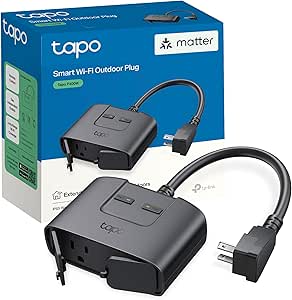 | Best for Multi-Platform Smart Homes | Model: P400M | Outlets: 2 independently controlled AC outlets | Weather resistance: IP65 | VIEW ON AMAZON | See Our Full Breakdown |
| Feit Electric 120V 15A Wi-Fi Smart Dual-Outlet Plug |  | Best for Simple Shared Control | Voltage: 120 V | Current: 15 A | Outlets: 2, controlled together | VIEW ON AMAZON | See Our Full Breakdown |
| Kasa EP40A Outdoor Smart Plug with Apple HomeKit |  | Best for Apple HomeKit Users | Model: EP40A | Outlets: 2 independently controlled AC outlets | Maximum load per outlet: 15 A / 1875 W | VIEW ON AMAZON | See Our Full Breakdown |
| Kasa Smart Outdoor Plug KP401 |  | Best Single-Outlet Pick | Model: KP401 | Connectivity: 2.4 GHz Wi-Fi | Maximum load: 15 A / 1875 W | VIEW ON AMAZON | See Our Full Breakdown |
| Kasa Outdoor Smart Dimmer Plug KP405 |  | Best for Dimming Outdoor Lights | Model: KP405 | Weather resistance: IP64 | Wi-Fi: 2.4 GHz, 802.11 b/g/n | VIEW ON AMAZON | See Our Full Breakdown |
| Wyze Outdoor Smart Plug with Dual Outlets and Energy Monitoring |  | Best for Energy Monitoring | Model: WLPPO1-1 | Outlets: 2 | Connectivity: 2.4 GHz Wi-Fi | VIEW ON AMAZON | See Our Full Breakdown |
| Meross Outdoor Smart Plug with Two Independent Outlets |  | Best for HomeKit Scheduling | Weather resistance: IP44 | Outlets: 2 independently controlled AC outlets | App control: Meross app | VIEW ON AMAZON | See Our Full Breakdown |
| meross Outdoor Smart Plug, 3 Independent Sockets, Apple HomeKit Compatible |  | Best for Three Independently Controlled Devices | Sockets: 3 independently controlled outlets | Wattage: 1,200 W | Operating voltage: 120 V AC | VIEW ON AMAZON | See Our Full Breakdown |
| Linkind Matter Outdoor Smart Plug |  | Best for Matter-Compatible Smart Homes | Connectivity: Matter over 2.4 GHz Wi-Fi | Maximum power: 1,800 W | Operating voltage: 120 V | VIEW ON AMAZON | See Our Full Breakdown |
| outdoor smart plug | Weather resistance | Connectivity | Model | Outlets |
|---|---|---|---|---|
| Kasa EP40 Outdoor Smart Plug w | IP64 | — | EP40 | 2 independently controlled AC outlets |
| Amazon Basics Outdoor Smart Pl | IP65 | 2.4 GHz Wi-Fi | HPPA52CWBAMZ | 2 independently controlled |
| Kasa Matter Smart Outdoor Plug | IP64 | 2.4 GHz Wi-Fi | EP40M | 2 individually controlled |
| BN-LINK Outdoor Smart Wi-Fi Pl | IP44 | 2.4 GHz Wi-Fi | BNC-60/U130T | 3 grounded outlets; controlled simultaneously |
| GE Cync Outdoor Smart Plug | — | Bluetooth and Wi-Fi | CPLGOD2BLG1 | — |
| Ring Outdoor Smart Plug | IP66; IP64 in use | Wireless connection to Ring Bridge | — | 2 |
| Tapo P400M Matter Outdoor Smar | IP65 | 2.4 GHz Wi-Fi | P400M | 2 independently controlled AC outlets |
| Feit Electric 120V 15A Wi-Fi S | — | 2.4 GHz Wi-Fi | — | 2, controlled together |
| Kasa EP40A Outdoor Smart Plug | IP64 | — | EP40A | 2 independently controlled AC outlets |
| Kasa Smart Outdoor Plug KP401 | IP64 | 2.4 GHz Wi-Fi | KP401 | — |
| Kasa Outdoor Smart Dimmer Plug | IP64 | — | KP405 | — |
| Wyze Outdoor Smart Plug with D | — | 2.4 GHz Wi-Fi | WLPPO1-1 | 2 |
| Meross Outdoor Smart Plug with | IP44 | — | — | 2 independently controlled AC outlets |
| meross Outdoor Smart Plug | — | Wi-Fi | — | — |
| Linkind Matter Outdoor Smart P | IP65 | Matter over 2.4 GHz Wi-Fi | — | — |
More Details on Our Top Picks
Kasa EP40 Outdoor Smart Plug with 2 Independently Controlled Outlets
I’d make the Kasa EP40 my all-around pick for households that want two outdoor devices to follow different schedules without choosing a specific smart-home ecosystem. Its independently controlled outlets let garden lights and another device run separately, while the Kasa app adds timers and sunrise/sunset scheduling. That gives it more flexibility than the BN-LINK, whose three outlets switch together. The EP40 also works with both Alexa and Google Assistant, unlike the Alexa-only Amazon Basics plug. Its IP64 weather resistance and stated open-space Wi-Fi range of up to 300 feet suit many yard setups, but the range depends on a strong 2.4 GHz signal reaching the plug. It lacks the broader Matter platform support of the Kasa EP40M, so buyers planning around Apple HomeKit or SmartThings should choose the EP40M instead.
Pros:- Two outlets operate independently for separate devices and schedules
- Works with Amazon Alexa and Google Assistant
- Kasa app supports remote control, timers, and sunrise/sunset scheduling
- IP64 weather resistance and stated Wi-Fi range up to 300 feet in open space
Cons:- Requires a 2.4 GHz Wi-Fi network with adequate signal outdoors
- Does not list Matter or Apple HomeKit compatibility
Best for: Households automating two outdoor devices on separate schedules with Alexa or Google Assistant
Not ideal for: Buyers building a Matter-based setup or placing the plug where 2.4 GHz Wi-Fi is weak
- Model:EP40
- Outlets:2 independently controlled AC outlets
- Weather resistance:IP64
- Wi-Fi:2.4 GHz; stated range up to 300 ft in open space
- Voice assistants:Amazon Alexa, Google Assistant
- Dimensions:4.9 × 2.38 × 2.29 in
- Certification:ETL
- Warranty:2 years
Our verdict“Choose the EP40 for two separately scheduled outdoor devices and straightforward Alexa or Google control, but pick the EP40M if Matter support matters more.”
Amazon Basics Outdoor Smart Plug with Two Individually Controlled Outlets
The Amazon Basics plug makes the most sense when a home already runs on Alexa and the buyer wants two outdoor outlets without adding a hub or another app. Alexa handles control, schedules, and routines, and each outlet can be managed separately or grouped. Its IP65 rating is a step above the IP64 rating listed for the Kasa EP40 and EP40M, which may suit buyers prioritizing the stated enclosure rating. The tradeoff is a narrow ecosystem: unlike the Kasa EP40, it does not support Google Assistant, and it offers no listed Matter compatibility like the EP40M. It also depends on 2.4 GHz Wi-Fi, so a distant patio can still be a problem if the router signal does not reach. I’d skip it if voice control across platforms is a requirement.
Pros:- Two outlets can be controlled separately or grouped
- Works with Alexa routines, remote control, and schedules
- IP65 weather-resistance rating
- No hub required
Cons:- Works exclusively with Alexa
- Requires a 2.4 GHz Wi-Fi connection
- No listed Matter or Google Assistant support
Best for: Alexa households that want two separately controlled outdoor outlets and do not want a hub
Not ideal for: Buyers who use Google Assistant, Matter, or want smart-home control beyond Alexa
- Model:HPPA52CWBAMZ
- Outlets:2 independently controlled
- Weather resistance:IP65
- Connectivity:2.4 GHz Wi-Fi
- Compatibility:Amazon Alexa only
- Amperage:15 A
- Hub required:No
- Material:PC and rubber
Our verdict“Pick this plug for a simple Alexa-centered setup, but choose the Kasa EP40 if you also want Google Assistant support.”
Kasa Matter Smart Outdoor Plug, Dual Outlet (EP40M)
If I were choosing an outdoor plug for a mixed-platform home, the Kasa EP40M would be my ecosystem-forward pick. Matter compatibility gives it a wider set of listed platforms than the Kasa EP40, including Apple HomeKit, Alexa, Google Home, and SmartThings. Its two outlets remain independently controlled, so platform flexibility does not mean giving up separate schedules for lights and other gear. Compared with the Amazon Basics plug, which is limited to Alexa, the EP40M is a better fit for households with multiple brands of smart-home devices. The tradeoffs are its 2.4 GHz Wi-Fi requirement and 15 A/1800 W maximum output; buyers should check that their connected equipment stays within that limit. Its IP64 rating matches the EP40, rather than the Amazon Basics model’s higher listed IP65 rating.
Pros:- Matter compatibility across several major smart-home platforms
- Two outlets can be controlled and scheduled independently
- Supports voice commands, schedules, and countdown timers
- Listed operating range spans -4°F to 122°F
Cons:- Requires a 2.4 GHz Wi-Fi network
- Maximum output is 15 A/1800 W
- IP64 rating is lower than the Amazon Basics plug’s listed IP65
Best for: Households using Matter with Apple HomeKit, Google Home, Alexa, or SmartThings that need two separate outdoor controls
Not ideal for: Buyers who need a higher listed weather-resistance rating than IP64 or equipment beyond 15 A/1800 W
- Model:EP40M
- Outlets:2 individually controlled
- Maximum output:15 A / 1800 W at 125 V
- Weather resistance:IP64
- Operating temperature:-4°F to 122°F (-20°C to 50°C)
- Connectivity:2.4 GHz Wi-Fi
- Compatibility:Apple HomeKit, Amazon Alexa, Google Home, Samsung SmartThings
- Certification:ETL
Our verdict“Choose the EP40M when cross-platform Matter support and independent outlet control matter more than a higher IP rating.”
BN-LINK Outdoor Smart Wi-Fi Plug with 3 Grounded Outlets
The BN-LINK is the practical choice when the main goal is switching several outdoor devices at once, not managing each one separately. Its three grounded outlets operate together, making it suited to a group of garden lights or other gear that should share one schedule. That is a different use case from the Kasa EP40, which has only two outlets but lets each follow its own timing. The BN-LINK supports Alexa and Google Assistant, plus Smart Life app scheduling and countdown timers, without a hub. Its IP44 weatherproof design is a more limited listed rating than the IP64 Kasa models or IP65 Amazon Basics plug, so placement and suitable outdoor protection matter. I’d pass if independent outlet control or a higher stated weather-resistance rating is a priority.
Pros:- Three grounded outlets can serve multiple devices at once
- Works with Alexa and Google Assistant
- Smart Life app supports schedules and countdown timers
- Does not require a hub
Cons:- All three outlets are controlled simultaneously
- IP44 rating is lower than the listed IP64 and IP65 alternatives
- Requires a 2.4 GHz Wi-Fi network
Best for: Buyers who want three outdoor devices to switch on and off together through an app, schedule, or voice assistant
Not ideal for: People who need separate schedules for each device or prefer a higher listed weather-resistance rating
- Model:BNC-60/U130T
- Outlets:3 grounded outlets; controlled simultaneously
- Connectivity:2.4 GHz Wi-Fi
- Voice assistants:Amazon Alexa, Google Assistant
- Voltage:120 V
- Cord length:6.8 in
- Weather resistance:IP44
- Certification:ETL listed
Our verdict“Choose the BN-LINK to control a group of three devices together, but choose the Kasa EP40 if separate outlet schedules are more useful.”
GE Cync Outdoor Smart Plug, Bluetooth and Wi-Fi, Weather Resistant, Black, 1 Pack
The GE Cync stands apart from the Kasa EP40 and Amazon Basics models by listing both Bluetooth and Wi-Fi, which gives buyers another connection method to weigh for their setup. It supports remote control and schedules through the Cync app, along with Alexa and Google Home voice commands. Its individually controllable outlets are useful when outdoor lights and another device should not share the same timetable. Unlike the BN-LINK, which switches all three outlets together, the Cync prioritizes separate control over outlet count. The product data describes it as designed for outdoor use with weatherproof outlet covers, but does not provide an IP rating, so buyers cannot compare its stated weather protection directly with the IP64 Kasa plugs or IP65 Amazon Basics option. Alexa and Google Home devices are sold separately.
Pros:- Lists both Bluetooth and Wi-Fi connectivity
- Supports the Cync app, Alexa, and Google Home
- Individually controllable outlets support separate schedules
- Rated at 15 A
Cons:- No specific IP weather-resistance rating is provided in the product data
- Alexa and Google Home devices are sold separately
- Product data does not specify outlet count
Best for: Cync app users who want individually controlled outdoor outlets and Bluetooth as well as Wi-Fi connectivity
Not ideal for: Buyers who need a clearly stated IP weather-resistance rating or want a plug with smart-home hubs included
- Model:CPLGOD2BLG1
- Connectivity:Bluetooth and Wi-Fi
- Compatibility:Amazon Alexa, Google Home, Cync app
- Outlet control:Individually controllable outlets
- Amperage:15 A
- Plug type:Type B
- Weather protection:Designed for outdoor use with weatherproof outlet covers; IP rating not specified
- Included components:One outdoor smart plug
Our verdict“Consider the Cync if its Bluetooth-and-Wi-Fi connection options fit your setup, but choose a model with a stated IP rating when weather protection needs clearer specification.”
Ring Outdoor Smart Plug
I’d choose the Ring Outdoor Smart Plug when outdoor controls need to sit inside an existing Ring setup. Its two outlets let me switch lights or appliances remotely and schedule them in the Ring app, but the outlets are not described as independently controlled. That makes it less flexible than the Tapo P400M, which offers separate outlet schedules and broad Matter compatibility. Ring’s key tradeoff is its dependency on a compatible Ring Bridge, Ring Alarm Pro, or supported Echo device; it does not connect directly over Wi-Fi. The IP66 rating is a strong weather-resistance specification, though it drops to IP64 while in use. I’d also plan on a weatherproof GFCI outlet at the installation point.
Pros:- Two outlets control outdoor lights or appliances
- Schedules and remote control are available through the Ring app
- Works with selected Ring and Echo equipment
- IP66 weather resistance when not in use
Cons:- Smart control requires compatible Ring or Echo hardware
- Outlets are not specified as independently controlled
- Weather resistance is IP64 while plugged in, and installation requires a weatherproof GFCI outlet
Best for: Ring households with a compatible Bridge, Ring Alarm Pro, or supported Echo device that want scheduled control of two outdoor loads.
Not ideal for: Buyers without compatible Ring or Echo hardware, or anyone who wants direct Wi-Fi setup and independent outlet control.
- Outlets:2
- Maximum load:15 A across both outlets; 1875 W resistance load
- Weather resistance:IP66; IP64 in use
- Connectivity:Wireless connection to Ring Bridge
- Power:120 VAC, 60 Hz input and output
- Operating temperature:-4°F to 122°F (-20°C to 50°C)
- Dimensions:4.92 x 3.14 x 1.96 in.
- Warranty:1-year limited
Our verdict“Choose this if you already have compatible Ring hardware and want scheduled control of two outdoor devices; skip it if you need a standalone Wi-Fi plug.”
Tapo P400M Matter Outdoor Smart Plug with 2 Individually Controlled Outlets
The Tapo P400M is my pick for households that want two outdoor loads controlled separately across different smart-home platforms. Matter compatibility with Apple Home, Alexa, Google Home, and SmartThings makes it more adaptable than the Feit Electric dual-outlet plug, whose outlets operate together and whose listed voice support is narrower. Separate schedules also mean a garden light and a seasonal decoration need not share a routine. Its IP65 rating is suited to outdoor use, while 2.4 GHz Wi-Fi is the connection requirement. The stated range of up to 300 feet applies to an open field, so walls and placement can limit reach. I’d favor this over the Ring plug when avoiding a dedicated Ring hub matters, but it still depends on a stable Wi-Fi signal.
Pros:- Two outlets can be controlled and scheduled independently
- Matter support spans Apple Home, Alexa, Google Home, and SmartThings
- IP65 weather resistance
- App and voice control support remote operation
Cons:- Requires a 2.4 GHz Wi-Fi network
- The 300-foot range is specified for an open field and may be shorter around buildings
- Depends on Wi-Fi coverage at the outdoor outlet
Best for: Smart-home households using Apple Home, Alexa, Google Home, or SmartThings that want independent schedules for two outdoor devices.
Not ideal for: Buyers whose outdoor location has weak 2.4 GHz Wi-Fi or who need a plug compatible with a 5 GHz-only network.
- Model:P400M
- Outlets:2 independently controlled AC outlets
- Weather resistance:IP65
- Operating voltage:125 V
- Wattage:1800 W
- Connectivity:2.4 GHz Wi-Fi
- Compatible platforms:Apple Home, Amazon Alexa, Google Home, SmartThings
- Operating temperature:-4°F to 122°F (-20°C to 50°C)
- Certification:ETL
Our verdict“Pick the P400M if you want independently scheduled outlets and broad Matter platform support, provided your outdoor area has reliable 2.4 GHz Wi-Fi.”
Feit Electric 120V 15A Wi-Fi Smart Dual-Outlet Plug
The Feit Electric dual-outlet plug suits buyers who want straightforward app schedules for two devices that can switch on and off together. That shared control is its defining compromise: unlike the Kasa EP40A or Tapo P400M, it does not let me assign separate routines to each outlet. For a pair of synchronized landscape lights, that may be simpler than managing independent controls; for a pump and decorative lights, it can be limiting. Feit lists wet-location outdoor use, 2.4 GHz Wi-Fi, and support for Alexa and Google Assistant. Shared app access can help household members manage the same setup. I’d choose it for uncomplicated paired loads, not for a mixed-use outlet where each device needs its own schedule or voice command.
Pros:- Two outlets provide a shared way to control a pair of devices
- Remote control and schedules are available in the Feit Electric app
- Works with Alexa and Google Assistant
- Rated for wet-location outdoor use
Cons:- Both outlets are controlled together rather than independently
- Requires 2.4 GHz Wi-Fi
- Listed voice-assistant support is narrower than the Matter-compatible Tapo P400M
Best for: Buyers who want two outdoor devices, such as a matched set of lights, to follow the same app schedule and switch together.
Not ideal for: Households with two different outdoor devices that need separate schedules or independent voice and app control.
- Voltage:120 V
- Current:15 A
- Outlets:2, controlled together
- Connectivity:2.4 GHz Wi-Fi
- App:Feit Electric
- Voice assistants:Amazon Alexa, Google Assistant
- Certification:ETL
Our verdict“Choose Feit for two outdoor loads that should always switch together; choose the Kasa EP40A or Tapo P400M when each outlet needs separate control.”
Kasa EP40A Outdoor Smart Plug with Apple HomeKit
The Kasa EP40A is the most direct fit here for Apple households that want HomeKit and Siri alongside Alexa and Google Assistant. Its two outlets operate independently, giving it an advantage over the Feit Electric plug when a patio light and another appliance need different schedules. Compared with the Kasa KP401, the EP40A adds a second independently managed outlet and wider listed voice-platform support, while the KP401 is the simpler single-plug choice with no hub requirement. The EP40A carries an IP64 rating and uses 2.4 GHz Wi-Fi. HomeKit remote access has an extra condition: a networked Apple device must remain at home. I’d pick it for Apple integration, but not if that requirement or the Wi-Fi limitation conflicts with the setup.
Pros:- Two outlets can be controlled independently
- Supports Apple HomeKit and Siri as well as Alexa and Google Assistant
- Remote control, grouping, and scheduling are supported
- Two-year warranty
Cons:- Requires a 2.4 GHz Wi-Fi network
- HomeKit remote control requires a networked Apple device at home
- IP64 weather resistance is less than the Tapo P400M’s IP65 rating
Best for: Apple Home users who want two independently controlled outdoor outlets and also value compatibility with Alexa or Google Assistant.
Not ideal for: Buyers who need HomeKit remote access without a networked Apple device at home, or whose outdoor outlet lacks 2.4 GHz Wi-Fi.
- Model:EP40A
- Outlets:2 independently controlled AC outlets
- Maximum load per outlet:15 A / 1875 W
- Voltage:125 V
- Weather resistance:IP64
- Wi-Fi:2.4 GHz; 802.11 b/g/n
- Voice assistants:Siri, Alexa, Google Assistant
- Warranty:2 years
Our verdict“Choose the EP40A for independent outdoor control within an Apple Home setup, as long as you can meet its Wi-Fi and HomeKit remote-access requirements.”
Kasa Smart Outdoor Plug KP401
The Kasa KP401 is the straightforward choice when one outdoor device needs remote control, rather than two outlets with separate management. It avoids the shared-outlet limitation of the Feit Electric plug by focusing on a single controlled connection, and it does not require a hub. Kasa’s app adds schedules, countdown timers, and sunrise or sunset offsets, which can automate landscape or holiday lighting without manual timing changes. The IP64 rating and attached protective cover suit exposure to dust and splashes, but this is not a submersion-ready product. Alexa, Google Assistant, and SmartThings support broaden control options, while 2.4 GHz Wi-Fi remains necessary. I’d choose the KP401 for one load and simple automation; the EP40A is a better fit if two independent outlets matter.
Pros:- No hub required
- App supports schedules, countdown timers, and sunrise or sunset offsets
- Works with Alexa, Google Assistant, and SmartThings
- Supports loads up to 15 A / 1875 W
Cons:- Single-plug control cannot manage two outdoor devices independently
- Requires a 2.4 GHz Wi-Fi connection
- IP64 protection covers dust and splashes, not full submersion
Best for: Homeowners automating one outdoor load, such as landscape lights or a pool pump, who want app schedules and sunrise or sunset timing.
Not ideal for: Buyers who need two independently controlled outlets, protection against submersion, or a connection that works without 2.4 GHz Wi-Fi.
- Model:KP401
- Connectivity:2.4 GHz Wi-Fi
- Maximum load:15 A / 1875 W
- Weather resistance:IP64
- Voice assistants:Amazon Alexa, Google Assistant
- Smart home compatibility:SmartThings
- Material:Polycarbonate
- Certification:ETL
- Warranty:2 years
Our verdict“Choose the KP401 when you want one outdoor load automated with Kasa schedules and voice control; choose the EP40A if you need two separate outlets.”
Kasa Outdoor Smart Dimmer Plug KP405
I’d choose the Kasa KP405 when adjusting light levels matters more than adding extra outlets. Its standout feature is app- and voice-controlled dimming, which can make patio or landscape lighting more flexible than the simple on/off control offered by the Kasa EP40. Scheduling and grouping add convenient ways to coordinate compatible lights, and the IP64 housing is rated for protection from dust and splashing water.
The tradeoff is specialization: dimming works only with dimmable lights, and the 300 W incandescent or 150 W LED/CFL limits narrow the loads it can handle. It also needs 2.4 GHz Wi-Fi. Unlike the dual-outlet Wyze plug, this is not a way to control two separate devices; I’d pick it only when brightness control is the priority.
Pros:- Adjusts compatible lights through the Kasa app or voice commands
- IP64 rating provides protection from dust and splashing water
- Supports scheduling and device grouping
- Works without a hub and supports Alexa, Google Assistant, and SmartThings
Cons:- Dimming is limited to compatible dimmable lights
- Requires a 2.4 GHz Wi-Fi network
- Power limits are 300 W for incandescent loads and 150 W for LED/CFL loads
Best for: People with compatible dimmable patio or landscape lights who want brightness adjustment, schedules, and voice control without a hub.
Not ideal for: Buyers who need multiple independently controlled outlets, or anyone whose outdoor lights are not dimmable.
- Model:KP405
- Weather resistance:IP64
- Wi-Fi:2.4 GHz, 802.11 b/g/n
- Wi-Fi range:Up to 300 ft
- Amperage:4 A
- Maximum power:300 W incandescent; 150 W LED/CFL
- Compatibility:Alexa, Google Assistant, SmartThings
- Certifications:ETL certified
Our verdict“Choose the KP405 when dimming compatible outdoor lights is more useful to you than the extra outlets offered by the Wyze dual-outlet plug.”
Wyze Outdoor Smart Plug with Dual Outlets and Energy Monitoring
The Wyze plug’s clearest advantage is combining two outdoor outlets with energy monitoring. That makes it a better fit than the Kasa KP405 for someone switching separate devices on and off and wanting to track their energy use; the Kasa is instead the pick for dimming compatible lights. Wyze also supports Alexa, Google Assistant, and IFTTT, giving buyers several ways to connect routines without adding a hub.
Its IP64 rating suits exposure to dust and splashing water, but it does not make the unit suitable for immersion. The main network restriction is 2.4 GHz Wi-Fi, shared with several other plugs in this roundup. The supplied details don’t say whether the two outlets operate independently, so I wouldn’t assume separate scheduling or control. Choose it for monitoring and outlet capacity, not for dimming or more advanced outlet-level control.
Pros:- Provides two outdoor outlets
- Includes energy monitoring
- Supports Alexa, Google Assistant, and IFTTT
- IP64-rated and does not require a hub
Cons:- Requires a 2.4 GHz Wi-Fi network
- The supplied product details do not confirm independent control of the outlets
- Does not offer the dimming function of the Kasa KP405
Best for: Outdoor smart-home owners who want to control two devices and monitor their energy use through Alexa, Google Assistant, or IFTTT.
Not ideal for: Buyers who need adjustable light brightness, a stated independent control option for each outlet, or support for networks other than 2.4 GHz Wi-Fi.
- Model:WLPPO1-1
- Outlets:2
- Connectivity:2.4 GHz Wi-Fi
- Ingress protection:IP64
- Voltage:120 V AC
- Amperage:15 A
- Compatibility:Alexa, Google Assistant, IFTTT
- Certification:ETL
Our verdict“Pick Wyze if energy monitoring and two outlets matter more than the Kasa KP405’s light-dimming control.”
Meross Outdoor Smart Plug with Two Independent Outlets
I’d put this Meross model on the shortlist for households that want two independently controlled outlets and scheduling that can follow sunrise or sunset. That flexibility separates it from the Wyze plug, whose supplied details don’t confirm independent outlet control. The Meross app and compatibility with Apple HomeKit, Siri, Alexa, Google Assistant, and SmartThings give it a broad place in mixed smart-home setups.
There are meaningful limits. Its IP44 rating offers less stated weather protection than the IP64-rated Wyze and Kasa KP405, so placement deserves care. HomeKit remote access requires a home hub, and the product description says not to use it with a pump. I’d favor the Linkind Matter plug for a stated higher weather rating and pump compatibility, but this Meross is a more direct fit when outlet independence and sunset-based routines lead the decision.
Pros:- Two outlets are controlled independently
- Supports schedules, timers, and sunrise or sunset settings
- Compatible with HomeKit, Siri, Alexa, Google Assistant, and SmartThings
- Housing has fire-retardant material and overload protection
Cons:- IP44 rating is lower than the IP64 rating on the Wyze and Kasa KP405
- HomeKit remote control requires a home hub
- Product description advises against use with a pump
Best for: Apple HomeKit households wanting separate control of two outdoor devices and sunrise or sunset schedules.
Not ideal for: People who need to control a pump, require stronger stated weather protection, or want HomeKit remote access without a home hub.
- Weather resistance:IP44
- Outlets:2 independently controlled AC outlets
- App control:Meross app
- Scheduling:Schedules, timers, sunrise and sunset settings
- Voice assistant compatibility:Siri, Amazon Alexa, Google Assistant
- Smart home compatibility:Apple HomeKit, SmartThings
- Safety features:Fire-retardant housing and overload protection
- Certifications:FCC, ETL
Our verdict“Choose this Meross if separate outlet control and HomeKit scheduling matter more than a higher weather-resistance rating or pump support.”
meross Outdoor Smart Plug, 3 Independent Sockets, Apple HomeKit Compatible
For controlling several outdoor devices separately from one plug, this Meross model offers three independent sockets, one more than the two-outlet Meross B08HQ2N235. Each socket can have its own schedule or timer, which suits setups such as separate strings of holiday lights or patio accessories. It also supports Apple HomeKit, Alexa, Google Assistant, and SmartThings, with voice control and sunrise or sunset scheduling described in the product details.
The extra outlet capacity comes with gaps buyers should weigh: the supplied listing does not state an IP rating, so I can’t compare its weather protection directly with the IP44 two-outlet Meross or IP65 Linkind. HomeKit remote control needs a continuously connected Apple home hub, and the details specify 10 A and 1,200 W. This is a stronger match for three separately managed loads than the Linkind, but less reassuring when weather-rating information is a deciding factor.
Pros:- Three sockets can be controlled independently
- Supports per-socket schedules and timers, including sunrise and sunset settings
- Compatible with Apple HomeKit, Alexa, Google Assistant, and SmartThings
- Supports voice control
Cons:- The supplied product details do not state an IP weather-resistance rating
- HomeKit remote control requires a compatible Apple home hub kept online
- Rated for 10 A and 1,200 W
Best for: HomeKit or multi-platform users who need to schedule and control three outdoor devices independently from one plug.
Not ideal for: Buyers who need a stated IP weather-resistance rating, want to avoid a HomeKit home hub for remote access, or need capacity beyond 10 A and 1,200 W.
- Sockets:3 independently controlled outlets
- Wattage:1,200 W
- Operating voltage:120 V AC
- Connectivity:Wi-Fi
- Control platforms:Apple HomeKit, Alexa, Google Assistant, SmartThings
- Scheduling:Schedules, timers, sunrise and sunset settings
- Operating temperature:Up to 104 °F
Our verdict“Choose this Meross when controlling three outdoor loads separately matters more than a clearly stated weather rating or hub-free HomeKit remote access.”
Linkind Matter Outdoor Smart Plug
The Linkind stands out for buyers building around Matter who want one outdoor plug to work with supported Apple Home, Alexa, or Google Home setups. Its IP65 rating is higher than the IP44 Meross two-outlet model’s stated rating, and the 15 A, 1,800 W capacity is clearly specified for compatible 120 V devices. Timers, schedules, remote control, voice control, and group control cover common outdoor lighting routines.
That flexibility depends on the right setup: Apple Home, Alexa, and Google Home control requires a compatible Matter hub. Like several alternatives here, it uses 2.4 GHz Wi-Fi, and it has no energy monitoring—a feature the Wyze plug does provide. The IP65 rating does not mean it can be immersed in water. I’d choose Linkind for platform flexibility and stated weather protection, but skip it if hub-free setup or energy tracking is the priority.
Pros:- Matter support connects compatible Apple Home, Alexa, and Google Home setups
- IP65 weather-resistance rating
- Supports up to 15 A and 1,800 W
- Offers timers, schedules, remote control, voice control, and group control
Cons:- Requires a compatible Matter hub for Apple Home, Alexa, and Google Home
- Limited to 2.4 GHz Wi-Fi and 120 V systems
- Does not provide energy monitoring and must not be immersed in water
Best for: Smart-home owners with a compatible Matter hub who want a higher-rated weather-resistant plug for 120 V outdoor devices.
Not ideal for: Buyers without a compatible Matter hub, anyone needing energy monitoring, or people seeking a plug suitable for immersion or non-120 V systems.
- Connectivity:Matter over 2.4 GHz Wi-Fi
- Maximum power:1,800 W
- Operating voltage:120 V
- Weather resistance:IP65
- Operating temperature:-30°C to 50°C (-22°F to 122°F)
- Wi-Fi range:Up to 300 ft
- Control methods:App and voice
- Compatible devices:Holiday and landscape lights, patio lights, outdoor fountains, pool pumps
Our verdict“Choose Linkind if you already have a compatible Matter hub and value IP65 protection and broad platform support over Wyze’s energy monitoring.”

How We Picked
I compared these 15 outdoor smart plugs on the practical questions that shape a purchase: outlet count and independent control, stated weather suitability, app and voice-assistant compatibility, setup requirements, and any added functions such as energy monitoring or dimming. I also weighed how clearly each model fits a specific buyer, since a plug built around Matter or HomeKit may be a better choice for one household than a more general Wi-Fi model.
The ranking favors useful everyday control and broad appeal over feature count alone. Models with two independently controlled outlets rise when that flexibility is paired with straightforward use; specialist picks rank for the buyers who need their particular platform or function. I treat outlet quantity and platform labels as reasons to compare, not as proof of superior weather protection or electrical capacity: buyers should verify the product’s current specifications and match them to their devices and installation.
Factors to Consider When Choosing Outdoor Smart Plug
Choosing an outdoor smart plug is less about collecting the most features and more about matching the plug to the devices, location, and smart-home setup you already have. I would settle the following questions before choosing between dual outlets, Matter models, and specialist plugs.
Count devices—and check whether each outlet is controlled separately
Start with the devices you actually plan to automate, such as patio lights, seasonal decorations, or a small fountain. Two sockets do not always mean two separate schedules; look for independent outlet control if you want to run one device while keeping another off. A three-socket design can reduce the need for separate plugs, but it may add bulk and does not automatically make the product suitable for higher combined loads. Check the manufacturer’s ratings for each outlet and the total load before connecting multiple devices. Avoid choosing by socket count alone: the right number is the one that suits your layout without crowding neighboring outlets or creating a tangled connection.
Match weather protection to the actual installation
“Outdoor” and “weather resistant” are not a substitute for checking the product’s stated protection and installation instructions. Think about whether the plug will sit under a covered patio, face direct rain, or be exposed to sprinklers and wind-driven water. Also check how the outlet covers close around the plugs you intend to use; a bulky adapter can interfere with a cover’s fit. Keep the connection elevated and positioned as the manufacturer directs, and use a suitable outdoor receptacle. Do not assume that a weather-resistant plug makes an indoor extension cord or an exposed wall outlet safe for outdoor use.
Choose a smart-home connection you can support
Wi-Fi models, Bluetooth-and-Wi-Fi models, Matter plugs, and HomeKit-focused options can involve different setup paths. Before buying, confirm your phone, router, app, and smart-home controller support the connection method you plan to use. Matter can make cross-platform use easier, but it does not remove the need for a compatible controller and network, and product features can differ between apps. A plug tied closely to one ecosystem may be simpler if your household already uses that platform. If you want remote access, check what network connection and account setup the manufacturer requires rather than assuming Bluetooth alone will provide control away from home.
Check device load and whether you need dimming or monitoring
Compare the plug’s electrical ratings with the device labels, including the total load when multiple outlets run at once. Do not use a smart plug to control equipment whose manufacturer requires direct connection or a specialized controller. If the goal is dimming, choose a model specifically designed for that function, such as a compatible dimmer plug, and verify that the lights themselves are dimmable. Energy monitoring can help track usage, but it is unnecessary if you only need a timer or remote on/off control. These added features should solve a real need rather than distract from load limits and compatibility.
Plan for Wi-Fi range, placement, and seasonal use
An outdoor outlet may sit beyond reliable indoor Wi-Fi, especially behind masonry, metal doors, or multiple walls. Check the signal where the plug will be installed before relying on schedules or remote commands; a strong signal near the router does not guarantee coverage at the patio. Bluetooth setup may help during pairing, but it is not the same as dependable remote control. For seasonal lights, consider whether the plug’s app makes schedules easy to revise when daylight hours change. If you will leave it installed year-round, prioritize an accessible location that allows you to inspect the connection and follow the maker’s care instructions.
Frequently Asked Questions
Is a Matter outdoor smart plug the right choice if my home already uses Alexa, Google Home, or Apple Home?
It can be a good fit if you want one plug to work across supported platforms, but Matter does not guarantee every feature appears in every app. Check the plug’s current compatibility details and whether your home has the required Matter controller and network setup. If you only use one ecosystem and want the simplest setup, a plug designed for that system may be less work. Also compare independent outlet control and app functions, since platform support alone does not tell you how the sockets behave. Choose Matter for flexibility you expect to use, not just for the label.
Can I leave an outdoor smart plug connected through rain and winter weather?
That depends on the specific model’s weather rating and the way it is installed, so check the manufacturer’s instructions rather than assuming all outdoor plugs handle the same exposure. Direct rain, snow, standing water, and freezing conditions can place different demands on the plug and connected devices. Keep the plug and receptacle positioned as directed, and make sure any covers close properly around the connected cords. Inspect the setup for damage or moisture before continued use. If your location exceeds the product’s stated conditions, disconnect it or choose equipment rated for that environment.
Will two outlets let me run two high-power outdoor devices at once?
Not necessarily. The number of sockets does not establish how much power the plug can safely handle, either per outlet or in total. Read the ratings on the smart plug and the connected devices, then follow any limits the manufacturer gives for simultaneous use. Avoid connecting equipment with startup surges or operating requirements the plug is not designed to handle. If the combined load is unclear, ask the manufacturer or a qualified electrician rather than relying on the app’s ability to switch both outlets.
Do I need energy monitoring for patio lights or seasonal decorations?
Usually not if your main goal is to turn lights on and off on a schedule. Energy monitoring is more useful when you want to compare consumption over time or investigate how much a particular device uses. It may add app data without changing the plug’s ability to automate a basic lighting routine. For decorations, timers and reliable connectivity are often the more relevant features. Choose monitoring when you have a specific question the usage data can answer.
What should I do if an outdoor smart plug has a weak Wi-Fi connection?
First check the signal at the outlet with the doors and barriers in their normal positions, since walls and exterior materials can weaken coverage. Move the router or improve coverage with a compatible access point if practical, then follow the plug maker’s pairing steps. Confirm any network-band requirements before setup; some smart devices need a particular Wi-Fi configuration. A model that uses a different connection path may suit your setup better, but check whether it still supports remote control as you expect. Do not place a plug or router where doing so would violate electrical or weather-safety guidance.
Conclusion
For most households, I would start with the Kasa EP40 as the best overall: its two independently controlled outlets make it flexible for common yard and patio tasks. The best value fit is the Amazon Basics dual-outlet model for buyers who want separate control without seeking Matter or specialist features; compare its current compatibility and ratings before choosing. For a best premium or platform-flexibility pick, I would look at the Tapo P400M or Kasa EP40M if Matter suits the rest of your home. Beginners who want a familiar two-outlet setup can start with the Kasa EP40, while HomeKit users should compare the Kasa EP40A and three-socket meross, and buyers who need dimming should focus on the Kasa KP405. Choose the Wyze if energy monitoring is a real priority, or a three-outlet model if your layout needs more sockets; otherwise, a simpler dual-outlet plug is the more direct match.