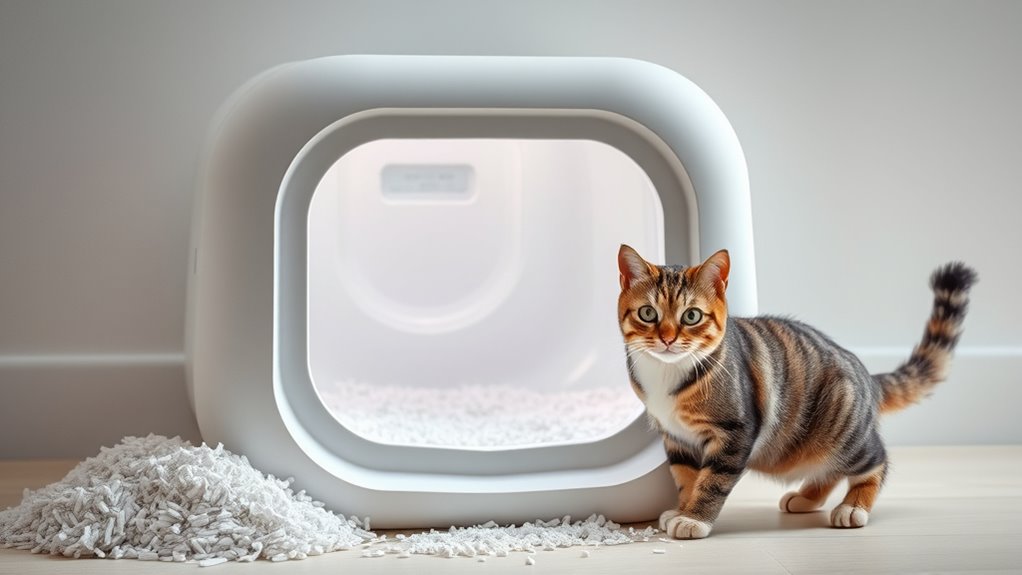

Smart cat litter boxes automate scooping, but the right choice depends on more than app features: opening style, cat access, safety systems, and daily maintenance all matter. I name the Neakasa M1 Plus Best Overall for its open-top approach, while the PETKIT PuraMax 2 stands out for shoppers seeking a more feature-focused enclosed option and the OneBug for buyers drawn to a straightforward open-top design. The main tradeoff is convenience versus fit: a more automated setup can bring extra parts, cleaning steps, or a shape some cats reject. I compare all 12 models by usability, safety, upkeep, and the kind of household each suits. Read on for the full breakdown and help matching a box to your cat.

Get furniture and decor delivered free with Prime
- Fast, free delivery on millions of items
- Prime Video, Amazon Music and more included
- Member-only deals all year
Complete the kit


Key Takeaways
- Open-top designs are a major dividing line: Neakasa M1 Plus, OneBug, Ellenpent, Mimfam AS11, PetPivot, Paruuntys, and CATLINK Open-X may suit cats that dislike enclosed spaces, while enclosed options can better contain litter and odors depending on setup.
- Safety features matter more than app labels: sensor coverage and the box’s response to a cat entering should guide a purchase; app control does not by itself tell you how the unit behaves during a cleaning cycle.
- Weight monitoring is a distinct benefit, not a must-have: Mintakawa adds this health-tracking angle, but buyers should decide whether they will use the data before accepting the added app dependence.
- Access and footprint can outweigh automation: PetPivot’s access step addresses entry, while open-top models need enough room around the unit and may not suit homes where tracking litter is a primary concern.
- Brand-name feature sets and simpler designs serve different buyers: PETKIT PuraMax 2 and CATLINK Open-X merit comparison for buyers prioritizing established smart features, while open-top alternatives may appeal to shoppers who value a less enclosed layout.
| Fumoi Automatic Self-Cleaning Litter Box with App Control and Safety Sensors |  | Best for Multi-Cat Capacity | Model: M4 | Type: Automated self-cleaning | Capacity: 86 L drum; 15 L waste compartment | VIEW ON AMAZON | See Our Full Breakdown |
| Neakasa M1 Plus Automatic Self-Cleaning Cat Litter Box |  | Best Open-Top Choice for Larger Cats | Model: M1 Plus (PS0120) | Supported cat weight: 3.3–33 lb | Multi-cat capacity: Up to 3 cats | VIEW ON AMAZON | See Our Full Breakdown |
| OneBug Automatic Self-Cleaning Open-Top Cat Litter Box |  | Best for No-App Simplicity | Model: ZNMSP-CH-D026-SE-NEW1 | Type: Automated self-cleaning, open-top | Dimensions: 20.6 × 15.7 × 23.03 in | VIEW ON AMAZON | See Our Full Breakdown |
| Ellenpent Open-Top Self-Cleaning Cat Litter Box |  | Best for App Monitoring in a Simple Setup | Type: Automated self-cleaning, open-top | Waste bin capacity: 9 L | Single-cat waste estimate: Up to 10 days | VIEW ON AMAZON | See Our Full Breakdown |
| Mimfam AS11 Automatic Self-Cleaning Cat Litter Box with Open-Top Design, Liner Bags, and Litter Mat |  | Best for Low-Noise, Liner-Based Cleanup | Model: AS11 | Entrance dimensions: 16.33 × 15.35 in | Waste container capacity: 10 L | VIEW ON AMAZON | See Our Full Breakdown |
| DuckSky Automatic Self-Cleaning Litter Box with App Control |  | Best for High Capacity | Interior capacity: 65 L | Waste collection capacity: 9 L | Suitable cat weight: 3–18 lb | VIEW ON AMAZON | See Our Full Breakdown |
| PetPivot Open-Top Self-Cleaning Cat Litter Box with Safety Sensors and Access Step |  | Best App-Free Pick | Design: Open top | Safety sensors: Seven pairs of infrared sensors | Safety features: Touch-sensitive safety pedal and mechanical rotation limiter | VIEW ON AMAZON | See Our Full Breakdown |
| Paruuntys Automatic Open-Top Self-Cleaning Litter Box |  | Best for a Wide, Open Entrance | Model: M5 | Design: Open top | Entrance size: 16.5 × 16.5 in | VIEW ON AMAZON | See Our Full Breakdown |
| CATLINK Open-X Self-Cleaning Cat Litter Box |  | Best for Safety and Activity Monitoring | Model: CL-CH-01 | Waste drawer capacity: 12 L | Stated hands-free cleaning: Up to 15 days for one cat | VIEW ON AMAZON | See Our Full Breakdown |
| Mintakawa Automatic Self-Cleaning Litter Box with App Control and Weight Monitoring |  | Best for Small and Medium Cats | Model: CAST-LB500C | Recommended cat weight: 3.5–15 lb | Connectivity: 2.4GHz Wi-Fi and Bluetooth | VIEW ON AMAZON | See Our Full Breakdown |
| PETKIT PuraMax 2 Automatic Self-Cleaning Cat Litter Box |  | Best for Multi-Cat Tracking | Interior capacity: 76L | Waste bin capacity: 7L | Supported cat weight: 3.3–22 lb | VIEW ON AMAZON | See Our Full Breakdown |
| Cumrige Automatic Litter Box with Safety Sensors and App Control |  | Best for Larger Cats and Longer Emptying Intervals | Drum capacity: 95L | Waste bin capacity: 15L | Supported cat weight: 2.2–33 lb | VIEW ON AMAZON | See Our Full Breakdown |
| smart cat litter boxe | Connectivity | Dimensions | Model | Warranty |
|---|---|---|---|---|
| Fumoi Automatic Self-Cleaning | 2.4 GHz Wi-Fi | 23 × 22.99 × 20 in | M4 | — |
| Neakasa M1 Plus Automatic Self | 2.4 GHz Wi-Fi | — | M1 Plus (PS0120) | — |
| OneBug Automatic Self-Cleaning | — | 20.6 × 15.7 × 23.03 in | ZNMSP-CH-D026-SE-NEW1 | 3 months for manufacturer defects |
| Ellenpent Open-Top Self-Cleani | 2.4 GHz Wi-Fi | 21.25 × 19.7 × 18.9 in | — | 2 years |
| Mimfam AS11 Automatic Self-Cle | — | 21.25 × 16.32 × 24 in | AS11 | 1 year manufacturer warranty |
| DuckSky Automatic Self-Cleanin | 2.4GHz Wi-Fi | 20 × 20 × 20 in | — | — |
| PetPivot Open-Top Self-Cleanin | — | 21.06 × 15.75 × 21.85 in | — | 1 year |
| Paruuntys Automatic Open-Top S | 2.4GHz Wi-Fi | 16.53 × 22.04 × 20.74 in | M5 | — |
| CATLINK Open-X Self-Cleaning C | Bluetooth, 2.4GHz Wi-Fi, and 5GHz Wi-Fi | — | CL-CH-01 | 1 year |
| Mintakawa Automatic Self-Clean | 2.4GHz Wi-Fi and Bluetooth | 19.84 × 22.44 × 18.23 in | CAST-LB500C | 1 year |
| PETKIT PuraMax 2 Automatic Sel | 2.4GHz Wi-Fi | — | — | — |
| Cumrige Automatic Litter Box w | — | — | — | — |
More Details on Our Top Picks
Fumoi Automatic Self-Cleaning Litter Box with App Control and Safety Sensors
For households where litter volume is the main concern, the Fumoi M4 has the largest stated drum and waste compartment in this group: 86 L and 15 L. That capacity can mean fewer interruptions to empty the drawer than the Ellenpent, whose waste bin holds 9 L. Its app adds cycle controls, usage records, and bin reminders, making it a better fit for owners who want remote monitoring than the OneBug, which skips app connectivity entirely.
The tradeoff is a substantial 35 lb footprint, and app features depend on 2.4 GHz Wi-Fi. Cats that are wary of enclosed or moving equipment may need time to adjust, while infrared sensors need routine cleaning. I’d choose it for busy multi-cat homes with room for a larger unit, not for owners prioritizing a compact, setup-simple box.
Pros:- 86 L drum and 15 L sealed waste compartment are suited to higher litter volume.
- App offers cycle controls, usage records, and waste-bin reminders.
- Infrared sensors pause operation when a cat approaches.
- Removable washable tray supports hands-on cleaning.
Cons:- At 23 × 22.99 × 20 inches and 35 lb, it needs a dedicated, sturdy spot.
- App features require 2.4 GHz Wi-Fi.
- Cats unfamiliar with automatic boxes may need an adjustment period, and sensors need regular cleaning.
Best for: Multi-cat households that want a large waste compartment and app-based usage records and reminders.
Not ideal for: Apartment owners short on floor space or households without 2.4 GHz Wi-Fi for app functions.
- Model:M4
- Type:Automated self-cleaning
- Capacity:86 L drum; 15 L waste compartment
- Connectivity:2.4 GHz Wi-Fi
- Safety:Infrared sensors pause operation when a cat approaches
- Dimensions:23 × 22.99 × 20 in
- Weight:35 lb
- Material and color:ABS; grey
Our verdict“Choose the Fumoi if your priority is a large-capacity, app-connected box for a busy multi-cat home and you have room for its sizable frame.”
Neakasa M1 Plus Automatic Self-Cleaning Cat Litter Box
The Neakasa M1 Plus stands out for pairing an open-top layout with support for cats weighing 3.3–33 lb. That makes it a more flexible match for large cats than the Mimfam AS11, which has a listed maximum weight capacity of 22 lb. Its anti-pinch design, rotary infrared sensors, and kitten mode address safety across different cat sizes, while activity tracking can help owners keep tabs on up to three cats.
The 11.2 L sealed waste bin is smaller than the Fumoi’s 15 L compartment, but the Neakasa gives a stated 7–14 days between emptying, with actual intervals depending on use. The app requires 2.4 GHz Wi-Fi, and kittens under 3.3 lb need kitten mode. I’d pick this over the no-app OneBug when tracking matters, but skip it if you want to avoid app setup.
Pros:- Open-top design supports cats weighing up to 33 lb.
- Anti-pinch design, rotary infrared sensors, and kitten mode provide multiple safety measures.
- App tracks activity across multiple cats.
- 11.2 L sealed waste bin and 7.2 L litter capacity support an estimated 7–14 days between emptying.
Cons:- App functions require 2.4 GHz Wi-Fi.
- Kittens under 3.3 lb require Kitten Mode.
- Its 11.2 L waste bin is smaller than the Fumoi M4’s 15 L compartment.
Best for: Owners of larger cats or up to three cats who want an open-top design with app-based activity tracking.
Not ideal for: Households that prefer an offline device, or owners of very small kittens who do not plan to use Kitten Mode.
- Model:M1 Plus (PS0120)
- Supported cat weight:3.3–33 lb
- Multi-cat capacity:Up to 3 cats
- Waste bin capacity:11.2 L
- Litter capacity:7.2 L
- Estimated use between emptying:7–14 days
- Connectivity:2.4 GHz Wi-Fi
- Safety features:Anti-pinch design, rotary infrared sensors, and Kitten Mode
Our verdict“Pick the Neakasa M1 Plus if you need open-top access for a larger cat and value safety features and multi-cat tracking.”
OneBug Automatic Self-Cleaning Open-Top Cat Litter Box
The OneBug is the straightforward pick for owners who want automatic waste removal without a network connection or app account. That sets it apart from the Wi-Fi-enabled Ellenpent and Neakasa M1 Plus: there are no app controls or activity records, but there is also no dependence on 2.4 GHz Wi-Fi. Its open-top design and multiple safety sensors add reassurance, while a stated 32 dB operating noise level may suit homes where loud cycling would be disruptive.
The compromise is capacity: the sealed bin is described as holding up to 10 days of waste for one cat, so multi-cat homes may need to empty it sooner than the Fumoi’s larger-compartment design suggests. Litter compatibility is specified for clumping clay and mineral types, not every litter material. Its three-month defect warranty is also shorter than the Neakasa’s two years.
Pros:- Works without an app or network connection.
- Listed operating noise level is 32 dB.
- Multiple safety sensors support safer cleaning cycles.
- Removable, washable components simplify routine maintenance.
Cons:- Waste capacity is stated for one cat and may require more frequent emptying in multi-cat homes.
- Compatibility is specified for clumping clay and mineral litters.
- Three-month manufacturer defect warranty is shorter than the Neakasa M1 Plus’s two-year warranty.
Best for: Owners who want an open-top automatic box with safety sensors and quiet operation but do not need app connectivity.
Not ideal for: Multi-cat households seeking extended time between emptying, or owners who want remote tracking and broader stated litter compatibility.
- Model:ZNMSP-CH-D026-SE-NEW1
- Type:Automated self-cleaning, open-top
- Dimensions:20.6 × 15.7 × 23.03 in
- Weight:15.4 lb
- Noise level:32 dB
- Waste capacity:Up to 10 days for one cat
- Litter compatibility:Most clumping clay and mineral litters
- Warranty:3 months for manufacturer defects
Our verdict“Choose the OneBug if you want quiet, app-free automatic cleaning for one cat and can accept a narrower litter-compatibility and warranty picture.”
Ellenpent Open-Top Self-Cleaning Cat Litter Box
The Ellenpent suits buyers who want app monitoring without handling a long assembly process: it arrives assembled and includes a litter mat. Its open top, infrared and weight sensors, and cleaning alerts give it a useful balance of access and remote oversight. Compared with the OneBug, it adds app-based usage monitoring; compared with the Fumoi M4, it takes up a smaller listed footprint and weighs substantially less.
That smaller format comes with a 9 L waste bin, and the advertised 10-day interval applies to one cat, so multi-cat homes should expect more frequent emptying. App functions require 2.4 GHz Wi-Fi, much like the Neakasa M1 Plus. A two-year warranty is a helpful counterpoint, but this is not the strongest capacity choice for households generating a lot of litter waste.
Pros:- Arrives assembled and includes a litter mat.
- App provides usage monitoring and cleaning alerts.
- Infrared and weight sensors pause cleaning when a cat enters.
- Sealed waste compartment and deodorizer gel support odor control.
Cons:- The 9 L bin’s advertised 10-day capacity is for one cat.
- App features require 2.4 GHz Wi-Fi.
- Its waste capacity is below the Fumoi M4’s 15 L compartment.
Best for: Single-cat households that want an assembled open-top box with app alerts and safety sensors.
Not ideal for: Multi-cat homes that prioritize a large waste compartment or people without 2.4 GHz Wi-Fi.
- Type:Automated self-cleaning, open-top
- Waste bin capacity:9 L
- Single-cat waste estimate:Up to 10 days
- Dimensions:21.25 × 19.7 × 18.9 in
- Weight:8 kg
- Connectivity:2.4 GHz Wi-Fi
- Safety sensors:Infrared and weight sensors
- Warranty:2 years
Our verdict“Choose the Ellenpent for an easy-start, app-connected box for one cat, but look to the Fumoi if waste capacity is your priority.”
Mimfam AS11 Automatic Self-Cleaning Cat Litter Box with Open-Top Design, Liner Bags, and Litter Mat
The Mimfam AS11 is the maintenance-focused choice here: its removable 10 L waste container and included disposable liners make bag changes more direct than relying on app reminders, as with the Fumoi M4. Four pairs of infrared sensors and three hall sensors pause cleaning when a cat is detected, and the stated 32 dB operation places it alongside the OneBug as a quiet-running option. Its open-top entry, measuring 16.33 × 15.35 inches, gives buyers a concrete fit detail to compare against their cat’s size and habits.
The 10 L bin is described as lasting up to 10 days for one cat, so frequent use or multiple cats can shorten that interval. It also has a listed maximum weight capacity of 22 lb, which makes the Neakasa M1 Plus a better fit for larger cats. I’d favor Mimfam for easy liner changes, not for app tracking or maximum cat-weight flexibility.
Pros:- Removable 10 L waste bin and included liner bags simplify waste disposal.
- Four pairs of infrared sensors and three hall sensors pause cleaning when a cat is detected.
- Listed noise level is 32 dB.
- Includes a litter mat.
Cons:- Maximum listed weight capacity is 22 lb, below the Neakasa M1 Plus’s 33 lb support.
- The up-to-10-day waste estimate is for one cat and can be shorter in multi-cat homes.
- No app or connectivity features are listed.
Best for: Owners of cats under 22 lb who want quiet operation, a removable waste bin, and included liners for cleanup.
Not ideal for: Owners of larger cats or multi-cat households expecting the stated single-cat emptying interval to hold.
- Model:AS11
- Entrance dimensions:16.33 × 15.35 in
- Waste container capacity:10 L
- Noise level:32 dB
- Sensors:4 pairs of infrared sensors and 3 hall sensors
- Dimensions:21.25 × 16.32 × 24 in
- Maximum weight capacity:22 lb
- Warranty:1 year manufacturer warranty
Our verdict“Choose the Mimfam AS11 if quiet cycling and liner-based waste changes matter more than app tracking or support for larger cats.”
DuckSky Automatic Self-Cleaning Litter Box with App Control
The DuckSky stands out for buyers who want room for a larger cat and fewer trips to empty the waste compartment. Its 65L interior and 9L collection compartment exceed the capacity details provided for the Paruuntys and Mintakawa, making it the more capacity-focused choice in this group. Weight and infrared sensors track visits and cat weight, while the app and manual controls give you two ways to manage cleaning. The separate waste compartment and ozone feature are designed to help with odors, and removable components make maintenance more approachable.
The tradeoff is a 60 lb listed item weight and a substantial 20-inch cube, so this is less suited to frequent moving or tight spaces. App control also requires 2.4GHz Wi-Fi. Choose DuckSky for capacity and tracking; choose the lighter PetPivot if you prefer app-free operation.
Pros:- 65L interior and 9L waste compartment offer substantial stated capacity.
- Weight and infrared sensors track cat weight and visits.
- Cleaning can be managed through the app or manual controls.
- Removable components support hands-on cleaning.
Cons:- Listed item weight of 60 lb makes relocation difficult.
- App connectivity requires 2.4GHz Wi-Fi.
- Its 20 × 20 × 20 in footprint may be awkward in compact rooms.
Best for: Households with cats between 3 and 18 lb that want a roomy interior, visit and weight tracking, and app or manual cleaning controls.
Not ideal for: People who need to move the box often, have limited floor space, or rely on Wi-Fi networks that do not support 2.4GHz.
- Interior capacity:65 L
- Waste collection capacity:9 L
- Suitable cat weight:3–18 lb
- Connectivity:2.4GHz Wi-Fi
- Dimensions:20 × 20 × 20 in
- Item weight:60 lb
- Odor control:Separate waste compartment and ozone feature
Our verdict“Choose DuckSky if capacity and app-based tracking matter more than a light, easy-to-relocate design.”
PetPivot Open-Top Self-Cleaning Cat Litter Box with Safety Sensors and Access Step
PetPivot is the clearest choice here for someone who wants automation without adding an app to the routine. Its open-top design, seven pairs of infrared sensors, touch-sensitive safety pedal, and mechanical rotation limiter put the emphasis on access and safeguards rather than remote monitoring. The included access step may also help senior cats get in, while tool-free modular disassembly makes maintenance less involved than a unit that requires more extensive dismantling.
Unlike the DuckSky and CATLINK Open-X, PetPivot does not offer app-based controls or usage reports, so it is a weaker fit for owners who want activity data on their phone. It is also designed for bentonite and mineral-based clumping litter, which narrows litter choices. That limitation is a worthwhile trade for buyers who prefer standard controls and no app dependence. Its 20.6 lb weight is far easier to handle than DuckSky’s listed 60 lb.
Pros:- Seven pairs of infrared sensors work alongside a mechanical rotation limiter and safety pedal.
- App-free operation avoids reliance on a phone or Wi-Fi.
- Includes an access step that may help senior cats enter.
- Tool-free modular disassembly supports maintenance.
Cons:- Limited to bentonite and mineral-based clumping litter.
- No app-based monitoring or remote controls are specified.
Best for: Cat owners who want an open-top automatic box with multiple safety features, an access step, and no app or subscription requirement.
Not ideal for: Owners who want phone-based cleaning schedules, visit tracking, or flexibility to use non-clumping litter.
- Design:Open top
- Safety sensors:Seven pairs of infrared sensors
- Safety features:Touch-sensitive safety pedal and mechanical rotation limiter
- Litter compatibility:Bentonite and mineral-based clumping litter
- Operation:App-free
- Dimensions:21.06 × 15.75 × 21.85 in
- Weight:20.6 lb
- Warranty:1 year
Our verdict“Pick PetPivot if you value accessible, app-free automation over phone tracking and broad litter compatibility.”
Paruuntys Automatic Open-Top Self-Cleaning Litter Box
The Paruuntys makes a strong case for cats that dislike enclosed entrances: its 16.5 × 16.5-inch opening gives them an unusually broad route in and out among the options listed here. Four weight-activated sensors and three infrared sensors pause operation when a cat is nearby, while the app adds scheduling, one-tap emptying, usage tracking, and alerts. That makes it more connected than the app-free PetPivot, and its included washable liner gives owners a reusable component for routine cleanup.
The 15L sealed waste bin is larger than the CATLINK Open-X’s 12L drawer by stated volume, though bin size alone does not establish how often either needs emptying. The Paruuntys still requires periodic waste-bin maintenance, and its app uses 2.4GHz Wi-Fi. Its listed 20 lb weight is manageable, but buyers seeking the CATLINK’s stated 30 dB operation or broader Wi-Fi band support should compare those details before choosing.
Pros:- Wide 16.5 × 16.5 in entrance supports easy access.
- Four weight-activated and three infrared sensors pause operation near a cat.
- App supports schedules, one-tap emptying, usage tracking, and alerts.
- Sealed 15L waste bin and washable liner support odor management and maintenance.
Cons:- Connectivity is limited to 2.4GHz Wi-Fi.
- The 15L waste bin still needs periodic emptying.
Best for: Owners of cats that prefer an open entry and buyers who want app scheduling, visit tracking, and alerts in one system.
Not ideal for: Households without 2.4GHz Wi-Fi or buyers seeking a box with no app dependency and minimal ongoing waste-bin attention.
- Model:M5
- Design:Open top
- Entrance size:16.5 × 16.5 in
- Sensors:Four weight-activated and three infrared
- Waste bin capacity:15 L
- Connectivity:2.4GHz Wi-Fi
- Dimensions:16.53 × 22.04 × 20.74 in
- Weight:20 lb
Our verdict“Choose Paruuntys if a broad open entrance and app-based routines matter more than app-free use or dual-band connectivity.”
CATLINK Open-X Self-Cleaning Cat Litter Box
CATLINK Open-X is the most feature-rich monitoring pick in this set: its app supports cleaning schedules and activity monitoring, and the safety package includes weight sensors, infrared detection, anti-pinch protection, and an emergency stop. It also has a stated 30 dB operating noise level, a useful distinction for homes where the box sits near living areas. Compared with PetPivot, CATLINK adds phone-based tracking; compared with Paruuntys, it supports Bluetooth as well as 2.4GHz and 5GHz Wi-Fi.
The 12L waste drawer is specified to hold up to 15 days of waste for one cat, but actual needs can vary by household. Multi-cat recognition comes with a catch: it is a paid app feature, and cats must differ in weight by at least 0.9 lb for accurate recognition. Buyers with similarly sized cats may get less value from that tracking feature, making Paruuntys a simpler app-equipped alternative.
Pros:- Safety features include weight and infrared sensors, anti-pinch protection, and emergency stop.
- App supports cleaning schedules and activity monitoring.
- 30 dB stated noise level suits quieter shared spaces.
- 12L waste drawer is specified for up to 15 days of use for one cat.
Cons:- Multi-cat recognition is a paid app feature.
- Accurate cat recognition requires a weight difference of at least 0.9 lb.
Best for: Owners who want app-based activity monitoring, layered safety features, and stated quiet operation, especially in a one-cat home.
Not ideal for: Multi-cat households with cats less than 0.9 lb apart in weight, or buyers who do not want a paid app feature for cat recognition.
- Model:CL-CH-01
- Waste drawer capacity:12 L
- Stated hands-free cleaning:Up to 15 days for one cat
- Connectivity:Bluetooth, 2.4GHz Wi-Fi, and 5GHz Wi-Fi
- Noise level:30 dB
- Safety features:Weight sensors, infrared detection, anti-pinch protection, and emergency stop
- Multi-cat recognition requirement:Cats must differ in weight by at least 0.9 lb (0.4 kg)
- Warranty:1 year
Our verdict“Choose CATLINK Open-X for its safety and monitoring package if its paid, weight-dependent multi-cat recognition suits your household.”
Mintakawa Automatic Self-Cleaning Litter Box with App Control and Weight Monitoring
Mintakawa is the most explicitly size-limited choice in this group, designed for cats weighing 3.5–15 lb. That makes it a more targeted option than DuckSky, which lists support up to 18 lb, and a practical fit for owners who want weight and visit tracking without choosing a larger-capacity unit. It connects through 2.4GHz Wi-Fi or Bluetooth, and its below-35 dB operating specification may appeal to homes where noise is a concern. A removable, washable drum also gives owners a more direct way to clean the main working component.
The tradeoffs are clear: larger cats fall outside its recommended range, and the unit needs about 30 minutes of assembly. CATLINK Open-X specifies 30 dB operation and adds anti-pinch protection, while Mintakawa’s appeal is its washable drum and stated cat-weight fit. Choose it for a smaller cat and hands-on cleaning access, not for a no-assembly setup.
Pros:- App tracks cat weight and litter-box visits.
- Supports 2.4GHz Wi-Fi and Bluetooth connectivity.
- Operating noise is specified below 35 dB.
- Removable, washable drum supports direct cleaning.
Cons:- Recommended for cats only up to 15 lb.
- Assembly is required and takes about 30 minutes.
Best for: Owners of kittens and small-to-medium cats weighing 3.5–15 lb who want app-based visit and weight tracking and a washable drum.
Not ideal for: Households with cats over 15 lb or buyers who want a ready-to-use box without assembly.
- Model:CAST-LB500C
- Recommended cat weight:3.5–15 lb
- Connectivity:2.4GHz Wi-Fi and Bluetooth
- Noise level:Below 35 dB
- Dimensions:19.84 × 22.44 × 18.23 in
- Item weight:9.72 kg
- Cleaning:Removable, washable drum
- Assembly:Required; about 30 minutes
- Warranty:1 year
Our verdict“Pick Mintakawa for a smaller cat if weight tracking and a washable drum matter more than avoiding assembly or accommodating larger cats.”
PETKIT PuraMax 2 Automatic Self-Cleaning Cat Litter Box
The PuraMax 2 is the stronger pick for households that need individual cat usage and weight tracking, rather than just remote control. Its app and multiple cleaning modes add flexibility, while seven infrared sensors and four weight sensors pause cleaning when a cat approaches. Compared with the Cumrige Automatic Litter Box, its 76L interior and 7L waste bin are smaller, but PETKIT specifies a low 7.87-inch entry and tracking for individual cats—useful where access and household monitoring matter more than maximum storage. A sealed bin and included odor remover target smells, and the stated bin capacity can last up to 15 days. The tradeoffs are a narrower supported weight range, clumping-litter restriction, and placement on a flat floor; it is not suitable on carpets or mats.
Pros:- App tracks usage and weight data for individual cats
- Multiple cleaning modes allow automatic, manual, timer-based, or emptying operation
- Seven infrared and four weight sensors pause cleaning when a cat approaches
- 76L interior, low entry, and included odor remover support shared household use
Cons:- The 7L waste bin is smaller than Cumrige’s 15L bin
- Requires clumping litter and a flat, uncovered floor location
- Does not support pets under 6 months or cats above 22 lb
Best for: Multi-cat households that want individual usage and weight records, plus a lower entry for cats that have difficulty stepping into taller boxes
Not ideal for: Homes with kittens under 6 months, cats over 22 lb, or carpeted litter-box locations
- Interior capacity:76L
- Waste bin capacity:7L
- Supported cat weight:3.3–22 lb
- Minimum pet age:6 months
- Entry height:7.87 inches
- Connectivity:2.4GHz Wi-Fi
- Safety sensors:7 infrared sensors and 4 weight sensors
- Cleaning modes:Auto, manual, timer, and empty
- Litter compatibility:Clumping litter
Our verdict“Choose the PuraMax 2 if cat-by-cat app tracking and a low entry matter more than the larger drum and waste capacity offered by Cumrige.”
Cumrige Automatic Litter Box with Safety Sensors and App Control
Cumrige stands out for its 95L drum and 15L waste bin, both larger than the PuraMax 2’s 76L interior and 7L bin. That capacity makes it a better fit for larger cats and households hoping to reduce how often they empty the waste compartment; the stated supported range extends to 33 lb. The Tuya Smart app adds remote cleaning, waste disposal, litter-change controls, and health tracking over 2.4GHz Wi-Fi. Presence sensors pause cleaning when a cat is inside, and the unit is designed for quiet operation and odor control. Compared with PETKIT, however, the provided details do not specify individual-cat tracking, a low-entry height, or a variety of cleaning modes. It also requires clumping litter, and its Wi-Fi support is limited to 2.4GHz.
Pros:- 95L drum accommodates cats across a stated weight range up to 33 lb
- 15L waste bin is larger than the PuraMax 2’s 7L bin
- Tuya Smart app offers remote controls and health tracking
- Presence sensors pause cleaning when a cat is inside
Cons:- Works only with 2.4GHz Wi-Fi
- Compatibility is specified for clumping litter
- Product details do not specify individual-cat tracking or entry height
Best for: Owners of larger cats or multi-cat homes who prioritize a spacious drum and a larger waste bin over specified individual-cat tracking
Not ideal for: Buyers who need 5GHz Wi-Fi, non-clumping litter compatibility, or documented low-entry access and cat-by-cat tracking
- Drum capacity:95L
- Waste bin capacity:15L
- Supported cat weight:2.2–33 lb
- App:Tuya Smart
- Wi-Fi compatibility:2.4GHz only
- Litter compatibility:Clumping litter
- Safety:Presence sensors pause cleaning when a cat is inside
- Operation:Designed for quiet operation
- Odor control:Designed for odor control
Our verdict“Pick Cumrige for its larger drum and waste bin, but choose the PuraMax 2 if individual-cat tracking and a specified low entry are higher priorities.”
How We Picked
I compared these 12 smart cat litter boxes around the decisions that affect everyday use: how cats enter the box, how the cleaning mechanism is positioned, what safety sensors and app functions are specified, and how much routine upkeep the design may involve. I also looked at access, litter containment, monitoring tools, and whether a feature solves a clear household need rather than simply adding another app control. A product name or feature label alone does not establish performance, so the roundup avoids treating automation as a substitute for checking fit and safety details.
The ranking favors options with a clear use case and a credible balance of cat acceptance, safety, and maintenance. Models with open-top designs are not automatically better than enclosed boxes; they rank well when that layout offers a meaningful advantage for cats wary of covered spaces. Specialized picks, such as weight monitoring or an access step, earn a place for the households they serve, but they rank below more broadly useful choices when the benefit is narrower. I flag tradeoffs throughout so readers can choose by their cat’s habits, available space, and willingness to maintain a smart appliance.
Factors to Consider When Choosing Smart Cat Litter Boxes
Before choosing among smart cat litter boxes, start with your cat and your home, not the app. Automation can reduce scooping, but it cannot make an unsuitable entrance comfortable or remove the need for cleaning and litter management. These broader checks can help prevent a feature-rich box from becoming an expensive mismatch.
Match the opening to your cat’s habits
A cat that avoids covered carriers or hides in open spaces may be more comfortable approaching an open-top box, while a cat that prefers privacy may take to a more enclosed design. Watch where your cat currently feels comfortable and how easily it steps over the present box’s rim. A common mistake is choosing the layout that looks tidiest to a person rather than the one the cat is likely to use. For older, small, or mobility-limited cats, entry height and room to turn can matter more than extra app controls. If you have more than one cat, consider whether each can enter and leave without being crowded. When possible, keep the old litter box available during a gradual introduction rather than removing a familiar option at once.
Check sensor behavior and cleaning-cycle safeguards
Sensor claims deserve closer attention than general phrases such as “smart” or “automatic.” Look for clear product guidance on how the unit detects a cat, pauses a cycle, and resumes cleaning after the cat leaves. Do not assume that a phone alert replaces an effective on-device safety response, especially if the box will run while nobody is home. Confirm any age, weight, or setup limits in the maker’s instructions before use. A useful safety feature should reduce risk without relying on the cat owner to watch the app constantly. If details are vague, treat that uncertainty as a reason to check the manual or contact the maker before buying.
Measure the whole setup, not just the litter box
Measure the intended spot with room for the entrance, the cat to turn, and you to reach the waste compartment. An open-top model can feel less confining, but its exposed layout may allow more litter scatter; an enclosed model may contain some mess while taking up more vertical or enclosed space. Remember to account for nearby walls, doors, outlets, and any step or mat you plan to use. Buyers often compare only the unit’s listed dimensions and overlook the clearance needed to remove a bin or clean around it. Check the route from delivery point to the final location too, particularly if the box is bulky. A good fit supports both cat access and routine owner maintenance.
Treat app features as tools, not the main event
App control can make it easier to check status, receive alerts, or review usage, but its value depends on what you will actually do with that information. Weight monitoring, such as the feature associated with Mintakawa, may interest owners tracking changes over time, yet it should not be treated as a veterinary diagnosis. Ask whether core cleaning functions remain usable if Wi-Fi drops or you prefer not to use a phone app. Also check the app’s permissions, account requirements, and whether multiple household members can access the same information. Avoid paying extra attention to a long feature list until you know which notifications or records would change your routine. Simple controls can be a better fit for households that want automated scooping without ongoing app engagement.
Plan for cleaning beyond the automatic cycle
Self-cleaning does not mean maintenance-free: waste bins still need emptying, and surfaces, sensors, and moving parts may need regular attention. Before buying, find the maker’s instructions for disassembly, compatible litter, liner use, and cleaning products. A design that uses proprietary supplies or has hard-to-reach areas can add friction over time, even if the daily cycle is convenient. Think about who will handle the routine work and whether the bin capacity suits your number of cats and the time you can spend on upkeep. Odor control also depends on timely emptying, suitable litter, and room ventilation, not just an enclosed shell. Compare the ongoing maintenance routine alongside the advertised automation features.
Decide when a specialized feature is worth prioritizing
A step, weight tracking, or a particular open-top layout is useful when it solves a real problem in your home; it is less valuable as a bonus feature without a clear purpose. PetPivot’s access step, for example, speaks to an entry-access need, while Mintakawa’s monitoring feature serves owners who want usage data. Do not let one appealing extra outweigh capacity, entry comfort, or safe operation. Multi-cat households should check the maker’s stated limits and think about how often waste will need clearing. First-time buyers may get more value from a straightforward setup and clear instructions than from the largest feature set. Pay more attention to specialized functions only when your cat or household will benefit from them consistently.
Frequently Asked Questions
Will my cat accept an automatic litter box?
Acceptance varies by cat, and a new shape or moving mechanism can put some cats off at first. Compare the entrance style with the box your cat already uses, then introduce the new unit gradually in a familiar location. Keep the old box available until your cat is using the new one reliably, and follow the maker’s guidance on when to enable automatic cycling. An open-top option may suit a cat that resists enclosed spaces, but it is not a guarantee of acceptance. If your cat avoids the box or shows a change in toileting habits, pause the transition and seek veterinary advice when appropriate.
Are open-top smart litter boxes better than enclosed models?
Neither layout is best for every cat or home. Open-top boxes can feel less restrictive and make it easier to see the cat’s activity, while enclosed designs may offer more privacy and help contain some litter or odor. The actual result depends on the cat’s preferences, the unit’s shape, the litter used, and the cleaning routine. An open design may be a poor match if scatter control is your main concern, while an enclosed entrance may deter a cat that dislikes confined spaces. Choose based on observed behavior and available room rather than assuming one style is universally superior.
Can I leave a self-cleaning litter box running when I’m away?
Do not rely on remote app access as the only safeguard. Check the maker’s instructions for sensor operation, cycle timing, and what happens if the unit loses power or connectivity. The box should be set up and observed at home before you depend on it during an absence, and waste capacity must suit the length of your trip and the number of cats. Leave a clean backup option available if the unit stops working or your cat refuses it. For longer absences, arrange for someone to check the litter area and your cat rather than treating automation as a substitute for care.
Does weight monitoring tell me whether my cat is healthy?
Weight or usage data can help you notice patterns, but it cannot diagnose a health issue or replace veterinary care. Readings may vary with positioning, litter, and whether a cat uses the box alone, so focus on trends rather than one measurement. In a multi-cat home, confirm how the product distinguishes individual cats, if it does so at all. If the data suggests a sustained change or you notice changes in appetite, behavior, or litter habits, contact your veterinarian. Choose monitoring because you will review and act on the information, not just because the feature appears in an app.
What should I check before switching from regular litter to a smart box?
Start by checking which litter types and textures the box supports, along with any limits on clumping, granule size, or fill level. A mismatch can affect cleaning performance or create extra maintenance, even when the box itself is working as described. Confirm whether the model requires specific liners or other supplies and how often its waste compartment needs attention in your household. Introduce the box beside the current one and keep familiar litter available while your cat adjusts. Read the setup and cleaning instructions before purchase so the new routine fits your space and schedule.
Conclusion
For the broadest mix of cat-friendly layout and smart-box convenience, I would start with the Neakasa M1 Plus as Best Overall, especially for households considering an open-top design. The OneBug is my Best Value-style pick for a simpler open-top approach, while buyers who want a more feature-focused enclosed option should compare the PETKIT PuraMax 2 as Best Premium. For Best for Beginners, the Fumoi makes sense for shoppers specifically seeking app control and safety sensors, provided its setup and maintenance instructions fit their needs. Choose PetPivot for an access-step-focused need or Mintakawa if weight monitoring is a feature you will actively use. I would not choose by app features alone: confirm the entrance suits your cat, the unit fits your space, and the cleaning routine feels manageable before settling on a model.
Halloween Picks
halloween
As an affiliate, we earn on qualifying purchases.