For shoppers searching for an iSpring Elite Series review focused on enhanced water filtration, the key choice is how much treatment and convenience you need under the sink. I rank the RO500AK first for its tankless format, NSF/ANSI 58 certification for TDS reduction, and stated 2:1 pure-to-waste ratio. The RCC1UP-AK is my pick for buyers who want UV treatment alongside RO and alkaline remineralization, while the RO5004F-AK pairs tankless convenience with UV and filter-life monitoring.

Get furniture and decor delivered free with Prime
- Fast, free delivery on millions of items
- Prime Video, Amazon Music and more included
- Member-only deals all year
Those strengths come with tradeoffs: tankless models need power and model-specific replacement filters, while the traditional tank-style systems take more cabinet room. I also include the RCC7P-AK for households that value a booster pump and a more straightforward six-stage design. My ranking weighs the stated filtration approach, useful distinctions, space demands, and maintenance—not claims that every model suits every water supply.
Complete the kit


Key Takeaways
- RO500AK is the strongest all-around choice for buyers who prioritize tankless storage, NSF/ANSI 58 certification for TDS reduction, and a stated 2:1 pure-to-waste ratio.
- RCC1UP-AK is the clearest UV-focused pick among these four, combining a seven-stage process with a smart flow sensor that activates its UV light when needed.
- RO5004F-AK offers tankless RO with UV, a built-in pump, and filter-life reminders, but its supplied details do not list a certification standard.
- RCC7P-AK suits low-pressure households that want a booster pump and alkaline stage without choosing one of the newer tankless designs.
- All four need under-sink installation; the powered models also need an electrical connection, and each requires ongoing filter upkeep.
| iSpring RO500AK Alkaline Reverse Osmosis Water Filtration System, NSF/ANSI 58 Certified, 500 GPD |  | Best Overall — Tankless performance with a stated certification | Model: RO500AK-BN | Purification method: Reverse osmosis | Certification: NSF/ANSI 58 for TDS reduction | VIEW ON AMAZON | See Our Full Breakdown |
| iSpring RCC1UP-AK 7-Stage Under-Sink Reverse Osmosis Water Filtration System with Booster Pump, UV Filter, and Alkaline Remineralization |  | Best for UV Treatment — Seven stages with sensor-controlled UV | Model: RCC1UP-AK | Filtration stages: 7 | Purification methods: Reverse osmosis, alkaline, activated carbon, carbon block, ultraviolet | VIEW ON AMAZON | See Our Full Breakdown |
| iSpring RO5004F-AK Tankless UV Alkaline Reverse Osmosis Water Filter, 500 GPD | 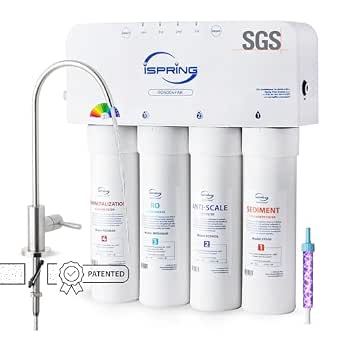 | Best Tankless UV Pick — Space-saving design with filter monitoring | Model: RO500-4FAK | Purification method: Reverse osmosis and ultraviolet | Capacity: Up to 500 gallons per day | VIEW ON AMAZON | See Our Full Breakdown |
| iSpring RCC7P-AK 6-Stage Under-Sink Reverse Osmosis Water Filter with Booster Pump and Alkaline Remineralization |  | Best for Low Water Pressure — Pump-assisted, straightforward RO | Model: RCC7P-AK | Filtration stages: 6 | Purification methods: Reverse osmosis, alkaline, activated carbon, carbon block | VIEW ON AMAZON | See Our Full Breakdown |
| ispring elite series review enhanced water filtration | Model | Dimensions | Capacity | Purification method |
|---|---|---|---|---|
| iSpring RO500AK Alkaline Rever | RO500AK-BN | 17.5 x 5.2 x 16.25 inches | 500 GPD | Reverse osmosis |
| iSpring RCC1UP-AK 7-Stage Unde | RCC1UP-AK | 15.35 x 9.06 x 18.11 inches | — | — |
| iSpring RO5004F-AK Tankless UV | RO500-4FAK | 15.2 x 6.1 x 16.6 inches | Up to 500 gallons per day | Reverse osmosis and ultraviolet |
| iSpring RCC7P-AK 6-Stage Under | RCC7P-AK | 15 x 8 x 18 inches | 75 gallons | — |
More Details on Our Top Picks
iSpring RO500AK Alkaline Reverse Osmosis Water Filtration System, NSF/ANSI 58 Certified, 500 GPD
The RO500AK takes the top spot because it makes a particularly useful combination of claims for buyers comparing enhanced RO filtration: a tankless design, alkaline remineralization, a stated 500 GPD capacity, and NSF/ANSI 58 certification for TDS reduction. Its listed 2:1 pure-to-waste ratio gives shoppers a defined comparison point that the other supplied product descriptions do not provide. The system is also described as reducing up to 99% of listed contaminants, including lead, PFAS, fluoride, and arsenic; that is a product claim, not a guarantee for every home’s water.
Compared with the RCC1UP-AK, the RO500AK gives up UV treatment but brings the clearest certification detail and a higher stated maximum flow rate of 0.4 GPM. Against the RO5004F-AK, it shares the tankless, 500 GPD category but has certification and operating specifications spelled out in the supplied information. Its auto-flush and filter reminders make routine upkeep easier to track, though different filters have different service intervals. I would choose it for a buyer who values documented TDS reduction and cabinet space more than UV treatment. It still requires power, compatible installation, and ongoing filter replacement.
Pros:- NSF/ANSI 58 certified for TDS reduction
- Tankless design saves under-sink storage space
- Alkaline remineralization and filter reminders
- Stated 2:1 pure-to-waste ratio and up to 0.4 GPM flow
Cons:- Requires an electrical connection
- Replacement filters have different service intervals
- Does not list UV treatment among its purification methods
Best for: Buyers seeking a tankless RO system with alkaline remineralization, stated NSF/ANSI 58 certification for TDS reduction, and a specified pure-to-waste ratio.
Not ideal for: Households that specifically want UV treatment, cannot provide an electrical connection, or prefer a system with one simple shared filter-service interval.
- Model:RO500AK-BN
- Purification method:Reverse osmosis
- Certification:NSF/ANSI 58 for TDS reduction
- Capacity:500 GPD
- Maximum flow rate:0.4 GPM
- Pure-to-waste ratio:2:1
- Dimensions:17.5 x 5.2 x 16.25 inches
- Maximum supported water TDS:1,000 ppm
Our verdict“I rank the RO500AK first for its tankless convenience and stated TDS certification, provided UV treatment is not a must-have.”
iSpring RCC1UP-AK 7-Stage Under-Sink Reverse Osmosis Water Filtration System with Booster Pump, UV Filter, and Alkaline Remineralization
For buyers who put UV treatment high on the list, the RCC1UP-AK is the most complete match in this group. It combines pre-filters, a stated 0.0001-micron RO membrane, UV treatment, and alkaline remineralization across seven stages. Its booster pump supports RO performance, while the smart flow sensor activates the UV light when needed rather than leaving it on continuously. That combination gives it a different purpose from the RO500AK, which is tankless and certified for TDS reduction but has no listed UV stage.
The tradeoff is a larger, more involved under-sink setup. At 15.35 x 9.06 x 18.11 inches and 16 kg, it needs cabinet room, and the corded electrical connection adds another installation requirement. The brushed nickel faucet and DIY parts help make the package more complete, but buyers still need to check cabinet dimensions and power access. Compared with the RCC7P-AK, this model adds UV and a seventh stage, while the RCC7P-AK keeps the treatment arrangement simpler and includes a transparent first-stage housing. I would select the RCC1UP-AK when UV is a specific priority, not simply because a higher stage count sounds better.
Pros:- Seven-stage system combines RO, UV, and alkaline remineralization
- Smart flow sensor activates UV when needed
- Booster pump supports RO performance
- Includes brushed nickel faucet and DIY installation parts
Cons:- Requires an electrical connection
- Needs substantial under-sink cabinet space
- Maximum listed flow rate is 0.07 GPM
Best for: Households wanting an under-sink RO system that explicitly combines UV treatment, alkaline remineralization, and a booster pump.
Not ideal for: Buyers who need a tankless unit, have limited cabinet space, or do not want a powered installation.
- Model:RCC1UP-AK
- Filtration stages:7
- Purification methods:Reverse osmosis, alkaline, activated carbon, carbon block, ultraviolet
- Maximum flow rate:0.07 GPM
- Maximum supported TDS:750 ppm
- Installation:Under sink
- Dimensions:15.35 x 9.06 x 18.11 inches
- Warranty:1-year limited manufacturer warranty
Our verdict“I recommend the RCC1UP-AK when UV treatment and a broad multi-stage process matter more than tankless space savings.”
iSpring RO5004F-AK Tankless UV Alkaline Reverse Osmosis Water Filter, 500 GPD
The RO5004F-AK is the natural choice for someone who wants tankless storage savings and UV treatment in the same system. It combines reverse osmosis, ultraviolet treatment, and alkaline remineralization, with a built-in pump intended to support output in low-pressure conditions. Filter-life monitoring and reminders also give it a convenience advantage over the more traditional RCC1UP-AK, whose supplied description highlights a sensor-controlled UV light but not the same monitoring setup.
Its stated capacity is up to 500 gallons per day, and the listed pure-to-drain ratio is 2:1. Those figures make it easier to compare with the RO500AK, but the supplied specifications do not list a certification standard, so I would not treat it as an equivalent substitute for the RO500AK’s stated NSF/ANSI 58 certification. The RO5004F-AK is also compact at 15.2 x 6.1 x 16.6 inches and weighs 15 pounds, though compact does not mean installation-free: it still goes under the sink, needs power, and relies on replacement filters. I place it behind the RCC1UP-AK for buyers who prioritize clearly specified UV operation and behind the RO500AK for certification detail.
Pros:- Tankless format saves under-sink space
- Combines UV treatment with alkaline remineralization
- Built-in pump supports output in low-pressure conditions
- Filter-life monitoring and reminders support maintenance
Cons:- Requires under-sink installation and ongoing filter replacement
- Requires an electrical connection
- Supplied specifications do not list a certification standard
Best for: Buyers who want a tankless under-sink RO system with UV, alkaline remineralization, a built-in pump, and maintenance reminders.
Not ideal for: Shoppers who require a stated certification standard in the supplied specifications or want to avoid powered under-sink equipment.
- Model:RO500-4FAK
- Purification method:Reverse osmosis and ultraviolet
- Capacity:Up to 500 gallons per day
- Pure-to-drain ratio:2:1
- Dimensions:15.2 x 6.1 x 16.6 inches
- Weight:15 pounds
- UV light life:Up to 8,000 hours
- Installation:Under sink
Our verdict“I would choose the RO5004F-AK for tankless convenience plus UV, while buyers prioritizing stated certification should compare it with the RO500AK.”
iSpring RCC7P-AK 6-Stage Under-Sink Reverse Osmosis Water Filter with Booster Pump and Alkaline Remineralization
The RCC7P-AK is the most focused choice for households that need a booster pump for low incoming water pressure and want alkaline remineralization after RO. Its six-stage process is less elaborate than the RCC1UP-AK’s seven stages because it does not list UV treatment, but it retains the central RO approach and a sixth stage for mineral restoration and alkalinity balancing. A transparent first-stage housing is a practical detail: it gives the owner a visible way to check the sediment filter’s condition, though it does not replace the scheduled care of the other filters.
Compared with the tankless RO500AK and RO5004F-AK, this system uses a more traditional under-sink format and takes 15 x 8 x 18 inches of cabinet space. Its listed maximum supported water TDS of 2,000 ppm is higher than the RCC1UP-AK’s 750 ppm figure, but that specification alone does not make it the right choice for every source water. The product information states reduction of up to 99% of more than 1,000 listed contaminants; buyers should check the exact claims and their own water conditions. This model makes the most sense when pressure support and visible first-stage monitoring outrank tankless convenience or UV.
Pros:- Booster pump supports filtration in low-pressure homes
- Six-stage process includes alkaline remineralization
- Transparent first-stage housing helps monitor filter condition
- Listed maximum supported water TDS is 2,000 ppm
Cons:- Requires an electrical connection
- Needs available under-sink cabinet space
- Does not include a listed UV treatment stage
Best for: Households with low water pressure seeking a booster-pump RO system with alkaline remineralization and a visible first-stage housing.
Not ideal for: Buyers who want UV treatment, a tankless design, or a smaller under-sink footprint.
- Model:RCC7P-AK
- Filtration stages:6
- Purification methods:Reverse osmosis, alkaline, activated carbon, carbon block
- Capacity:75 gallons
- Dimensions:15 x 8 x 18 inches
- Maximum supported water TDS:2,000 ppm
- Maximum temperature:100 °F
- Warranty:1-year limited manufacturer warranty upon registration
Our verdict“I recommend the RCC7P-AK for pump-assisted, remineralizing RO when UV and tankless storage are not priorities.”

How We Picked
I compared these four iSpring systems against the promise of enhanced water filtration: what treatment stages are identified, what the product information says about performance, and how the design affects everyday installation and upkeep. I gave weight to concrete distinctions such as the RO500AK’s NSF/ANSI 58 certification for TDS reduction, the RCC1UP-AK’s UV stage and sensor, and the RO5004F-AK’s tankless build with UV and filter-life monitoring.
I also looked at practical fit. A tankless unit can free cabinet space, while a booster pump may be useful where incoming pressure is low; neither detail makes a system universally better. I kept the ranking tied to the supplied specifications and did not treat broad contaminant-reduction statements as a substitute for a model-specific certification. Because source-water conditions, plumbing, and installation differ by home, I recommend checking the relevant product documentation and testing your water before choosing.
| ispring elite series review enhanced water filtration | Model | Purification method | Purification methods |
|---|---|---|---|
| iSpring RO500AK Alkaline Rever | RO500AK-BN | Reverse osmosis | — |
| iSpring RCC1UP-AK 7-Stage Unde | RCC1UP-AK | — | Reverse osmosis, alkaline, activated carbon, carbon block, ultraviolet |
| iSpring RO5004F-AK Tankless UV | RO500-4FAK | Reverse osmosis and ultraviolet | — |
| iSpring RCC7P-AK 6-Stage Under | RCC7P-AK | — | Reverse osmosis, alkaline, activated carbon, carbon block |
Factors to Consider When Choosing Ispring Elite Series Review Enhanced Water Filtration
I would start by matching the system to the water concern and the physical limits of the installation, rather than choosing by stage count alone. These four products share under-sink RO, but their strongest distinctions are UV treatment, tankless layout, pump support, and stated certification details.
Choose treatment for a specific water need
Reverse osmosis is the shared core here, but the added stages differ. The RCC1UP-AK and RO5004F-AK explicitly include UV, while the RO500AK’s standout documented distinction is NSF/ANSI 58 certification for TDS reduction. The RCC7P-AK focuses on RO, carbon filtration, pump support, and alkaline remineralization. I would identify the contaminants or water characteristics you want addressed, then check the product’s exact documentation against a recent water test. A general reduction statement is not the same as proof that a particular contaminant is reduced under your conditions.
Tankless convenience versus cabinet layout
The RO500AK and RO5004F-AK are tankless, a useful design difference when cabinet space is tight. Their listed dimensions still need to be checked against plumbing, disposal units, and stored items; tankless does not mean no under-sink footprint. The RCC1UP-AK and RCC7P-AK are also substantial under-sink systems, so measure the cabinet before ordering and allow room to reach filters and connections. I would not choose on dimensions alone: installation access matters as much as the unit’s outer size.
Flow, pressure, and stated capacity
Capacity and flow specifications describe different things, so I would avoid treating GPD as a promise of a particular faucet experience in every home. The RO500AK lists up to 0.4 GPM and 500 GPD; the RO5004F-AK lists up to 500 gallons per day, while the RCC1UP-AK lists a maximum flow rate of 0.07 GPM. The RCC1UP-AK and RCC7P-AK include booster pumps, and the RO5004F-AK describes a built-in pump for low-pressure conditions. Check household water pressure and the operating requirements for the model you choose.
Certification and performance claims
Among the supplied product details, the RO500AK explicitly lists NSF/ANSI 58 certification for TDS reduction. That is a more specific purchasing detail than a broad statement about reducing many contaminants. The RCC1UP-AK, RO5004F-AK, and RCC7P-AK descriptions include treatment features or reduction claims, but the supplied information does not list the same certification. I would verify the exact model, certification scope, and contaminant claims in current manufacturer materials before relying on a system for a health-related water concern.
Plan for power and filter upkeep
Each of these systems requires an under-sink installation, and the powered models need an electrical connection. Filter reminders on the RO500AK and RO5004F-AK can help track maintenance, while the RCC1UP-AK’s flow sensor controls UV activation. The RO500AK’s filter intervals differ by cartridge, so a reminder does not remove the need to follow each replacement schedule. Before choosing, check filter availability, replacement instructions, warranty terms, and whether you can access the unit easily after installation.
Decide whether remineralization and UV belong in your setup
All four listed picks include an alkaline remineralization stage or are described as alkaline, so that feature alone does not separate them much. UV is more selective: it appears in the RCC1UP-AK and RO5004F-AK descriptions. I would choose UV only if it fits the treatment plan for your water and household, rather than assuming extra stages are automatically better. For a buyer who values stated certification and a tankless build, the RO500AK remains the more evidence-specific option in this lineup; for UV, compare the RCC1UP-AK’s sensor-controlled light with the RO5004F-AK’s tankless format.
Frequently Asked Questions
Which iSpring system in this comparison has UV treatment?
The RCC1UP-AK and RO5004F-AK are the two models whose supplied descriptions explicitly list UV treatment. The RCC1UP-AK has a smart flow sensor that activates its UV light when needed, while the RO5004F-AK combines UV with a tankless layout, built-in pump, and filter-life monitoring. Neither detail by itself establishes that UV is necessary for every home; I would match treatment to your water information.
Which model has the clearest certification information?
The RO500AK is the only product in this supplied lineup that explicitly lists NSF/ANSI 58 certification, specified for TDS reduction. The other models include filtration features and contaminant-reduction claims, but their provided details do not list that same certification. I would confirm the certification scope and exact model identity in current product documentation before using it as a deciding factor.
Are these systems suitable for low water pressure?
The RCC1UP-AK and RCC7P-AK have booster pumps, and the RO5004F-AK description says its built-in pump supports output in low-pressure conditions. The RO500AK lists an operating pressure range of 15–70 psi, which can help buyers compare it with their supply. Check your measured pressure and the manufacturer’s installation requirements; pump support does not remove the need to confirm that a specific model fits your plumbing and conditions.
Do all four systems add minerals back to the water?
Yes, each product description identifies alkaline remineralization or an alkaline stage. That shared feature makes other differences—such as UV, certification details, tankless design, and pump configuration—more useful for separating the models. If mineral content or water chemistry is a specific concern, review the manufacturer’s details and consider testing your treated water rather than inferring an exact result from the word alkaline.
What should I check before installing an iSpring under-sink RO system?
I would measure the cabinet, check for a suitable electrical outlet, review the plumbing connections, and leave working space for filter changes. Also check incoming water pressure, source-water conditions, replacement-filter schedules, and warranty requirements. The tankless RO500AK and RO5004F-AK can reduce storage demands, but they still need under-sink room and access; the RCC1UP-AK and RCC7P-AK need cabinet space for their systems as well.
Conclusion
My pick depends on what you want enhanced filtration to mean. Choose the RO500AK for a tankless design, stated NSF/ANSI 58 certification for TDS reduction, and a specified 2:1 pure-to-waste ratio. Choose the RCC1UP-AK if UV treatment, a sensor-controlled light, and seven-stage RO are your priorities. The RO5004F-AK fits buyers who want tankless convenience with UV and filter reminders, while the RCC7P-AK suits low-pressure homes that prefer pump-assisted RO without a listed UV stage.
Before deciding, I would check cabinet measurements, access to power, household water pressure, exact filter schedules, and the treatment claims relevant to your source water. Those checks matter more than choosing the system with the most stages: the right option is the one whose documented features match your water needs and installation limits.
Fall Picks
fall essentials
As an affiliate, we earn on qualifying purchases.