TL;DR
Artist and designer Jude Morgan used the back of her sofa and a pair of orange chairs to define two areas in her small living room: one oriented toward the television and one for making art. Apartment Therapy’s House Tour report says separate rugs helped distinguish the spaces without adding a partition.
Artist and designer Jude Morgan arranged her sofa with its back toward a pair of orange chairs, creating separate living and art areas in the small living room of her 1920s rental, according to an Apartment Therapy House Tour report. The layout gives the television-facing seating area and a place to work at an easel distinct orientations without a wall or additional divider.
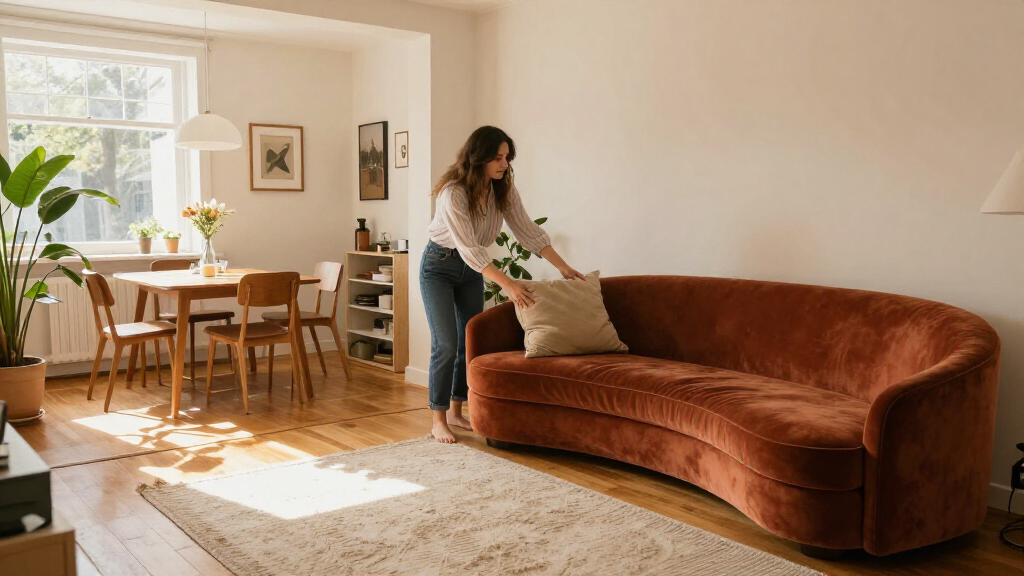
Morgan said her first priority in choosing an apartment was finding one that could accommodate her “ginormous” sofa. She also wanted a dedicated place to make art, after previously working in shared areas of her homes. The arrangement emerged when she positioned the sofa across the room: its back then served as a boundary for the second seating area.
The television faces the main living area. Behind the sofa, two orange chairs face the room’s French windows and the art space, where Morgan keeps an easel. The report describes the chairs as an Anthropologie design, though it says they are sold out. Two rugs further mark the separate areas: a West Elm Walker Noble Kuba Wool rug in the art space and another rug in the living area.
Morgan also used family items to give the art area a personal character. She said the chair pillows came from her mother and the records displayed on the wall were from her father’s collection. The Apartment Therapy report presents the arrangement as an example of using existing furniture placement to make a small room serve more than one purpose.
How One Sofa Defines Two Areas
The layout shows how the orientation of furniture can shape how a room is used. Morgan’s sofa separates a television-oriented living space from a quieter area for art, while the chairs provide seating in the second zone. The rugs reinforce the distinction visually, without a permanent wall or a new piece of dividing furniture.
For readers with small or awkwardly shaped rooms, the arrangement offers a practical idea to test with furniture they already own. Its usefulness will depend on a room’s dimensions, circulation paths, and the size of the furniture. The report does not provide measurements or say whether the setup would suit other layouts, so it is an example rather than a universal solution.
Morgan’s Search for an Art Space
Morgan’s apartment is described in the source as a 1920s rental. Her goals were shaped by two specific needs: room for a large sofa and a dedicated place to create art. Apartment Therapy says she had previously worked in communal parts of her homes and wanted an area set aside for making work.
In its account, the furniture placement was the turning point. The sofa continued to anchor the living room and face the television, while chairs placed behind it established another direction and use. The article also mentions other unconventional furniture placements as examples of changing how a living space functions, but its central focus is Morgan’s home tour and the arrangement she chose.
““As soon as I put my sofa this way, I realized that was the best decision because it created two completely separate faces.””
— Jude Morgan, speaking in the House Tour quoted by Apartment Therapy
Room Dimensions and Layout Details
The report does not give the room’s dimensions, the furniture measurements, or the distance between the seating areas. It also does not describe how people move through the room or whether the furniture arrangement changed over time. Those details would affect how well the idea could work in another home.
The source identifies the orange chairs as an Anthropologie design and says they are sold out, but it does not provide a current price or availability for the rugs. Apartment Therapy notes that it may earn a commission if readers buy products through its links; the article says prices were accurate at the time of publication.
More Details in the House Tour
Apartment Therapy directs readers to Morgan’s full House Tour for more views and details about her home. The report does not announce a renovation, a follow-up project, or another planned development. Based on the available account, the next step for readers interested in the layout is to consult the full tour and assess whether their own room can accommodate back-to-back seating and clear paths through the space.
Key Questions
How did Jude Morgan create two areas in one living room?
She placed a pair of orange chairs behind her sofa, facing away from the main living area. The sofa faces the television, while the chairs and easel form a separate art area.
Did Morgan add a wall or room divider?
The Apartment Therapy report describes furniture placement and separate rugs defining the areas. It does not report that Morgan added a wall or a physical partition.
What helped distinguish the art area?
A West Elm Walker Noble Kuba Wool rug, an easel, family keepsakes, and the chairs helped identify the area as a place for art and quiet seating, according to the report.
Are the orange chairs still available?
Apartment Therapy says the Anthropologie chairs featured in the tour are sold out. The report does not provide updated availability or identify an alternative model.
Source: rss