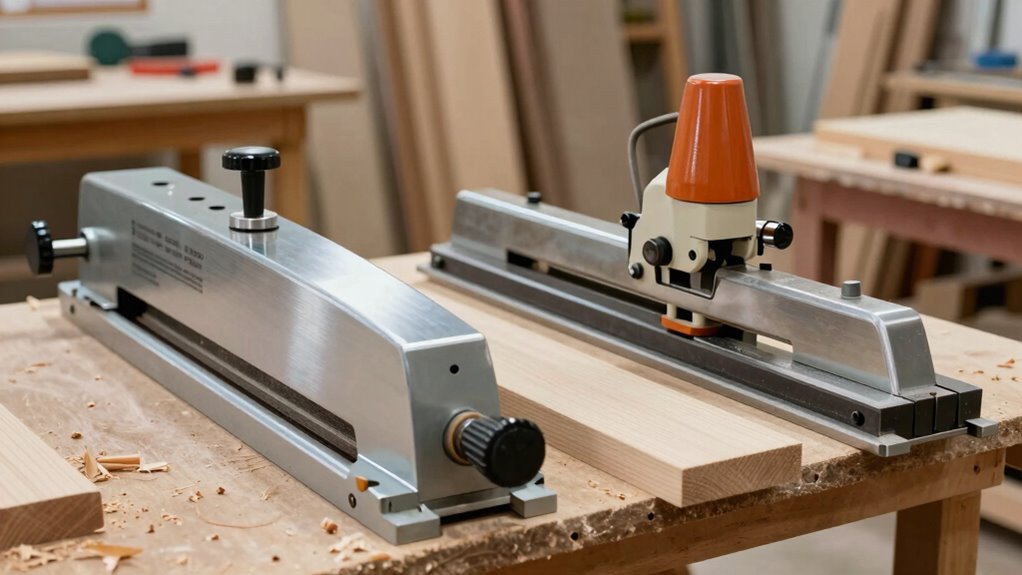
Planers and jointers are essential tools that help you prepare wood for projects. A jointer straightens and flattens edges so boards fit tightly together, making your pieces square and smooth. A planer smooths the surface and reduces thickness evenly across the wood. Understanding what each tool does helps you choose the right one for your task. Keep going to discover more tips to get the best results from both tools.
Key Takeaways
- Jointers flatten and straighten edges, preparing them for precise joining or gluing.
- Planers smooth surfaces and make them a consistent thickness for a polished look.
- Use a jointer to fix warped or uneven edges; use a planer to reduce thickness evenly.
- Jointers focus on edges; planers work on broad surface faces.
- Both tools work together for perfect wood preparation—jointers for edges, planers for surfaces.

JORGENSEN Chamfer Plane, Edge Corner Plane with 4 Cutter Heads, Storage Space – Hand Plane for Woodworking, Carpenter Woodworking Tools for Edge Trimming of Wood, Edge Corner Flattening
Professional Level Blade: The blade is a professional level O1 tool steel, improving sanding efficiency while minimizing blade…
As an affiliate, we earn on qualifying purchases.
As an affiliate, we earn on qualifying purchases.
What Are Jointers and How Do They Prepare Wood Edges?

Have you ever wondered how woodworkers create perfectly flat, straight edges? It all starts with understanding grain direction and edge flattening. When preparing wood for joinery, you need a clean, smooth edge that fits tightly with other pieces. Jointers are designed to remove unevenness and correct warping along the edge, ensuring it’s straight and square to the face. You begin by checking the grain direction—working against it can cause tear-out, so you align the grain properly. Using a jointer, you feed the board along the cutter head, which shaves off any high spots and evens out the edge. This process results in a perfectly flat, straight edge, ready for gluing or further machining. Proper edge flattening is essential for a tight, seamless fit in woodworking projects. Additionally, understanding how to properly set up and adjust the jointer can significantly improve the quality of your results. Being aware of wood grain patterns and their impact on cutting can also help prevent tear-out and achieve cleaner edges. Moreover, maintenance of the jointer plays a crucial role in maintaining consistent and high-quality cuts over time. Developing a good technique for feeding the wood can further enhance the smoothness and accuracy of your cuts, ensuring optimal results. Familiarity with grain orientation can help you anticipate and avoid common problems during edge preparation.

JORGENSEN No.101 Mini Wood Planer – Mini Hand Planer for Woodworking, Block Plane, Small Hand Plane for Trimming, Wood Planing, Craft, Professional Ductile Iron Body, Adjustable Cutting Depth
Professional Level Blade: The blade is made of professional level O1 tool steel, improving cutting efficiency while minimizing…
As an affiliate, we earn on qualifying purchases.
As an affiliate, we earn on qualifying purchases.
How Do Planers Make Surfaces Smooth and Even?

A planer works by shaving thin layers off the surface of a board to create a smooth, even finish. It removes uneven spots and high spots, guaranteeing surface leveling throughout the wood. This process also helps with grain smoothing, reducing roughness caused by natural wood patterns. As you feed the board into the planer, the blades cut the surface consistently, resulting in a uniform thickness. This not only improves the appearance but also prepares the wood for further finishing or assembly. You’ll notice how the surface feels much smoother after planning, making it easier to work with. Plus, the even surface reduces glue gaps and helps achieve a professional look. Fundamentally, your planer is a powerful tool for transforming rough lumber into polished, ready-to-use pieces.
- You get a consistent, smooth surface every time
- Grain smoothing reduces roughness and splinters
- Surface leveling ensures uniform thickness
- Makes finishing easier and more professional
- Saves time compared to manual sanding
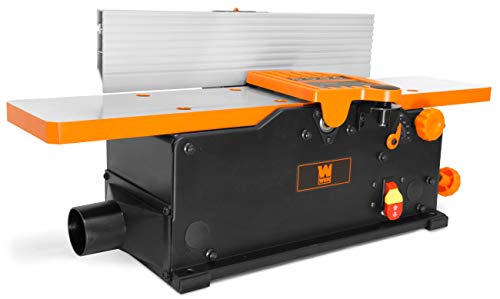
WEN JT3062 10-Amp 6-Inch 2-Blade Benchtop Jointer, Black
10-amp motor provides up to 22,000 cuts per minute anywhere from 0 to 1/8 of an inch in…
As an affiliate, we earn on qualifying purchases.
As an affiliate, we earn on qualifying purchases.
Jointers vs. Planers: What’s the Main Difference?
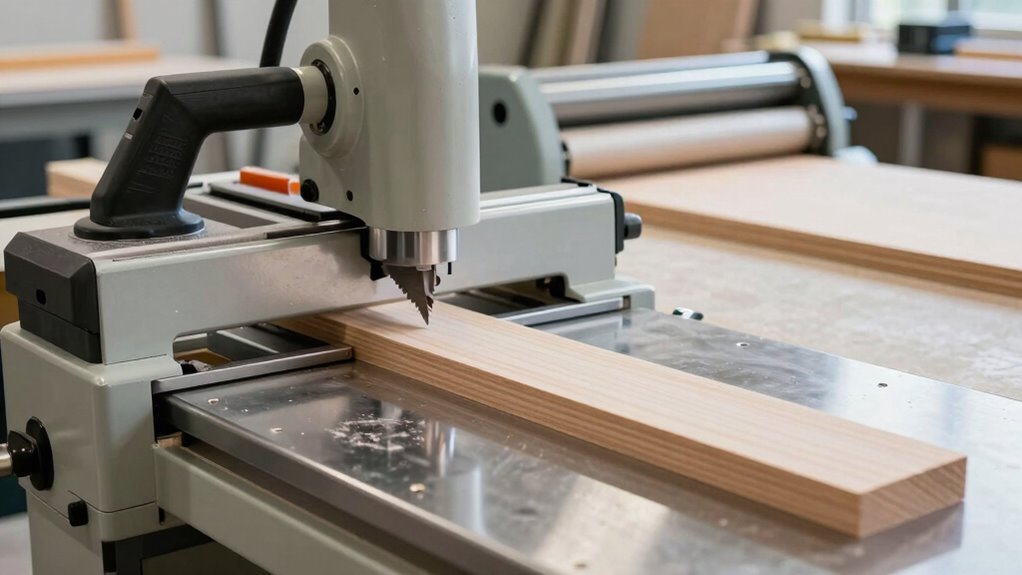
Ever wondered how jointers and planers differ in woodworking? The main difference lies in their purpose. Jointers are designed to create a flat, square edge by removing unevenness and aligning the wood grain. Planers, on the other hand, focus on reducing thickness and smoothing surfaces after edges are squared. The key to their effectiveness is blade sharpness, which impacts cut quality and surface finish. Proper tool maintenance ensures these blades stay sharp and perform optimally. Regularly checking and sharpening blades helps maintain cut quality and prolongs the life of the tools. Additionally, understanding the contrast ratio of your tools can help in achieving precise cuts and finishes. Here’s a quick comparison:
| Tool | Primary Function | Best For |
|---|---|---|
| Jointer | Flattening and squaring edges | Preparing edges for glue-up |
| Planer | Reducing thickness and smoothing | Achieving uniform thickness |
| Blade Sharpness | Ensures clean cuts and smooth finishes | Maintains wood grain integrity |

Amazon Basics Woodworking Hand Planer – No.4 Adjustable Bench Plane with 2-Inch Steel Blade for Quality Wood Smoothing Cuts, Grey/Black
Professional quality: Durable cast iron body provides stability and strength;
As an affiliate, we earn on qualifying purchases.
As an affiliate, we earn on qualifying purchases.
When Should You Use a Jointer Instead of a Planer?

Knowing when to use a jointer instead of a planer depends on the task at hand. Use a jointer when you need to create perfectly straight edges or flatten one face of the wood. It’s essential for preparing boards for glue-ups and ensuring consistent wood thickness along the edges. A planer, on the other hand, is better suited for reducing overall wood thickness and smoothing large surface areas.
Use a jointer for straight edges and flattening; a planer for thickness reduction and surface smoothing.
Consider using a jointer if:
- You want to straighten uneven or warped edges
- You need to prepare edges for gluing
- You’re working with rough-sawn wood requiring flattening
- You want precise edge straightness for accurate assembly
- You’re fixing bowed or twisted boards before planing the surface
How to Decide Which Tool Is Right for Your Woodworking Project

Choosing between a jointer and a planer depends on the specific needs of your project. First, consider tool compatibility: if you need to flatten and straighten rough lumber edges, a jointer is essential. If you want to create smooth, uniform surfaces on thick boards, a planer is your go-to. Your budget considerations also matter; jointers tend to be more expensive upfront, but planers can be more versatile if you already own some woodworking tools. Think about the tasks you’ll perform most often—if you frequently prepare rough stock, a combination of both tools might be best. Ultimately, understanding your project requirements and available budget will help you decide which tool will serve you best and improve your woodworking efficiency.
Common Mistakes to Avoid When Using Jointers and Planers
Using jointers and planers correctly is essential to achieving professional results and ensuring safety, but many woodworkers make mistakes that can lead to poor finishes or accidents. To avoid this, always follow safety precautions and maintenance tips. First, never bypass safety guards or ignore safety instructions. Second, regularly clean and inspect your tools for worn parts or debris. Third, avoid feeding wood too quickly to prevent kickback or uneven cuts. Fourth, always use proper push sticks or push blocks for safety. Fifth, ensure your blades are sharp and properly aligned before use. Staying vigilant with safety precautions and regular maintenance tips helps prevent accidents and guarantees cleaner, more precise results. Additionally, understanding the importance of Free Floating mechanisms can improve your control and safety during operation. Remember, proper technique and care are key to successful woodworking with jointers and planers. Being aware of proper setup and maintaining consistent blade condition further enhances safety and quality. Regularly practicing these safety measures can significantly reduce the risk of accidents and improve your overall woodworking experience. Incorporating correct technique can also help achieve smoother finishes and more accurate cuts. Also, paying attention to blade alignment ensures optimal performance and safety during operation.
Frequently Asked Questions
Can I Use a Planer to Straighten Uneven Wood Edges?
You can use a planer to straighten uneven wood edges, but it’s not ideal for edge jointing. To do this effectively, you’d need to carefully set the planer blades to remove just enough material. Keep in mind, planers excel at surfacing large, flat surfaces, but for precise edge jointing, a jointer is better. Use a planer for minor corrections, but rely on a jointer for perfectly straight edges.
What Safety Precautions Should I Follow With Jointers and Planers?
Safety with jointers and planers isn’t just about avoiding injury—it’s about respecting the blades that can cut sharply and harm you. Always keep your hands clear of blade danger zones and use push sticks when necessary. Wear eye and dust protection to prevent debris from causing harm. Double-check blade safety covers before use, and keep your workspace clean. Remember, safety precautions protect you from serious injuries and ensure smooth, effective woodworking.
Are There Specific Wood Types Better Suited for Jointers or Planers?
You’ll find softer woods like pine and cedar work well with jointers and planers, as they’re easier to shape and less likely to cause damage. Hardwoods such as oak and maple can also be used but require more caution. The wood’s compatibility affects finishing effects—smoother, uniform surfaces lead to better results. Always choose the right wood for your project to guarantee ideal tool performance and a high-quality finish.
How Do I Maintain and Clean My Jointer and Planer?
To keep your jointer and planer in top shape, regularly clean the dust collection system to prevent buildup and guarantee smooth operation. Sharpen your blades when they become dull to maintain cutting quality. Also, wipe down surfaces and check for debris or resin buildup. Proper maintenance prolongs the tools’ lifespan and keeps your projects precise. Remember to turn off and unplug them before cleaning or blade sharpening for safety.
Can I Rent These Tools Instead of Buying?
Yes, you can rent these tools instead of buying to save on equipment costs. Tool rental companies offer jointers and planers for short-term use, which is perfect if you only need them for a specific project. Renting allows you to access high-quality equipment without the upfront expense, making it a cost-effective option while ensuring you have the right tools for your woodworking needs.
Conclusion
Think of jointers and planers as your woodworking toolbox’s trusty compass and map. The jointer straightens and edges your wood, while the planer smooths its surface like a gentle river flowing seamlessly. Knowing when to use each guarantees your project stays on course. Mastering these tools is like steering with confidence—turning rough, uncharted wood into a beautifully crafted masterpiece. With practice, you’ll confidently direct your woodworking journey to success.