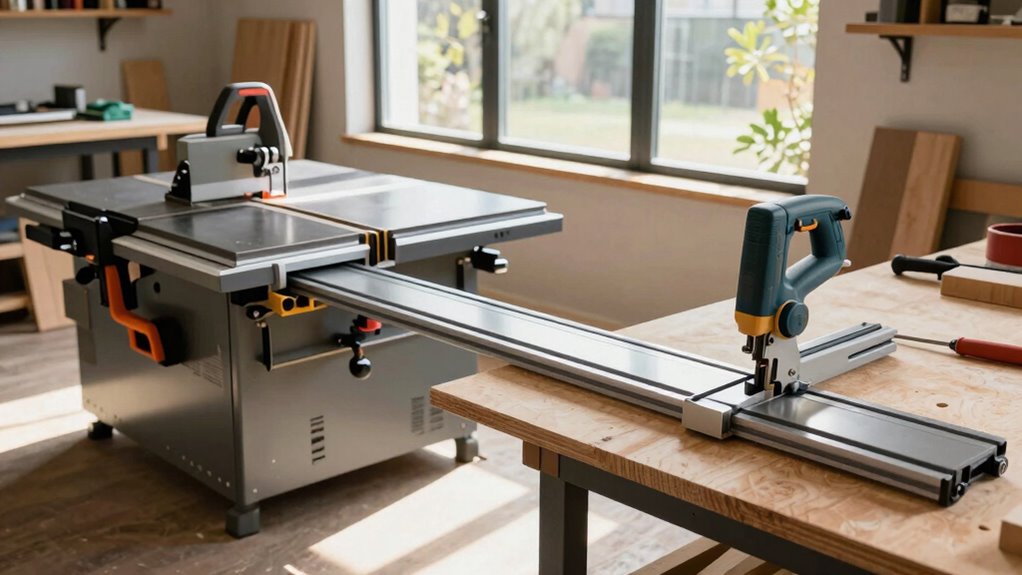

If your home workshop is spacious and you frequently work on large projects, a table saw offers stability, precision, and power for ripping and crosscuts. For smaller spaces or projects needing portability, a track saw is ideal because it’s easy to move and handles sheet cuts accurately. Both tools require safety features and dust collection systems to keep your workspace safe and clean. Keep exploring to discover which saw best fits your specific workshop needs and projects.

Get furniture and decor delivered free with Prime
- Fast, free delivery on millions of items
- Prime Video, Amazon Music and more included
- Member-only deals all year
Key Takeaways
- Table saws are ideal for large, stable workshops focused on precise, repetitive cuts for furniture and cabinetry projects.
- Track saws offer portability, making them suitable for small workshops, on-site work, or limited space environments.
- Both saw types enhance safety with features like blade guards and dust collection, fitting various workshop safety standards.
- Dust collection integration in both saws maintains a clean workspace, improving visibility and overall safety.
- Selecting between them depends on project size, workspace space, and the need for mobility or large-material handling.
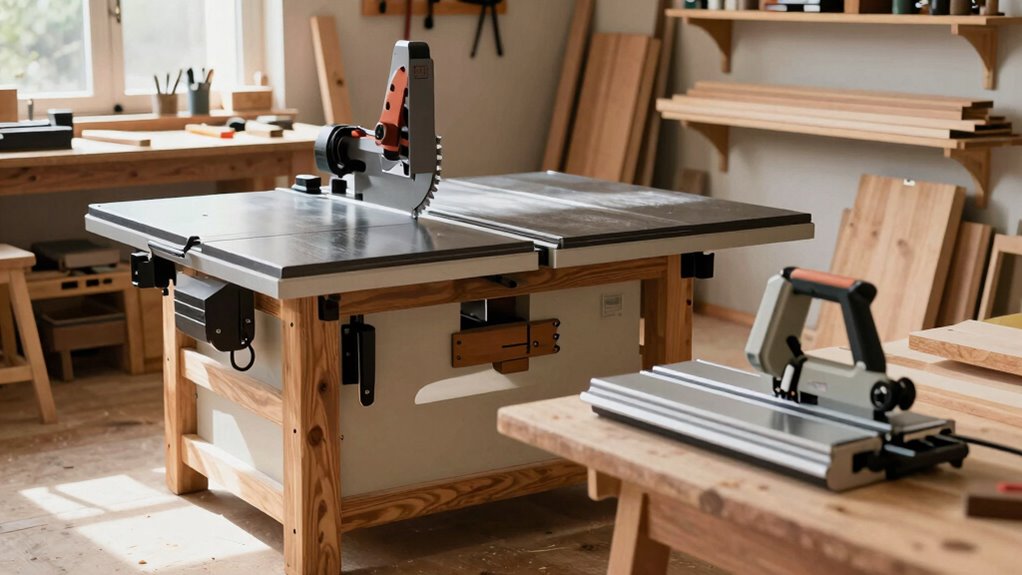
When setting up a home workshop, choosing the right saws can make all the difference in your projects. Whether you’re working on furniture, cabinetry, or small crafts, your choice impacts not only the quality of your cuts but also your safety and workspace cleanliness. Table saws are often the centerpiece of a dedicated workshop. They provide stability and precision for ripping long boards and making accurate crosscuts. With a sturdy fence and a powerful motor, a table saw allows you to handle larger materials with ease. However, safety should always be your priority. Modern table saws come equipped with blade safety features, such as riving knives and blade guards, which help prevent kickbacks and protect your fingers during cuts. Proper blade safety practices are essential; always make certain guards are in place and that you’re using push sticks when necessary. Dust collection is another essential aspect of a well-designed workshop. A good table saw should be connected to a dust extraction system to keep the workspace clean, reduce airborne particles, and maintain clear visibility of your cut line. A dust-collection system also prolongs the life of your saw and keeps your environment healthier. Additionally, blade safety features are crucial for minimizing accidents and ensuring a safer working environment.
On the other hand, track saws excel in versatility and portability. If your workshop space is limited or you prefer to work on-site, a track saw might be your best option. These saws are designed for precise, straight cuts along panels and sheets, making them ideal for cabinetry or furniture projects where large surfaces need to be cut down to size. Since track saws are portable, they don’t require a dedicated space, and you can easily bring them to different locations. When working with a track saw, blade safety remains just as important. Make sure the blade guard is always in place, and handle the tool with care to avoid accidents. Dust collection is equally essential here; many track saws feature built-in dust ports or are compatible with shop vacuums, ensuring your workspace stays clean and dust-free. Additionally, portability and versatility are key advantages that set track saws apart from stationary options. Incorporating dust collection systems with your tools can significantly improve your workshop environment and safety.
Ultimately, the best saw for your home workshop depends on your specific needs. If you often work with large pieces and require precise, repeated cuts, a table saw offers unmatched stability and power. If your projects are smaller or you need mobility, a track saw provides flexibility and convenience. Whichever you choose, emphasizing blade safety and effective dust collection will help you create quality work safely and efficiently.
As an affiliate, we earn on qualifying purchases.
Frequently Asked Questions
Can Both Saw Types Handle Large, Thick Hardwoods Effectively?
Both saw types can handle large, thick hardwoods, but with differences. A table saw generally offers better cutting precision and can manage thicker, denser materials more effectively, especially with stable support. Track saws excel at making precise, straight cuts on large panels, but may struggle with extremely thick hardwoods due to limited motor power. Consider your specific needs for grain thickness and cutting accuracy to choose the best tool.
Which Saw Is Safer for Beginner Woodworkers?
A track saw is generally safer for beginner woodworkers because it offers better safety features like controlled cutting and less kickback. Its design minimizes the risk of accidents, making it more suitable for those just starting out. When considering safety, keep beginner considerations in mind, such as ease of use and safety features, to guarantee a safer and more confident woodworking experience.
Do Track Saws Require Specialized Blades?
Did you know that most track saws don’t require specialized blades? You can often use standard blades, but blade compatibility varies by model. Safety features like blade guards and riving knives are common, enhancing safety during cuts. While some track saws have specific blades for particular materials, many users find that standard blades work well, making them versatile and accessible for different projects in your home workshop.
Are There Mobility Differences Between the Two Saws?
Yes, there are mobility differences between the two saws. Track saws are more portable, allowing you to easily transport them and adapt to different workspace setups. They excel in workspace flexibility, fitting into smaller or changing areas. Table saws tend to be bulkier and fixed, making them less portable but better suited for a dedicated workshop. Your choice depends on how much mobility and workspace flexibility you need.
How Do Maintenance Requirements Compare for Each Saw?
You’ll find that table saws generally require more maintenance, especially with blade maintenance and motor upkeep, since they’re larger and have more moving parts. Track saws tend to be easier to maintain, with less frequent blade changes and simpler motor upkeep. Regular cleaning and blade sharpening are essential for both, but you’ll spend more time on motor and blade maintenance with a table saw to keep it running smoothly.
Conclusion
Imagine the warm scent of freshly cut wood filling your home workshop as your chosen saw hums steadily. Whether you prefer the steady precision of a table saw or the sleek control of a track saw, each tool shapes your projects and fuels your creativity. With the right saw by your side, your workshop becomes a haven of craftsmanship, where every cut brings your vision to life—one perfect piece at a time.
Halloween Picks
halloween
As an affiliate, we earn on qualifying purchases.