For most low-voltage landscape lighting projects, I’d start with the GOSDENG 14 AWG 2-Conductor Wire, 250 ft: its middle-ground gauge and long roll suit many yard layouts. The SUNVIE 12/2, 250 ft is a stronger fit for longer runs or higher loads, while the GOSDENG 16/2, 250 ft may suit smaller systems where lighter cable is adequate. The main tradeoffs are wire gauge, run length, and how much cable your layout actually needs. Read on for how these 11 options compare and which one best fits your project.

Get furniture and decor delivered free with Prime
- Fast, free delivery on millions of items
- Prime Video, Amazon Music and more included
- Member-only deals all year
Complete the kit


Key Takeaways
- 14 AWG is the roundup’s middle-ground choice: the 250-foot GOSDENG and Energeaster rolls balance longer coverage with a thicker conductor than the 16 AWG options.
- 12 AWG stands apart for demanding layouts: the SUNVIE and GOSDENG 12-gauge, 250-foot cables are the picks to compare when runs are long or the connected lighting load is higher.
- Roll length changes the fit as much as gauge: 50- and 100-foot options may better match compact projects, while 200- and 250-foot rolls suit broader layouts.
- There are near-matches across brands and sizes: several products share a gauge and two-conductor format, so buyers can focus on needed length and verified cable specifications rather than assuming a brand name changes performance.
- Plan the system before choosing cable: gauge alone cannot determine suitability; total connected load, run distance, installation method, and transformer compatibility also matter.




| cable for outdoor lighting | Length | Conductors | Conductor material | Gauge |
|---|---|---|---|---|
| GOSDENG 14 AWG 2-Conductor Low | 250 ft | 2 | Copper-clad aluminum | 14 AWG |
| GOSDENG 16/2 Low Voltage Lands | 250 ft | 2 | Copper-clad aluminum | 16 AWG |
| Energeaster 250 ft 16 AWG 2-Co | 250 ft | 2 | Copper-clad aluminum | 16 AWG |
| Elite 16 AWG 2-Conductor Low-V | 50 ft | 2 | Pure copper | 16 AWG |
| SUNVIE 100 ft 12/2 Low-Voltage | 100 ft | 2 | Pure copper | 12 AWG |
| Energeaster 250 ft 14 AWG 2-Co | 250 ft | 2 | Copper-clad aluminum | — |
| FIRMERST 14/2 Low Voltage Land | 200 feet | 2 | Copper | — |
| SUNVIE 100 ft 16/2 Low Voltage | 100 ft | 2 | Pure copper | — |
| GOSDENG 12/2 Low-Voltage Lands | 250 ft | 2 | Copper-clad aluminum | — |
| UBOORY 16/2 Low Voltage Landsc | 100 feet | 2 | Bare copper | — |
| SUNVIE 12/2 Low-Voltage Landsc | 250 ft | 2 | Pure copper | 12 AWG |
More Details on Our Top Picks
GOSDENG 14 AWG 2-Conductor Low-Voltage Landscape Wire, 250 ft
For a long outdoor lighting layout where flexibility and footage matter, I’d shortlist this 250-foot, 14 AWG cable. Its thicker conductors than the GOSDENG 16/2 give it a better fit for longer low-voltage runs, while the flexible PVC jacket can make routing around beds and borders easier. The tradeoff is conductor material: this uses copper-clad aluminum, not pure copper like the Elite 16 AWG wire or SUNVIE 12/2. That can suit projects where lower weight and flexibility are priorities, but buyers seeking pure-copper conductors should choose another option. The supplied data specifies 12 V use, so I would not select it for systems operating at other voltages without confirming compatibility. Its generous spool length also means less need to join short sections across a larger yard.
Pros:- 250-foot length covers a broad layout with fewer cable joins
- 14 AWG is thicker than the listed 16 AWG alternatives for longer runs
- Flexible PVC jacket supports easier routing
- Lighter copper-clad aluminum conductors are easier to handle than heavier copper wire
Cons:- Copper-clad aluminum is not pure copper
- Specified for 12 V applications, limiting fit for other system voltages
Best for: Homeowners wiring a larger 12 V landscape lighting layout who want a long spool of flexible 14 AWG cable.
Not ideal for: Buyers who require pure-copper conductors or whose lighting system is not rated for 12 V.
- Gauge:14 AWG
- Length:250 ft
- Conductors:2
- Conductor material:Copper-clad aluminum
- Jacket:Black PVC
- Voltage:12 V
- Strands:51
- Operating temperature:-35°C to 105°C
Our verdict“Choose this for a long 12 V lighting run when 14 AWG and flexible handling matter more than pure-copper conductors.”
GOSDENG 16/2 Low Voltage Landscape Wire, 250 ft
I’d pick this GOSDENG when the plan calls for a full 250 feet of 16-gauge cable and the system uses 12 V. It shares the flexible PVC jacket and copper-clad aluminum conductors of the 14 AWG GOSDENG, but the smaller gauge makes it better suited to layouts where the run length and electrical requirements are appropriate for 16 AWG. Compared with the Elite 16 AWG wire, it provides five times the listed length, but the Elite specifies pure copper and direct-burial, waterproof, and UV-resistant features that are not stated here. The spool format is practical for storing and feeding wire during installation. I’d skip it when the project demands pure copper or documented direct-burial suitability.
Pros:- 250-foot spool supports larger layouts with fewer joins
- Flexible PVC jacket helps with routing around landscaping
- Two conductors serve common low-voltage lighting connections
- Operating range is listed from -35°C to 105°C
Cons:- Copper-clad aluminum is not pure copper
- Direct-burial and UV-resistance ratings are not provided in the supplied details
- 16 AWG may not suit every longer run or system load
Best for: DIYers planning a sizeable 12 V lighting layout with cable runs suited to 16 AWG and wanting one long spool.
Not ideal for: Installers who need documented direct-burial ratings, pure-copper conductors, or a thicker gauge for their system design.
- Gauge:16 AWG
- Length:250 ft
- Conductors:2
- Conductor material:Copper-clad aluminum
- Jacket:Black PVC
- Voltage:12 V
- Strands:42
- Operating temperature:-35°C to 105°C
Our verdict“Choose this for extensive 12 V layouts that can use 16 AWG and do not require the Elite wire’s stated burial and environmental ratings.”
Energeaster 250 ft 16 AWG 2-Conductor Low-Voltage Landscape Wire
This Energeaster is a flexible pick for buyers whose outdoor lighting is part of a broader 12 V or 24 V DC project. Like the GOSDENG 16/2, it offers 250 feet of 16 AWG, two-conductor cable with a PVC jacket and copper-clad aluminum conductors. Its listed compatibility with both 12 V and 24 V DC applications gives it a stated range the GOSDENG 16/2 does not provide. The product details also describe the jacket as flame-retardant and resistant to aging and moisture, though they do not specify a direct-burial or certification rating. Compared with the Elite 16 AWG, it brings much more cable, while the Elite provides pure copper and explicit outdoor installation credentials. I’d choose Energeaster for flexible project use, not when documented burial ratings are the deciding factor.
Pros:- 250-foot length can serve larger or multi-part low-voltage projects
- Listed for 12 V and 24 V DC applications
- Flexible construction can simplify routing
- PVC jacket is described as flame-retardant and resistant to moisture and aging
Cons:- Copper-clad aluminum conductors are not pure copper
- Gauge-specific voltage and temperature ratings are not detailed beyond the product information
- Direct-burial approval is not stated
Best for: DIYers combining landscape lights with other 12 V or 24 V DC connections and needing a long, flexible spool.
Not ideal for: Buyers who need pure copper or a clearly stated direct-burial and certification rating for a buried installation.
- Gauge:16 AWG
- Length:250 ft
- Conductors:2
- Conductor material:Copper-clad aluminum
- Jacket:PVC
- Color:Black
- Intended voltage:12 V or 24 V DC
- Operating temperature:-35°C to 105°C
Our verdict“Choose Energeaster when you need a flexible 16 AWG spool for varied low-voltage DC uses, but not when burial certification is mandatory.”
Elite 16 AWG 2-Conductor Low-Voltage Landscape Lighting Wire, 50 ft
For a short run that will be buried outdoors, I’d favor the Elite over the longer GOSDENG and Energeaster spools because it specifically lists direct-burial use, waterproofing, UV resistance, and UL-related certifications. Its pure-copper conductors are another distinction from those copper-clad aluminum alternatives. The compromise is reach: at 50 feet, it offers far less cable than their 250-foot spools, so a larger yard may require additional sections or a different product. Its stated voltage limit is up to 30 V, making it a defined choice for compatible low-voltage systems rather than a general-purpose high-voltage cable. For buyers prioritizing documented outdoor installation features over footage, that tradeoff is sensible; for broad layouts, the longer GOSDENG options are more convenient.
Pros:- Pure-copper conductors
- Rated for direct burial
- Waterproof and UV resistant
- UL listed and described as meeting several UL and CSA standards
Cons:- 50-foot length is much shorter than the 250-foot GOSDENG and Energeaster options
- Limited to applications up to 30 V
Best for: Homeowners installing a short, buried low-voltage lighting run who want pure copper and stated outdoor ratings.
Not ideal for: Buyers wiring a large property or a system above 30 V, or those who need a longer spool for fewer connections.
- Gauge:16 AWG
- Length:50 ft
- Conductors:2
- Conductor material:Pure copper
- Maximum stated voltage:30 V
- Outdoor features:Waterproof, UV resistant, direct burial
- Certifications:UL listed; meets UL 1581, UL 13, UL 1493, and CSA 22.2
- Color:Black
Our verdict“Choose the Elite for a short outdoor run where direct-burial features and pure copper matter more than spool length.”
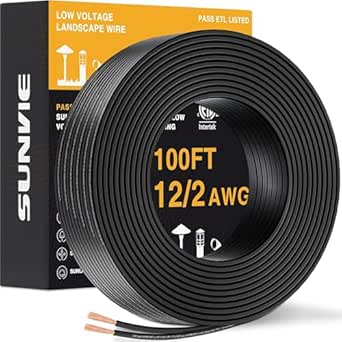
SUNVIE 100 ft 12/2 Low-Voltage Landscape Wire, 12 AWG Copper
I’d choose the SUNVIE when a lighting plan calls for 12 AWG pure-copper cable in a manageable 100-foot length. Its thicker gauge and copper conductors distinguish it from the 14 AWG GOSDENG and the 16 AWG options, while its ETL listing and direct-burial design make its outdoor use more clearly specified than those longer spools. The listed maximum working voltage is 300 V, but this is still presented for landscape lighting and other low-voltage devices; buyers should match cable and installation to their system requirements rather than treat that rating as a recommendation for household mains wiring. Compared with the Elite, SUNVIE offers twice the cable length and a heavier gauge, though the supplied details do not list the Elite’s set of UL and CSA standards. Its 100-foot reach may still be short for large properties.
Pros:- 12 AWG pure-copper conductors
- Designed for direct burial and outdoor use
- ETL listed and rated VW-1 for fire resistance
- 100-foot length offers more reach than the Elite 50-foot option
Cons:- 100 feet may not cover large properties without additional cable
- Heavier-gauge cable can be less convenient to route than the listed 16 AWG options
- A 300 V maximum rating does not by itself establish suitability for every wiring application
Best for: Homeowners who want a heavier-gauge pure-copper cable for a medium-length outdoor lighting run with direct-burial use.
Not ideal for: Buyers needing a 250-foot spool, or those whose project requires a specific certification or voltage rating not stated for this cable.
- Gauge:12 AWG
- Length:100 ft
- Conductors:2
- Conductor material:Pure copper
- Insulation:Black SPT-2 PVC
- Maximum working voltage:300 V
- Listing:ETL listed
- Fire resistance:VW-1
- Strands:65
Our verdict“Choose SUNVIE for a medium-length outdoor run where heavier pure-copper conductors and stated direct-burial suitability are priorities.”
Energeaster 250 ft 14 AWG 2-Conductor Low-Voltage Landscape Wire
For a long low-voltage lighting layout, this 250-foot roll gives you more reach than the 100-foot SUNVIE and UBOORY options without moving up to a heavier 12 AWG cable. Its 14 AWG conductors suit many 12V or 24V DC landscape-lighting connections, while the flexible PVC jacket can make routing around beds and edging easier. The tradeoff is the conductor material: copper-clad aluminum is not the same as the copper used in the FIRMERST 14/2 or SUNVIE 16/2. I would choose this when coverage and easier handling matter more than having copper conductors. Check the fixture and installation requirements before buying, especially for longer runs where wire gauge and voltage drop need to be matched to the load.
Pros:- 250-foot length can cover a larger layout with fewer roll changes.
- 14 AWG size offers a middle ground between lighter 16 AWG wire and heavier 12 AWG options.
- Flexible PVC jacket is easier to route around landscape features.
- Listed for 12V DC and 24V DC equipment connections.
Cons:- Copper-clad aluminum is a tradeoff for buyers who prefer copper conductors.
- The provided data does not specify direct-burial certification.
- Voltage-drop suitability depends on run length and connected load.
Best for: DIYers wiring an extended 12V or 24V landscape-lighting layout who want a long roll of flexible 14 AWG cable.
Not ideal for: Buyers who specifically want copper conductors or need cable selected for a demanding long run without first checking voltage-drop requirements.
- Length:250 ft
- Wire gauge:14 AWG
- Conductors:2
- Conductor material:Copper-clad aluminum
- Jacket material:PVC
- Voltage:12V DC; also listed for 24V DC use
- Operating temperature:-35°C to 105°C
- Color:Black
Our verdict“Choose this for a longer low-voltage layout when flexible 14 AWG cable matters more than copper conductors or stated burial certification.”
FIRMERST 14/2 Low Voltage Landscape Wire, 200 Feet
The clearest advantage here is stated direct-burial suitability, which makes this a more straightforward choice for a cable route that will be covered by soil. It pairs that outdoor focus with copper conductors and a 14 AWG, two-conductor build. Compared with the Energeaster 250 ft 14 AWG cable, FIRMERST supplies less wire, but its listed burial rating and copper material may be more persuasive for buyers prioritizing those details over maximum roll length. It is intended for applications at 30 volts or less; the listed 150-volt maximum working voltage should not be mistaken for the recommended application range. I would skip it if the project needs a longer single roll or uses equipment outside its stated low-voltage guidance.
Pros:- Direct-burial rating is stated for underground landscape routes.
- Copper conductors avoid the copper-clad aluminum construction of the Energeaster and GOSDENG options.
- 14 AWG, two-conductor format suits compatible low-voltage lighting circuits.
- Black jacket is described as resistant to water, dirt, dust, and prolonged sun exposure.
Cons:- The 200-foot roll is shorter than the 250-foot Energeaster and GOSDENG rolls.
- Recommended application voltage is limited to 30 volts or less.
- A 150-volt maximum working voltage does not make it a general-purpose high-voltage cable.
Best for: Homeowners routing 14 AWG landscape-lighting cable underground who want copper conductors and an explicit direct-burial listing.
Not ideal for: Buyers planning a very long layout who need more than 200 feet, or anyone wiring equipment above the recommended 30-volt application range.
- Length:200 feet
- Wire gauge:14 AWG
- Conductors:2
- Conductor material:Copper
- Recommended application voltage:30 volts or less
- Maximum working voltage:150 volts
- Direct burial:Yes
- Safety compliance:RoHS compliant; VW-1 fire rating
Our verdict“Pick FIRMERST for an underground low-voltage lighting route where stated burial suitability and copper conductors take priority over a 250-foot roll.”
SUNVIE 100 ft 16/2 Low Voltage Landscape Wire
For a compact project, this SUNVIE roll combines pure copper conductors with stated direct-burial suitability and ETL listing. That gives it a clearer certification profile than the 100-foot UBOORY, whose data states direct-burial certification but does not list ETL. Its 16 AWG size and 100-foot length fit smaller lighting layouts, repairs, or extensions better than broad property installations; the 250-foot Energeaster 14 AWG offers more reach and a thicker gauge for buyers with a larger plan. The main compromise is practical: 16 AWG and a short roll call for careful matching to the run length and fixture load. I would not choose it simply because its stated maximum working voltage is higher; the listed application is low-voltage use.
Pros:- Pure copper conductors provide a copper alternative to copper-clad aluminum rolls.
- Direct-burial installation is listed for underground use.
- ETL listing adds a stated certification detail.
- Flexible PVC insulation supports routing around garden features.
Cons:- 100-foot length may be insufficient for larger properties.
- 16 AWG is lighter than the 14 AWG Energeaster and FIRMERST options.
- Listed for low-voltage applications, not as a general-purpose cable despite the higher maximum working-voltage figure.
Best for: Buyers wiring a small outdoor lighting section who want pure copper, direct-burial suitability, and an ETL-listed cable.
Not ideal for: People covering a large yard or planning long runs that may call for a heavier gauge or substantially more than 100 feet.
- Length:100 ft
- Wire gauge:16 AWG
- Conductors:2
- Conductor material:Pure copper
- Insulation:Black SPT-2 PVC
- Voltage:30 V listed; 300 V maximum working voltage
- Installation:Direct burial
- Certification:ETL listed
- Fire resistance:VW-1
Our verdict“Choose this for a modest low-voltage lighting run when ETL listing and pure copper matter more than roll length or thicker wire.”
GOSDENG 12/2 Low-Voltage Landscape Wire, 12 AWG, 250 ft
This is the heaviest-gauge choice in this batch: 12 AWG cable in a 250-foot roll gives buyers a thicker-wire option than the 14 AWG Energeaster and FIRMERST. That can make it worth comparing for longer low-voltage layouts, but gauge alone does not settle whether a run is suitable; the connected load, distance, and system requirements still matter. The tradeoff is that this cable uses copper-clad aluminum, unlike the copper-conductor FIRMERST, and the provided data does not state direct-burial certification. Its flexible, weatherproof PVC jacket and broad stated temperature range support outdoor use, but I would verify installation requirements before burying it. The 12V listing also makes the intended use clearer than a general-purpose cable, not a substitute for checking compatibility.
Pros:- 12 AWG gauge is thicker than the 14 AWG and 16 AWG options in this batch.
- 250-foot roll supports extended layouts.
- Flexible PVC jacket is described as weatherproof.
- Operating temperature range is listed from -35°C to 105°C.
Cons:- Copper-clad aluminum may not suit buyers seeking copper conductors.
- Direct-burial certification is not specified in the provided product data.
- A 12V listing means buyers should confirm compatibility with their lighting system.
Best for: Installers who need a 250-foot roll of 12 AWG cable for compatible low-voltage outdoor lighting and will confirm the route and load requirements.
Not ideal for: Buyers who require copper conductors or explicit direct-burial certification, or who only need a short, light-duty cable run.
- Length:250 ft
- Wire gauge:12 AWG
- Conductors:2
- Conductor material:Copper-clad aluminum
- Jacket material:PVC
- Voltage:12 volts
- Operating temperature:-35°C to 105°C
- Color:Black
Our verdict“Consider this for a long low-voltage route where 12 AWG is appropriate, but choose a copper, burial-certified option if those details are requirements.”
UBOORY 16/2 Low Voltage Landscape Wire, 100 Feet
UBOORY suits a contained project where 100 feet of 16 AWG bare copper is enough and underground installation is part of the plan. Its 65-strand conductor construction is presented as flexible, while the jacket is designed to resist sunlight, wear, and damp conditions. Compared with the similarly sized SUNVIE 16/2, UBOORY lists a lifetime warranty and direct-burial certification; SUNVIE, by contrast, specifies ETL listing and VW-1 fire resistance. That makes the choice less about length or gauge and more about which documented details match the project. The limitation is the same short-roll, lighter-gauge profile: it is not the pick for a sprawling layout, and its recommended use is limited to 30 volts or less.
Pros:- Bare copper conductors are specified, unlike the copper-clad aluminum long-roll options.
- Direct-burial certification suits underground routing.
- 65 strands are listed for a flexible conductor construction.
- Lifetime warranty is stated in the product data.
Cons:- 100-foot roll is better suited to smaller layouts than the 250-foot options.
- 16 AWG is thinner than the 14 AWG and 12 AWG cables in this batch.
- Recommended application voltage is 30 volts or less.
Best for: DIYers handling a small, low-voltage outdoor lighting project who want bare copper, direct-burial certification, and a stated lifetime warranty.
Not ideal for: Buyers wiring a large property, needing a heavier gauge, or requiring an ETL listing specifically.
- Length:100 feet
- Wire gauge:16 AWG
- Conductors:2
- Conductor material:Bare copper
- Strands:65
- Recommended application voltage:30 volts or less
- Maximum working voltage:300 volts
- Direct burial:Certified
- Warranty:Lifetime
Our verdict“Choose UBOORY for a small buried lighting run when its copper conductors and warranty matter more than extra length or a heavier gauge.”
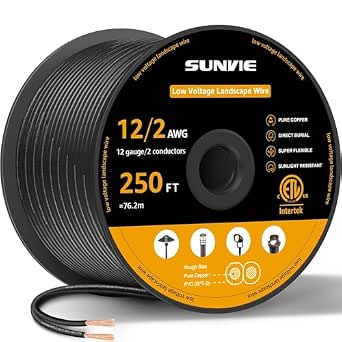
SUNVIE 12/2 Low-Voltage Landscape Wire, 12-Gauge Pure Copper, 250 ft
I’d choose this 250-foot, 12 AWG cable when a landscape lighting layout needs substantial length and a heavier conductor. Its pure copper, two-conductor construction suits compatible low-voltage systems, while the thicker gauge is a step up from the GOSDENG 14 AWG and 16 AWG 250-foot options for buyers prioritizing conductor size. The spool and flexible black PVC insulation can make routing around planting beds and along a property easier, and its direct-burial and outdoor-exposure ratings suit installations where cable will face soil, sunlight, or moisture. The tradeoff is application scope: this is not a general-purpose household cable, and the larger gauge may be more cable than a small lighting setup needs. I’d match it to the transformer and fixtures before buying.
Pros:- 12 AWG pure-copper conductors provide a heavier-gauge option than the listed 14 AWG and 16 AWG alternatives.
- 250-foot spool suits larger yards and multi-fixture layouts.
- Rated for direct burial, sunlight, abrasion, and moisture exposure.
- Flexible black PVC insulation is intended to ease cable routing.
Cons:- Limited to compatible low-voltage applications rather than general-purpose wiring.
- The 250-foot length may leave substantial excess for small projects.
- Requires matching the wire to the lighting system’s voltage and installation requirements.
Best for: Homeowners wiring a spread-out low-voltage landscape lighting system who want 250 feet of 12 AWG pure-copper cable rated for direct burial.
Not ideal for: Buyers wiring indoor or line-voltage fixtures, or small garden layouts that do not need a long run of heavier-gauge cable.
- Length:250 ft
- Gauge:12 AWG
- Conductors:2
- Conductor material:Pure copper
- Insulation:Black SPT-2 PVC
- Maximum working voltage:300 V
- Certification:ETL Listed
Our verdict“Choose this SUNVIE cable for a long outdoor low-voltage lighting run where 12 AWG pure-copper conductors and direct-burial suitability are priorities.”

How We Picked
I compared the 11 listed cables through the needs of low-voltage outdoor landscape lighting: conductor gauge, stated roll length, two-conductor format, and how well each option appears suited to compact or extended layouts. I gave more weight to useful distinctions between 12, 14, and 16 AWG and to the practical difference between a short roll and a 200- or 250-foot supply. Since the supplied product details do not establish every construction or certification specification, I avoid treating unverified claims as proven advantages.
The ordering reflects breadth of fit rather than a claim that one cable works for every system. The GOSDENG 14 AWG, 250-foot roll leads as a versatile starting point; 12 AWG options rank higher for buyers prioritizing longer runs or more demanding loads, while 16 AWG and shorter rolls make more sense for modest layouts. Similar products are separated by gauge and length, not by unsupported assumptions about brand performance. Before buying, match the cable to the lighting manufacturer’s requirements and calculate the run and load.
| cable for outdoor lighting | Conductor material |
|---|---|
| GOSDENG 14 AWG 2-Conductor Low | Copper-clad aluminum |
| GOSDENG 16/2 Low Voltage Lands | Copper-clad aluminum |
| Energeaster 250 ft 16 AWG 2-Co | Copper-clad aluminum |
| Elite 16 AWG 2-Conductor Low-V | Pure copper |
| SUNVIE 100 ft 12/2 Low-Voltage | Pure copper |
| Energeaster 250 ft 14 AWG 2-Co | Copper-clad aluminum |
| FIRMERST 14/2 Low Voltage Land | Copper |
| SUNVIE 100 ft 16/2 Low Voltage | Pure copper |
| GOSDENG 12/2 Low-Voltage Lands | Copper-clad aluminum |
| UBOORY 16/2 Low Voltage Landsc | Bare copper |
| SUNVIE 12/2 Low-Voltage Landsc | Pure copper |
Factors to Consider When Choosing Cable For Outdoor Lighting
I’d choose outdoor lighting cable from the system outward: first confirm what the fixtures and transformer require, then size the cable to the route and load. These checks help prevent buying a roll that is either poorly matched to the circuit or much longer than the project needs.
Match Gauge to Run Length and Load
Gauge affects how much voltage is lost along a cable run, so longer routes and heavier connected loads generally call for thicker conductors. In AWG sizing, a lower number indicates thicker wire: 12 AWG is thicker than 14 AWG, which is thicker than 16 AWG. Do not pick a gauge from yard size alone; account for the full cable distance and the total wattage on that circuit. A common mistake is to use one long trunk line for many fixtures without checking voltage drop at the far end. Use the lighting system’s specifications or a voltage-drop calculation to confirm the choice before ordering.
Calculate the Route Before Choosing Roll Length
Measure the planned route from the transformer, along the actual paths the cable will take, to each fixture connection. Add slack for turns, service loops, and routing around obstacles, but avoid buying a very long roll based only on a rough estimate. A 50- or 100-foot roll can suit a compact installation, while 200- and 250-foot options give more flexibility across a larger yard. If the layout has several branches, count the cable needed for every branch rather than measuring only the longest route. Buying too little can force a mid-project splice; buying far too much leaves unused cable and can make storage less tidy.
Check the Cable’s Outdoor and Burial Suitability
“Outdoor” in a product name does not, by itself, tell you how the cable may be installed. Check the cable’s printed markings and documentation for its permitted use, burial rating, and any limits on exposure to moisture or sunlight. Direct-burial suitability matters if cable will go in soil; cable routed above ground may need protection suited to its location. Don’t assume that a low-voltage circuit makes every cable installation method acceptable. Follow local electrical rules and the instructions for the cable, fixtures, and transformer.
Confirm Compatibility With the Transformer and Fixtures
Landscape lighting cable is only one part of the system: the transformer output, fixture voltage, connectors, and total load must work together. Add the wattage of all fixtures on a circuit and compare it with the transformer’s capacity and the cable plan. A system with several branches may need a different layout from one with a single short run, even if both use the same gauge. Check that the cable’s conductor size fits the connectors you plan to use, since an incompatible connection can complicate installation. When specifications are unclear, verify them with the manufacturer instead of relying on a product title alone.
Choose Copper and Construction Details From Verified Specs
Conductor material and cable construction can affect durability, handling, and compatibility, but product titles do not always provide enough detail to compare them fairly. Look for clearly stated conductor material, insulation details, and relevant certification or listing information in the manufacturer’s documentation. Avoid assuming that two cables with the same gauge and length have identical construction. If the cable will be exposed to rough conditions or buried, documentation is more useful than broad phrases such as “heavy duty.” Pay for construction details that match the installation rather than a label that does not explain what the cable can withstand.
Balance Easier Handling Against Extra Capacity
Thicker cable can provide more capacity for longer runs, but it may be less flexible and may not fit every connector as easily as a thinner option. A smaller-gauge cable can be easier to route around a compact garden, yet it may not suit a long route or a larger connected load. Think about where the wire must pass, how it will connect to fixtures, and whether you may extend the system later. If expansion is likely, plan for the future load and route rather than choosing solely for today’s fixture count. If the project is small and fixed, extra cable capacity may add bulk without solving a real need.
Frequently Asked Questions
Should I choose 12, 14, or 16 AWG cable for my landscape lights?
Choose based on the cable run and total connected load, not just the number of fixtures. Thicker 12 AWG cable is often the better candidate for longer runs or higher loads, while 14 AWG can suit many mid-sized layouts and 16 AWG may fit shorter, lighter systems. These are starting points, not a substitute for the fixture and transformer instructions. Calculate the route and load, then check voltage-drop guidance for your system. If the farthest lights need a particular operating voltage, verify it at that point in the layout.
Can I connect two rolls of landscape lighting cable to make a longer run?
A longer run may be possible, but the connection needs to be compatible with the cable and suitable for its outdoor location. Use connectors rated for the intended environment and installation method, and follow the cable and lighting-system instructions. Every added connection is another point that can loosen or admit moisture if installed poorly. Also recalculate voltage drop across the full run; joining two lengths does not remove the electrical effects of added distance. If the layout permits, a continuous cable run can simplify the installation.
Is low-voltage landscape cable safe to bury directly in soil?
Only if the cable’s markings and manufacturer documentation identify it as suitable for direct burial under the conditions of your installation. A low-voltage rating does not automatically mean the insulation is designed for prolonged contact with soil or moisture. Check local requirements and follow any specified burial depth or protection method. If the cable is not rated for direct burial, use an approved protective route or choose a cable that is. Keep connections protected with products designed for the same environment.
How much cable should I buy for a yard with several lighting branches?
Draw the route from the transformer to each branch and measure the cable path, not a straight line across the yard. Add the lengths for each segment that serves a separate branch, then include reasonable slack for connections and future servicing. Avoid counting a shared trunk section more than once, but do include every branch after it splits. Compare that total with the roll sizes in this roundup; a longer roll can be convenient, though unused cable is not automatically useful capacity. Recheck the plan after placing fixtures, since actual routing can change the estimate.
When is it worth choosing 12 AWG instead of 14 AWG or 16 AWG?
Consider 12 AWG when the planned route is long, the circuit carries a larger load, or the lighting-system guidance calls for a thicker conductor to manage voltage drop. Compared with 14 or 16 AWG, it may provide more room for a demanding layout, but it can be bulkier and less convenient to route or connect. A thicker cable will not fix an overloaded transformer or unsuitable circuit design. Check the total load, connector fit, and system specifications before paying for extra capacity. For a short, lightly loaded route, a smaller gauge may be a more practical match.
Conclusion
For a flexible starting point, I’d choose the GOSDENG 14 AWG, 250 ft as the best overall. Buyers who want a longer-run or higher-load candidate should compare the SUNVIE 12/2, 250 ft for the best premium-style capacity pick, while the GOSDENG 16/2, 250 ft is my best value-style option for a lighter system that still needs a long roll. For beginners with a compact layout, the Elite 16 AWG, 50 ft is a manageable short-roll starting point, provided the system requirements support 16 AWG. If you need a balance of gauge and coverage, consider the Energeaster 14 AWG, 250 ft; if you need a 200-foot roll, compare the FIRMERST 14/2. Check load, route length, installation rating, and connector compatibility before choosing any of them.
Halloween Picks
halloween
As an affiliate, we earn on qualifying purchases.