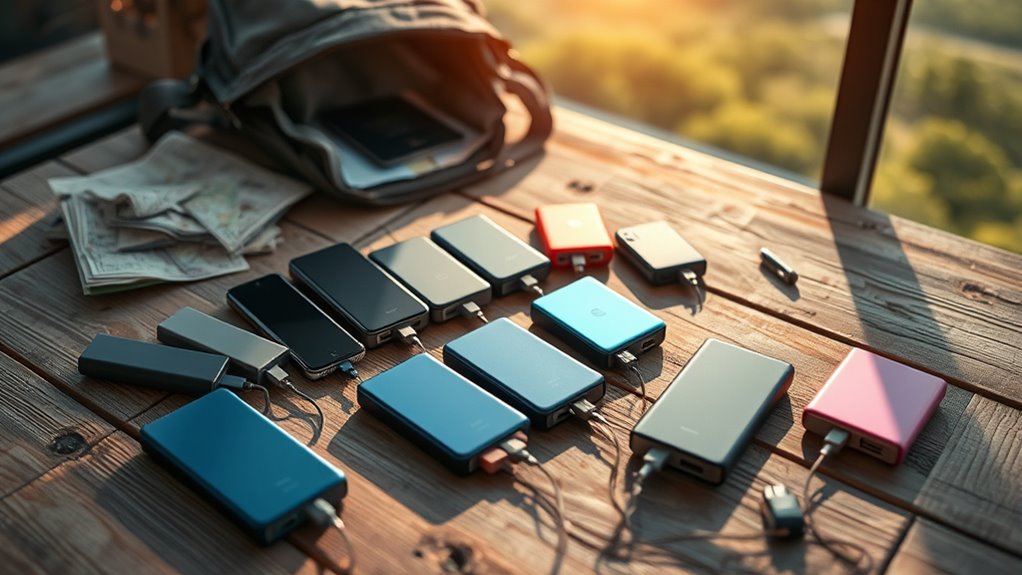

For most travelers, I’d start with the Anker 10,000mAh 30W Portable Power Bank: its balance of capacity and USB-C charging suits everyday top-ups without the bulk of a large bank. The INIU 10,000mAh 45W is a stronger fit when faster charging matters, while the Anker Nano 5,000mAh favors pocket space over backup capacity. The key tradeoff is whether you want a lighter charger, more energy for multiple devices, or built-in cables that reduce what you need to pack. Read on for how the 13 options compare and which compromises make sense for different trips.

Get furniture and decor delivered free with Prime
- Fast, free delivery on millions of items
- Prime Video, Amazon Music and more included
- Member-only deals all year
Complete the kit


Key Takeaways
- The 10,000mAh models are the most balanced travel size. They offer a more practical middle ground than the pocket-friendly 5,000mAh banks and the bulkier 20,000mAh and 50,000mAh options.
- Charging speed separates two similar-capacity picks. The INIU is rated at 45W and the Anker at 30W, so check whether your devices can use the extra output before choosing by wattage.
- Built-in cables trade packing convenience for flexibility. They reduce the need to carry separate leads, but travelers who want to replace or choose cable lengths may prefer a bank with standard ports.
- Very high capacity adds weight and baggage-planning questions. The OHOVIV 50,000mAh may suit long stretches away from outlets, but it is a much less compact choice than the 10,000mAh picks.
- Multipacks fit shared or split-up travel better than solo carry. The two-pack options provide separate small chargers, while a single higher-capacity bank keeps charging power in one place.


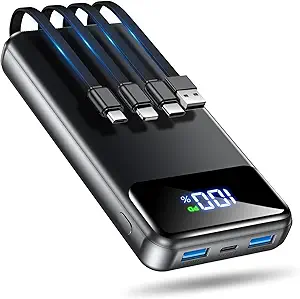


| portable chargers for travel | Battery capacity | Built-in cables | Dimensions | Weight |
|---|---|---|---|---|
| HELLEE 15,000mAh Portable Char | 15,000mAh | USB-A, USB-C, iOS, Micro | 6 x 3.2 x 1.1 inches | 250g |
| Anker Portable Charger Nano Po | 5,000mAh | — | — | — |
| Anker 10,000mAh 30W Portable P | 10,000mAh | — | 4.32 x 2.58 x 0.98 inches | — |
| 2-Pack 10000mAh Portable Charg | 10,000mAh | iOS cable, USB-C cable | 5.83 x 2.68 x 0.63 inches | 1.19 lb |
| VRURC Portable Charger with Bu | 10,000mAh | 4 | 5.7 x 2.7 x 0.73 inches | 74 grams |
| Charmast Portable Charger Powe | — | iOS, USB-C, and Micro-USB | — | 227g / 0.5 lb |
| Charmast 20,000mAh Portable Ch | 20,000mAh | USB-C and Micro-USB | 6.3 × 2.85 × 0.72 in | — |
| INIU 10,000mAh 45W Fast-Chargi | 10,000mAh | — | — | — |
| OHOVIV Portable Charger Power | — | Lightning, Type-C, Micro, and USB-A | 5.82 × 2.83 × 1.18 in | 1.07 lb |
| 2-Pack Portable Charger for iP | — | — | — | — |
| Portable Charger Power Bank 15 | — | iOS and Type-C | 5.90 × 2.69 × 0.7 inches | 0.5 lb |
| Orfeika 20,000mAh Power Bank w | 20,000mAh | 4: iPhone, USB-C, USB-A, and Micro | 6.33 × 2.85 × 0.74 inches | 0.73 lb |
| Charmast 20000mAh Portable Cha | 20,000mAh | USB-C and Micro-USB | 6.3 × 2.87 × 0.75 inches | 340 grams |
More Details on Our Top Picks
HELLEE 15,000mAh Portable Charger with 4 Built-In Cables
Four built-in cable types make the HELLEE a practical pick for travelers carrying a mix of USB-C, Lightning, Micro-USB, and USB-A devices. Its 15,000mAh capacity gives it more reserve than the Anker Nano’s 5,000mAh, while six listed outputs make it better suited to charging a group’s devices from one bank. The tradeoff is bulk: at 250g, it is less pocket-friendly than the compact Anker options, and the listed three-hour recharge time may take a sizeable break in your itinerary. The digital display helps you judge whether there is enough charge for the next leg. Choose it for cable convenience and shared charging; skip it if a light daily carry matters more than capacity.
Pros:- Four built-in cable types cover common device connectors.
- 15,000mAh capacity offers more backup than the 5,000mAh Anker Nano.
- Six listed outputs support charging multiple devices.
- Digital display shows the remaining charge.
Cons:- At 250g, it is relatively heavy for a compact travel bank.
- The listed three-hour recharge time can be inconvenient on a tight itinerary.
- Built-in cables offer less flexibility than carrying replaceable cords.
Best for: Travelers carrying several device types who want one charger to share without packing separate cables.
Not ideal for: Light packers who need a truly pocketable charger or want a quick recharge between short stops.
- Battery capacity:15,000mAh
- Built-in cables:USB-A, USB-C, iOS, Micro
- Number of outputs:6
- Fast charging output:22.5W
- Weight:250g
- Dimensions:6 x 3.2 x 1.1 inches
- Battery charge time:3 hours
Our verdict“Choose the HELLEE if shared charging and built-in cable variety matter more to you than minimizing bag weight.”
Anker Portable Charger Nano Power Bank with Built-in USB-C, 5,000mAh, 22.5W
When bag space is tight, the Anker Nano’s compact format is easier to justify than the HELLEE’s larger 15,000mAh reserve. Its foldable USB-C connector keeps the charging plug tucked away, and the two USB-C ports add flexibility for compatible devices. At 5,000mAh, though, this is a top-up bank for a commute, day trip, or a low-battery stretch—not the choice for several days away from outlets. The Anker 10,000mAh 30W bank carries twice the stated capacity and more output power, making it a better fit for longer days or faster device charging. Pick the Nano for minimal carry and USB-C convenience; skip it if you need repeated phone charges or support for non-USB-C devices.
Pros:- Compact design is suited to light travel carry.
- Foldable USB-C connector tucks away when not in use.
- 22.5W output supports fast charging.
- Two USB-C ports provide connection options for compatible devices.
Cons:- 5,000mAh capacity is limited for extended trips.
- USB-C charging compatibility excludes devices that rely on other connectors.
- Less reserve and output power than the Anker 10,000mAh 30W model.
Best for: USB-C phone owners who want a small backup for day trips, commutes, or a light travel bag.
Not ideal for: Travelers who need multiple full device recharges or carry devices without USB-C charging.
- Battery capacity:5,000mAh
- Wattage:22.5W
- Ports:Dual USB-C
- Technology:PowerIQ 3.0
- Included cable:USB-C to USB-C, 2 ft
- Connector design:Foldable built-in USB-C connector
Our verdict“Choose the Nano if you want a small USB-C backup for short outings and can recharge from an outlet regularly.”
Anker 10,000mAh 30W Portable Power Bank with USB-C Fast Charging
30W output sets this Anker apart from the 22.5W HELLEE and Nano, giving compatible devices more charging power in a compact travel bank. Its built-in USB-C cable means one less cord to pack, and USB-C input and output let the same connection serve for recharging the bank and powering devices. The 10,000mAh capacity is a more balanced middle ground than the Nano’s 5,000mAh, but it still offers less reserve than the HELLEE. That makes it a stronger fit for a day of travel than a long stretch away from outlets. iPhone 14 and earlier owners will need to bring a Lightning cable, and there is no wireless charging. Choose it for a compact, higher-output USB-C setup.
Pros:- 30W output exceeds the 22.5W ratings of the HELLEE and Anker Nano.
- Built-in USB-C cable reduces loose accessories.
- USB-C supports both input and output.
- Compact dimensions suit travel bags.
Cons:- 10,000mAh capacity offers less reserve than the HELLEE’s 15,000mAh.
- iPhone 14 and earlier owners need a separate Lightning cable.
- No wireless charging feature.
Best for: USB-C device owners who want more charging output than the Anker Nano and a built-in cable for travel.
Not ideal for: Travelers with iPhone 14 or earlier who want to pack only one cable, or anyone seeking wireless charging.
- Battery capacity:10,000mAh
- Wattage:30W
- Dimensions:4.32 x 2.58 x 0.98 inches
- Cable:Built-in USB-C
- Input/output:USB-C in and out
- Cable durability:Tested for over 10,000 bends
Our verdict“Choose this Anker for compact travel charging when 30W USB-C output matters more than maximum capacity or wireless charging.”
2-Pack 10000mAh Portable Charger with Built-in Cables
Two separate 10,000mAh banks make this set useful when a pair of travelers would rather carry one charger each than share the HELLEE’s single 15,000mAh unit. Each bank has built-in iOS and USB-C cables, USB-A ports, and a display for checking charge, so there is less need to pack adapters for common devices. The stated five ports and ability to charge up to four devices suit busy travel days, though the 10,000mAh capacity per bank may call for more frequent recharging than the HELLEE. The listed 1.19 lb weight is a notable drawback for a slim bank, and its fixed cables cannot be replaced if damaged. This set makes most sense when two people need independent backup power.
Pros:- Two banks let travelers carry independent backup power.
- Built-in iOS and USB-C cables reduce extra cords.
- Digital display shows remaining charge.
- Multiple ports allow simultaneous charging.
Cons:- Listed weight of 1.19 lb is substantial for a slim travel bank.
- 10,000mAh capacity per bank may require frequent recharging during heavy use.
- Fixed built-in cables cannot be replaced if damaged.
Best for: Pairs who want a dedicated power bank each, especially when they carry both USB-C and iOS devices.
Not ideal for: Solo travelers who want one light bank, or buyers who prefer replaceable charging cables.
- Battery capacity:10,000mAh
- Pack size:2 power banks
- Number of ports:5
- Built-in cables:iOS cable, USB-C cable
- Dimensions:5.83 x 2.68 x 0.63 inches
- Weight:1.19 lb
- Warranty:3 years
Our verdict“Choose this two-pack when two travelers need their own cable-equipped backup banks and can accept the added weight.”
VRURC Portable Charger with Built-in Cables, 10000mAh Slim Power Bank with LED Display and Multiple Outputs
The VRURC’s four built-in cables and listed mix of USB-C, USB-A, and Micro-USB ports aim to cover several devices without a pouch of loose cords. Its 10,000mAh capacity is more practical for a day out than the Anker Nano’s 5,000mAh, while the LED display gives a clear read on remaining charge. The stated 12W output is lower than the 22.5W HELLEE and 30W Anker, so compatible devices may charge more slowly; the listed six-hour input time also makes overnight recharging the safer plan. The product data calls it 74 grams, a notably low listed weight, but travelers should weigh that spec against their own carry needs. This suits mixed-device backup when cable coverage matters more than charging speed.
Pros:- Four built-in cables reduce the number of separate cords to pack.
- 10,000mAh capacity is double the Anker Nano’s stated capacity.
- LED display shows remaining battery life.
- Compact dimensions are suited to a travel bag.
Cons:- 12W output is lower than the HELLEE’s 22.5W and Anker 30W model.
- Listed six-hour input charging time calls for advance recharging.
- Built-in cables are less flexible than separate replaceable cords.
Best for: Travelers with a mix of older and newer devices who value built-in cable variety and a remaining-charge display.
Not ideal for: People prioritizing faster output or who need a large battery reserve for several days without outlets.
- Battery capacity:10,000mAh
- Number of outputs:6
- Output power:12W
- Input charging time:6 hours
- Dimensions:5.7 x 2.7 x 0.73 inches
- Weight:74 grams
- Built-in cables:4
- Ports:USB-C, USB-A, Micro-USB
Our verdict“Choose the VRURC if connector variety and a charge display matter more than faster output or a longer-lasting reserve.”
Charmast Portable Charger Power Bank with Built-in Cables, 10000mAh
The Charmast 10,000mAh makes sense for travelers who want a charge-ready kit without packing a separate wall adapter and several leads. Its built-in wall plug lets me recharge from an outlet directly, while the integrated iOS, USB-C, and Micro-USB cables cover several common device types. That is a simpler setup than the INIU 10,000mAh 45W, which offers higher stated output but comes with a short detachable USB-C cable instead of a wall plug. Charmast’s 227g weight is easy to carry, and the display makes remaining charge easy to check. The tradeoff is modest capacity and a listed 5V/3A output with no fast-charging claim, so it suits a phone top-up better than powering several devices through a long travel day.
Pros:- Built-in iOS, USB-C, and Micro-USB cables reduce the number of separate leads to pack.
- Integrated wall plug simplifies recharging at an outlet.
- Digital display shows remaining battery percentage.
- 227g weight is manageable for a day bag.
Cons:- 10,000mAh capacity may not cover heavy use over an extended travel day.
- No fast-charging support is specified.
- Built-in cables may not suit every device or preferred cable setup.
Best for: Travelers carrying a mix of common phone types who want one compact charger with its own cables and wall plug.
Not ideal for: Heavy phone users or travelers charging tablets and several devices, since its 10,000mAh capacity and 5V/3A output are limiting.
- Capacity:10,000mAh
- Weight:227g / 0.5 lb
- Output:5V/3A
- Built-in cables:iOS, USB-C, and Micro-USB
- Recharge options:Built-in wall plug or USB-C input
- Display:Digital remaining-power display
- Charging feature:Pass-through charging
Our verdict“Choose this Charmast for a tidy, all-in-one phone charging kit; pick the INIU if faster stated output matters more than an integrated wall plug.”
Charmast 20,000mAh Portable Charger with Built-In Cables
When I need one power bank to cover several devices between outlets, the Charmast 20,000mAh offers a stronger travel-day buffer than the 10,000mAh Charmast model. Six outputs and built-in USB-C and Micro-USB cables make it practical for sharing or charging a group of compatible devices, while the digital display helps track the larger reserve. Its stated 22.5W maximum output also gives it a faster-charging case than the smaller Charmast, whose listed output is 5V/3A without a fast-charge claim. The cost of that extra capacity is more bulk and weight than a compact 10,000mAh pick. At 77Wh, the listed energy capacity is below the 100Wh carry-on threshold, but it still belongs in carry-on luggage rather than checked baggage.
Pros:- 20,000mAh capacity provides more reserve than the 10,000mAh Charmast.
- Six output ports support charging several devices at once.
- Built-in USB-C and Micro-USB cables reduce loose accessories.
- Digital percentage display makes the remaining charge easy to monitor.
Cons:- Larger capacity makes it heavier than 10,000mAh travel banks.
- Must be packed in carry-on luggage, not checked luggage.
- Built-in cables cover USB-C and Micro-USB, but may not fit every traveler’s devices.
Best for: Travelers or small groups who carry several phones and want a larger shared charge reserve with built-in USB-C and Micro-USB leads.
Not ideal for: Pack-light travelers who mainly need a single phone top-up and would rather carry a smaller, lighter bank.
- Battery capacity:20,000mAh
- Energy capacity:77Wh
- Maximum output power:22.5W
- Output current:5A
- Voltage:12V DC
- Output ports:6
- Built-in cables:USB-C and Micro-USB
- Dimensions:6.3 × 2.85 × 0.72 in
- Battery display:Digital, 0–100%
Our verdict“Pick this Charmast when multiple devices and longer stretches between outlets matter more than minimizing bag weight.”
INIU 10,000mAh 45W Fast-Charging Portable Power Bank
The INIU 10,000mAh is the speed-focused choice among these smaller travel banks: its stated 45W maximum output is well above the Charmast 10,000mAh’s listed 5V/3A output. That extra output can make short stops more useful for topping up compatible devices, while two USB-C ports and one USB-A port give me more ways to connect than a single-port pocket bank. At 10,000mAh, it remains easier to carry than the Charmast 20,000mAh, but it has less reserve for long days or charging companions’ devices. The included braided USB-C cable is detachable, which lets me replace or pack a longer lead, though its 0.4-foot length is better for close connections than comfortable use while holding a phone.
Pros:- 45W maximum output is higher than the listed output of the Charmast 10,000mAh.
- Two USB-C ports and one USB-A port accommodate several connection types.
- Compact 10,000mAh capacity is easier to carry than the 20,000mAh Charmast.
- Detachable braided USB-C cable can be replaced or swapped for a longer lead.
Cons:- 10,000mAh capacity may need recharging during extended trips.
- Included cable is only 0.4 ft long.
- Fast charging depends on device compatibility.
Best for: Travelers with a compatible fast-charging phone who want higher stated output in a compact 10,000mAh bank.
Not ideal for: People who need a large shared battery reserve or prefer a full-length cable included in the box.
- Battery capacity:10,000mAh
- Maximum output:45W
- Ports:2 USB-C and 1 USB-A
- Included cable:0.4 ft detachable braided USB-C cable
- Voltage:12V
- Amperage:3A
- Special features:Fast charging, flashlight, lightweight design, and overcharge protection
- Warranty and support:3-year care and lifetime technical support
Our verdict“Choose the INIU for higher stated charging output in a compact bank, provided its short cable and smaller reserve suit your trip.”
OHOVIV Portable Charger Power Bank 50000mAh with Fast Charging and Built-in Cables
For trips where access to an outlet may be scarce, the OHOVIV 50,000mAh prioritizes a large charge reserve over easy everyday carry. Its listed capacity is two and a half times the Charmast 20,000mAh, making it a better fit for repeated phone top-ups or charging several devices across a longer stretch. Built-in Lightning, Type-C, Micro, and USB-A cables also reduce the need to pack separate leads, and the 22.5W output offers a fast-charging claim. But at 1.07 lb, it is substantially heavier than the smaller travel options, and its 50,000mAh capacity is about 185Wh based on the standard 3.7V cell rating—above the common 100Wh carry-on threshold. I would check airline rules before packing it, since it may not be permitted on a flight.
Pros:- 50,000mAh capacity provides substantially more reserve than the Charmast 20,000mAh.
- Built-in Lightning, Type-C, Micro, and USB-A cables cover a range of connections.
- 22.5W output is specified for fast charging.
- Multiple ports support charging several devices.
Cons:- At 1.07 lb, it is heavy for daily travel carry.
- Its 50,000mAh capacity is around 185Wh at a standard 3.7V cell rating, above the common 100Wh carry-on threshold; check airline rules before flying.
- Wall charger block is not included.
Best for: Road trippers, campers, or travelers away from outlets who need a large reserve for multiple phone charges and devices.
Not ideal for: Air travelers who need a straightforward carry-on power bank, or anyone prioritizing a light day bag.
- Capacity:50,000mAh
- Output power:22.5W
- Charging ports:2 USB-A and 1 Type-C
- Built-in cables:Lightning, Type-C, Micro, and USB-A
- Dimensions:5.82 × 2.83 × 1.18 in
- Weight:1.07 lb
- Safety features:Overcharge and short-circuit protection
- Display:Digital power-level display
Our verdict“Choose this OHOVIV for extended trips with limited outlet access, but check airline rules and accept its weight before taking it on a flight.”
2-Pack Portable Charger for iPhone 17/16/15, 5000mAh PD USB-C Power Bank
This two-pack of 5,000mAh chargers suits travelers who value a small backup they can split between bags or keep close at hand. Each unit is more pocket-friendly than the INIU 10,000mAh, though the INIU offers twice the capacity in one bank and higher stated output at 45W. This pack specifies PD quick charging and a USB-C port, so it fits newer iPhones and many Android phones without the built-in cable assortment found on the Charmast models. The LCD gives a clear charge-status check, but its display calls for careful handling. With only 5,000mAh per unit, these are best treated as emergency top-ups rather than a full-trip power source; the listing also does not state output wattage, so charging speed is harder to compare directly.
Pros:- Two separate compact units can be carried in different bags.
- PD quick charging is specified for compatible devices.
- LCD shows charge status.
- USB-C compatibility covers iPhone 15/16/17 and a range of Android phones.
Cons:- Each unit has only 5,000mAh, less capacity than the single INIU 10,000mAh.
- USB-C only, so older Micro-USB devices need another cable or adapter.
- Output wattage is not specified, making charging speed difficult to compare.
Best for: Travelers who want two small USB-C backups to distribute between a day bag and a personal bag for newer phones.
Not ideal for: People needing multiple full phone charges, built-in cables, or a clearly specified high output for fast charging.
- Pack:2 portable chargers
- Capacity:5,000mAh per charger
- Charging port:USB-C
- Fast charging:PD quick charging
- Compatibility:iPhone 17/16/15 series and listed Android Type-C phones
- Warranty:Three years
- Material:ABS
- Display:Smart LCD charge-status display
Our verdict“Pick this two-pack for discreet emergency phone backup in separate bags, not as the main charger for a long trip.”
Portable Charger Power Bank 15000mAh with Built-in Cables and Fast Charging
Built-in iOS and Type-C cables make this a tidy travel choice for someone who wants a useful reserve without packing separate charging cords. Its 15,000mAh capacity offers more breathing room than the 10,000mAh Anker Power Bank Nano, while the slim 0.7-inch body and 0.5-pound weight keep it easier to carry than the larger Orfeika 20,000mAh. The 22.5W fast charging is also a little quicker on paper than Orfeika’s 20W USB-C output. The tradeoff is less stored power than either 20,000mAh option, so it suits phone top-ups better than powering several devices through a long trip. It can charge up to four devices at once, but that limit and the lack of a wall adapter make it less self-contained for group travel.
Pros:- Built-in iOS and Type-C cables reduce the number of separate cords to pack
- 22.5W PD fast charging supports quicker top-ups
- Slim 0.5-pound design is easier to carry than the 0.73-pound Orfeika
- Digital display shows the remaining battery percentage
Cons:- 15,000mAh capacity is below the 20,000mAh Orfeika and Charmast options
- No adapter or wall charger is included
- Simultaneous charging is limited to four devices
Best for: Solo travelers who want built-in iOS and Type-C cables, a readable battery display, and a lighter carry than a 20,000mAh bank
Not ideal for: Travelers who need the most capacity for several days away from outlets or want a wall adapter included
- Capacity:15,000mAh
- Fast charging:Up to 22.5W PD
- Built-in cables:iOS and Type-C
- Ports:USB-A, Type-C, Micro
- Dimensions:5.90 × 2.69 × 0.7 inches
- Weight:0.5 lb
- Simultaneous charging:Up to 4 devices
- Battery display:Digital remaining-percentage display
Our verdict“Choose this for a lighter, cable-ready travel kit; pick a 20,000mAh model if longer trips call for more reserve power.”
Orfeika 20,000mAh Power Bank with 4 Built-In Cables
For travelers carrying a phone, earbuds, and other small devices, four built-in cable types can simplify the charging kit: iPhone, USB-C, USB-A, and Micro. Its 20,000mAh capacity gives it more reserve than the 15,000mAh Portable Charger Power Bank in this batch, and the listing says it can charge up to six devices simultaneously. That makes the Orfeika the more group-oriented option, though its 0.73-pound weight is noticeably more to carry than the slimmer 0.5-pound model. Its 20W USB-C output is capable of fast charging, but it is below the other model’s stated 22.5W. The listed port counts also conflict between four ports and six outputs, so I would not rely on the six-device claim without checking the product details.
Pros:- 20,000mAh capacity provides more reserve than the 15,000mAh model in this batch
- Four built-in cable types cover iPhone, USB-C, USB-A, and Micro devices
- LED display shows the remaining battery percentage
- Low-power mode is designed for small devices
Cons:- At 0.73 lb, it weighs more than the 15,000mAh option in this batch
- 20W USB-C output is lower than that model’s stated 22.5W
- Specifications list four ports while the description claims six outputs
Best for: Travelers with a mix of older and current devices who value multiple built-in cable types and extra battery capacity
Not ideal for: Light-packing solo travelers who prefer a smaller, lighter charger or need clearly documented output counts
- Battery capacity:20,000mAh
- Battery energy:77Wh
- USB-C output:Up to 20W
- Built-in cables:4: iPhone, USB-C, USB-A, and Micro
- Dimensions:6.33 × 2.85 × 0.74 inches
- Weight:0.73 lb
- Display:LED battery display
- Other features:Low-power mode and multiple safety protections
- Safety standards:UL 2056 and UN38.3
Our verdict“Pick the Orfeika when cable variety and extra capacity matter more than low carry weight or unambiguous output details.”
Charmast 20000mAh Portable Charger with Built-in Cables, 22.5W Fast Charging Power Bank for Multiple Devices
The Charmast pairs 20,000mAh capacity with a stated 22.5W output, making it a stronger fit for travelers who want a substantial phone-charge reserve and faster top-ups. Compared with the Orfeika, it claims higher output power and has a lower listed weight of 340 grams, though the two listings describe their ports differently and the Orfeika includes four cable types. Charmast includes built-in USB-C and Micro-USB cables, which cover fewer connections than Orfeika’s four cables but can still trim loose accessories from a travel bag. Its three listed ports and six-output claim are also difficult to reconcile, so I would avoid choosing it solely for charging a large group at once. The 20,000mAh capacity also means it is less suited to travelers who prioritize the smallest carry.
Pros:- 20,000mAh capacity offers more reserve than the 15,000mAh model in this batch
- Stated 22.5W output is higher than the Orfeika’s 20W USB-C output
- Built-in USB-C and Micro-USB cables reduce the need for separate cords
- Digital display shows the remaining battery percentage
Cons:- 340-gram weight is heavier than a compact, low-capacity travel bank
- Only USB-C and Micro-USB cables are built in, fewer types than the Orfeika provides
- The listed three ports and claim of up to six outputs leave simultaneous charging details unclear
Best for: Travelers who want a high-capacity bank with stated 22.5W output and mainly carry USB-C or Micro-USB devices
Not ideal for: Minimalist travelers seeking a pocket-sized charger or groups that need a clearly specified number of simultaneous outputs
- Battery capacity:20,000mAh
- Output power:22.5W
- Voltage:5V
- Amperage:3A
- Ports:3 listed ports
- Built-in cables:USB-C and Micro-USB
- Weight:340 grams
- Dimensions:6.3 × 2.87 × 0.75 inches
- Display:Digital battery-level display
Our verdict“Choose the Charmast for substantial capacity and stated 22.5W output if its built-in cable types match your devices.”

How We Picked
I compared these chargers through the demands of travel: how much backup capacity they offer, how quickly they can charge compatible devices, and how easily their design fits into a day bag or pocket. I also considered cable arrangements, number of outputs, display features, and whether the format suits one traveler or a group. A built-in cable can simplify packing, but it does not automatically make a charger a better choice if the capacity, output, or form factor is a poor match.
The ranking favors a useful balance for common trips, then distinguishes options by their clearest strengths. The Anker 10,000mAh 30W leads as a broadly suitable capacity and output combination; the INIU offers more rated charging power at the same capacity, and the 5,000mAh Anker Nano puts portability first. Higher-capacity and cable-rich models rank for travelers with more specific needs because their extra bulk or fixed cable setup is a tradeoff. Product details here are based on the listed specifications, not hands-on testing.
Factors to Consider When Choosing Portable Chargers For Travel
Travel chargers are easier to compare when you start with the trip rather than the biggest number on the box. I’d work out how many devices need backup, how long you’ll be away from an outlet, and which cables you already carry. These broader choices can matter more than a small difference in listed capacity.
Match Capacity to Your Time Away From Outlets
Capacity is a guide to stored energy, not a promise of an exact number of full device charges. Conversion losses and the power needs of your phone or tablet affect what reaches the device. For a day of sightseeing, a compact or mid-capacity bank may be easier to carry than a large reserve you rarely use. For a long travel day or several devices, extra capacity can reduce the need to ration top-ups. A common mistake is choosing the largest capacity without checking its weight and dimensions. Think through a typical day and a delayed or disrupted day, then choose for the level of backup you will actually carry.
Check Whether Charging Speed Matches Your Devices
Wattage describes the charger’s possible output, but your device also needs to support the relevant charging standard to benefit from it. A high-output bank may be useful for a compatible phone or tablet, yet offer little advantage with a device that draws less power. Cable and port capabilities can also affect charging speed, so check the full charging path rather than the bank’s headline figure alone. If you mainly need overnight or occasional phone top-ups, capacity and portability may matter more than maximum wattage. Travelers who charge during short airport stops may value faster compatible output more. Avoid paying for speed your devices cannot use.
Choose Built-In Cables for Convenience, Not as a Universal Upgrade
Integrated cables can make packing simpler and help when a separate lead is easy to forget. They are most useful when the built-in connectors match the devices you bring and the cable placement works for how you carry the bank. The tradeoff is less freedom to swap in a different cable if one is damaged, too short, or incompatible with a new device. A bank with standard ports gives you more choice, but adds loose accessories to manage. Before choosing, list the connectors your phone, earbuds, and other travel devices use. For a mixed-device group, flexible ports may be more useful than a charger designed around one cable set.
Think About Carrying Comfort and Airline Rules
A power bank that stays in your bag all day needs to be comfortable to carry, not just capable on paper. Larger capacity often means a bigger, heavier charger, which can be inconvenient on walking-heavy trips or in a small personal bag. Check the airline’s current rules for spare lithium batteries and power banks before flying, including any capacity limits and carry-on requirements. Do not assume that a very large bank is permitted just because it is sold for travel. Keep capacity markings readable, since they can help identify the unit during travel checks. If your itinerary includes flights, a manageable size and clear specifications can make packing simpler.
Decide Whether You Need One Shared Bank or Several Small Ones
A single higher-capacity bank centralizes charging and can serve more than one device when it has suitable outputs. A multipack lets travelers keep separate chargers in different bags or share them across a group. Several small banks can be convenient when people split up, but they can also mean more units and cables to track. A shared bank may be simpler for a solo traveler, while a family or group might value independent access. Consider who will carry the charger and whether devices need power at the same time. Choose the setup that fits how your party moves, rather than assuming more units always mean more useful backup.
Frequently Asked Questions
Is a 5,000mAh charger enough for a full day of travel?
It can be enough if you want a compact emergency top-up and your phone starts the day charged. It leaves less room for repeated charging or powering several devices than a 10,000mAh model. Actual usable energy varies with conversion losses and the device being charged, so capacity does not translate directly into a guaranteed number of full charges. If maps, photos, and travel apps will keep your phone busy, a larger bank gives more breathing room. Choose the smaller size when pocket space matters more than a generous reserve.
Should I choose a 20,000mAh or 50,000mAh power bank for a long trip?
Start with the stretches when you expect to be away from wall power and how many devices you need to charge. A 20,000mAh model can provide a larger reserve than a 10,000mAh bank while avoiding the particularly large capacity of a 50,000mAh option. The biggest bank may appeal for extended trips or several devices, but extra size and weight can make it less pleasant to carry. Air travel adds another consideration: check current airline rules for power-bank capacity before packing. A longer trip alone does not mean you will benefit from carrying the largest option every day.
Are built-in charging cables reliable enough for travel?
They can be handy when their connectors match your devices and you want fewer loose accessories to pack. Their fixed design means you may have less flexibility if you need a different cable length or a connector for another device. If an integrated cable is damaged, replacing it may not be as simple as swapping a separate lead. Travelers with one main device may find the convenience worthwhile, while people carrying mixed devices may prefer standard ports. Check the included connector types against every device you plan to charge.
Does a 45W power bank charge my phone faster than a 30W one?
Only if your phone supports a compatible charging standard and can draw more power than it would from the lower-output bank. Otherwise, the extra rated output may not change how quickly the phone charges. The charging cable and the bank’s port also need to support the required delivery. For a phone that draws less power, capacity, size, or cable convenience may be a better basis for choosing. Check your device specifications before treating higher wattage as a reason to pick one charger.
Can I bring a high-capacity power bank on a plane?
Rules depend on the airline and applicable aviation regulations, so check current requirements for your specific route before flying. Power banks are generally treated as spare lithium batteries, and rules can limit their capacity or require them to stay in carry-on baggage. A 50,000mAh label does not by itself tell you whether a particular airline will accept the unit; the stated watt-hour rating may be relevant. Keep the capacity markings visible and do not pack a power bank in checked baggage unless the airline explicitly allows it. If the label is missing or unclear, ask the carrier before travel.
What are the best best portable chargers for travel?
The best best portable chargers for travel are the picks above: choose one that fits your trip length, the devices you need to charge, and how much space you have in your bag. For flights, check the airline’s rules for carrying a portable charger, and keep it accessible in your carry-on. Consider which ports and charging features suit your devices, and whether you’ll be able to recharge the charger between outings. The best portable chargers for travel are the ones that match your routine, so compare the recommendations above against your needs before choosing.
Conclusion
For a broadly useful travel charger, I’d choose the Anker 10,000mAh 30W as the best overall balance in this lineup. The best value by format is the 2-Pack 10000mAh Portable Charger with Built-In Cables for travelers who want separate chargers for two people or bags, while the Anker 10,000mAh 30W remains a sensible single-unit choice. For the best premium-style performance pick, the INIU 10,000mAh 45W suits devices that can use its higher output. Beginners who want a familiar, simple option can start with the Anker Nano if a modest emergency reserve is enough, or the 10,000mAh Anker for longer days. Choose the OHOVIV 50,000mAh for unusually long stretches away from outlets, and consider a built-in-cable model when reducing loose leads matters more than cable flexibility.