
Choosing the right portable wifi hotspots depends heavily on whether you prioritize raw speed, global connectivity, or simple plug-and-play convenience. The GL.iNet MUDI 7 stands out as the best overall pick for tech-savvy travelers who need Wi-Fi 7 capabilities and flexible eSIM support, while the SIMO Solis Edge offers the most seamless experience for those who want a device that works immediately upon arrival in over 140 countries. The core tradeoff in this category lies between managing your own data plans for lower long-term costs versus paying a premium for hassle-free, pre-paid global connectivity. This guide breaks down the specific strengths and limitations of fifteen leading models to help you match a device to your travel style and data needs.

Get furniture and decor delivered free with Prime
- Fast, free delivery on millions of items
- Prime Video, Amazon Music and more included
- Member-only deals all year
Complete the kit


Key Takeaways
- Travel routers like the GL.iNet series offer superior networking features (VPN, firewall) compared to basic MiFi devices, but they require you to supply your own SIM or eSIM data.
- Pre-paid global solutions like SIMO and RoamWiFi eliminate SIM swapping but often have higher per-GB data costs and stricter fair-use policies.
- Wi-Fi 7 support is becoming a differentiator in high-end models, though most users will not see a speed benefit unless their connected devices also support the latest standard.
- Battery life claims vary wildly; devices with 5G modems generally drain power faster than 4G LTE models, making USB-C pass-through charging a critical feature for long days.
- Physical SIM slot flexibility is declining in ultra-compact devices; if you need to use local prepaid SIMs in specific countries, verify the device supports the correct band combinations before buying.
| GL.iNet GL-E750V2 Mudi 4G LTE Portable Travel Router |  | Best for VPN and Local Storage | Cellular connectivity: 4G LTE with SIM card slot | Wi-Fi: Dual-band 802.11ac (Wi-Fi 5); up to 300 Mbps on 2.4 GHz and 433 Mbps on 5 GHz | VPN support: OpenVPN and WireGuard | VIEW ON AMAZON | See Our Full Breakdown |
| RoamWiFi Mobile Hotspot Pocket WiFi, Portable WiFi No SIM Card Needed, MiFi |  | Best for Multi-Country Trips | Coverage: Worldwide coverage advertised in 170+ countries | Included data: 100 GB US/Canada/Mexico and 1 GB global data; valid for 90 days | Device capacity: Up to 10 devices | VIEW ON AMAZON | See Our Full Breakdown |
| Unlocked 4G LTE Mobile WiFi Hotspot with SIM Card Slot |  | Best for BYO-Plan Simplicity | Cellular connectivity: 4G LTE | SIM card: Standard SIM card slot | Wi-Fi standard: 802.11ac, single-band | VIEW ON AMAZON | See Our Full Breakdown |
| Statelinker S2 Portable 4G LTE Wi-Fi 6 Hotspot |  | Best for North American Day Trips | Network: 4G LTE | Wi-Fi generation: Wi-Fi 6 (802.11ax) | Frequency: 2.4 GHz | VIEW ON AMAZON | See Our Full Breakdown |
| TP-Link Roam 7 BE3600 Wi-Fi 7 Portable Travel Router |  | Best for Sharing Public Wi-Fi | Wi-Fi standard: Wi-Fi 7 | Wireless bands and speeds: Dual-band 2.4 GHz and 5 GHz; up to 688 Mbps on 2.4 GHz and 2,882 Mbps on 5 GHz; no 6 GHz | Maximum devices: Up to 90 | VIEW ON AMAZON | See Our Full Breakdown |
| SIMO Solis Edge 5G Wi-Fi Hotspot with 1GB Monthly and 30GB Global Data |  | Best for Frequent International Travel | Cellular network: 5G | Wi-Fi: Wi-Fi 6 (802.11ax), dual-band | Security: WPA3 | VIEW ON AMAZON | See Our Full Breakdown |
| GL.iNet MUDI 7 5G Tri-Band Wi-Fi 7 Travel Router with eSIM |  | Best Premium Feature Set | Cellular chipset: Qualcomm Dragonwing MBB Gen 3 (X72) | Maximum 5G download speed: 4.67 Gbps | Wi-Fi: Wi-Fi 7, tri-band: 2.4 GHz, 5 GHz, and 6 GHz | VIEW ON AMAZON | See Our Full Breakdown |
| GL.iNet GL-MT3000 Beryl AX Wi-Fi 6 Travel Router | 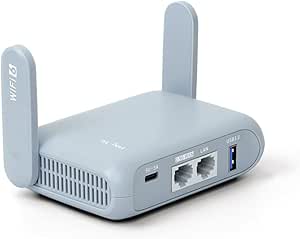 | Best for VPN and Wired Hotel Connections | Wi-Fi: Wi-Fi 6, dual-band 2.4 GHz and 5 GHz | Wireless speed: 574 Mbps (2.4 GHz) + 2402 Mbps (5 GHz) | WAN port: 2.5G | VIEW ON AMAZON | See Our Full Breakdown |
| SIMO Solis Hero 4G Mobile Hotspot with 1GB Monthly and 30GB Global Data |  | Best for Travelers Who Want a Built-In Power Bank | Cellular connectivity: LTE (4G) | Wireless standard: 802.11ac | Frequency band: Dual-band; includes 5 GHz | VIEW ON AMAZON | See Our Full Breakdown |
| TP-Link Roam 6 AX1500 Portable Wi-Fi 6 Travel Router (TL-WR1502X) |  | Best for Sharing Public Wi-Fi | Wi-Fi: Wi-Fi 6 (802.11ax), dual-band 2.4 GHz and 5 GHz | Maximum data rate: 1500 Mbps: up to 1201 Mbps on 5 GHz and 300 Mbps on 2.4 GHz | Operating modes: Router, Hotspot, Access Point, Range Extender, and Client | VIEW ON AMAZON | See Our Full Breakdown |
| Roam 6 AX1500 Portable Wi‑Fi 6 Travel Router |  | Best High-Capacity Travel Router | Wi-Fi Standard: Wi-Fi 6 (802.11ax) | Dual-Band Speed: Up to 1,201 Mbps (5 GHz) / 300 Mbps (2.4 GHz) | Maximum Devices: 60 | VIEW ON AMAZON | See Our Full Breakdown |
| GL.iNet Slate AX (GL-AXT1800) Wi-Fi 6 Travel Router |  | Best for Power Users | Model: GL-AXT1800 | Wi-Fi Generation: Wi-Fi 6 (802.11ax) | Combined Speed: Up to 1800 Mbps | VIEW ON AMAZON | See Our Full Breakdown |
| RoamWiFi Portable Mobile Hotspot |  | Best Value for North America | Coverage: Over 160 countries and regions | Included Local Data: 50GB (US, Canada, Mexico) | Included Global Data: 1GB | VIEW ON AMAZON | See Our Full Breakdown |
| RoamWiFi 4G LTE Mobile Hotspot with 10GB US Data |  | Best Entry-Level Cellular Hotspot | Connectivity: 4G LTE, UMTS | Coverage: 160+ countries | Included Data: 10GB US/CA/MX + 1GB Global | VIEW ON AMAZON | See Our Full Breakdown |
| RoamWiFi 4G LTE Mobile Hotspot | | Best for Emergency Backup | Connectivity: LTE, Wi-Fi | Coverage: 170+ countries | Included Data: 1GB (US, Canada, Mexico) | VIEW ON AMAZON | See Our Full Breakdown |
More Details on Our Top Picks
GL.iNet GL-E750V2 Mudi 4G LTE Portable Travel Router
The GL.iNet Mudi is the strongest fit here for travelers who want a cellular hotspot with more control over privacy and files. Its SIM slot provides 4G LTE, while OpenVPN and WireGuard support lets users route traffic through a VPN; the tradeoff is reduced throughput when VPNs are active. Compared with the Unlocked 4G LTE Mobile WiFi Hotspot, the Mudi adds dual-band Wi-Fi, VPN tools, and microSD expansion, but its 7,000 mAh battery is only rated for up to eight hours. The microSD slot can hold up to 1 TB, making it useful for carrying files alongside connectivity. Check regional cellular restrictions before buying, and note that a physical eSIM card must be purchased separately.
Pros:- SIM-based 4G LTE connectivity with a built-in cellular module
- Supports OpenVPN and WireGuard
- MicroSD expansion supports up to 1 TB
- Dual-band Wi-Fi and a 7,000 mAh built-in battery
Cons:- Battery life is rated for up to eight hours
- Cellular use is restricted in several listed regions
- Physical eSIM card must be purchased separately
Best for: Travelers who want SIM-based 4G, VPN options, and expandable local storage in one battery-powered device
Not ideal for: People who need all-day battery life, unrestricted regional cellular compatibility, or a simple hotspot that works without extra setup
- Cellular connectivity:4G LTE with SIM card slot
- Wi-Fi:Dual-band 802.11ac (Wi-Fi 5); up to 300 Mbps on 2.4 GHz and 433 Mbps on 5 GHz
- VPN support:OpenVPN and WireGuard
- VPN speeds:Up to 50 Mbps with WireGuard; up to 10 Mbps with OpenVPN
- Battery:7,000 mAh; rated for up to 8 hours
- Expandable storage:MicroSD up to 1 TB
- Ports:One USB 2.0 port
- Dimensions and weight:5.7 × 3.1 × 0.9 in; 285 g
Our verdict“Choose the Mudi if VPN control and expandable storage matter more than longer battery life or plug-and-play simplicity.”
RoamWiFi Mobile Hotspot Pocket WiFi, Portable WiFi No SIM Card Needed, MiFi
The RoamWiFi Pocket WiFi suits travelers who want a ready-to-go connection without sourcing a local SIM for every stop. It advertises coverage in 170+ countries and supports up to 10 devices, while its included data gives US, Canada, and Mexico travelers 100 GB for 90 days. The international allowance is much smaller at 1 GB, so this is better for light use abroad than for relying on it as a full-trip data connection. Unlike the Statelinker S2, which is limited to North America but includes a longer stated battery life, RoamWiFi emphasizes broader geographic reach. The listing does not specify battery capacity or runtime, making trip-length planning less certain; buyers should also check data terms and network availability for their destinations.
Pros:- Advertised coverage in more than 170 countries without swapping SIM cards
- Includes 100 GB for US, Canada, and Mexico plus 1 GB global data, valid for 90 days
- Supports up to 10 connected devices
- WPA3 security is listed
Cons:- Only 1 GB of included global data outside the US, Canada, and Mexico
- Battery runtime and capacity are not specified in the supplied data
- Coverage and data availability can vary by destination
Best for: Travelers crossing several countries who want one hotspot and can keep international data use light
Not ideal for: International travelers who stream or work heavily on mobile data, or buyers who need a clearly stated battery runtime
- Coverage:Worldwide coverage advertised in 170+ countries
- Included data:100 GB US/Canada/Mexico and 1 GB global data; valid for 90 days
- Device capacity:Up to 10 devices
- Wi-Fi standard:802.11ac
- Security:WPA3
- RAM:1 GB
- Ports:One port
- Power:5 V
Our verdict“Pick RoamWiFi for multi-country convenience if the included global allowance suits your travel habits.”
Unlocked 4G LTE Mobile WiFi Hotspot with SIM Card Slot
This unlocked 4G LTE hotspot is a straightforward choice for buyers who already have a compatible SIM and data plan. Its standard SIM slot and support for up to 15 devices make it more flexible for a small group than the Statelinker S2, which supports up to eight connections but includes data. That distinction matters: this model does not bundle a plan, so the owner chooses the carrier and pays for service separately. The listed Wi-Fi standard is 802.11ac, but the device is single-band, unlike the dual-band GL.iNet Mudi. A 3,000 mAh rechargeable battery keeps it portable, though no runtime is supplied, so it is difficult to judge how long it will last away from a charger. WPA2-PSK provides password protection, but this is a simpler feature set than the Mudi’s VPN tools.
Pros:- Standard SIM slot supports use with compatible carrier plans
- Connects up to 15 devices
- Rechargeable 3,000 mAh battery
- WPA2-PSK password protection
Cons:- Requires a separate cellular data plan
- Battery runtime is not specified
- Single-band Wi-Fi offers less flexibility than the dual-band GL.iNet Mudi
Best for: Buyers with an existing compatible SIM plan who need a basic hotspot for a small group or backup connection
Not ideal for: Travelers seeking included data, known battery runtime, dual-band Wi-Fi, or built-in VPN features
- Cellular connectivity:4G LTE
- SIM card:Standard SIM card slot
- Wi-Fi standard:802.11ac, single-band
- Maximum Wi-Fi data transfer rate:300 Mbps
- Device capacity:Up to 15 devices
- Battery capacity:3,000 mAh
- Security:WPA2-PSK
Our verdict“Choose this hotspot if you already have a suitable SIM plan and want a basic connection for up to 15 devices.”
Statelinker S2 Portable 4G LTE Wi-Fi 6 Hotspot
The Statelinker S2 is the easiest fit for North American users who value long stated battery life and some included data over broad international reach. It weighs about 3.4 ounces, supports up to eight devices, and is rated for up to 15 hours—a more explicit endurance claim than the RoamWiFi Pocket WiFi listing provides. The S2 also avoids a physical SIM card, but its coverage is limited to North America, so it is less versatile than RoamWiFi’s advertised 170+ country reach. Included data starts with 10 GB for 30 days, followed by 2 GB monthly after activation; that allowance is better treated as light-use connectivity than a replacement for a high-volume plan. Although it lists Wi-Fi 6, the supplied frequency information is 2.4 GHz only.
Pros:- Rated for up to 15 hours of battery life
- Lightweight at about 3.4 ounces
- Includes 10 GB for 30 days and 2 GB monthly after activation
- Supports up to eight connected devices
Cons:- Coverage is limited to North America
- Monthly data requires initial activation
- Included data may not suit heavy streaming or work use
Best for: North American commuters and day travelers who want a light hotspot with stated battery life and a modest included data allowance
Not ideal for: Frequent international travelers, heavy-data users, or buyers who do not want to activate a monthly data offer
- Network:4G LTE
- Wi-Fi generation:Wi-Fi 6 (802.11ax)
- Frequency:2.4 GHz
- Coverage:North America
- Connected devices:Up to 8
- Battery life:Up to 15 hours
- Weight:About 3.4 ounces
- Included and monthly data:10 GB for 30 days plus 2 GB monthly after activation
Our verdict“Pick the S2 for lightweight North American trips where long stated runtime matters more than international coverage or large data allowances.”
TP-Link Roam 7 BE3600 Wi-Fi 7 Portable Travel Router
The TP-Link Roam 7 is a travel router rather than a self-contained cellular hotspot: it creates a private network from public Wi-Fi, Ethernet, or USB tethering, but the supplied specifications do not include a cellular modem or SIM slot. That makes it a better match for hotel stays, conferences, or shared connections than the GL.iNet Mudi, which can connect directly through a SIM. Roam 7’s Wi-Fi 7 support, multi-gigabit WAN port, USB 3.0 file sharing, and capacity for up to 90 devices make it the most capable network-sharing option in this group. Its limits are practical ones: there is no 6 GHz band, no OpenWrt support, and USB-C power means you need a separate power source. Choose it for flexible network management, not independent mobile data.
Pros:- Creates a private network from public Wi-Fi, Ethernet, or USB tethering
- Supports up to 90 devices and several network modes
- Includes OpenVPN and WireGuard support
- Offers a 2.5 Gbps WAN port and USB 3.0 file sharing
Cons:- No cellular modem or SIM-based mobile data is listed
- Does not support the 6 GHz band
- Requires USB-C power and does not support OpenWrt
Best for: Travelers who want to turn hotel, public Wi-Fi, Ethernet, or USB tethering into a shared private network
Not ideal for: Buyers who need a standalone cellular hotspot with a SIM slot and built-in mobile data
- Wi-Fi standard:Wi-Fi 7
- Wireless bands and speeds:Dual-band 2.4 GHz and 5 GHz; up to 688 Mbps on 2.4 GHz and 2,882 Mbps on 5 GHz; no 6 GHz
- Maximum devices:Up to 90
- Ports:1 × 2.5 Gbps WAN, 1 × 1 Gbps LAN, USB 3.0, USB-C power
- Network modes:Router, Hotspot, Access Point, Range Extender, Client
- VPN protocols:OpenVPN, WireGuard, PPTP, L2TP
- Power:USB-C; supports 5 V PD power sources
- OpenWrt support:Not supported
Our verdict“Choose the Roam 7 if you need a flexible private travel network from an existing connection, not a standalone cellular hotspot.”
SIMO Solis Edge 5G Wi-Fi Hotspot with 1GB Monthly and 30GB Global Data
I’d choose the SIMO Solis Edge for international trips where avoiding local SIM swaps matters more than having a large monthly data allowance. Its access to 300+ carriers in 140+ countries and automatic signal selection make it more travel-focused than the GL.iNet MUDI 7, which offers more network setup options but asks buyers to manage eSIM or physical SIM arrangements. The Edge also pairs 5G with Wi-Fi 6, a useful combination for sharing a fast connection with newer devices.
The tradeoff is its included data: 1GB monthly is a small allowance for regular streaming, video calls, or several users. The separate 30GB global pack adds travel data, but buyers should check its terms before relying on it. I’d also verify the device’s weight, since the supplied product information lists conflicting measurements.
Pros:- Access to more than 300 carriers across 140+ countries with automatic signal selection
- 5G cellular service paired with Wi-Fi 6
- Includes 1GB monthly and a separate 30GB global data pack
- No SIM card or contract required
Cons:- The 1GB monthly allowance is limited for regular or shared use
- Product information gives conflicting device weights
- Its travel data terms may require planning around the separate global pack
Best for: International travelers who want a SIM-free hotspot with broad carrier access and can keep data use modest or plan around the included global pack.
Not ideal for: Frequent video streamers, groups with heavy data needs, or buyers who need a clearly confirmed lightweight carry weight.
- Cellular network:5G
- Wi-Fi:Wi-Fi 6 (802.11ax), dual-band
- Security:WPA3
- Coverage:140+ countries; 300+ mobile carriers
- Included data:1GB monthly and 30GB global data pack
- SIM and contract:No SIM card or contract required
- Model:S5G25-30
- Listed weight:Conflicting figures: 2.8 oz (78.8 g) in description and 10.88 oz in product measurements
Our verdict“Choose the Solis Edge for broad international coverage without a SIM swap, but skip it if you need a generous ongoing data allowance.”
GL.iNet MUDI 7 5G Tri-Band Wi-Fi 7 Travel Router with eSIM
The GL.iNet MUDI 7 is the most capable option here for travelers who want a configurable network, not just cellular Wi-Fi. Its 5G, tri-band Wi-Fi 7, and support for up to 64 devices give it more headroom than the SIMO Solis Edge, while multi-WAN failover can switch among cellular, Ethernet, Wi-Fi repeater, and USB tethering. That flexibility suits work trips where a backup connection matters, and the touchscreen makes core status checks less dependent on a laptop.
It is also the most involved pick: eSIM activation occupies one SIM position, advertised peak speeds are not a promise of typical service, and its many networking tools may be unnecessary for casual browsing. The Solis Edge is simpler for travelers who mainly want broad roaming access; I’d pick the MUDI 7 when network control and backup paths justify carrying a more elaborate router.
Pros:- Combines 5G with tri-band Wi-Fi 7 and support for up to 64 devices
- eSIM and dual nano-SIM slots offer several cellular options
- Multi-WAN failover supports cellular, Ethernet, Wi-Fi repeater, and USB tethering
- Includes VPN support, a touchscreen, and 2.5 Gbps Ethernet
Cons:- eSIM activation uses one of the SIM positions
- Advertised maximum cellular speeds may not reflect real-world network performance
- Its advanced configuration and connectivity options can be excessive for basic travel use
Best for: Remote workers and technically confident travelers who need 5G, multiple connection fallback options, VPN tools, and support for many devices.
Not ideal for: Casual travelers seeking a straightforward hotspot, or buyers who do not need advanced routing and multi-WAN features.
- Cellular chipset:Qualcomm Dragonwing MBB Gen 3 (X72)
- Maximum 5G download speed:4.67 Gbps
- Wi-Fi:Wi-Fi 7, tri-band: 2.4 GHz, 5 GHz, and 6 GHz
- Maximum connected devices:64
- SIM support:Built-in eSIM and dual nano-SIM slots; dual standby
- Multi-WAN:5G cellular, Ethernet, Wi-Fi repeater, and USB tethering
- Ethernet:2.5 Gbps WAN/LAN
- Battery:5,150 mAh; up to 13.5 hours
- Display and charging:2.8-inch color touchscreen; 30W PD/PPS USB-C
Our verdict“Pick the MUDI 7 if you need an advanced, flexible travel network; choose the simpler Solis Edge for less hands-on international connectivity.”
GL.iNet GL-MT3000 Beryl AX Wi-Fi 6 Travel Router
The GL.iNet Beryl AX is a travel router, not a cellular hotspot: it creates a private network from an existing wired connection, so it makes the most sense in hotels or workspaces with Ethernet. Its 2.5G WAN, gigabit LAN, and USB 3.0 give it a more capable wired setup than the TP-Link Roam 6, while OpenWrt and OpenVPN or WireGuard support appeal to travelers who want configurable privacy tools. Unlike the SIMO Solis Hero, it does not provide its own cellular data or a built-in battery.
That distinction is the main buying decision. The Beryl AX can share a connection and route it through VPN software, but it cannot replace a mobile hotspot when there is no usable Wi-Fi, Ethernet, or tethered source. VPN throughput is also limited by the listed hardware figures, and VPN service may involve a separate subscription. I’d choose it for network control, not for roaming independence.
Pros:- OpenWrt supports extensive network customization
- Supports OpenVPN and WireGuard client and server modes
- Includes 2.5G WAN, gigabit LAN, and USB 3.0
- Wi-Fi 6 supports dual-band connections
Cons:- Does not provide cellular connectivity or mobile data
- Requires an existing network or USB-tethered connection to share
- Listed VPN throughput is limited to 150 Mbps for OpenVPN and 300 Mbps for WireGuard
Best for: Travelers who regularly connect to hotel Ethernet or public Wi-Fi and want a compact router with configurable VPN and network features.
Not ideal for: Buyers who need independent cellular internet, a built-in battery, or a hotspot that works without another connection source.
- Wi-Fi:Wi-Fi 6, dual-band 2.4 GHz and 5 GHz
- Wireless speed:574 Mbps (2.4 GHz) + 2402 Mbps (5 GHz)
- WAN port:2.5G
- LAN port:1 Gbps
- USB:USB 3.0
- VPN protocols:OpenVPN and WireGuard; client and server support
- Maximum VPN speed:150 Mbps OpenVPN; 300 Mbps WireGuard
- Firmware:OpenWrt 21.02
- Security:WPA2-PSK, WPA3, DNS over HTTPS, and DNS over TLS
Our verdict“Choose the Beryl AX for a configurable private network from existing connections, not as a standalone portable hotspot.”
SIMO Solis Hero 4G Mobile Hotspot with 1GB Monthly and 30GB Global Data
The SIMO Solis Hero pairs a straightforward 4G hotspot with a 5,250 mAh power bank, making it a practical choice for travelers who want one device to share a connection and top up a phone. Like the Solis Edge, it offers coverage across 140+ countries through 300+ carriers without requiring a SIM card or contract. The Edge adds 5G and Wi-Fi 6, so it is the stronger fit for buyers prioritizing newer network standards; the Hero’s distinguishing advantage is its phone-charging battery and support for up to 10 connected devices.
The data allowance needs close attention: the included 30GB global pack expires after 30 days, while the ongoing monthly inclusion is only 1GB. That can work for a defined trip with managed usage, but is less convenient for frequent or heavy use. I’d pick it for practical travel utility over speed, and skip it if long-term data capacity is the priority.
Pros:- Built-in 5,250 mAh battery can also power a connected phone
- Connects up to 10 devices
- Coverage across 140+ countries through 300+ carriers with automatic signal selection
- Includes 1GB monthly and a separate 30GB global data pack
Cons:- The one-time 30GB global pack expires after 30 days
- The 1GB monthly allowance is limited for regular use
- Uses 4G rather than the 5G connectivity offered by the Solis Edge
Best for: International travelers who want a 4G connection for a small group and value a built-in power bank for phone top-ups.
Not ideal for: Buyers seeking 5G, a large ongoing monthly data allowance, or global data that does not have a stated 30-day expiry.
- Cellular connectivity:LTE (4G)
- Wireless standard:802.11ac
- Frequency band:Dual-band; includes 5 GHz
- Maximum connected devices:10
- Battery:5,250 mAh; built-in power bank
- Coverage:140+ countries; 300+ carriers
- Included data:1GB monthly and one-time 30GB global pack
- Global pack validity:30 days
Our verdict“Choose the Solis Hero for a travel hotspot that doubles as a phone power bank, provided its time-limited data pack fits your trip.”
TP-Link Roam 6 AX1500 Portable Wi-Fi 6 Travel Router (TL-WR1502X)
The TP-Link Roam 6 is a compact travel router for turning public Wi-Fi, Ethernet, or USB tethering into a private network. That makes it useful in hotels and other places where you already have internet, but it is not a cellular hotspot: unlike the SIMO Solis Hero, it has no mobile data connection of its own. Its role is closer to the GL.iNet Beryl AX, though the Roam 6 offers several operating modes and two gigabit Ethernet ports without OpenWrt support.
Wi-Fi 6 and USB-C power make it easy to fit into a travel setup, and a compatible power bank can supply power when an outlet is inconvenient. The limitation is dependence on a separate internet source, so it cannot keep a connection going when public Wi-Fi, Ethernet, or tethering is unavailable. Buyers seeking cellular coverage should choose a true hotspot; buyers who want a private network from an existing connection may prefer this simpler approach.
Pros:- Creates a private network from public Wi-Fi, Ethernet, or USB tethering
- Supports router, hotspot, access point, range extender, and client modes
- Includes two gigabit Ethernet ports
- USB-C power supports use with a compatible power bank
Cons:- Does not include cellular connectivity or provide mobile data
- Needs a separate internet source to create a working connection
- Does not support OpenWrt
Best for: Travelers who regularly use hotel or public Wi-Fi and want to share it through a private Wi-Fi 6 network, including from a compatible power bank.
Not ideal for: People who need standalone mobile internet, cellular coverage, or OpenWrt customization.
- Wi-Fi:Wi-Fi 6 (802.11ax), dual-band 2.4 GHz and 5 GHz
- Maximum data rate:1500 Mbps: up to 1201 Mbps on 5 GHz and 300 Mbps on 2.4 GHz
- Operating modes:Router, Hotspot, Access Point, Range Extender, and Client
- Ports:Two gigabit Ethernet ports, one USB 2.0 port, and one USB-C power port
- Security:WPA-PSK, WPA2-Enterprise, and WPA3
- Dimensions:4.09 × 3.54 × 1.10 in
- Power:USB-C; supports a 5V/3A PD source
- OpenWrt support:Not supported
Our verdict“Choose the Roam 6 if you need to privatize and share an existing connection, but choose the Solis Hero if you need cellular internet on the move.”
Roam 6 AX1500 Portable Wi‑Fi 6 Travel Router
This router stands out for its exceptional device capacity, supporting up to 60 simultaneous connections, which is double what many competitors offer. Compared to the GL.iNet Slate AX, the Roam 6 prioritizes raw throughput and stability over firmware flexibility. It delivers solid Wi-Fi 6 speeds, making it ideal for digital nomads who connect multiple laptops and phones without lag. However, the lack of OpenWrt support is a significant drawback for power users who want custom firewall rules or advanced ad-blocking capabilities. It operates as a dedicated travel router, requiring a source internet connection, so it is not a standalone cellular device.
Pros:- Supports up to 60 devices simultaneously
- Includes built-in OpenVPN and WireGuard support
- Offers versatile operating modes including Repeater and Client
- Delivers Wi-Fi 6 speeds on both 2.4GHz and 5GHz bands
Cons:- Does not support OpenWrt firmware
- Requires an external internet source to function
Best for: Digital nomads and families traveling together who need to connect many devices simultaneously to a single hotel or Airbnb Wi-Fi source.
Not ideal for: Tech enthusiasts who require custom firmware like OpenWrt, or solo travelers who need cellular connectivity built-in.
- Wi-Fi Standard:Wi-Fi 6 (802.11ax)
- Dual-Band Speed:Up to 1,201 Mbps (5 GHz) / 300 Mbps (2.4 GHz)
- Maximum Devices:60
- WAN/LAN Port:1 Gbps
- VPN Support:OpenVPN, WireGuard
- Power Input:USB-C, 5V/3A PD
Our verdict“This is the best choice for groups needing stable, high-capacity Wi-Fi 6 performance from an existing network source.”
GL.iNet Slate AX (GL-AXT1800) Wi-Fi 6 Travel Router
The Slate AX wins on customizability and speed, running OpenWrt 21.02 which allows deep configuration tweaks that the Roam 6 AX1500 simply cannot match. With combined speeds reaching 1800 Mbps and support for 120 devices, it handles heavy loads with ease. The inclusion of a physical toggle for AdGuard Home and VPN is a clever touch for privacy-conscious travelers. However, the initial setup requires configuring the toggle via the admin panel, adding a layer of complexity for beginners. It also relies on an external internet source, distinguishing it from cellular-only hotspots.
Pros:- Runs OpenWrt for extensive customization
- Supports up to 120 connected devices
- High-speed VPN performance (up to 550 Mbps WireGuard)
- Includes USB file sharing capabilities
Cons:- Physical feature toggle requires initial configuration
- Complexity may overwhelm non-technical users
Best for: Advanced users who want to customize their network settings, block ads globally, or use specific VPN protocols like WireGuard at high speeds.
Not ideal for: Casual users who prefer a plug-and-play experience without needing to configure admin panels or toggles.
- Model:GL-AXT1800
- Wi-Fi Generation:Wi-Fi 6 (802.11ax)
- Combined Speed:Up to 1800 Mbps
- Max Devices:120
- Operating System:OpenWrt 21.02
- VPN Speeds:OpenVPN up to 500 Mbps, WireGuard up to 550 Mbps
- Ports:3 (Ethernet, USB-C)
Our verdict“Choose this router if you value firmware flexibility and high-speed privacy features over simple setup.”
RoamWiFi Portable Mobile Hotspot
This hotspot offers a compelling deal for travelers in the US, Canada, and Mexico, bundling 50GB of local data right out of the box. Unlike the RoamWiFi 4G LTE Mobile Hotspot with 10GB, this model provides significantly more local bandwidth, making it suitable for moderate streaming or work use. It connects to cellular networks directly, eliminating the need for a separate SIM card. The tradeoff is the limited global data of just 1GB, which is insufficient for international trips outside North America. Additionally, the data expires quickly, forcing users to purchase more if the trip extends beyond 60 days.
Pros:- Includes 50GB of data for US, Canada, and Mexico
- No SIM card or annual contract required
- Covers over 160 countries globally
- Supports up to 10 devices simultaneously
Cons:- Global data allowance is only 1GB
- Included data expires after 60 days
Best for: Travelers focusing primarily on the US, Canada, and Mexico who want substantial local data without committing to a monthly contract.
Not ideal for: International travelers heading outside North America, as the 1GB global allowance is too small for practical use.
- Coverage:Over 160 countries and regions
- Included Local Data:50GB (US, Canada, Mexico)
- Included Global Data:1GB
- Data Validity:60 days
- Max Devices:10
- Wi-Fi Standard:802.11ac
- Security:WPA3
Our verdict“A strong option for North American trips where high local data volume is prioritized over global coverage.”
RoamWiFi 4G LTE Mobile Hotspot with 10GB US Data
This model serves as a cost-effective entry point into cellular hotspots, offering 10GB of data for North America. While the RoamWiFi Portable Mobile Hotspot provides five times the local data, this device is adequate for light users who mainly browse email and maps. It shares the same global coverage promise but is hampered by a strict 30-day expiration on the included data. The 1GB global allowance remains a bottleneck for international travel. It is a functional device for short trips, but the limited data cap requires careful management to avoid running out mid-journey.
Pros:- Includes 10GB of local data for North America
- No SIM card required
- Compact and easy to set up
- Covers 160+ countries
Cons:- Data expires in just 30 days
- Total included data is limited to 11GB
Best for: Budget-conscious travelers on short trips to North America who have light data needs and want to avoid long-term commitments.
Not ideal for: Heavy data users or those traveling internationally, as the 10GB local and 1GB global caps are too restrictive.
- Connectivity:4G LTE, UMTS
- Coverage:160+ countries
- Included Data:10GB US/CA/MX + 1GB Global
- Data Validity:30 days
- Max Devices:10
- Wi-Fi Standard:802.11ac
- Control:App
Our verdict“Suitable for short, light-usage trips in North America where minimal data consumption is guaranteed.”
RoamWiFi 4G LTE Mobile Hotspot
As the most basic option in the RoamWiFi lineup, this hotspot provides connectivity in over 170 countries but includes only 1GB of local data. Compared to the RoamWiFi 4G LTE Mobile Hotspot with 10GB, it offers less bundled data but slightly broader country coverage. It is best viewed as a backup solution or a device for very light usage, such as checking messages on a flight or in remote areas. The lack of specified battery life is a concern for long days out. It works without a SIM, but the minimal data allowance makes it unsuitable for streaming or heavy browsing without immediate top-ups.
Pros:- Covers more than 170 countries
- No SIM card or contract needed
- Supports up to 10 devices
- Simple app-based control
Cons:- Only 1GB of included local data
- Battery life is not specified
Best for: Frequent flyers who need a lightweight backup device for emergency connectivity or very light data usage across many countries.
Not ideal for: Anyone planning to use data for navigation, video calls, or general browsing, as 1GB is insufficient for most modern needs.
- Connectivity:LTE, Wi-Fi
- Coverage:170+ countries
- Included Data:1GB (US, Canada, Mexico)
- Data Validity:30 days
- Max Devices:10
- Wi-Fi Standard:Wi-Fi 5 (802.11ac)
- Data Transfer Rate:150 Mbps
Our verdict“A viable emergency backup or ultra-light usage device for global travelers who manage data meticulously.”

How We Picked
I evaluated these portable wifi hotspots based on three primary criteria: connectivity flexibility, network performance, and ease of use. Connectivity flexibility examines whether a device supports physical SIMs, eSIMs, or both, and if it includes Ethernet ports for stable hotel connections. Network performance looks at supported generations (4G LTE vs. 5G), Wi-Fi standards (Wi-Fi 6 vs. Wi-Fi 7), and concurrent device limits. Ease of use weighs the setup process, app interface quality, and whether the device requires complex APN configuration or works out of the box.
The ranking logic prioritizes versatility for the top spots. Devices that allow users to switch between local data plans and global roaming plans ranked higher than locked, carrier-specific units. However, dedicated MiFi devices with built-in data plans received high marks for beginners due to their zero-configuration nature. I penalized models with poor battery efficiency or limited band support that could cause compatibility issues in major travel hubs like Europe or Asia.
Factors to Consider When Choosing Portable Wifi Hotspots
Selecting a portable hotspot involves more than just picking the fastest modem. You must balance the cost of hardware against the ongoing cost of data, while also considering the physical constraints of your travel lifestyle.Understanding the SIM vs. eSIM vs. Built-in Data Tradeoff
The most significant decision you will face is how to source your internet connection. Travel routers (like GL.iNet or TP-Link) typically have empty SIM slots, meaning you buy the hardware once and then purchase cheap local data plans or international eSIMs as needed. This approach offers the lowest long-term cost but requires you to research carriers and configure Access Point Names (APNs) for each country. In contrast, MiFi devices (like RoamWiFi or SIMO) often come with a built-in data plan or a proprietary SIM. These are plug-and-play, requiring no technical setup, but you are locked into their specific pricing tiers and data caps. If you travel frequently for short periods, the convenience of a built-in plan may outweigh the higher per-GB cost. If you are a digital nomad staying in one place for weeks, bringing your own router and buying local SIMs is far more economical.
4G LTE vs. 5G: Is the Upgrade Worth It?
5G hotspots promise faster speeds and lower latency, but the reality is more nuanced. In many rural or international travel destinations, 5G coverage remains spotty, meaning you will often fall back to 4G LTE anyway. A 5G device costs more upfront and consumes more battery power due to the complex modem architecture. For most travelers checking email, streaming video, or making video calls, a high-quality 4G LTE Advanced Pro device is sufficient and more reliable. Only choose a 5G hotspot if you work in major metropolitan areas with robust 5G infrastructure or if you need to upload large files quickly. Additionally, ensure your 5G device supports sub-6 GHz bands commonly used globally, rather than just mmWave bands which are limited to specific US cities.
Wi-Fi Standards and Device Compatibility
The Wi-Fi standard supported by the hotspot affects how many devices you can connect simultaneously and how stable the connection remains in congested environments. Wi-Fi 6 has become the baseline for good performance, offering better multi-device handling than older Wi-Fi 5 units. Wi-Fi 7 is emerging in premium models, offering lower latency and higher peak speeds, but your laptop, phone, and tablet must also support Wi-Fi 7 to benefit from these improvements. If your devices are older, a Wi-Fi 6 hotspot will perform just as well. Pay attention to band support as well; dual-band (2.4 GHz and 5 GHz) is standard, but tri-band devices can help reduce interference in crowded hotels or conference centers by offering a dedicated 6 GHz band for compatible devices.
Battery Life and Power Management Realities
Manufacturer battery claims are often measured under idle conditions, not active data usage. A device advertised as lasting 12 hours may only last 4-5 hours if you are actively streaming or connecting multiple devices. Look for hotspots that support USB-C Power Delivery (PD) charging, which allows you to charge the device quickly using modern power banks. Some travel routers also feature pass-through charging, letting you power the device while it acts as a router for a wired connection, though this can generate heat. If you plan to use the hotspot all day without access to a wall outlet, prioritize models with larger battery capacities (5,000 mAh or higher) or consider carrying a high-capacity power bank specifically for the hotspot, as your phone’s power bank may not provide enough juice for a high-performance 5G modem.
Network Security and VPN Integration
Public networks in hotels, airports, and cafes are breeding grounds for cyber threats. While basic MiFi devices create a private network for your devices, they often lack advanced security features. Travel routers frequently include built-in VPN clients and firewalls, allowing you to route all connected traffic through a secure tunnel automatically. This is a major advantage for professionals handling sensitive data. If you choose a basic hotspot without VPN support, you must manually install VPN apps on every individual device you connect, which is prone to user error. For peace of mind, look for devices that support OpenVPN or WireGuard natively, as these offer better performance and security than older protocols.
Frequently Asked Questions
Can I use my existing phone carrier’s data plan with these hotspots?
It depends on the specific hotspot and your carrier’s policies. Most unlocked travel routers allow you to insert a physical SIM from your carrier, but many carriers restrict hotspot usage on their standard phone plans or charge extra for it. Some devices, like the SIMO or RoamWiFi models, use their own proprietary networks and cannot accept your carrier’s SIM. Always check if your carrier allows SIM swapping and if they permit tethering on the plan you intend to use before purchasing a third-party hotspot.Do I need a 5G hotspot if I mostly travel in Europe and Asia?
Not necessarily. While 5G networks are expanding in major cities across Europe and Asia, many secondary cities and rural areas still rely heavily on 4G LTE. A high-quality 4G LTE Advanced Pro hotspot is often more consistent and cost-effective for these regions. Furthermore, 5G bands vary significantly by country; ensure a 5G device supports the specific bands used in your destination countries. Unless you are working exclusively in capital cities with known 5G rollout, a 4G device will likely provide a more stable and battery-efficient experience.What is the difference between a travel router and a mobile hotspot?
A mobile hotspot (MiFi) is primarily designed to create a WiFi network from a cellular connection, focusing on portability and battery life. A travel router, like the GL.iNet models, often includes cellular capabilities but also functions as a traditional router, allowing you to plug into a hotel’s Ethernet port to create a secure WiFi network. Travel routers typically offer more advanced networking features, such as VPN support, firewall rules, and multiple LAN ports, making them better for users who need to connect wired devices or manage network security manually.How many devices can I connect to a portable WiFi hotspot?
Most portable hotspots support between 10 and 20 connected devices, but this number refers to the maximum connection limit, not the number of devices that can actively use data at high speeds simultaneously. For optimal performance, it is best to keep active connections under 5-7 devices. If you need to connect many devices, look for models with Wi-Fi 6 or Wi-Fi 7 support, as these standards handle multiple simultaneous connections more efficiently than older Wi-Fi 5 models, reducing latency and buffering.Is it better to buy a hotspot with a data plan or bring my own SIM?
Bringing your own SIM is generally cheaper if you are staying in one country for a week or longer, as you can buy local prepaid data plans. However, buying a hotspot with a built-in data plan (like SIMO) is better for multi-country trips or short visits, as it eliminates the hassle of finding local stores and setting up APNs. Consider the total cost of ownership: a cheap hotspot with expensive data may cost more over a year than a premium router with flexible SIM slots and cheap local data.Conclusion
The best portable wifi hotspot for you depends on your travel frequency and technical comfort level. For tech-savvy travelers and digital nomads, the GL.iNet MUDI 7 is the best overall choice, offering future-proof Wi-Fi 7 speeds, eSIM flexibility, and robust networking features. If you prioritize ease of use and global coverage without worrying about SIM cards, the SIMO Solis Edge is the best premium option for seamless connectivity. For beginners or casual travelers who want a simple, reliable device for occasional trips, the TP-Link Roam 6 provides an excellent balance of price and performance. Finally, for those on a strict budget who only need basic connectivity in supported regions, the RoamWiFi Pocket WiFi offers a low-barrier entry point, provided you accept the limitations of its data plans.
Halloween Picks
halloween
As an affiliate, we earn on qualifying purchases.