
For most kitchens, I’d start with the iSpring RCC7-BN: its familiar tank-based design offers a straightforward route to reverse osmosis without the electrical needs of many tankless models. The Waterdrop G3P800 is a standout if you want fast, high-capacity tankless filtration, while the APEC ROES-50 suits buyers who prefer a conventional system with a modest production rate. The main tradeoffs are under-sink space, power access, water sent to drain, and whether you want added mineralization or UV treatment. I compare all 15 options below so you can match the system to your kitchen, household, and installation preferences.

Get furniture and decor delivered free with Prime
- Fast, free delivery on millions of items
- Prime Video, Amazon Music and more included
- Member-only deals all year
Complete the kit


Key Takeaways
- Tankless systems lead on rated output: Several Waterdrop models are listed at 700 or 800 GPD, while the traditional APEC ROES-50 and Express Water RO5DX are rated at 50 GPD.
- Higher output often brings a power requirement: Many tankless models need a plug-in connection, while the iSpring RCC7-BN and APEC ROES-50 offer electric-free, tank-based formats.
- Drain ratios vary across the lineup: The Waterdrop G2 lists a 1:1 pure-to-drain ratio, while the T3-C and T3-M list 2:1; compare stated ratios alongside your household water-use priorities.
- Mineralization is a distinct feature, not a substitute for filtration: Alkaline or remineralizing stages appear on several iSpring and Waterdrop models, but buyers should choose them for taste preferences rather than assume they replace core RO performance.
- Special features narrow the field: The iSpring RCC7AK-UV adds LED UV treatment, while the T3-T is rated at 220 GPD, making them more targeted choices than the high-output tankless options.




More Details on Our Top Picks
iSpring RCC7-BN 5-Stage Under-Sink Reverse Osmosis Water Filter System
The iSpring RCC7-BN is my pick for buyers who want a conventional under-sink RO setup with a clear certification and no electrical connection. Its NSF/ANSI 58 certification and stated reduction of up to 99% of more than 1,000 contaminants give it a stronger documented filtration case than the GLACIER FRESH GFU03, whose supplied details emphasize membrane size and capacity instead. It produces up to 75 gallons per day, which is a different proposition from the much higher stated capacities of the tankless Waterdrop G5P700A and GLACIER FRESH models; for typical household drinking and cooking, that may be a reasonable trade for a simpler, non-electric system. The tradeoff is a multi-part under-sink installation and a larger footprint than compact tankless units. The included brushed-nickel faucet is useful, but the warranty requires registration.
Pros:- NSF/ANSI 58 certified
- No electrical power required
- Rated to produce up to 75 gallons per day
- Includes a lead-free brushed-nickel faucet
Cons:- Requires space for a traditional under-sink installation
- Warranty coverage requires registration
- Lower stated daily capacity than the tankless GLACIER FRESH GFU03 and Waterdrop G5P700A
Best for: Households seeking NSF/ANSI 58-certified RO filtration that can operate without an electrical outlet under the sink.
Not ideal for: Buyers with very limited cabinet space or those who want a tankless system with high stated daily capacity and quick cartridge swaps.
- Filtration stages:5
- Certification:NSF/ANSI 58
- Daily production capacity:75 gallons
- Maximum supported TDS:750 ppm
- Power:No power needed
- Dimensions:23.62 × 15.75 × 11.81 in
- Faucet finish:Brushed nickel
- Warranty:1-year manufacturer warranty upon registration
Our verdict“Choose the RCC7-BN if you want certified, non-electric RO filtration and can accommodate a traditional under-sink installation.”
GLACIER FRESH GFU03 Electric-Free Under-Sink Reverse Osmosis Water Filter, 800 GPD
The GLACIER FRESH GFU03 stands out among tankless options because it pairs a stated 800 GPD capacity with water-powered operation, avoiding the outlet requirement of the Waterdrop G5P700A and Waterdrop T3-C. Its 3:1 purified-water-to-wastewater ratio is also more water-conscious than the 2:1 ratio listed for those Waterdrop models. The compact tankless format frees cabinet room compared with the traditional iSpring RCC7-BN, while replaceable cartridges are designed for quick changes. Those advantages depend on suitable inlet pressure: the system recommends at least 40 PSI, and flow varies with pressure, so the headline capacity alone does not describe every home’s actual performance. Faucet installation also calls for drilling, and replacement or new cartridges need a 10–20 minute rinse before use.
Pros:- Tankless design saves cabinet space
- Operates without electricity
- Listed 3:1 purified-water-to-wastewater ratio
- Cartridges are designed for quick replacement
Cons:- Faucet installation requires drilling a 1/2–1 in hole
- Flow depends on inlet pressure, with at least 40 PSI recommended
- Cartridges need a 10–20 minute rinse after installation or replacement
Best for: Homeowners who want a high-capacity tankless RO system but have no convenient under-sink electrical outlet.
Not ideal for: Renters or buyers unwilling to drill for a dedicated faucet, and homes with low inlet pressure.
- Filtration:5-stage reverse osmosis
- Maximum capacity:800 gallons per day
- Maximum flow rate:0.6 gpm
- Pure-to-wastewater ratio:3:1
- RO membrane pore size:0.0001 μm
- Operating pressure:0.25–0.7 MPa
- Dimensions:13.58 × 8.27 × 16.54 in
- Power:Water-powered; no electricity required
Our verdict“Pick the GFU03 for a space-saving, high-capacity tankless system when avoiding electrical power matters more than installation simplicity.”
Waterdrop T3-C Reverse Osmosis Water Filter, NSF/ANSI 372 Certified, 8-Stage Under Sink RO Water Filter, 450 GPD Tankless Water Filtration System, 2:1 Pure to Drain, BPA Free, Plug-in Required
The Waterdrop T3-C is the most convenience-oriented choice here for buyers who want electronic prompts rather than tracking filter dates themselves. Its smart replacement alerts, all-in-one cartridge, LED light, and automatic flushing offer more built-in guidance than the simpler iSpring RCC7-BN. The eight-stage process and 0.0001 μm membrane are described as reducing heavy metals, chlorine, PFOA, and PFOS, while the 2:1 pure-to-drain ratio uses less water per unit of purified water than the GLACIER FRESH GFU03’s stated 3:1 ratio. The price of that convenience is dependence on an electrical connection, plus a countertop hole for the faucet. Its 450 GPD capacity is also below the listed 700 GPD Waterdrop G5P700A, so buyers prioritizing stated output over alerts may prefer that alternative.
Pros:- Smart alerts help track filter replacement
- All-in-one cartridge is designed for quick replacement
- Automatic flushing and LED indicator are built in
- Tankless design can be installed under the sink or wall-mounted
Cons:- Requires an electrical connection
- Faucet installation requires drilling the countertop
- 450 GPD listed capacity is lower than the Waterdrop G5P700A’s 700 GPD
Best for: Busy households that want filter-change prompts, automatic flushing, and a tankless system in a home with an outlet nearby.
Not ideal for: Renters who cannot drill for a faucet, households without an accessible electrical connection, or buyers prioritizing the lineup’s highest listed capacity.
- Filtration stages:8
- Daily capacity:450 GPD
- RO membrane pore size:0.0001 μm
- Pure-to-drain ratio:2:1
- Certification:NSF/ANSI 372
- Power:Plug-in required
- Filter life:CF: 6 months; CB: 12 months; RO: 24 months
- Installation:Under sink or wall-mounted; faucet installation requires countertop drilling
Our verdict“Choose the T3-C if reminders and automated upkeep matter more to you than a higher stated capacity or power-free operation.”
Waterdrop G5P700A Tankless Alkaline Reverse Osmosis Water Filter, 700 GPD
The Waterdrop G5P700A combines a relatively high stated capacity with an alkaline mineralization stage, making it a more fitting choice for buyers who want RO treatment followed by added minerals. Compared with the Waterdrop T3-C, it lists 700 GPD rather than 450 GPD and has a specified maximum flow rate of 1.31 liters per minute, though the T3-C supplies more detail about alerts and automatic flushing. The G5P700A’s 2:1 pure-to-drain ratio is less water-efficient by the listed ratio than the GLACIER FRESH GFU03’s 3:1, but it beats the power-free model on stated daily capacity. NSF/ANSI 58 and 372 certifications add useful documentation. The tradeoffs are an electrical connection and a faucet hole in the countertop; its maximum supported TDS is 500 ppm.
Pros:- NSF/ANSI 58 and 372 certified
- Alkaline stage adds calcium, magnesium, sodium, and potassium
- 700 GPD capacity with a listed 1.31 L/min maximum flow rate
- Tankless design and 2:1 pure-to-drain ratio
Cons:- Requires a corded electrical connection
- Faucet installation requires countertop drilling
- Listed maximum supported TDS is 500 ppm, below the iSpring RCC7-BN’s 750 ppm
Best for: Households wanting a tankless RO system with added minerals, documented certifications, and a higher stated capacity than the T3-C.
Not ideal for: Renters who cannot drill a countertop or buyers who need a system that runs without electricity or supports higher-TDS feed water.
- Filtration:8-stage reverse osmosis
- Capacity:700 GPD
- Maximum flow rate:1.31 liters per minute
- Pure-to-drain ratio:2:1
- Certifications:NSF/ANSI 58 and 372
- Maximum supported TDS:500 ppm
- Dimensions:16.69 × 5.69 × 13.9 in
- Warranty:1 year
Our verdict“Choose the G5P700A if you want certified tankless RO with remineralization and accept power and countertop drilling requirements.”
iSpring RCC7AK-BLK 6-Stage Alkaline Reverse Osmosis Water Filtration System with Black Faucet
The iSpring RCC7AK-BLK suits buyers who want a traditional under-sink RO system with remineralization and a black faucet, rather than the electronically managed tankless format of the Waterdrop G5P700A or T3-C. Its six-stage filtration includes a remineralization stage intended to restore minerals and alkalinity after RO treatment, and the system is NSF/ANSI 58 certified for TDS and several specified contaminants. That certification gives it a clearer stated compliance basis than the supplied details for the Waterdrop T3-C, which list NSF/ANSI 372. The tradeoff is a bulkier installation than tankless alternatives, with dimensions of 15.5 × 16 × 18 inches. Product data also lists AC power, so buyers should confirm the installation’s power needs before choosing it; that is less straightforward than the no-power RCC7-BN.
Pros:- NSF/ANSI 58 certified
- Six-stage filtration includes remineralization
- Includes a black faucet and installation components
- Extra filter is included
Cons:- Traditional system needs substantial under-sink space
- Product data lists AC power, unlike the no-power iSpring RCC7-BN
- Daily capacity is not specified in the supplied product data
Best for: Buyers who prefer a conventional under-sink system, want remineralization, and are coordinating a black faucet with their kitchen fixtures.
Not ideal for: People seeking a compact tankless system, a clearly specified high daily output, or a setup that is definitely power-free.
- Filtration stages:6
- Certification:NSF/ANSI 58
- Membrane filtration size:0.0001 microns
- Capacity:75 gallons
- Dimensions:15.5 × 16 × 18 in
- Weight:12.5 kg
- Power source:AC
- Included components:Extra filter
Our verdict“Pick the RCC7AK-BLK if you want remineralized RO water and a black faucet in a traditional system, and can verify its power and cabinet requirements.”
APEC Water ROES-50 5-Stage Under-Sink Reverse Osmosis System, 50 GPD
The APEC ROES-50 is a straightforward choice for buyers who want a conventional under-sink RO setup with its storage tank and dedicated faucet included. Its five stages target contaminants such as lead, chlorine, arsenic, and fluoride, while the 50-gallon-per-day rating suits ordinary household drinking and cooking needs better than a high-output tankless unit would for a buyer focused on simplicity. Compared with the Waterdrop G3P800, this APEC has far lower stated capacity and takes space for a tank, but it does not add a smart faucet or depend on an electrical connection according to the supplied product details. Quick-connect fittings and color-coded tubing are intended to make setup more approachable. The tradeoff is ongoing filter replacement, plus the cabinet space and plumbing work that come with a tank-based system.
Pros:- Five filtration stages target a broad set of listed contaminants, including lead, arsenic, and fluoride.
- Includes a storage tank, brushed nickel faucet, installation kit, and filter set.
- Quick-connect fittings and colored tubing are designed to simplify DIY setup and maintenance.
- NSF/ANSI 58 and 372 certifications are listed.
Cons:- The tank takes up cabinet space that tankless options such as the Waterdrop G3P800 avoid.
- The listed filter cycle is six months, so replacement upkeep is part of ownership.
- Its 50 GPD capacity is modest beside the high-output tankless systems in this lineup.
Best for: Households seeking a conventional tank-and-faucet RO setup for daily drinking water, without needing tankless capacity or smart monitoring.
Not ideal for: Buyers short on cabinet space or seeking a tankless system with high stated output and live faucet monitoring.
- Filtration stages:5
- Daily capacity:50 gallons
- Purification methods:Activated carbon and reverse osmosis
- Operating pressure:40–85 psi
- Maximum supported TDS:2000 ppm
- Filter life cycle:6 months
- Dimensions:15.5 × 5.25 × 17 in
- Certifications:NSF/ANSI 372 and 58
Our verdict“Choose the APEC ROES-50 if you want a conventional, included-tank RO system and can spare the under-sink space for it.”
Express Water RO5DX 5-Stage Under-Sink Reverse Osmosis System, 50 GPD
The Express Water RO5DX is the clearest fit here for buyers who want a tank-based system that runs without electricity. Its package includes a 4-gallon tank, faucet, leak detector, and filters for setup and first-year use, giving DIY installers more of the core hardware in one kit than the APEC ROES-50 listing specifies. The leak detector adds a practical safeguard beneath the sink, while the system can sit freestanding or be mounted in a cabinet. Its 50 GPD capacity is suited to routine household use, not the rapid output promised by the tankless Waterdrop models. The tradeoffs are meaningful: it can send 1–3 gallons of wastewater down the drain per gallon filtered, tools are not included, and some installations may call for extra tubing or pressure-related equipment.
Pros:- Operates without electricity.
- Includes a 4-gallon storage tank, faucet, leak detector, and filters for setup and first-year use.
- Can be freestanding or mounted inside a cabinet.
- DIY-oriented kit includes a tank stand and filter housing wrench.
Cons:- Produces 1–3 gallons of wastewater per gallon of filtered water, depending on conditions.
- Tools are not included, and some installations may require extra tubing or pressure equipment.
- The tank uses cabinet space and the 50 GPD rating is well below the Waterdrop G3P800’s stated output.
Best for: DIY-minded households that want an electric-free, tank-based RO kit with a leak detector and included first-year filters.
Not ideal for: Buyers aiming to minimize wastewater, avoid a storage tank, or complete installation without sourcing tools or possible add-on parts.
- Filtration stages:5
- Daily production capacity:50 GPD
- Power:No power needed
- Storage tank capacity:4 gallons; 3.2-gallon water capacity
- Operating water pressure:40–80 psi
- Maximum supported TDS:300 ppm
- Dimensions:14 × 5 × 15 in
- Materials:Brass faucet, plastic system, steel tank
Our verdict“Pick the RO5DX if you want a no-electricity tank system and value its included leak detector more than a compact, high-output design.”
Waterdrop T3-M Remineralization Reverse Osmosis Water Filter, NSF/ANSI 372 Certified, 9-Stage Undersink RO System, 450 GPD Tankless RO Water Filtration System, 2:1 Pure to Drain, Plug-in Required
The Waterdrop T3-M pairs tankless RO filtration with a post-filtration mineral stage, making it the most taste-focused pick in this group. Its 450 GPD stated capacity and 2:1 pure-to-drain ratio offer a different balance from the faster Waterdrop G3P800: the G3P800 lists greater output and a better 3:1 ratio, while the T3-M adds calcium, magnesium, and other minerals for buyers who prefer that profile in drinking water. The nine-stage design is described as reducing heavy metals, chlorine, PFOA, and PFOS, with a 0.0001 μm RO membrane. Smart filter alerts and a quick-change all-in-one cartridge may make routine upkeep less fiddly than separate housings. This system still needs a plug and countertop drilling for its faucet, and the supplied specifications do not provide dimensions or operating limits for checking fit.
Pros:- Nine-stage filtration includes a mineral-enrichment stage with calcium and magnesium.
- Tankless design avoids storing treated water in a separate tank.
- Smart alerts indicate when filters need replacement, and the all-in-one cartridge is designed for quick changes.
- Listed 2:1 pure-to-drain ratio and 450 GPD capacity.
Cons:- Requires electricity and countertop drilling for faucet installation.
- Its 450 GPD capacity and 2:1 ratio trail the Waterdrop G3P800’s listed 800 GPD and 3:1 ratio.
- Product data supplied here does not give dimensions, operating pressure, or maximum supported TDS for fit checks.
Best for: Buyers who want tankless RO water with added minerals, filter-change alerts, and a cartridge designed for quick replacement.
Not ideal for: Renters who cannot drill a faucet hole, households without a nearby outlet, or buyers prioritizing the highest stated capacity and water-efficiency ratio.
- Filtration stages:9
- Daily capacity:450 GPD
- Design:Tankless, under-sink
- Pure-to-drain ratio:2:1
- RO membrane pore size:0.0001 μm
- Mineral enrichment:Calcium, magnesium, and other minerals
- Filter replacement intervals:CF filter: 6 months; CB filter: 12 months; RO filter: 24 months
- Certification listed:NSF/ANSI 372
Our verdict“Choose the T3-M if you want tankless RO with mineralized water and can accommodate its electrical and faucet-drilling requirements.”
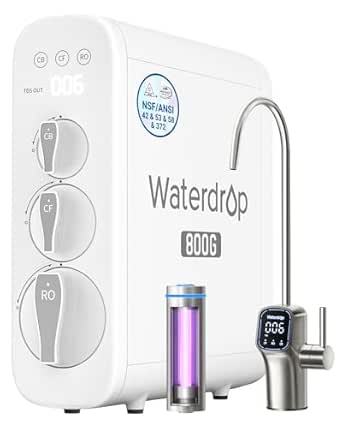
Waterdrop G3P800 Tankless Reverse Osmosis Water Filter System, 800 GPD
For households that want high stated output without a storage tank, the Waterdrop G3P800 is the strongest capacity-focused option in this five-product group. Its 800 GPD rating and 3:1 filtered-water-to-wastewater ratio make it a more compelling fit for frequent use than the 50 GPD APEC ROES-50, while the tankless format frees the space a conventional tank would occupy. The smart faucet adds a TDS display and LED lighting, giving users a visible readout instead of the simpler faucet supplied with traditional systems. Its listed 10-stage filtration targets TDS, chlorine, lead, fluoride, PFAS, and other contaminants, and the product specifies several NSF/ANSI certifications. The compromises are reliance on corded power and a maximum supported TDS of 500 ppm, so it is not the flexible choice for every water supply.
Pros:- 800 GPD stated capacity is the highest among these five products.
- Tankless design avoids a separate storage tank.
- Listed 3:1 filtered-water-to-wastewater ratio compares favorably with the T3-M and G3P600 at 2:1.
- Smart faucet displays TDS and includes LED lighting; NSF/ANSI 42, 53, 58, and 372 are listed.
Cons:- Requires corded electrical power under the sink.
- Maximum supported TDS is listed as 500 ppm, lower than the APEC ROES-50 and Waterdrop G3P600 specifications.
- Its dimensions should be checked against cabinet space before installation.
Best for: Busy households that want high stated daily capacity, a tankless layout, and faucet-based TDS monitoring.
Not ideal for: Homes without an outlet near the sink or buyers whose source water exceeds the listed 500 ppm maximum supported TDS.
- Filtration:10-stage reverse osmosis
- Daily capacity:800 gallons
- Pure-to-drain ratio:3:1
- Maximum supported TDS:500 ppm
- Power source:Corded electric
- Dimensions:18.12 × 5.67 × 17.72 in
- Certifications:NSF/ANSI 42, 53, 58, and 372
- Warranty:1 year
Our verdict“Choose the G3P800 if you want the highest stated capacity and a 3:1 ratio, provided you have power and your water is within its TDS limit.”
Waterdrop G3P600 Tankless Reverse Osmosis Water Filter System with Silver Faucet
The Waterdrop G3P600 is a useful middle ground for buyers who want tankless convenience and a smart faucet but need a higher listed TDS ceiling than the G3P800 offers. Its maximum supported TDS is 1500 ppm, compared with 500 ppm for the Waterdrop G3P800, though the G3P600 gives up stated capacity at 600 GPD versus 800 GPD. The faucet tracks both TDS and filter life, so maintenance cues are easier to see than with the basic faucet on the APEC ROES-50. An 8-stage design and 2:1 pure-to-drain ratio round out a feature set aimed at compact, frequent-use kitchens. It still needs corded power, and its listed 87 psi operating pressure is worth checking against the home’s water supply before choosing it.
Pros:- Tankless design saves the cabinet space needed by the APEC ROES-50 storage tank.
- Smart faucet displays both TDS and filter life.
- 600 GPD stated capacity is higher than the T3-M’s 450 GPD.
- Maximum supported TDS of 1500 ppm exceeds the G3P800’s listed 500 ppm.
Cons:- Requires corded electricity under the sink.
- Its 2:1 pure-to-drain ratio is less water-efficient than the G3P800’s listed 3:1 ratio.
- Listed 87 psi operating pressure may rule it out for some home water supplies.
Best for: Households seeking a tankless RO system with faucet-based TDS and filter-life monitoring, especially when the listed 500 ppm limit on the G3P800 is too low.
Not ideal for: Buyers without under-sink power, those seeking a 3:1 pure-to-drain ratio, or homes unable to meet the listed 87 psi operating pressure.
- Filtration:8-stage reverse osmosis
- Daily capacity:600 gallons
- Pure-to-drain ratio:2:1
- Flow rate:0.42 gpm
- Maximum supported TDS:1500 ppm
- Operating pressure:87 psi
- Power source:Corded electric
- Certifications:NSF/ANSI 42, 58, and 372; FCC
Our verdict“Pick the G3P600 if its higher listed TDS limit and filter-life display matter more to you than the G3P800’s greater capacity and 3:1 ratio.”
iSpring RCC7AK-BN 6-Stage Alkaline Reverse Osmosis Water Filtration System
I’d choose the RCC7AK-BN for a familiar under-sink RO layout with a separate storage tank and a mineral stage. Its NSF/ANSI 58 certification applies to the system, while the alkaline stage adds minerals after filtration; that makes it a more certification-focused choice than the Waterdrop T3-T, whose listed certification is for material content rather than RO performance. The 75 GPD capacity is modest beside the tankless Waterdrop G5P500A, but the storage tank provides a reserve instead of relying on high-throughput, powered delivery. A top-mounted faucet fastener and DIY-oriented connections can ease installation, and the clear first-stage housing gives a visible cue for sediment buildup. The tradeoff is the larger tank footprint and routine filter changes, so I’d skip it if under-sink space is scarce or you want a tankless design.
Pros:- NSF/ANSI 58 certification for the system
- Alkaline remineralization follows RO filtration
- Top-mounted faucet fastener and DIY-friendly connections
- Transparent first-stage housing makes sediment buildup visible
Cons:- Storage tank takes up cabinet space
- 75 GPD capacity is lower than the tankless options in this roundup
- Filters require periodic replacement
Best for: Households that want an NSF/ANSI 58-certified RO system, remineralization, and a conventional storage tank with a brushed-nickel faucet.
Not ideal for: Buyers with crowded cabinets or a preference for tankless, high-output systems such as the Waterdrop G5P500A.
Our verdict“Choose this iSpring if you want certified RO filtration and remineralization in a traditional tank-based setup.”
Waterdrop T3-T 220 GPD Reverse Osmosis Water Filter System
The Waterdrop T3-T suits buyers who need to preserve cabinet room but don’t need the highest production rate in this group. Its compact 12.6 × 6.1 × 14.69-inch body is easier to accommodate than the tank-based iSpring RCC7AK-BN, and its stated 220 GPD output offers faster production than that conventional 75 GPD system. The 2:1 pure-to-drain ratio and remineralization stage add useful efficiency and taste-oriented features, while staggered filter lifespans—six, 12, and 24 months—make maintenance less uniform but give some filters longer service intervals. The listed NSF/ANSI 372 certification concerns material content, not the same RO performance certification listed for the RCC7AK-BN. Installation still calls for faucet-hole drilling, and the setup may challenge buyers unfamiliar with under-sink plumbing.
Pros:- Compact body helps preserve under-sink storage
- 220 GPD stated production capacity
- 2:1 pure-to-drain ratio
- Remineralization and staggered filter lifespans
Cons:- Faucet installation requires drilling
- Initial plumbing setup may be difficult for some buyers
- NSF/ANSI 372 is a materials certification, not an RO performance certification
Best for: Small-kitchen households seeking a compact powered RO system with remineralization and moderate-to-high daily water demand.
Not ideal for: Renters or DIY-averse buyers who cannot drill a faucet hole or want a straightforward, tank-based installation.
Our verdict“Pick the T3-T when compact dimensions and a 2:1 drain ratio matter more than the higher output of the Waterdrop G5P500A.”
Waterdrop G5P500A Tankless Reverse Osmosis System with Alkaline Mineralization
For buyers who want high stated capacity without a storage tank, the G5P500A is the strongest fit here: its 500 GPD rating is well above the 220 GPD Waterdrop T3-T, and its compact tankless body frees cabinet space. The 2:1 pure-to-drain ratio and alkaline mineralization add practical distinctions, while the listed filtration targets include lead, fluoride, chlorine, and PFAS. NSF/ANSI 58 and 372 certifications provide a broader certification profile than the T3-T’s listed materials certification alone. The tradeoffs are meaningful: this unit needs a corded power source and a drilled faucet opening, and its stated maximum TDS is 500 ppm, below the iSpring RCC7AK-BN’s 750 ppm. I’d match it to compatible incoming water and an accessible outlet rather than treating capacity as the only selection factor.
Pros:- 500 GPD stated capacity in a tankless design
- 2:1 pure-to-drain ratio
- Alkaline mineralization adds calcium, magnesium, sodium, and potassium
- NSF/ANSI 58 and 372 certifications
Cons:- Requires a corded electrical connection
- Faucet installation requires countertop drilling
- Maximum supported TDS is 500 ppm
Best for: Households with heavy filtered-water use, limited cabinet space, and an outlet available under the sink.
Not ideal for: Buyers avoiding electrical appliances or whose incoming water exceeds the stated 500 ppm maximum supported TDS.
Our verdict“Choose the G5P500A for high demand and tankless storage savings if you can provide power and your feed water fits its stated limits.”
Waterdrop G2 Reverse Osmosis System, 7 Stage Tankless RO Water Filter System, Under Sink Water Filtration System, 400 GPD, 1:1 Pure to Drain, Reduces TDS, USA Tech
The Waterdrop G2 is a tankless option for buyers who want fast production and a stated 1:1 pure-to-drain ratio without adding a mineral stage. Its 400 GPD rating sits between the T3-T’s 220 GPD and the G5P500A’s 500 GPD, making it a middle ground on output rather than the most powerful pick. The integrated electrical and water circuits, twist-and-pull filters, and included pair of filters are aimed at simpler upkeep; the product claims installation in under 30 minutes, though faucet-hole drilling and an under-sink outlet remain requirements. Unlike the G5P500A, the G2’s supplied details don’t list alkaline remineralization or NSF/ANSI 58 certification. I’d favor it when space and drain ratio lead the decision, but not when certification coverage or mineral addition is a priority.
Pros:- Tankless design saves cabinet space
- 400 GPD stated production capacity
- 1:1 pure-to-drain ratio
- Twist-and-pull filters and two filters included
Cons:- Requires an under-sink electrical outlet
- Faucet installation requires drilling
- Supplied product details do not list NSF/ANSI 58 certification or remineralization
Best for: Homeowners seeking a tankless system with 400 GPD stated output, a 1:1 pure-to-drain ratio, and twist-and-pull filter changes.
Not ideal for: Renters without permission to drill, kitchens without an under-sink outlet, or buyers seeking listed NSF/ANSI 58 certification or remineralization.
Our verdict“Pick the G2 if you want tankless convenience and a 1:1 drain ratio, but choose the G5P500A if you want listed RO certification and mineralization.”
iSpring RCC7AK-UV 7-Stage Reverse Osmosis Water Filter System with Alkaline and LED UV Filtration
The RCC7AK-UV combines a conventional RO tank with both alkaline mineral filtration and LED UV treatment, a feature combination none of the other four picks offers. Its 75 GPD membrane and 3.2-gallon tank make it a lower-output, reserve-based alternative to the tankless Waterdrop G5P500A, which is rated at 500 GPD and avoids a tank. This iSpring also lists NSF/ANSI 58 and 372 certifications, plus a transparent first-stage housing and top-mounted faucet fastener. The added UV function comes with an electrical requirement, and feed pressure must stay within 40–95 psi; buyers should check both before purchase. I’d choose it for its extra treatment stage and tank reserve, not for compactness or high production speed.
Pros:- Seven-stage setup includes RO, alkaline filtration, and UV treatment
- 3.2-gallon storage tank provides a reserve
- NSF/ANSI 58 and 372 certifications
- Top-mounted faucet fastener and transparent first-stage housing
Cons:- Requires a corded electrical power source
- 75 GPD membrane capacity is much lower than the tankless G5P500A’s stated capacity
- Feed water pressure must be within 40–95 psi
Best for: Households that specifically want RO, remineralization, UV treatment, and a storage tank in one under-sink system.
Not ideal for: Buyers with no under-sink outlet, feed pressure outside 40–95 psi, or a preference for compact tankless systems.
Our verdict“Choose the RCC7AK-UV if UV treatment and a tank reserve matter more to you than tankless storage savings or high daily output.”

How We Picked
I ranked these under-sink reverse osmosis systems by how well their stated design and features fit common household priorities: filtration format, rated production, tank versus tankless installation, power needs, drain ratio where listed, and added features such as mineralization or UV treatment. I also weighed practical ownership factors, including under-sink space, replacement-filter complexity, and how clearly the product’s stated specifications help a buyer predict fit.
The order favors systems that balance useful performance with a clear, broadly applicable setup, rather than rewarding the largest GPD figure alone. Tankless models rank higher for buyers seeking capacity and a smaller storage footprint, while traditional tank systems remain strong picks for shoppers who prefer electric-free operation or familiar installation. Specialized models rank for their particular use cases, not as universal upgrades; buyers should check current certification details, included parts, and installation requirements before choosing.
Factors to Consider When Choosing Under Sink Reverse Osmosis
Choosing an RO system is less about finding the longest feature list and more about matching the system to your plumbing, household use, and maintenance preferences. I’d check these five factors before deciding which format belongs under your sink.
Match Rated Output to How You Use Water
Gallons per day is a production rating, not a promise that a faucet will deliver that volume instantly. A household that fills bottles and uses filtered water for cooking may be comfortable with a lower-rated system, while frequent use across several people can make higher-output models appealing. Tank systems store treated water, which can provide a ready reserve even when the membrane’s rated production is modest. Tankless systems produce water on demand, so check the product’s stated flow and household fit rather than comparing GPD figures alone. A common mistake is paying for a high output rating without asking whether your daily use needs it. I’d also account for temperature, pressure, and other conditions that can affect actual production.
Choose Tanked or Tankless Around Your Cabinet
A tank-based system needs room for both the filter assembly and its storage tank, so measure the cabinet around plumbing, bins, and garbage disposals before ordering. Tankless designs remove the separate storage tank and can free up cabinet space, but the unit itself still needs a suitable mounting area and access for filter changes. Tankless models in this roundup commonly list a plug-in requirement, which means a nearby outlet may be part of the installation plan. Tank systems can suit kitchens without convenient power access, though their larger footprint may be a poor match for crowded cabinets. Check the faucet-hole situation too: a spare hole or a plan for drilling can change the installation from simple to involved. The best format is the one your kitchen can accommodate and maintain.
Read Drain-Ratio Claims in Context
Reverse osmosis separates treated water from a reject stream, so the amount sent to drain matters to buyers watching household water use. Compare stated pure-to-drain ratios only when the products give figures on a comparable basis; the Waterdrop G2 lists 1:1, while the T3-C and T3-M list 2:1. A ratio is useful for comparing claims, but operating conditions and installation can affect real-world results. Avoid assuming that a larger GPD rating also means less water waste, since production and drain ratio describe different things. If water efficiency is a priority, check the manufacturer’s definition of the ratio and the conditions used to obtain it. Pair that information with your local water costs and normal daily use.
Decide Whether Mineralization or UV Fits Your Goal
Some systems add a remineralization or alkaline stage after RO filtration, which can appeal to people who prefer a particular taste or want minerals added back to treated water. These stages are an optional feature, not a reason by themselves to assume a system filters better than a standard RO model. The iSpring RCC7AK-UV adds LED UV treatment alongside alkaline filtration, giving it a more specialized role than systems without UV. Before paying for extra stages, identify the concern you want the feature to address and check what the manufacturer says it does. More stages can also mean additional filters to track and replace. Buyers who mainly want a straightforward RO setup may prefer a simpler configuration.
Plan for Filter Replacement and Service Access
The purchase decision includes ongoing filter changes, so look up the replacement schedule and the exact cartridge set for the model you’re considering. Quick-change designs may make routine service easier, while systems with multiple stages can require more parts and reminders. A cramped cabinet can make even a simple filter change awkward if the unit is mounted behind plumbing or stored items. Check whether replacement filters are easy to identify and whether the system’s instructions explain the sequence clearly. Don’t assume every filter has the same service interval; sediment, carbon, and membrane components may be treated differently. A system that is easy to maintain is more likely to stay in regular use.
Frequently Asked Questions
Do I need an electrical outlet under the sink for an RO system?
Not always. Several tankless models in this roundup specify a plug-in requirement, so you should confirm outlet access before choosing one. Traditional tank-based options such as the iSpring RCC7-BN and APEC ROES-50 are electric-free designs. If you want tankless filtration but lack a nearby outlet, check the manufacturer’s installation instructions rather than assuming an extension cord or alternative power setup is approved. Include outlet location in your cabinet measurements and installation plan.
Is a tankless system a better choice than a tank-based system for a small cabinet?
Tankless systems can free space by removing the separate storage tank, which may help in a crowded cabinet. They still need room for the unit, its filter access, and the plumbing connections, so they are not automatically a fit for every small space. Many also require electrical power, unlike electric-free tank systems. Measure the cabinet and map out where the filters will be changed before deciding. If you have room for a tank but no outlet, a conventional system may be the more practical choice.
Should I choose a system with alkaline or remineralization stages?
Choose these features if you prefer the taste profile they are intended to provide or specifically want a post-RO mineral stage. They are not necessary for every household, and their presence alone does not establish that a system removes more contaminants. Extra stages can add replacement parts and maintenance tasks, so check the cartridge schedule before buying. The iSpring RCC7AK models and several Waterdrop options include mineralization features, while other picks keep the setup more conventional. I’d base the choice on your preference and service willingness, not the stage count alone.
How should I compare the pure-to-drain ratios listed for these systems?
Use the ratio as one point of comparison, while checking how each manufacturer defines and measures it. In this group, the Waterdrop G2 lists a 1:1 pure-to-drain ratio, and the T3-C and T3-M list 2:1. Those figures do not tell you the system’s rated production or guarantee the same results in every home. Water pressure and other operating conditions can affect performance, so review the stated test conditions where available. If water use is a major concern, compare the ratio alongside installation requirements and your expected daily demand.
Can I install an under-sink RO system myself, or should I hire a plumber?
Some buyers may be comfortable with a DIY installation, but the work can involve water-line connections, a dedicated faucet, and possibly a drain connection or cabinet modification. Your experience with plumbing and the sink’s existing holes matter as much as the system’s instructions. Tankless products that require power add an outlet question to the plan. Before starting, read the installation manual and confirm whether the setup fits your sink and local requirements. Hire a plumber if drilling, unfamiliar connections, or leak risk would make the project uncomfortable.
Conclusion
My best overall pick is the iSpring RCC7-BN for buyers who want an electric-free, conventional RO setup. For best value in a straightforward tank format, I’d compare the APEC ROES-50 and Express Water RO5DX, both rated at 50 GPD. The best premium, high-output direction is the Waterdrop G3P800 for shoppers who want tankless capacity and can accommodate its installation needs. Beginners who prefer a familiar design can start with the iSpring RCC7-BN, while buyers seeking extra treatment features should look at the iSpring RCC7AK-UV for UV plus alkaline filtration or the mineralization-focused models for taste preference. Choose by cabinet space, outlet access, household demand, and willingness to maintain added stages; those details matter more than chasing the biggest feature list.
Halloween Picks

Kalolary 11 ft Halloween Inflatable Archway Ghost House Tunnel

JOYIN 5-Foot Halloween Animatronic Drinking Skeleton

15-Foot Halloween Pumpkin Inflatable with LED Lights and Air Blower
As an affiliate, we earn on qualifying purchases.