
TL;DR

Get furniture and decor delivered free — and shop member deals
- Fast, free delivery on millions of items
- Access to Prime Big Deal Days deals on October 6–7
- Prime Video, Amazon Music and more included
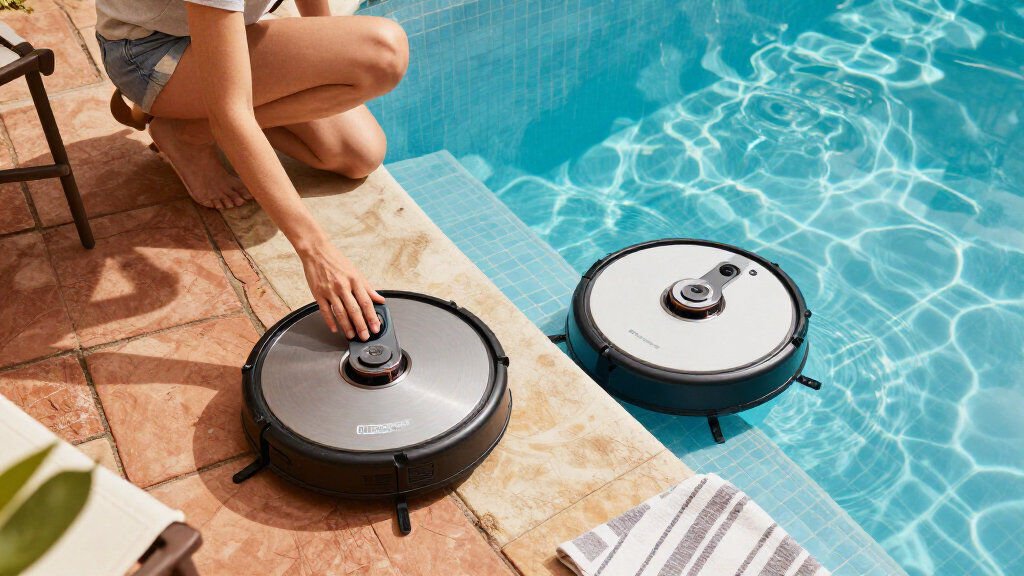
In this robotic pool cleaner comparison, the BRINBO C1 most closely matches the Scuba S3 across the listed filtration, runtime, modes, and warranty specs, while the Aiper Scuba S1 leads on stated runtime at up to 270 minutes in Eco mode. The LiteVac G1 offers a lighter listed weight and multiple modes, and the Beatbot Sora 30 is notably light but has no runtime listed in the supplied specifications. Check pool compatibility, filtration details, and current product documentation before choosing.
A pool robot can look perfect on a spec sheet and still be the wrong fit for your pool. A long runtime means little if you mainly need to lift fine pollen from the floor, and a very fine filter can become a chore if it clogs every afternoon.
This robotic pool cleaner comparison uses the Aiper Scuba S3 as a reference point because its listed features—five modes, up to 240 minutes in Eco mode, and a two-stage filter setup—make a useful checklist. The S3 may be discontinued or difficult to find through some sellers, so treat it as a benchmark, not a guaranteed purchase option.
You’ll compare four alternatives by their supplied specifications, learn what those numbers do and don’t tell you, and match features to common pool conditions. The goal is practical: choose a cleaner that suits your debris, surfaces, and routine, rather than buying the longest spec sheet.
Use the Scuba S3’s 240-minute Eco runtime, five modes, layered filtration, and two-year warranty as comparison points—not as proof it is currently available.
BRINBO C1 has the most complete supplied overlap with those four Scuba S3 comparison categories, but its listed Eco runtime is up to 180 minutes.
Scuba S1 has the longest stated Eco runtime in this comparison, at up to 270 minutes; its other-mode runtime is listed as up to 180 minutes.
Match filter design to your debris: fine filtration may help with dust, while leaf-heavy pools also need practical capacity and easy rinsing.
Verify missing details such as pool-size limits, charge time, warranty terms, mode names, and the Sora 30’s listed 938-gram weight before choosing.
Use the Scuba S3 specs as a practical shopping checklist
A robotic pool cleaner comparison works best when you turn the Scuba S3’s listed specifications into questions about your own pool. Its brief lists five cleaning modes, up to 240 minutes of Eco-mode runtime, a 180-micron mesh filter with a replaceable 3-micron layer, and a two-year warranty. Those figures offer a starting point, not proof that another machine cleans better.
Start with the debris you actually see. If your pool gathers maple seeds and large leaves, a filter’s fine-particle rating may matter less than its basket capacity and how easily you can empty it. If a dusty film settles on the steps after a windy day, fine filtration may matter more. The S3’s layered setup suggests separate attention to larger debris and finer particles, but you should confirm how each model’s filters are arranged and maintained.
Next, think about where the dirt collects. A pool with a flat floor and little tree cover creates a different job from a kidney-shaped pool with steps, a sloped deep end, and leaves caught along the waterline. A list of cleaning modes only helps if the manual explains what each mode covers. Five modes do not automatically mean five distinct cleaning paths.
For example, imagine a 30-foot in-ground pool under two birch trees. The floor collects grit, while the surface gets leaves after a breezy afternoon. A cleaner that handles the floor well may still leave you skimming leaves by hand. Use the S3 as a feature checklist, then look for clear evidence that a candidate handles the surfaces and debris you care about.
Think in jobs, not feature counts: runtime, filtration, and modes matter when they solve a recurring problem in your pool.
As an affiliate, we earn on qualifying purchases.
Compare the five cleaners without letting one number decide
This robotic pool cleaner comparison shows that no single alternative matches every supplied Scuba S3 specification. BRINBO C1 lists a similar Eco runtime, seven modes, washable filters, and a two-year warranty; Scuba S1 lists the longest stated Eco runtime. The comparison below records only the supplied specifications, so a blank or “not specified” means you should verify the detail with the seller or manufacturer.
| Model | Filtration | Runtime listed | Modes listed | Weight listed | Warranty listed |
|---|---|---|---|---|---|
| Aiper Scuba S3 reference | 180-micron mesh plus replaceable 3-micron layer | Up to 240 minutes, Eco | 5 | 18 lb | 2 years |
| BRINBO C1 | Dual system; washable, reusable filters | Up to 180 minutes, Eco | 7 | Not specified | 2 years |
| Aiper Scuba S1 | 3-micron ultra-fine and 180-micron standard filters | Up to 270 minutes, Eco; up to 180 minutes in other modes | Not specified | 17 lb | 2 years |
| Gosvor LiteVac G1 | Double filtration, 3-micron | Up to 200 minutes, Eco; 150 minutes in Smart, Floor, or Wall modes | 5 | 15.2 lb | Not specified |
| Beatbot Sora 30 | 150-micron filter | Not specified | 4, including quick and deep cleaning | 938 g listed | 2 years |
Read the table as a shortlist tool, not a head-to-head cleaning test. The BRINBO C1 has the fullest overlap with the S3’s listed comparison points, but its stated Eco runtime is 60 minutes shorter. The Scuba S1 has a longer stated Eco run, yet its number of modes is not supplied here. For someone who values a clear runtime figure, that distinction matters; for someone who wants washable filters, the BRINBO’s stated filter design may deserve a closer look.
The Sora 30’s listed weight is especially different from the other figures. At 938 grams, it is far lighter on paper than models listed at 15 to 18 pounds. Before treating that as a practical advantage, confirm what the weight figure measures and whether it refers to the complete unit. Specs can use different conventions, and an apparent mismatch deserves a quick check.
Pick a filter that matches your pool’s mess
Choose filtration according to the debris your pool produces, because a filter that catches very fine particles can also need more frequent attention. The Scuba S3 listing pairs a 180-micron mesh with a replaceable 3-micron layer, while the Scuba S1 lists a 3-micron ultra-fine filter and a 180-micron standard filter. BRINBO describes a washable, reusable dual system, Gosvor lists double filtration at 3 microns, and Beatbot lists a 150-micron filter.
Micron figures describe particle size, but they do not tell you everything about cleaning performance. Filter area, water flow, basket capacity, and the type of dirt all affect how often the robot needs attention. A very fine layer may help with fine dust or some pollen, yet it can load up faster in a pool full of leaves and loose debris. That’s a tradeoff, not a flaw.
Take a realistic case: after a storm, your pool holds a scattering of oak leaves, small twigs, and gritty sediment. You may want to remove the large debris with a skimmer before running a robot fitted for fine particles. Otherwise, the filter can fill early, and a robot that could have cleaned the floor may stop with half the pool left. On a calm week, that same fine layer may be useful for the faint dust that turns the water cloudy near the steps.
When you compare models, check whether the filter is reusable, replaceable, or both, and find out how it opens for rinsing. A washable design, such as the BRINBO’s listed reusable filters, may simplify routine upkeep. A replaceable fine layer, as listed for the S3, may offer a different maintenance path. For either design, rinse the filter after the cycle and let it dry as the manual directs; trapped wet debris can smell like pond water by the next morning.
- Large leaves: check basket capacity and ease of emptying.
- Fine dust or pollen: look for a clearly described fine-filter stage.
- Mixed debris: confirm how the robot handles a loaded filter and how quickly you can rinse it.
Match runtime to your pool instead of chasing the biggest figure
Runtime matters when it gives a cleaner enough time to cover your pool in the mode you plan to use. In the supplied specifications, the Scuba S1 has the longest stated Eco runtime at up to 270 minutes, followed by the Scuba S3 at 240 minutes, the Gosvor LiteVac G1 at 200 minutes, and the BRINBO C1 at 180 minutes. Beatbot Sora 30 has no runtime listed in this comparison, so you’ll need to verify it directly.
Those numbers are maximum stated runtimes, not a promise that every cleaning mode lasts that long. The LiteVac G1, for example, lists up to 200 minutes in Eco mode and 150 minutes in Smart, Floor, or Wall modes. The Scuba S1 similarly lists up to 270 minutes in Eco but up to 180 minutes in other modes. If wall climbing or a more active cleaning program uses more power, its practical cycle may be shorter.
Picture a compact above-ground pool that collects a little dust each day. A 180-minute Eco cycle could be more than enough, and a longer maximum runtime might not change your routine. Now consider a larger in-ground pool with a broad deep end and a long shallow shelf. The extra stated runtime on the Scuba S1 could be useful, but only if the machine supports your pool size and shape and its navigation covers the floor effectively.
Use this quick decision process before you prioritize battery life:
- Estimate the cleaning job. Note your pool dimensions, shape, and whether the robot must clean walls or a waterline.
- Choose the mode you’ll really use. Compare runtime for that mode, not only the maximum Eco figure.
- Check recovery and charging details. Confirm how the robot signals a finished cycle, how you retrieve it, and how long it takes to recharge.
- Leave room for real conditions. Heavy debris or extra climbing can change how much of one cycle gets done.
That process keeps a long runtime in perspective. A robot that completes your usual cleaning job in one sensible cycle can be a better fit than a model with a larger headline number but unclear pool coverage.
Choose cleaning modes for the surfaces you need covered
Cleaning modes are useful when they let you direct the robot toward a real task, such as cleaning only the floor or spending more time on walls. The Scuba S3 and LiteVac G1 each list five modes, the BRINBO C1 lists seven, and Beatbot Sora 30 lists four, including quick and deep cleaning. A higher mode count sounds flexible, but the mode names and coverage matter more than the total.
For instance, a pool owner who wants a fast floor pickup before guests arrive may value a quick-clean program. Someone whose tile line gathers oily sunscreen residue may care more about waterline scrubbing—if the product actually supports it. The LiteVac G1’s supplied product description mentions wall, waterline, and shallow-area cleaning, while its spec list names ECO, Smart, Floor, Wall, and custom modes. Read the manual to see exactly what “custom” changes and whether the advertised areas are covered in the mode you select.
The BRINBO C1’s seven listed modes may offer more choices, but the comparison data does not name each one. That means you should not assume it has a particular wall or waterline setting. Ask for the mode list and check whether the robot climbs your pool surface, handles steps, or works on a shallow tanning ledge. These are practical questions, especially if your pool has a ledge where water is only a few inches deep.
Navigation adds another layer. Some robots follow more systematic routes, while others may cover the pool less predictably. The supplied specifications do not give enough detail to compare the navigation systems of these five models, so seek a manual or manufacturer description rather than inferring mapping ability from mode count. A robot can have several programs and still miss a narrow cove if its route does not suit the shape.
Ask what each mode cleans, where it cleans, and how long it runs. A named feature becomes valuable only when it matches a surface or cleaning problem you actually have.
Weigh and retrieve the robot with your shoulders in mind
A robot’s listed weight affects more than storage: you lift it out of the water, carry it to a rinse area, and may need to empty it while it is wet. The Scuba S3 is listed at 18 pounds, the Scuba S1 at 17 pounds, and the LiteVac G1 at 15.2 pounds. BRINBO has no weight listed in the supplied data, and Beatbot Sora 30 is listed at 938 grams, a figure worth verifying against the complete product package.
Even a difference of a few pounds can feel larger when the cleaner is dripping, awkward to grip, or being lifted over a pool wall. If you have a storage shed several yards away, the carry matters too. Think about who will handle the robot most often: a strong adult with a poolside cart may not mind an 18-pound cleaner, while someone with shoulder pain may prefer a lighter unit or a retrieval aid.
Consider a typical Saturday. You finish a cycle, pull the machine from the water, and carry it across hot pavers to rinse the filter. A handle that gives you a secure grip may matter more than a small difference in listed weight. Look for guidance on lifting, retrieval hooks, drainage, and storage. A unit that drains quickly can feel easier to handle than a similar-weight cleaner that holds water as you carry it.
Check the product’s pool compatibility and construction details before buying. The S3 is described for in-ground pools, while the Sora 30 listing says above- and in-ground pools. Do not assume another model fits your pool just because its size seems right. Surface type, water depth, steps, slopes, and pool shape can all affect climbing and coverage. Confirm those limits in current documentation, especially if you have a vinyl liner, delicate finish, unusual ledge, or steep transition from shallow to deep water.
Check warranties and missing details before you decide
A listed warranty is useful only when you understand what it covers and how you would make a claim. The Scuba S3, BRINBO C1, Scuba S1, and Beatbot Sora 30 are each listed with a two-year warranty in the supplied data. No warranty term is supplied for the Gosvor LiteVac G1, so treat that as an unanswered question—not proof that the product has no warranty.
Before choosing, confirm the current warranty terms, registration requirements, exclusions, and support route. A warranty may treat batteries, filters, wear parts, or accidental damage differently from the main unit. For example, if your robot stops charging after one season, you’ll want to know whether the battery is covered and whether the seller or manufacturer handles the claim. Keep the receipt and product serial number somewhere you can find them.
Also look for missing specifications that affect everyday use. The table does not provide power consumption, charge time, app support, pool-size limits, or detailed navigation information for every model. The research brief describes market trends such as smartphone controls, improved navigation, and longer-lasting batteries, but those broad trends do not establish that a specific cleaner includes a feature. Verify the exact model rather than relying on general claims about modern pool robots.
One useful habit is to save the product page and manual before purchase. Write down the model number, listed runtime, filter type, and warranty period. If a seller’s description says one thing and the manual says another, ask for clarification before placing the order. When a model such as the S3 appears difficult to find, this extra check can help you avoid confusing a similarly named product with the exact version you intended to compare.
- Confirm exact model identity and whether listed accessories are included.
- Check support and warranty terms in writing.
- Verify missing specs such as charge time, pool-size limit, and app features.
Use this buyer profile to narrow your shortlist
Your best match depends on which job you need the robot to do most often, not on which model wins one column. From the supplied figures, BRINBO C1 gives the most complete direct overlap with the Scuba S3’s listed runtime, filtration, modes, and warranty categories. Scuba S1 stands out for its stated 270-minute Eco runtime, while LiteVac G1 combines five modes with a listed 15.2-pound weight. Beatbot Sora 30 has a 150-micron filter, four listed modes, and a two-year warranty.
If you want a close spec-sheet substitute, begin with BRINBO C1 and confirm its filter details, actual mode names, weight, and compatibility. Its 180-minute Eco runtime is shorter than the S3’s 240-minute listing, so decide whether that difference matters for your pool. If runtime leads your list, investigate the Scuba S1 first, while checking which modes it offers and whether its dimensions suit your pool.
If you want a lighter listed option, the LiteVac G1’s 15.2-pound figure may appeal, though its warranty is not specified in the supplied data. Ask the seller for the warranty and confirm how the 3-micron double filtration performs with the debris you get. If you are considering the Sora 30 for an above-ground or in-ground pool, verify the unusual 938-gram weight figure, the runtime, and the exact size limits before relying on those details.
Here’s a concrete example. A pool with pine needles and fine dust, used by a family that cleans twice a week, may call for a filter that is quick to rinse and a mode that handles routine floor dirt. A large pool with long gaps between cleanings may put more emphasis on runtime and debris capacity. Neither case has one universal winner. Use the listed specifications to form a shortlist, then let pool size, debris, and maintenance habits settle the decision.
The closest specification match is not automatically the best cleaner for your pool. Choose the model whose verified features solve your most frequent cleaning problem.
Frequently Asked Questions
Is the Aiper Scuba S3 still available?
The Scuba S3 may be discontinued or difficult to find through some sellers, but the supplied information does not establish its current availability. Check the manufacturer or seller directly and confirm the exact model number before ordering. If you cannot verify it, use its listed specifications as a benchmark and compare current alternatives.
Which alternative most closely matches the Scuba S3 specs?
BRINBO C1 has the most complete supplied overlap across filtration, Eco-mode runtime, cleaning modes, and warranty. Its listed runtime is up to 180 minutes in Eco mode, compared with up to 240 minutes for the S3. Confirm the C1’s mode names, weight, pool compatibility, and current documentation before deciding.
Which cleaner has the longest listed runtime?
Aiper Scuba S1 has the longest stated Eco-mode runtime in this comparison: up to 270 minutes. Its supplied specifications list up to 180 minutes in other modes, so do not assume the maximum applies to every cleaning program. Actual runtime and coverage can depend on mode and pool conditions.
Does a 3-micron filter mean a cleaner is always better?
No. A finer filter can help capture smaller particles, but it may need more frequent rinsing, especially when the pool has heavy debris. Filter area, capacity, water flow, and the type of dirt matter too. For a leaf-heavy pool, clear the largest debris and check how easy the basket is to empty.
What should I verify before buying a replacement pool robot?
Confirm the exact model, pool-size and surface compatibility, runtime for the mode you plan to use, filter maintenance, and warranty terms. Also check charge time, retrieval guidance, and whether the robot handles your steps, slopes, or waterline. If a specification is missing or looks unusual—such as the Sora 30’s listed 938-gram weight—ask the seller or manufacturer to confirm it.
Conclusion
Use the Scuba S3 as a measuring stick, then choose by the work your pool demands. If you want the closest listed spec overlap, start with BRINBO C1; if long Eco runtime leads your priorities, examine Scuba S1. Check the manuals and current warranty terms before you commit.
The right pool robot is the one that leaves you with clear water and less time spent rinsing filters—not the one with the biggest number on its box.
Halloween Picks
halloween
As an affiliate, we earn on qualifying purchases.